Salzburg Neighborhood Guide: Altstadt vs Affordable Suburbs
Finding a flat in Salzburg often feels like competing in a high-stakes Olympic sport where the prize is a 30-square-meter studio with a slanted ceiling. I spent four months couch-surfing before I finally landed a place that didn't require a king's ransom. This guide breaks down Salzburg's neighborhoods to help you find a home that fits your budget and lifestyle.
The Altstadt Allure: Living in the Tourist Postcard
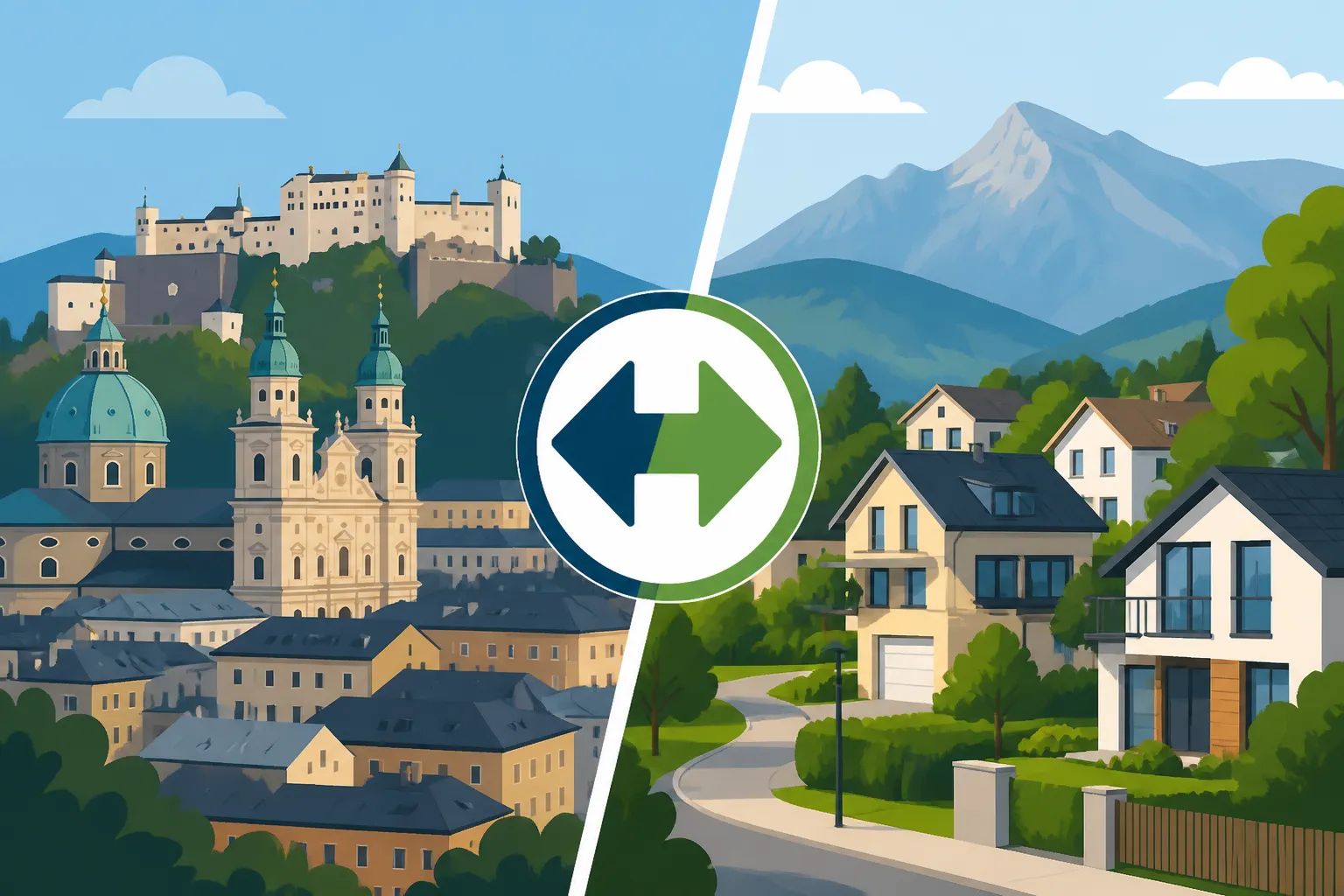
The Altstadt, or Old Town, is the image that comes to mind when most people think of Salzburg. It is a UNESCO World Heritage site filled with narrow cobblestone streets, wrought-iron signs, and the looming presence of the Hohensalzburg Fortress. Living here means you are stepping directly into a living museum every time you walk out of your front door. However, the reality of daily life in the Altstadt is far different from the romanticized version seen by the millions of tourists who visit annually.
Right Bank vs Left Bank Differences
The Altstadt is split by the Salzach River into the Left Bank (Linksseitige Altstadt) and the Right Bank (Rechtsseitige Altstadt). The Left Bank is the older, more "classical" side, home to the Cathedral and the Getreidegasse. It is incredibly dense, and finding a modern apartment here is nearly impossible. Most residential units are tucked away in centuries-old buildings where elevators are a luxury and the staircases are steep and narrow.
The Right Bank, centered around the Linzer Gasse, feels slightly more lived-in. While it still retains its historical charm, it tends to be a bit more accessible for residents. You will find more local-oriented shops and slightly more breathing room. When exploring these areas, it is important to understand how the local regulations work, as many of these buildings fall under strict heritage protection laws. If you are comparing this vibe to other Austrian cities, you might find our Vienna Neighborhood Guide: Best Districts for Expats helpful for a sense of scale.
The Cost of Character and Heritage
Let’s be honest: living in the Altstadt is expensive. You aren't just paying for the square footage; you are paying for the privilege of the address. Rents here are among the highest in Austria, often rivaling the first district in Vienna. Because many of these buildings are protected, landlords cannot easily renovate, meaning you might pay a premium for a kitchen that hasn't been updated since the 1990s or heating systems that are less than efficient.
Furthermore, the price of groceries and basic services in the immediate vicinity of the Altstadt is often inflated due to the high volume of tourists. You won't find many large, budget-friendly supermarkets here; instead, you’ll be frequenting smaller "City" versions of Billa or Spar. Understanding Renting in Austria: MRG Laws, Leases, and Bestellerprinzip is crucial here, as many Altstadt apartments fall under specific rent control categories (Altbau) that might actually work in your favor if you know the law.
Noise, Crowds, and Accessibility
The biggest frustration for Altstadt residents is undoubtedly the crowds. From the Salzburg Festival in the summer to the Christmas Markets in the winter, the streets are perpetually packed. If you value silence and privacy, the Altstadt may not be for you. Delivery trucks arrive early in the morning, and the bells of the many churches will become your uninvited alarm clock.
Accessibility is another major hurdle. Most of the Altstadt is a pedestrian zone. If you own a car, forget about parking near your building. You will likely have to pay for a spot in one of the expensive mountain garages (Mönchsberggarage), which can cost hundreds of euros per month. Most expats living here rely entirely on the bus system or bicycles. If you're coming from another city, you might notice this is quite different from the layout discussed in our Graz Neighborhood Guide: Family Areas vs Student Hubs.
The Upscale Comforts: Maxglan, Riedenburg, and Nonntal
For those who want to stay close to the center but need more "real-life" amenities, the districts just outside the Altstadt offer a perfect compromise. These areas are characterized by a mix of historic villas, green spaces, and a much higher concentration of locals compared to the Old Town.
Maxglan: The Expat and Family Favorite
Maxglan is arguably the most sought-after residential district in Salzburg for professionals and families. It feels like a village within the city. The Maxglaner Hauptstraße is lined with independent shops, bakeries, and traditional gasthof restaurants. It is also home to the Stiegl Brewery, which provides a wonderful community focal point with its beer garden.
The housing in Maxglan is diverse. You can find everything from renovated apartments in historic buildings to modern, sustainable complexes. It is particularly popular because it is flat, making it perfect for cycling into the center (about 10 minutes) or walking. For many newcomers, Maxglan is where they first experience the Everyday Etiquette: Garbage Sorting, Noise, and Ruhezeit that defines Austrian neighborhood harmony.
Riedenburg: Quiet Luxury Close to Town
Riedenburg is the gateway between the Altstadt and Maxglan. It is one of the most prestigious areas to live in. The architecture here is stunning, featuring many late 19th-century "Gründerzeit" villas. It is incredibly quiet, yet you can walk to the Festival Hall in less than ten minutes through the Sigmundstor (the tunnel through the mountain).
Because it is so desirable, the competition for flats in Riedenburg is fierce. You will need to have your documents ready the moment a listing goes live. If you are in the process of moving, make sure you understand The Meldezettel Process: Registering Your Address Legally because you’ll need that registration to apply for residential parking permits in this district.
Nonntal: Academic Vibes and Greenery
Located south of the Altstadt, Nonntal is home to part of the University of Salzburg. This gives the area a slightly more youthful, intellectual energy. It is a beautiful district that transitions from the dense urban edge of the Old Town into the wide-open green fields of the Freisaal area.
Nonntal is divided into "Inner Nonntal" and "Outer Nonntal." Inner Nonntal is older and more expensive, while Outer Nonntal offers more modern apartment blocks and better access to parks. It’s a fantastic area for runners and cyclists, as the paths leading out toward Hellbrunn Palace are right on your doorstep. When budgeting for a place here, don't forget to factor in the Utilities Setup: Electricity, Gas, Water, and Internet costs, which can vary significantly between the older villas and new builds.
The Working Class Heart: Lehen and Itzling
If you are looking for affordability and a more multicultural vibe, you will likely find yourself looking at Lehen or Itzling. Historically, these areas had a bit of a "rough" reputation by Salzburg standards, but significant investment and gentrification have transformed them into vibrant, practical places to live.
Lehen: Diversity and Modern Development
Lehen is Salzburg’s most populous district and its most diverse. For years, it was avoided by many expats, but that has changed. The city invested heavily in the Lehener Park and the Neue Mitte Lehen, which includes a stunning modern library and a lively square. The rental prices here are significantly lower than in Maxglan or Riedenburg, making it the go-to spot for students and young families.
The architecture in Lehen is a mix of post-war apartment blocks and brand-new developments. It is very well connected by the "Obus" (trolleybus) lines and has some of the best international grocery stores in the city. If you’re living here, you’ll quickly master Supermarket Etiquette: Checkout Speed and Packing Own Bags, as the local stores can get very busy on Saturday mornings.
Itzling and Elisabeth-Vorstadt: The Railway Hub
Elisabeth-Vorstadt is the area surrounding the Salzburg Hauptbahnhof (Main Station). While living near a train station in any city has its pros and cons, this area is incredibly convenient for those who work outside the city or travel frequently. Itzling, located further north, is an industrial and residential mix that offers some of the most competitive rents in the city.
The "Science City" in Itzling is a hub for tech companies and research institutes, making it a logical choice if your job is located there. While it lacks the picturesque charm of the Altstadt, it provides a very functional lifestyle with plenty of fitness centers, hardware stores, and quick transport links. For those commuting from here, looking into Public Transport Passes: Weekly, Monthly, and Annual Options is a must to save on daily travel costs.
The Leafy Suburbs: Parsch, Aigen, and Leopoldskron
For those with a higher budget who want a house or a large garden, the eastern and southern edges of the city are the place to be. These districts are where you will find the highest concentrations of wealth in Salzburg.
Parsch and Aigen: Prestige and Peace
Aigen is often cited as one of the most expensive residential areas in all of Austria. Nestled at the foot of the Gaisberg mountain, it offers incredible views and total tranquility. It feels more like a wealthy country village than a city suburb. Parsch is its slightly more "middle-class" neighbor, offering a similar vibe but with a few more apartment options.
These areas are perfect for families who want their children to grow up with nature on their doorstep. The S-Bahn train runs through these districts, connecting you to the city center in about 5-7 minutes. If you are looking for medical providers in these quieter areas, you might find our guide on Finding English-Speaking Doctors in Austria's Major Cities useful, as many private practices are located in these residential hubs.
Leopoldskron-Moos: The Rural Escape
If you’ve seen "The Sound of Music," you’ll recognize the Leopoldskron Palace and its lake. The neighborhood behind it, known as "The Moos," consists of one long road stretching toward the mountains, flanked by farmhouses and luxury homes. It is technically within the city limits, but it is purely rural in character.
Living here requires a car. While there is a bus, it is infrequent compared to the city lines. However, the trade-off is unparalleled peace and some of the best air quality in the region. It’s a popular spot for wealthy retirees and those who work remotely and want to feel like they are on a permanent vacation.
Beyond the City Limits: Affordable Commuter Towns
Given that Salzburg is one of the most expensive cities in Austria, many expats choose to live in the surrounding towns in Salzburg-Land or even across the border in Bavaria.
Hallein: The Industrial-Cool Alternative
Hallein is about 15 kilometers south of Salzburg and was historically a salt-mining town. For a long time, it was seen as purely industrial, but its medieval old town is actually quite beautiful and much cheaper than Salzburg’s. It has developed a "cool" factor recently, with artists and young professionals moving in to take advantage of the lower rents and the burgeoning cafe scene.
The commute from Hallein to Salzburg is incredibly easy. The S3 train runs every 30 minutes and takes about 20 minutes to reach the Salzburg center. For many, the savings on rent more than pay for the transport. It’s worth checking Is the Klimaticket Worth It? Cost and Benefit Analysis if you decide to take this route, as it covers the entire country’s transport for a fixed annual fee.
Puch, Oberndorf, and Freilassing
Puch is located just south of the city and is home to the Salzburg University of Applied Sciences (Fachhochschule). It’s a quiet, family-oriented village. Oberndorf, to the north, is famous for being the birthplace of "Silent Night" and offers a lovely riverside lifestyle.
Then there is Freilassing, which is actually in Germany. Many people work in Salzburg but live in Freilassing because German grocery prices and rents are generally lower. However, crossing the border every day can be a headache during major holidays or if there are sudden border controls. You also have to navigate two different tax and social security systems, which can be a bureaucratic nightmare for non-EU citizens.
Logistics and Practicalities of Moving to Salzburg
Regardless of which neighborhood you choose, the process of securing a home in Salzburg requires patience and preparation. The market is small, and high-quality apartments often disappear within 24 hours of being posted on platforms like Willhaben.
Dealing with Salzburg Landlords
Salzburg is a "small town" at heart. Many landlords are private individuals who own one or two buildings and have a very specific idea of who they want as a tenant. They often prefer long-term stability and may ask for extensive proof of income. It is quite common for landlords to ask for a "Selbstauskunft," a self-disclosure form detailing your employment and family status.
In Salzburg, it is also standard to sign a three-year minimum lease. While you can legally leave after one year (plus a three-month notice period), landlords will often pick the candidate who expresses a desire to stay longer. Be prepared to pay a "Kaution" (deposit) of 3 to 4 months of rent upfront.
Transportation and Connectivity
Salzburg is a "15-minute city." No matter where you live, you can usually get to the center within 15 to 20 minutes by bike or bus. The "Obus" system is one of the largest in Europe and is remarkably punctual. However, the city struggles with traffic congestion, especially on rainy days when everyone abandons their bikes for cars.
If you live in the suburbs like Aigen or Itzling, the S-Bahn is your best friend. It is much faster than the bus and much more comfortable. When you first arrive, I highly recommend getting a 24-hour ticket and just riding the different lines to see which neighborhoods feel like "home" to you before you start signing any contracts.
Comparison Table: Salzburg Neighborhoods at a Glance
| Neighborhood | Vibe | Price Level | Commute to Center | Best For |
|---|---|---|---|---|
| Altstadt | Historic / Touristy | Very High | 0-5 mins (Walk) | History buffs, no car owners |
| Maxglan | Village / Trendy | High | 10 mins (Bike/Bus) | Families, Expats, Professionals |
| Lehen | Urban / Diverse | Moderate | 10 mins (Bus) | Students, Budget-conscious |
| Aigen | Quiet / Upscale | Very High | 7 mins (S-Bahn) | Wealthy families, Nature lovers |
| Itzling | Practical / Industrial | Moderate | 15 mins (Bus) | Commuters, Tech workers |
| Hallein | Artistic / Small Town | Lower | 20 mins (Train) | Those seeking more space for less |
Disclaimer
The information provided in this guide is for general informational purposes only and does not constitute legal, financial, or professional advice. Rental laws, market prices, and neighborhood dynamics in Austria can change. While every effort has been made to ensure accuracy, readers are encouraged to consult with local real estate professionals, legal advisors, or the Arbeiterkammer for specific inquiries regarding rental contracts and housing rights in Salzburg.