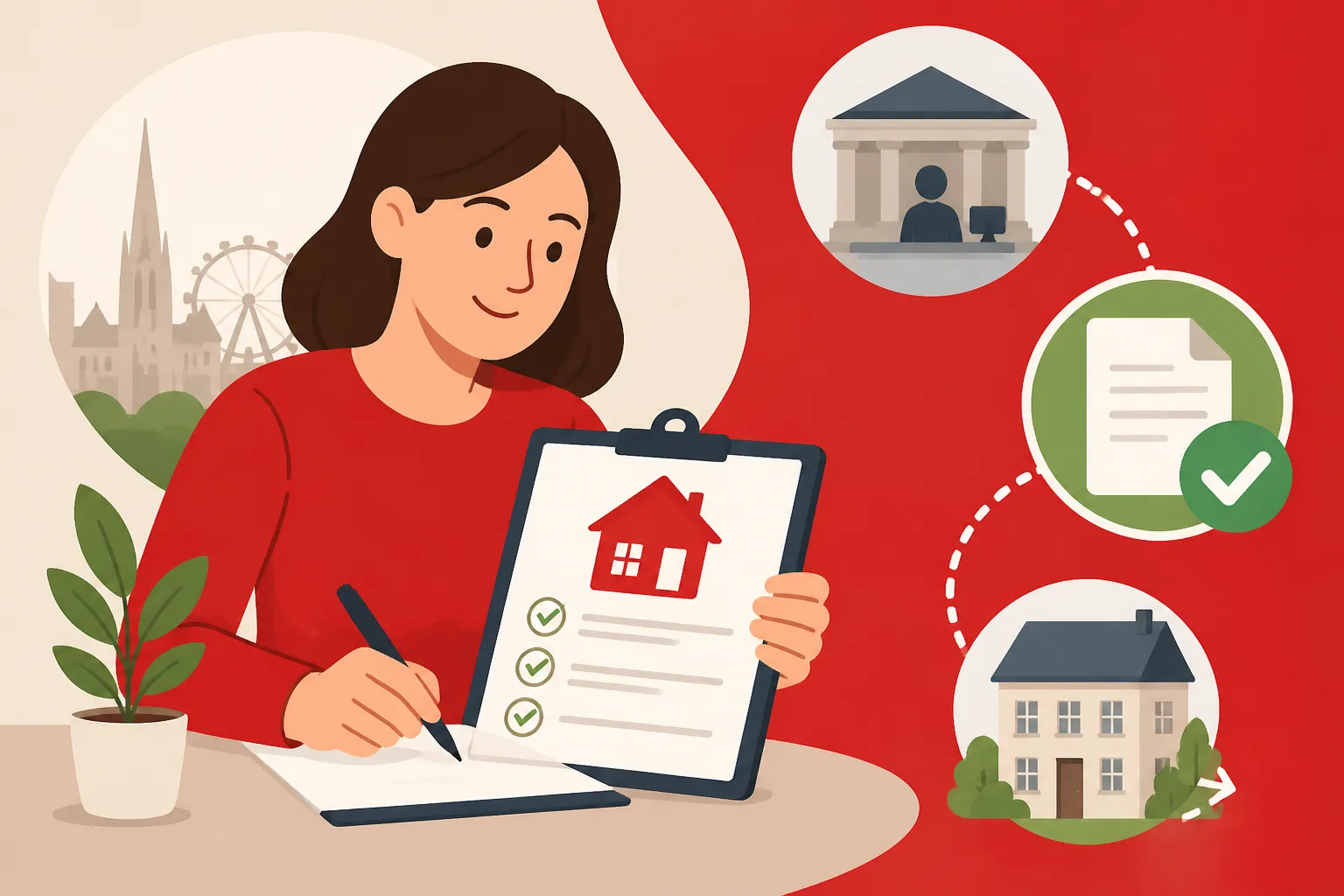
The Meldezettel Process: Registering Your Address Legally
You have exactly three days from the moment you move into your new Austrian apartment to tell the government where you are sleeping. I remember the sheer panic of my first week in Vienna, trying to find a working printer while juggling boxes and a confusing German-only form. This guide breaks down everything you need to navigate the mandatory Meldezettel process smoothly.
Understanding the Meldezettel Legal Framework
The Meldezettel is more than just a piece of paper; it is the foundation of your legal existence in Austria. Without it, you effectively do not exist in the eyes of the state, which means no bank account, no health insurance, and certainly no residency permit. The law that governs this is the Meldegesetz (Registration Act), and it is strictly enforced across all nine federal states.
What exactly is a Meldezettel
Technically, the "Meldezettel" refers to the paper form you fill out, while the official document you receive back is called the Bestätigung der Meldung (Confirmation of Registration). However, everyone—from your landlord to your HR manager—will simply ask for your Meldezettel. It serves as official proof of your address. This system allows the Austrian government to track population density, allocate tax revenue to specific districts, and ensure that public services like garbage collection and schools are appropriately funded.
As part of your Living in Austria 2027: The Expat Starter Guide, obtaining this document is your absolute first priority. It links your identity to a specific physical location, which is why you must update it every single time you move, even if you are just moving to the apartment next door in the same building.
The 3-Day Rule Reality Check
The law states you must register within three working days of moving in. In my experience, this is one of the biggest culture shocks for newcomers who are used to more relaxed administrative timelines. If you arrive on a Friday, your clock starts ticking, and by Wednesday, you should have visited a registration office.
Does the "Meldeamt" (registration office) check your lease date? Yes, they do. While being a few days late usually results in a stern look and a verbal warning, significant delays can lead to administrative fines. In 2026, these fines have become more standardized across cities like Vienna and Graz. If you are waiting for your Austria Visas & Residence Titles 2027: Complete Guide to be processed, being late on your registration can create unnecessary red flags in your file.
Who is responsible for registration
The responsibility for registration lies solely with the person moving in. If you are moving in with a partner, both of you must be registered. If you have children, you are responsible for registering them as well. The only person who needs to help you is the "Unterkunftsgeber"—the person providing the accommodation. Usually, this is your landlord or the main tenant if you are subletting. They must sign your form to confirm you actually live there. This is a critical step in Renting in Austria: MRG Laws, Leases, and Bestellerprinzip because a landlord’s refusal to sign a Meldezettel is a major legal violation.
Step-by-Step Guide to Your First Registration
Navigating the bureaucracy can feel like a maze, but the actual process is quite linear if you have your documents in order. The physical act of registering is free, but the time cost can be high if you don't book an appointment.
The Meldezettel Form
You can find the Meldezettel form (Meldezettel-Formular) online as a PDF, at any "Magistrat" (city hall), or even at some tobacco shops (Tabak-Trafik). The form is in German, which can be intimidating. You will need to provide your full name, date of birth, place of birth, and nationality.
One section that often trips up expats is the "Religionsbekenntnis" (Religious Affiliation). This is not just for demographic data; it is used to determine if you are liable for church tax. If you write "Roman Catholic," the church will eventually find you and send a bill. If you are not a practicing member of a church that collects tax in Austria, many expats choose to write "o.B." (ohne Bekenntnis), which means "no affiliation." This is a key detail we often discuss in the context of Money in Austria 2027: Banking, Payments, and Financial Setup because it impacts your monthly budget.
Securing the Landlord Signature
Section 2 of the form requires the signature of the provider of the accommodation. Do not sign this yourself. Your landlord must sign it. If you are living in a "Wohngemeinschaft" (WG) or shared flat, the main tenant on the lease can sign as your accommodation provider.
If you are in a similar spot, keep your emails as proof that you attempted to get the signature on time. Most officials at the Meldeamt are human and will understand a short delay if you can show you were proactive. This is especially important for The 3-Day Rule for Meldezettel Registration After Arrival compliance.
Visiting the Meldeservice in Person
In large cities like Vienna, you go to a "Magistratisches Bezirksamt." In smaller towns, you go to the "Gemeindeamt" or "Bezirkshauptmannschaft." In 2026, most offices require you to book an "Appointment" (Termin) online in advance. Showing up without one might result in a four-hour wait or being turned away entirely.
Once your name is called, the process takes about five minutes. The official will type your details into the Central Residence Register (ZMR), print out your Bestätigung der Meldung, and hand it to you. Check the spelling of your name immediately! If there is a typo, it will haunt you when you try Opening an Austrian Bank Account: Requirements and Top Banks later that week.
| Terminology | Meaning | Importance |
|---|---|---|
| Hauptwohnsitz | Main Residence | Where you spend the majority of your time; used for taxes and voting. |
| Nebenwohnsitz | Secondary Residence | A vacation home or temporary stay; does not grant certain local benefits. |
| ZMR-Zahl | Central Register Number | A unique 12-digit number assigned to you for life in Austria. |
| Meldebestätigung | Proof of Registration | The actual document you need for all other administrative tasks. |
Documentation and Practical Requirements
The Austrian authorities love original documents. While the world is going digital, the person behind the plexiglass at the Meldeamt will almost always want to see the physical version of your passport and other certificates.
Essential Identity Documents
For your first registration, you must bring a valid travel document. For most expats, this is your passport. If you are an EU/EEA citizen, a national ID card is sufficient. If you are a non-EU citizen, you should also bring your visa or residence permit if you already have one, though the Meldezettel is often a prerequisite for getting the permit itself.
If you have multiple citizenships, you must declare all of them. This is a common point of confusion for dual citizens, but the system is designed to handle it. Providing accurate data here ensures your records match up with your Healthcare Checklist for Your First 30 Days in Austria when your social insurance is activated.
Proof of Accommodation Variations
While the signed form is usually enough, some offices—especially in smaller districts—might ask to see your rental contract (Mietvertrag). It’s always better to have a copy in your folder just in case. If you are staying with a friend for free, they are your "Unterkunftsgeber." They sign the form, and you may need a "Wohnrechtsvereinbarung," which is a simple letter stating you have the right to live there without a formal lease.
If you are staying in a hotel or a serviced apartment for your first few weeks, the hotel is required to register you in their guest book. However, this is not the same as a Meldezettel. If you need a formal Meldezettel for a bank or a visa while living in a hotel, you must ask the hotel manager to sign the official Meldezettel form for you. Some hotels are hesitant to do this for short stays, so clarify this before booking.
Handling Birth Certificates and Marriage Documents
If this is your first time registering in Austria, you should bring your birth certificate. If you are married or have children, bring the marriage certificate and the children’s birth certificates. If these documents are not in German or English, they generally need to be translated by a certified court translator in Austria.
People can get sent away because their marriage certificate was a photocopy. Always bring the originals. The official will scan them and return them to you. This data is fed into the registry and is vital for things like Applying for the Familienbeihilfe (Child Benefit) Allowance later on.
The Modern Way: Registering via ID Austria
By 2026, Austria has significantly upgraded its digital infrastructure. The "Handy-Signatur" has been fully replaced by ID Austria, which is a high-security digital identity that allows you to sign documents and access government services from your smartphone.
Setting Up Your Digital Identity
You cannot use the digital registration service until you have your ID Austria fully activated. For expats, this usually happens in two steps: first, you get your physical Meldezettel and residency permit, and then you visit a specialized office (often the same one where you got your Meldezettel) to "authenticate" your ID Austria.
Once activated, ID Austria is a lifesaver. It allows you to skip the physical queues for future moves. If you move from one apartment to another within Austria, you can perform the "Ummeldung" (change of address) entirely through the "Digitales Amt" app. This is one of the most powerful ID Austria and E-Government Tools for Foreign Residents available to you.
Using the Central Register (ZMR) Online
The online portal allows you to download a fresh copy of your Meldebestätigung at any time for a small fee (usually around 7-15 Euros). This is incredibly helpful because many banks and authorities require a "current" Meldezettel, which they define as one issued within the last three months.
When you use the online system to change your address, the system automatically notifies your old district that you have moved. You don't need to go back to your old neighborhood to "unregister" if you are staying within Austria. The "Ummeldung" handles both the deregistration of the old address and the registration of the new one simultaneously.
Limitations of Online Registration
Digital registration is generally only available for your "Hauptwohnsitz" (main residence). If you are registering your very first address in Austria, most districts still require a face-to-face visit to verify your identity and your original documents (like that birth certificate).
Furthermore, if you are not a citizen of the EU/EEA or Switzerland, there may be additional hurdles in the digital system depending on your specific residence title. Always check the "Digitales Amt" app first, but be prepared that your first time will likely involve a trip to the office. This is a common topic in the Using ID Austria to Change Your Address Without a City Hall Visit guide.
Life Changes: Deregistering and Moving
Living in Austria often involves a bit of "apartment hopping" as you find your feet. Each move triggers a new legal obligation to update your records.
Moving Within Austria (Ummeldung)
As mentioned, an "Ummeldung" is a combined process. When you sign a new lease and move your belongings, you have three days to register the new address. The official at the desk (or the online system) will ask for your old address. Once they process the new one, the old one is automatically closed out in the system.
You will receive a new Bestätigung der Meldung. Keep the old ones! Sometimes, when applying for permanent residency or citizenship years later, having a "Meldeverlauf" (a history of your registrations) is very useful to prove you have been in the country continuously.
Leaving Austria Permanently (Abmeldung)
If you decide to leave Austria for good, you must "abmelden" (deregister). This can be done up to three days before you leave or within three days after you have left. If you are doing it after leaving, you will need to do it by mail or via ID Austria.
Failure to deregister can lead to massive headaches. You might continue to be billed for the ORF household fee, your health insurance might continue to accrue debt in your name, and the "Finanzamt" (tax office) might still consider you a tax resident. Always get your Abmeldebestätigung before you head to the airport.
Registering a Secondary Residence (Nebenwohnsitz)
If you live in Vienna for work but have a small cabin in Tyrol for weekends, you must register the cabin as a "Nebenwohnsitz." Your main center of life—where you work, where your family is, and where you spend the most time—is your "Hauptwohnsitz."
Be careful: some cities, especially Vienna, have different rules for "Parkpickerl" (parking permits) and social benefits based on whether your address is a main or secondary residence. Generally, you can only have one Hauptwohnsitz in Austria, but as many Nebenwohnsitze as you can afford.
Common Hurdles and How to Solve Them
Not every move is straightforward. Sometimes you’re in a gray area, and the Austrian system isn’t always built for "gray."
The Airbnb and Hotel Catch-22
If you are staying in an Airbnb for your first month, you are technically a "tourist" and don't need a Meldezettel for the first few weeks. However, if you need to open a bank account or apply for a residence permit immediately, you need that Meldezettel.
Many Airbnb hosts refuse to sign the form because they are not legally registered to offer long-term housing or want to avoid certain taxes. Before you book a long-term stay, send a message: "Will you sign a Meldezettel form for me?" If they say no, find another place. You cannot bypass this requirement if you plan to stay in Austria longer than 90 days.
Shared Apartments (WG) and Subletting
In a "Wohngemeinschaft," the person signing your form is whoever is on the main lease. If the landlord has prohibited subletting, the main tenant might be scared to sign your Meldezettel. This puts you in legal jeopardy. Always ensure your living situation is "legal" and "above board."
If you are a student, your university might offer a "Wohnrechtsvereinbarung" for dorms, which acts as the landlord's signature. This is a crucial step for the Student Self-Insurance Requirements and Monthly Costs 2026 because the insurance company will demand proof of your address before they issue your e-card.
Penalties and Late Registration Fines
What happens if you forget? If you are a week late, honestly, just go to the office, be extremely polite, and apologize profusely in your best German (or English). Most of the time, they will just process it.
If you are months late, or if you were caught "living black" (wohnen ohne Meldung), the fines can range from 50 Euros to over 700 Euros for repeat offenses. Moreover, if the "Fremdenpolizei" (Immigration Police) discovers you are living at an address different from your registered one, it can lead to the revocation of your residence permit. The Meldezettel is the one thing in Austria you do not want to be lazy about.
Disclaimer
The information provided in this guide is for informational purposes only and does not constitute legal advice. While every effort has been made to ensure the accuracy of the details regarding Austrian registration laws in 2026, regulations can change. Always consult the official website of the Austrian Federal Government (oesterreich.gv.at) or a qualified legal professional for your specific situation.