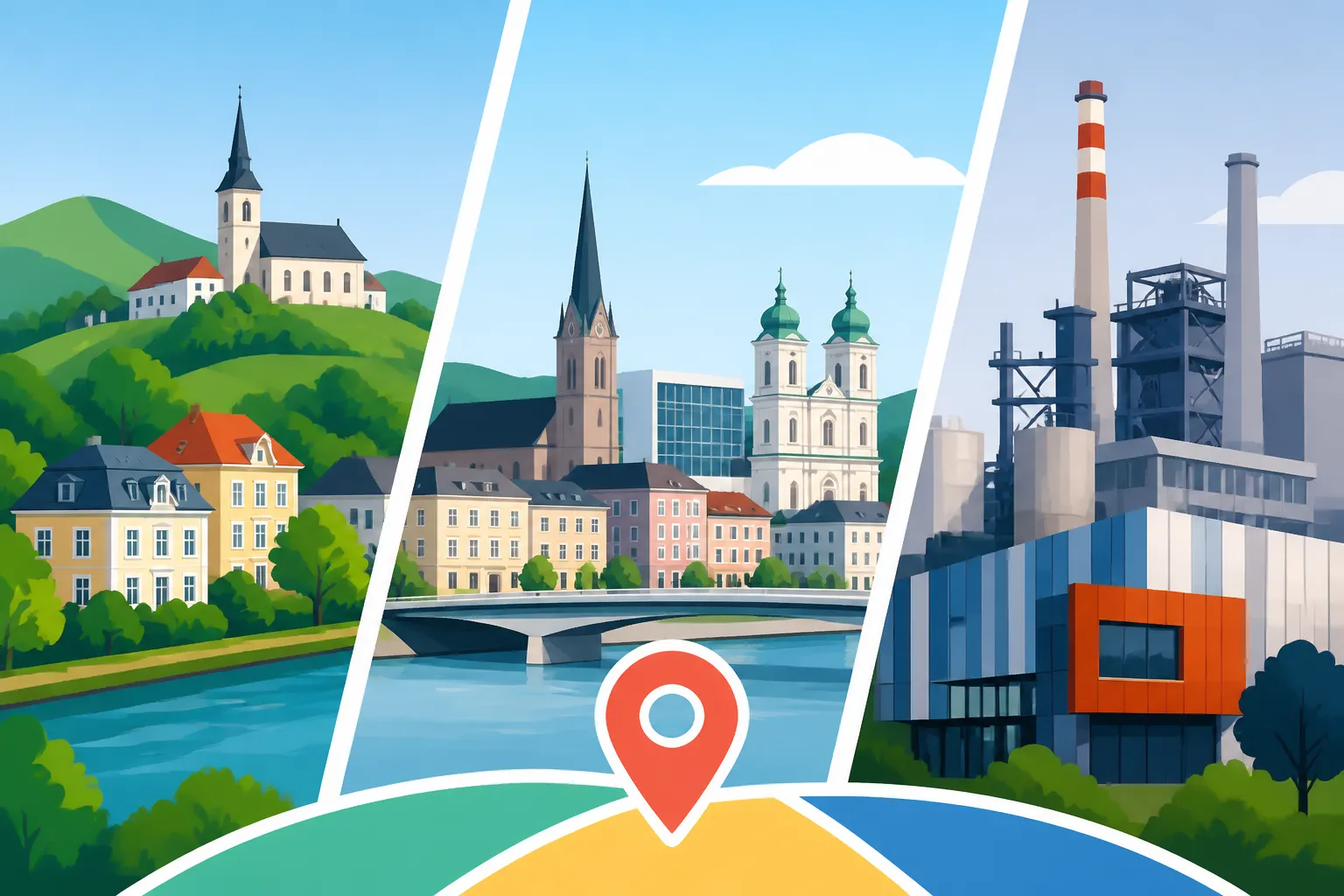
Linz Neighborhood Guide: Urfahr, Center, and Industrial Areas
Finding the right district in Linz often feels like a high-stakes puzzle where the pieces change shape depending on which side of the Danube you stand. I remember my first month here, wandering across the Nibelungenbrücke in a freezing wind, realizing that choosing a flat based solely on a map was my first big expat mistake. This guide solves the "where to live" dilemma by breaking down the distinct personalities of Urfahr, the Innere Stadt, and the industrial south so you can find a home that actually fits your lifestyle.
Settling Into the Steel City: An Expat Reality Check
Linz has undergone a massive transformation from a gritty industrial hub into a tech-forward cultural center, but the industrial roots remain the city's economic heartbeat. When you first arrive, the sight of the massive Voestalpine chimneys on the horizon might be intimidating, yet they represent the stability and wealth that make this city such a practical choice for foreigners. Unlike the museum-like atmosphere of Salzburg or the sprawling chaos of Vienna, Linz is a "working city." Everything here is designed for efficiency, which is a blessing once you start navigating the local bureaucracy and transport systems.
The rental market here is competitive but far more approachable than in the capital. However, you need to understand that Linz functions as a city of two halves. The Danube is not just a geographical feature; it is a psychological and logistical boundary. If you work in the south but live in the north, your life will revolve around bridge traffic and tram schedules. I learned very quickly that your quality of life in Linz is directly tied to how well you align your residence with your daily commute and your need for green space.
Understanding the legal landscape is your first line of defense. Before you sign anything, you should familiarize yourself with Renting in Austria: MRG Laws, Leases, and Bestellerprinzip to ensure you aren't paying unnecessary fees or signing a contract that lacks the standard tenant protections. In 2026, the market has shifted slightly, but the core principles of Austrian rental law remain your best friend when dealing with landlords who might try to take advantage of a newcomer's lack of local knowledge.
The Industrial Identity vs Cultural Charm
The "Steel City" moniker is something locals wear with pride, and as an expat, you will soon see why. The industry provides high-paying roles that fuel the Linz Job Market: Engineering, Manufacturing, and IT, creating a city that is wealthy, safe, and incredibly well-maintained. You aren't just moving to a place with factories; you are moving to the home of the Ars Electronica Center, a world-class museum of the future that sits right on the riverbank. This contrast between heavy industry and cutting-edge digital art defines the Linz experience.
Living here means embracing the smell of the "Voest" on certain days when the wind blows just right, but also enjoying some of the cleanest air in Europe once you head toward the hills. The city has invested billions into "greening" the industrial image, resulting in beautiful riverside parks and a harbor area that is slowly turning into a gallery of street art. It is a city that doesn't try to be something it isn't, and that honesty is incredibly refreshing after you've lived in more tourist-heavy European hubs.
Navigating the Linz Rental Market in 2026
By 2026, the rental market in Linz has become more digitized, yet the old-school "who you know" networking still plays a role. Most expats start their search on platforms like Willhaben, but the real gems are often found through internal company boards or local Facebook groups. When looking at listings, pay close attention to the distinction between Altbau vs Neubau: Differences in Rent, Charm, and Heating. An Altbau apartment in the center might have beautiful high ceilings and parquet floors, but the heating costs in an Upper Austrian winter can be eye-watering if the windows haven't been modernized.
You should also be prepared for the "Bestellerprinzip" reality. This rule means that in most cases, the landlord pays the real estate agent's commission, not you. This has made moving much more affordable for expats who used to have to cough up thousands of Euros in fees just to get a set of keys. However, it also means that good apartments go fast. Have your documents—pay slips, work contract, and ID—ready in a PDF folder so you can apply the moment you walk out of a viewing.
Urfahr: The Green Haven North of the Danube
Urfahr is often described by locals as a "city within a city," and for many expats, it is the ultimate residential goal. Located on the northern bank of the Danube, it offers a distinctively slower pace of life compared to the bustling Innere Stadt. It is the gateway to the Mühlviertel region, meaning you are never more than a few minutes away from hiking trails and rolling hills. For families, Urfahr is almost always the first choice due to its abundance of parks, quiet residential streets, and high-quality schools.
The logistical catch of Urfahr is the bridge situation. While the tram lines (1, 2, 3, and 4) are incredibly efficient, the road traffic across the Nibelungenbrücke during rush hour is legendary. If you are someone who prefers to commute by bike or foot, Urfahr is a dream; if you insist on driving a car to a job in the southern industrial zone, you might find yourself frustrated. I lived near the Rudolfstraße for a year and found that the ability to walk along the Danube every evening far outweighed the minor inconvenience of the morning tram crush.
Pöstlingberg and the Premium Living Experience
If you have a higher budget and want a view that will make your friends back home jealous, Pöstlingberg is the place to be. This is the hill that overlooks Linz, crowned by the famous pilgrimage basilica. Living here feels more like being in a luxury Alpine village than an industrial city. The air is crisper, the streets are lined with villas, and the Pöstlingbergbahn (one of the steepest adhesion railways in the world) provides a charming, if slightly slow, connection to the city center.
However, prestige comes with a price. Not only is the rent significantly higher here, but you will also likely need a car for grocery shopping and daily errands. While it is the pinnacle of Linz real estate, it can feel a bit isolated for a new expat who is trying to build a social circle. Most of my friends who moved to Pöstlingberg eventually traded the view for a more "connected" life down in the valley once they realized how much they missed being able to walk to a café on a Sunday morning.
Family Life and Educational Infrastructure
Urfahr is arguably the best place in Upper Austria for raising children. The district is home to numerous "Kindergartens" and "Volksschulen" that are integrated into the community. If you are moving with school-aged children, you will want to look into Finding Childcare: Kindergarten Registration Timelines as early as possible. Spaces in the most popular Urfahr facilities fill up months in advance, often during the February registration period for the following autumn.
The proximity to the Johannes Kepler University (JKU) also gives the northern part of Urfahr a vibrant, youthful energy. While the university itself is located in the Auhof area, many students and faculty members live in the surrounding residential blocks. This creates a safe, educated, and international atmosphere. You will find more English-speaking neighbors here than in the gritty industrial districts, which can be a huge comfort during your first year of integration.
The Urfahr Market and Local Community
One of the highlights of living in this district is the Urfahranermarkt, a massive bi-annual fair that takes place right on the riverbank. While it brings noise and crowds for two weeks a year, it is a cornerstone of Linz culture. On a more daily basis, the area around the "Ars Electronica" and the "Lentos Kunstmuseum" offers a sophisticated lifestyle. You can spend your Saturdays browsing local organic shops or sitting at a riverside café watching the river cruise ships dock.
The sense of community in Urfahr is strong. People tend to stay here for decades, and neighbors actually get to know each other. This brings us to an important cultural point: Quiet Hours (Ruhezeit) and Apartment Neighbor Etiquette. In Urfahr, these rules are taken very seriously. If you are planning a housewarming party or decide to vacuum your living room on a Sunday afternoon, expect a polite but firm knock on the door. Respecting the "Mittagsruhe" (midday quiet) and Sunday silence is the fastest way to earn the respect of your new Austrian neighbors.
Innere Stadt: Living in the Heart of the Action
For those who want to be steps away from the best restaurants, bars, and shops, the Innere Stadt (City Center) is the only choice. The heart of the district is the Hauptplatz, one of the largest enclosed squares in Europe, which hosts everything from Christmas markets to political rallies. Living in the center means you are at the nexus of the entire public transport system. Every tram line passes through here, making a car completely unnecessary.
The trade-off for this convenience is, of course, the noise and the price per square meter. The Innere Stadt is a mix of beautifully restored historic buildings and sleek, modern developments. It attracts young professionals, digital nomads, and expats who want to soak up every bit of urban European life. When I first moved to the Altstadt (the historic old town section), I loved being able to stumble out of my door and into a hidden courtyard bar, but I had to invest in some very high-quality earplugs for the Friday night revelry.
Landstraße and the Shopping Pulse
The Landstraße is the second busiest shopping street in Austria, trailing only Vienna’s Mariahilferstraße. It stretches from the Hauptplatz all the way down to the Musiktheater at Volksgarten. Living on or near the Landstraße means you have every imaginable amenity at your doorstep. From high-end fashion boutiques to international grocery chains, everything is within a five-minute walk.
However, the "side streets" of the Landstraße are where the real residential gems are found. Streets like the Bischofstraße or Herrenstraße offer a more peaceful vibe while still being incredibly central. Here, you will find small galleries, independent bookshops, and some of the city's best bakeries. It is a highly walkable lifestyle that perfectly suits someone who hasn't yet mastered the Is the Klimaticket Worth It? Cost and Benefit Analysis for longer commutes, though having a pass is still recommended for rainy days.
Nightlife and Cultural Proximity
The Innere Stadt is the cultural engine of Linz. The Musiktheater am Volksgarten is one of the most modern opera houses in Europe, and the Brucknerhaus offers world-class classical music. If you live in this district, your "living room" extends into these public spaces. You are also close to the "Bermuda Triangle" of Linz—an area of the old town known for its dense concentration of bars and pubs.
For an expat, this proximity to nightlife makes it much easier to meet people. There are several "Stammtisch" groups for foreigners that meet in the center's pubs. Being able to walk home after a few Gösser beers rather than worrying about the last tram is a significant luxury. Just be aware that during the "Pflasterspektakel" (a massive street art festival), the center becomes incredibly crowded, and if your apartment faces the street, you will be part of the performance whether you like it or not.
The Industrial South and Hafenviertel: Gritty Meets Global
Moving south of the city center, the atmosphere changes. This is where the heavy lifting of the Austrian economy happens. The districts of Kleinmünchen, Lustenau, and St. Peter are dominated by large-scale industry, but they also offer some of the most affordable and practical housing options in the city. For many expats working at Voestalpine, Borealis, or Siemens, living in the south is a logical choice that eliminates the dreaded Danube crossing.
In recent years, the "Hafenviertel" (Harbor District) has become the trendy outlier of the south. What was once a purely industrial shipping port is now home to "Mural Harbor," one of the world's largest outdoor graffiti galleries. The area is gentrifying rapidly, with old warehouses being converted into lofts and tech startups moving into the "Hafenportal." It is edgy, diverse, and feels more like Berlin than typical provincial Austria.
Living Near the Giants: Voestalpine and Siemens
If you are a specialized engineer or researcher, you might find yourself living in the southern districts to be close to work. The housing here is often functional—think post-war apartment blocks and newer, efficient Neubau complexes. While it lacks the "fairytale" charm of the Altstadt, it is incredibly well-connected by the tram lines 1 and 2. The rents here are among the lowest in the city, providing a great Cost of Living Benchmarks for Singles, Couples, and Families for those looking to save money for travel or future investments.
The southern districts also have a very international feel. Because of the large industrial employers, you will find people from all over the world living here. This diversity is reflected in the local supermarkets and eateries, where you can find excellent Balkan, Turkish, and Asian food that is often more authentic (and cheaper) than what you find in the city center.
The Hafenviertel Gentrification Project
The Hafenviertel is currently the most exciting "up-and-coming" area in Linz. It appeals to a younger demographic that enjoys the industrial-chic aesthetic. You have the "Posthof," a legendary concert venue nearby, and the "Zeitgeschichte Museum." The living spaces here are often larger than in the center, and many of the new developments feature balconies with views of the industrial cranes and the river—a view that has its own rugged beauty.
One thing to keep in mind is that the infrastructure in the harbor is still catching up to the residential growth. While there are buses, the tram doesn't go all the way into the port yet. Most residents here rely on bicycles or e-scooters. It is also an area where you might occasionally need to deal with Finding English-Speaking Plumbers and Electricians as older buildings are renovated. It's a bit of a frontier, but for the right person, it’s the coolest place in town.
Comparing Living Costs Across Linz Districts
When deciding between these areas, the budget is usually the deciding factor. Linz is generally more affordable than Vienna, but the "Upper Austrian premium" still applies to the best neighborhoods. You should budget not just for rent, but also for "Betriebskosten" (operating costs) and heating. In 2026, energy prices have stabilized, but they remain a significant portion of your monthly outgoings.
| District | Vibe | Typical Rent (1BR) | Transport Links | Best For |
|---|---|---|---|---|
| Urfahr | Green, Family, Quiet | €850 – €1,100 | Excellent (Trams 1, 2) | Families, Academics |
| Innere Stadt | Urban, Busy, Historic | €950 – €1,300 | Perfect (All Trams) | Singles, Foodies |
| Pöstlingberg | Luxury, Elite, Views | €1,400+ | Car Dependent | High Earners |
| Hafenviertel | Edgy, Artistic, New | €800 – €1,050 | Bus / Bike | Creatives, Techies |
| South / Industrial | Practical, Diverse | €700 – €900 | Good (Tram 1, 2) | Factory Workers, Budgeters |
Rent Benchmarks and Hidden Fees
When looking at these prices, remember they are "Kaltmiete" (cold rent). You will need to add roughly €150–€250 for utilities and building maintenance. Also, be aware of the "Kaution" (deposit), which is typically three months of "Warmmiete." it is wise to set aside a "moving fund" of at least €4,000 to cover the first month's rent, the deposit, and basic furniture, especially since many Austrian apartments are rented without kitchens or light fixtures.
Utility Expectations and District Heating
Linz is famous for its "Fernwärme" (district heating) provided by Linz AG. If your apartment is connected to this system, you are in luck. It is incredibly efficient and generally cheaper than gas or electric heating. When viewing apartments in Urfahr or the South, always ask: "Is it Linz AG Fernwärme?" If the answer is yes, your winter bills will be much more predictable. You will also need to set up your own account for Electricity Providers in Austria (Wien Energie, Verbund)—though in Linz, Linz AG is the dominant local player that most people stick with for simplicity.
Practical Steps for Moving to Linz
Once you’ve picked your district, the administrative race begins. Austria loves its paperwork, and Linz is no exception. The city is very efficient, but they expect you to follow the rules to the letter. Your first week will be a blur of visits to the "Magistrat" and setting up your basic services. Don't let the stern faces at the service desk intimidate you; they are generally very helpful if you have all your documents organized and at least attempt a "Grüss Gott."
The Meldezettel and Local Registration
Within three days of moving into your new flat, you must perform The Meldezettel Process: Registering Your Address Legally. In Linz, you do this at the "Wissensturm" near the main station or at the various "Bürgerservice" points in districts like Urfahr. This document is the "key" to your life in Austria—you cannot open a bank account, get a phone contract, or register for an e-card without it. I recommend getting three or four original stamped copies; you’ll be surprised how many offices want to see it.
Transportation and the Klimaticket
Linz is a very compact city, and the public transport system is one of the best in the country. The "Linz AG Linien" are punctual and clean. As soon as you have your Meldezettel, you should look into getting a yearly pass. For most expats, the regional "Klimaticket OÖ" is a fantastic deal, as it allows you to travel not just within Linz, but across the entire province of Upper Austria. This opens up weekend trips to the lakes of the Salzkammergut or the mountains of the Pyhrn-Priel region without ever needing a car.
Finally, as you settle in, remember that integration happens in the small moments. Learn how to navigate Managing Household Waste: Strict Recycling Rules Explained—your neighbors will judge you more on how you sort your plastic than on your German grammar. Take the time to explore your local "Greissler" (small grocer), and soon the Steel City will start feeling like home.
Medical and Legal Disclaimer
The information provided in this guide is for general informational purposes only and does not constitute legal, financial, or professional real estate advice. While every effort has been made to ensure the accuracy of the content regarding Linz neighborhoods and Austrian rental laws as of 2026, regulations and market conditions are subject to change. Readers should consult with qualified professionals, such as the Mietervereinigung (Tenants' Association) or a licensed legal advisor, before signing any contracts or making significant financial commitments. The author and publisher are not responsible for any actions taken based on the contents of this article.