Finding Childcare: Kindergarten Registration Timelines
The panic of securing a kindergarten spot in Austria can hit you the moment the pregnancy test turns positive. I remember staring at a German-only website in Vienna, wondering if I had already missed the deadline for a child who was not even born yet. This guide breaks down the specific registration timelines and bureaucratic hurdles to ensure your child gets the care they need.
The Austrian Childcare Landscape: Public vs. Private
Navigating the childcare system in Austria is one of the first major "administrative tests" for expat parents. The system is decentralized, meaning the rules in Vienna differ significantly from those in Graz or a small village in Tyrol. Understanding these nuances is essential before you even look at a calendar.
Understanding the Public System
In most major cities, public kindergartens are managed by the municipality. In Vienna, this is the responsibility of the MA 10 (Magistratsabteilung 10). These facilities are highly sought after because they are heavily subsidized. For many residents, public kindergarten is virtually free, though you will still pay for "Essensbeitrag" (meal costs). Public spots are allocated based on a points system that prioritizes working parents and those living closest to the facility. If you are also in the process of Enrolling Your Child in a Public Kindergarten in Vienna, you will quickly realize that the demand often outstrips supply, making the timeline your most important tool.
The Role of Private Kindergartens
Because public spots are competitive, a robust private sector exists. These range from parent-run cooperatives (Kindergruppen) to large organizations like Diakonie, Kinderfreunde, or Montessori centers. Private options often have more flexible hours and may offer bilingual programs, which is a major draw for expat families. While more expensive, they are still partially subsidized by the city in many cases. If you are struggling with the public system, looking into private options early is a smart backup plan. During your first month, it is worth checking a Healthcare Checklist for Your First 30 Days in Austria to ensure all your family's social insurance details are in order, as these are often required for registration.
Alternative Care and Tagesmütter
For children under three, many parents opt for a Tagesmutter or Tagesvater (childminder). These are individuals who look after a small group of children (usually no more than five) in a home-like environment. This is often an easier transition for very young children and can be a life-saver if you miss the primary kindergarten registration window. The registration for these childminders often follows a different, more flexible timeline, but you still need to register with the municipal authorities to receive the necessary subsidies.
Registration Timelines: When to Start Looking
In Austria, the early bird does not just get the worm; they get a spot within walking distance of their apartment. Timing is everything, and missing a window by even a few days can mean waiting an entire year for a placement.
The Magic Window in Vienna
In Vienna, the primary registration period for the following school year (which starts in September) typically runs from November to the end of December, or sometimes into January and February. If you want a spot for your child in September 2026, you must submit your "Vormerkung" (pre-registration) during this specific window in late 2025 or early 2026. This applies specifically to municipal kindergartens. If you miss this window, you are relegated to the "late" list, where your chances of getting your first or second choice of location drop significantly.
Provincial Differences in Graz, Linz, and Salzburg
Outside of the capital, the timelines can be even more varied. In Graz, for example, the main registration period often happens in late winter. In smaller towns, you might simply walk into the local Gemeinde (town hall) and ask for a spot. However, as more expats move to hubs like Linz or Salzburg, these cities are adopting more structured online registration periods. It is vital to check the specific municipality website as soon as you have your Meldezettel Process: Registering Your Address Legally completed. Without a registered address, you generally cannot even enter the registration system.
Mid-Year Entries and Emergencies
What happens if you move to Austria in March? This is a common expat scenario. While the official start is September, "under-the-year" spots do open up when families move away. However, these are rare. If you find yourself in this situation, you will need to contact the MA 10 or the local equivalent directly to report an "urgent need." Be prepared to provide proof of employment, as the system favors parents who must return to work. In the meantime, you might need to rely on Finding Reliable English-Speaking Babysitters and Nannies to bridge the gap.
Step-by-Step Registration Process
The bureaucracy can feel like a labyrinth, but once you have the right documents, it becomes a series of checkboxes. Do not let the German terminology intimidate you; the process is designed to be systematic.
Getting Your Kundennummer
In Vienna, before you can apply for a spot, you must obtain a "Kundennummer" (customer number) from the MA 10. This is a unique identifier for your child in the city’s database. To get this, you usually need to provide your child's birth certificate and your Meldezettel. This number is the "key" that unlocks the online registration portal. If you are a new arrival, make sure you have Certified Translations of Documents: What the Rules Demand ready, as birth certificates not in German or English may be rejected.
The Online Application Portal
Once you have your Kundennummer, you log into the city's portal to select your preferred kindergartens. Most systems allow you to choose up to three locations in order of preference. It is advisable for parents to physically visit the kindergartens before listing them. Even if you don't speak perfect German, seeing the facility and meeting the "Leitung" (director) gives you a feel for the environment. Mentioning that you are also looking for Finding an English-Speaking Pediatrician Accepting New Patients can sometimes spark a helpful conversation with other parents at the facility who have been in your shoes.
Essential Documentation for Expats
When you finally get an offer for a spot, you will need to attend an in-person meeting to sign the contract. You will typically need:
- The child’s e-card (social insurance card).
- The "Impfpass" (vaccination record) to show the child is up to date on basic shots.
- Proof of employment or a "Bestätigung" from the AMS if you are job hunting.
- The Austrian e-card: Registration, Photo Rules, and Usage Guide can help you ensure your child's insurance is active and ready for the contract signing.
Financial Considerations and Subsidies
One of the greatest perks of living in Austria is the support for families, but you have to know which forms to file to actually receive the money.
Is Kindergarten Really Free?
The term "free kindergarten" is a bit of a misnomer. While the "Betreuung" (care) is often covered by the city, parents are usually responsible for "Verpflegung" (meals). This can range from 70 to 100 EUR per month. In private kindergartens, the city pays a subsidy directly to the provider, and you pay the "top-up" fee. This top-up can be anywhere from 100 to 600 EUR depending on the prestige and offerings of the school. Understanding the Cost of Living in Vienna: Singles vs Families is crucial for budgeting these monthly outgoings.
Applying for the Familienbeihilfe
Every resident child in Austria is entitled to "Familienbeihilfe" (family allowance). This monthly payment from the tax office (Finanzamt) is intended to help with the costs of raising a child, including childcare expenses. You should apply for this as soon as you arrive and have your residency permits. The process is now largely digital via FinanzOnline. If you are unsure how to navigate the portal, our guide on Logging into FinanzOnline with the ID Austria App will walk you through the login process.
Hidden Costs and Extra Activities
Beyond the monthly fees, keep an eye out for "Bastelbeitrag" (crafting fees) or costs for excursions to the zoo or theater. These are usually small amounts collected a few times a year. Also, many kindergartens require a one-time "Einschreibgebühr" (registration fee), particularly in the private sector. It is also wise to consider Personal Liability Insurance (Privathaftpflicht): A Must-Have because, let’s be honest, kids break things. Most Austrian parents wouldn't dream of not having this insurance once their child starts interacting with others in a group setting.
Navigating Cultural and Language Barriers
The "Austrian way" of childcare might be different from what you are used to. There is a heavy emphasis on independence, outdoor play (regardless of weather), and a specific settling-in process.
Finding English-Speaking Support
While most kindergarten teachers in major cities speak some English, the official language of communication is German. This can be daunting during parent-teacher evenings (Elternabend). If your German is still in the early stages, it is perfectly acceptable to bring a friend to translate or ask if there is a staff member who can assist. You can also look for International vs Bilingual Schools in Vienna and Beyond if you want an environment where English is the primary or secondary language, though these spots are even more limited and require earlier registration.
The Eingewöhnungsphase (Settling-in Period)
This is a concept that catches many expats off guard. In Austria, you don't just drop your child off on day one and leave. The "Eingewöhnung" is a phased transition that can take anywhere from two to six weeks. In the first few days, you stay in the room with your child for an hour. Gradually, you leave the room for longer periods. You must plan your return to work around this period, as you cannot work full-time while your child is only attending for 90 minutes a day. This is a standard part of the Austrian Work Culture: 14 Salaries, Meetings, and Etiquette, and most employers are understanding of this "phase-in" time.
Communication with Educators
Austrians value direct communication. If there is an issue, the "Pädagogin" (educator) will tell you plainly. This isn't rudeness; it's the cultural norm. Similarly, they expect you to be punctual. If the kindergarten closes at 17:00, being there at 17:05 is considered a significant lapse in etiquette. Building a good relationship with the staff is key. If you are struggling with the transition, don't hesitate to seek out Mental Health in Austria: Counseling, Therapy, and Expat Support to talk through the stress of relocating with a family.
Practical Tips for Success
After years of helping expats navigate this, I have found a few "pro-tips" that can make the difference between getting a spot and being left on the waitlist.
Visiting the Facilities
Never accept a spot without visiting. Look for the "Tag der offenen Tür" (Open House days), which usually happen in the autumn. Check the cleanliness, the outdoor space, and the mood of the children. Ask about the "Pädagogisches Konzept"—is it Montessori, Waldorf, or a traditional focus on play? If you are moving to a specific area, checking a Vienna Neighborhood Guide: Best Districts for Expats can help you narrow down which kindergartens are in the most family-friendly zones.
Managing the Waitlist Stress
If you are put on a waitlist, do not just sit back and wait. Call the MA 10 or the private provider once a month to "update" them on your situation. Politely reiterate that you are still very interested and that your work situation depends on it. Persistence often pays off when a spot unexpectedly opens up. In the meantime, keep your paperwork organized. Ensure your ID Austria and E-Government Tools for Foreign Residents are fully set up so you can sign documents digitally the moment an offer arrives.
| Option | Age Group | Average Cost (Vienna) | Pros | Cons |
|---|---|---|---|---|
| Public Kindergarten | 0-6 years | ~70-100 EUR (Meals) | Very affordable, standardized care | Strict registration windows, less flexibility |
| Private Kindergarten | 0-6 years | 150-600 EUR | Flexible hours, often bilingual | Higher cost, varies in quality |
| Tagesmutter | 0-3 years | 100-300 EUR | Small groups, home environment | Less social interaction with large groups |
| Kindergruppe | 2-6 years | 200-400 EUR | High parent involvement | Requires parents to volunteer time/work |
Summary of Key Registration Deadlines
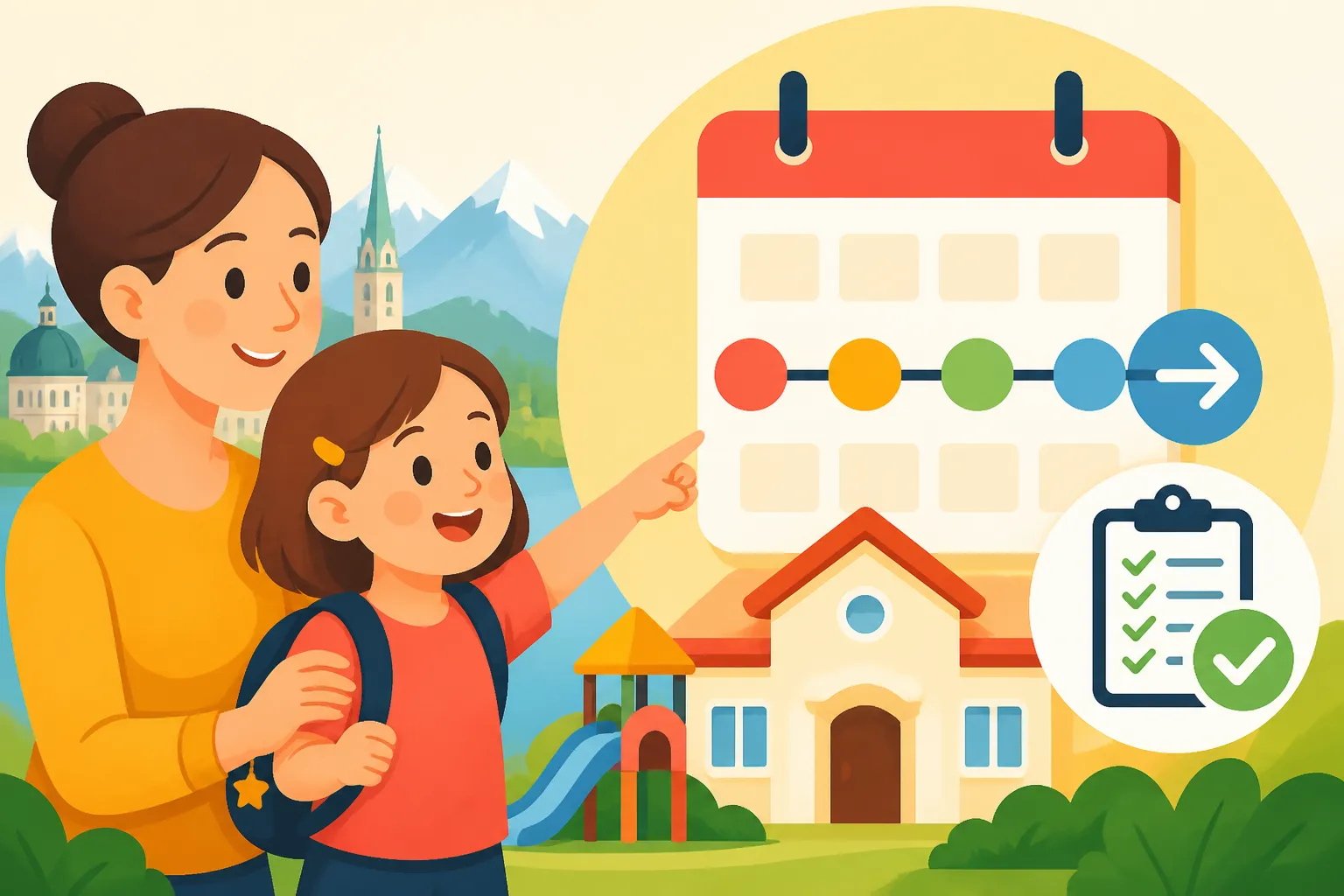
To keep your sanity, mark these dates in your calendar the moment you arrive or as soon as you know you are expecting:
- October/November: Research all local kindergartens and attend Open House days.
- November – December: Apply for your Kundennummer and submit your "Vormerkung" for public spots in Vienna.
- January – March: Registration windows for many private organizations and provincial public spots (Graz, Linz).
- March – May: Most families receive their "Zusage" (acceptance letter) or "Absage" (rejection letter).
- June: Finalize contracts and provide The Digital Eltern-Kind-Pass 2026: What Changed for Parents health documentation.
- September: The new school year begins.
Moving to a new country with a child is a monumental task. The paperwork can feel heavy, but the quality of care your child will receive in Austria is among the best in the world. Once you survive the "registration season," you can focus on the fun parts of expat life, like Skiing Etiquette and Lift Line Rules in the Austrian Alps for your child's first winter on the slopes.
Disclaimer
The information provided in this guide is for informational purposes only and does not constitute legal or professional administrative advice. Registration timelines and requirements in Austria are subject to change by municipal authorities. Always verify current deadlines and document requirements with your local Magistrat or Gemeinde. While we strive to keep our data accurate for 2026, individual cases may vary based on residency status and local availability.