District Heating (Fernwärme) vs Gas Heating Costs
Finding yourself staring at a metal box in your kitchen that periodically roars to life, or wondering why your neighbor doesn't have a boiler at all, is a classic Austrian rite of passage. I remember my first winter in Vienna, terrified to turn the thermostat above 19 degrees because I had no idea if my gas bill would bankrupt me by March. This guide demystifies the battle between District Heating (Fernwärme) and Gas (Gasetagenheizung) so you can budget accurately and stay warm without the financial anxiety.
Understanding the Heating Landscape in Austria
When you are scrolling through apartment listings on Willhaben, the heating system is often tucked away in the fine print, yet it dictates a huge portion of your monthly "Betriebskosten" (operating costs). In Austria, and particularly in cities like Vienna, Linz, and Graz, the infrastructure is a mix of old-world gas solutions and modern, centralized networks. Understanding which one you are signing up for is the first step toward avoiding a massive "Nachzahlung" at the end of the year.
The Legacy of Gas Heating Gasetagenheizung
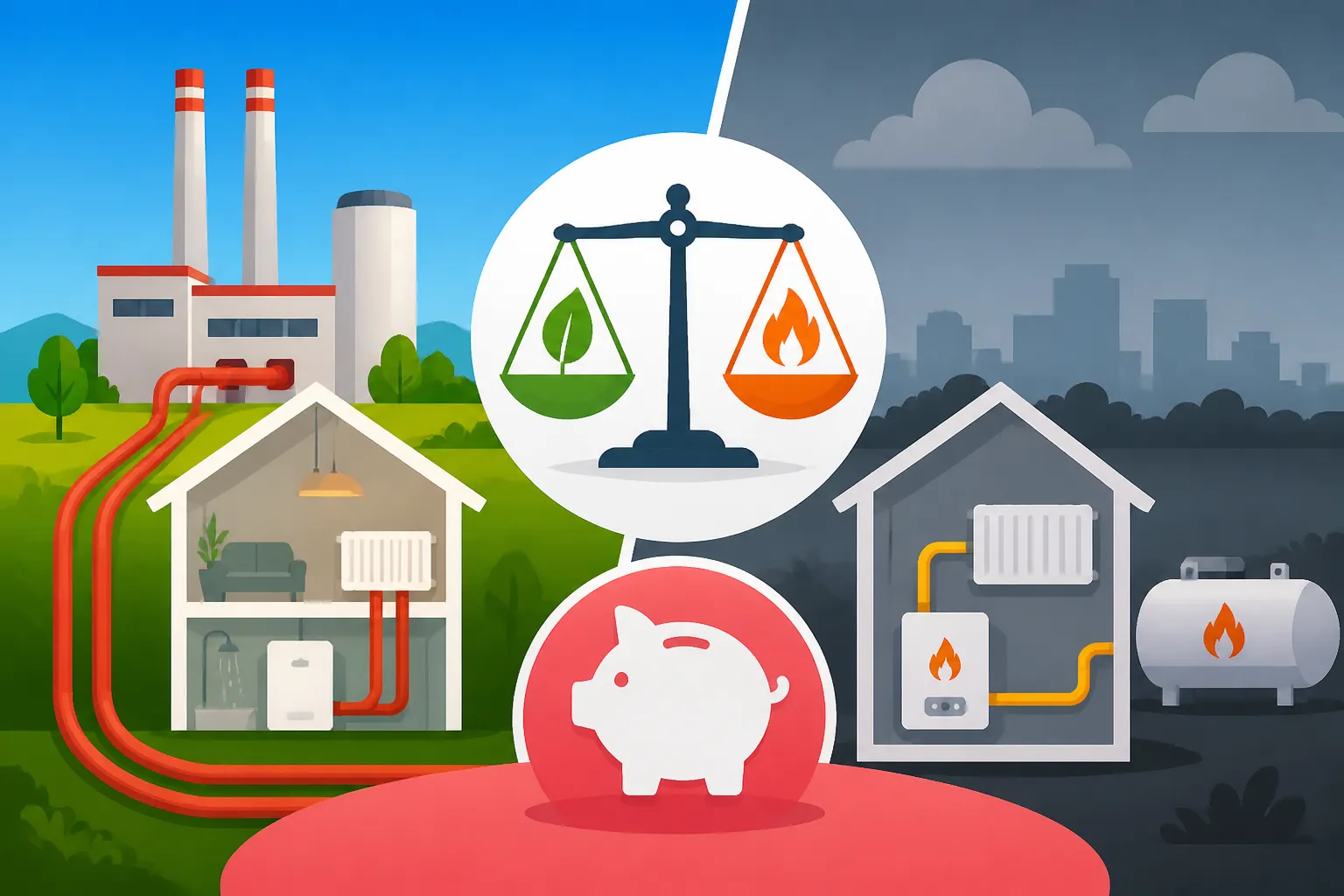
The Gasetagenheizung is the traditional powerhouse of the Austrian Altbau. It refers to a system where each individual apartment has its own gas-powered boiler, usually mounted on a wall in the kitchen or bathroom. When you turn on your radiators or run a hot shower, that specific boiler ignites to heat the water just for your unit. From a veteran expat's perspective, this system offers the most control but also the most responsibility. You are the one who decides exactly when the heat goes on and off, but you are also the one responsible for the mechanical health of the unit.
Living with a gas boiler means you are intimately involved with your energy provider. You will have a gas meter somewhere in your hallway or apartment, and your bills are directly tied to the cubic meters of gas you burn. In older buildings, these systems can be surprisingly efficient if the boiler is modern, but they can also be total "energy vampires" if the unit is twenty years old and struggling to maintain pressure. I have lived in apartments where the gas boiler felt like a temperamental roommate that required constant shushing and expensive annual checkups.
The Rise of Fernwärme District Heating
Fernwärme, or district heating, is the "set it and forget it" option that many expats pray for. Instead of a boiler in your apartment, the heat is generated at a massive central plant—often using waste incineration, biomass, or geothermal energy—and pumped through a network of highly insulated underground pipes directly into your building. Within your apartment, you simply have a heat exchanger or a series of valves. There is no flame, no carbon monoxide risk, and no mechanical roaring in your ear while you try to cook dinner.
This system is becoming the standard for Neubau (new build) projects across Austria. It is generally considered more environmentally friendly because it utilizes industrial waste heat that would otherwise be lost. For residents, it feels more like a public utility, similar to water. You turn the dial on the radiator, and the heat is just there, provided by the city network. In my experience, Fernwärme offers a much more consistent ambient temperature, though it sometimes lacks the "blast of heat" feeling that a gas radiator provides during a sudden January cold snap.
Government Phasing and Climate Goals
It is crucial to know that Austria is currently in the middle of a massive energy transition. The government has set ambitious goals to phase out fossil fuel heating in favor of renewable sources. This means that if you are looking at a building with an old gas system, there is a high probability that the landlord or the Hausverwaltung is already discussing a long-term plan to switch to Fernwärme or heat pumps. This transition is part of the broader Austria Healthcare System 2027: Complete Guide for Foreign Residents effort to improve urban living standards and sustainability.
For a tenant, this transition can be a double-edged sword. While a modern system is more efficient, the construction phase can be noisy and disruptive. However, the legal framework in Austria increasingly favors these upgrades. If you are choosing between two apartments and one already has Fernwärme, you are likely looking at a more future-proof home. Understanding Altbau vs Neubau: Differences in Rent, Charm, and Heating is essential here, as the type of building almost always dictates which heating system you will be using for the duration of your lease.
Comparing the Costs Fernwärme vs Gas
The big question every expat asks is: "Which one is cheaper?" The answer, frustratingly, is "it depends," but we can break down the price structures to give you a clearer picture. Heating costs in Austria aren't just about the fuel; they include base fees, delivery charges, and taxes that can often make up 50% of your total bill.
Monthly Base Fees and Consumption Rates
Gas billing is usually split into a "Grundpreis" (base price) and a "Arbeitspreis" (consumption price per kWh). Because you have your own meter, you only pay for what you use. If you go on vacation for a month and turn the boiler to the "frost protection" setting, your consumption bill will be nearly zero. This makes gas a popular choice for people who are frequently away or who are very disciplined about their thermostat settings. However, gas prices are subject to global market volatility, which we have all seen fluctuate wildly in recent years.
Fernwärme, on the other hand, often has a more complex pricing structure. It usually includes a base fee based on the size of your apartment (square meters) and a connected load fee, alongside your actual consumption. This means even if you use zero heat, you will still have a significant monthly bill. In many cases, the "fixed" portion of a Fernwärme bill is higher than that of gas, but the "variable" portion can be more stable. When you are looking at the Cost of Living in Vienna: Singles vs Families, you must account for these fixed utility costs that don't scale down even if you are a frugal energy user.
Maintenance and Service Costs Thermenwartung
This is the hidden "gotcha" of gas heating that ruins many an expat's budget in their first year. If you have a gas boiler, you are legally required to have a professional "Thermenwartung" (boiler service) performed every year or every two years, depending on your contract. This usually costs between 150 and 250 Euros. If you skip this, and the boiler breaks, the landlord can legally hold you responsible for the multi-thousand-Euro repair bill.
With Fernwärme, this cost simply does not exist for the tenant. The maintenance of the central plant and the heat exchangers is the responsibility of the provider (like Wien Energie or Salzburg AG) and the building owner. It is built into the service charges of the building. When you are doing your Utility Setup: Electricity, Gas, Water, and Internet, the lack of an annual 200-Euro maintenance fee makes Fernwärme significantly more attractive for those who prefer a predictable, all-inclusive monthly expense. It removes one more administrative headache from your "to-do" list in Austria.
The Dreaded Nachzahlung Annual Adjustment
In Austria, you don't pay your actual usage every month. Instead, the utility company estimates your annual usage and divides it into equal monthly "Teilbeträge" (installments). Once a year, someone (or an automated system) reads your meter, and you receive an "Abrechnung." If you used more than estimated, you get a "Nachzahlung"—a bill for the difference that must be paid immediately. If you used less, you get a credit.
Gas Nachzahlungs can be brutal because of how much heat escapes through old Altbau windows. Expats are sometimes hit with 800-Euro bills in April because they didn't realize their "Teilbetrag" was set too low by the previous tenant. Fernwärme adjustments tend to be less volatile because the provider has better data on the building's overall performance, but they can still happen. To avoid this, you should check your Lohnzettel Breakdown: Gross vs Net Salary Explained to ensure you are setting aside enough "emergency" money for these year-end utility stings.
| Feature | Gas (Gasetagenheizung) | District Heating (Fernwärme) |
|---|---|---|
| Control | Individual (High) | Centralized (Medium) |
| Maintenance | Annual service required (150-250 EUR) | Included in utility fees |
| Space | Requires a boiler unit in-home | Small heat exchanger or nothing |
| Price Stability | Volatile (Market-dependent) | More stable (Regulated) |
| Safety | Risk of Carbon Monoxide | Extremely safe |
| Billing | Individual meter | Often based on sq. meters + usage |
Operational Differences and Lifestyle Impact
Beyond the Euro signs, the way these systems actually function will change how you live in your apartment. From the noise of the machinery to the way the air feels on a cold February morning, the "vibe" of your home is deeply tied to its heat source.
Space and Safety Considerations
The most obvious impact of a gas boiler is physical. In many Viennese apartments, the "Therme" is a bulky white box taking up valuable wall space in the kitchen or bathroom. It requires a flue or chimney connection, which limits where you can place furniture or cabinets. More importantly, because it involves burning gas, there is a non-zero risk of carbon monoxide poisoning if the unit is faulty or if the apartment isn't properly ventilated. This is why the "Rauchfangkehrer" (chimney sweep) is a regular visitor in Austrian life—they are there to ensure you aren't being poisoned by your own heater.
Fernwärme is essentially invisible. The pipes enter the apartment, often behind a small panel, and go straight to the radiators. You gain back that square meter of wall space, and you lose the constant background hum of the boiler. For families with small children or anyone with health anxieties, the safety profile of Fernwärme is a massive selling point. You never have to worry about a "gas smell" or whether you left the pilot light on. If you are still in your first month of arrival, refer to the Healthcare Checklist for Your First 30 Days in Austria to make sure you have your local emergency numbers saved, just in case you ever do encounter a gas-related issue.
Reliability and Infrastructure
Gas boilers are mechanical devices with moving parts, sensors, and pumps. They can, and do, break down. Usually, this happens on the coldest Saturday of the year when every plumber in the city is already booked. Being without heat and hot water for 48 hours while waiting for a spare part is a miserable experience. If you are in this situation, knowing how to find After-Hours Medical Care: Weekend Clinics and Night Doctors might actually be relevant if the cold starts affecting your health, especially for the elderly or infants.
Fernwärme is incredibly reliable. Because the heat is generated on an industrial scale with multiple redundancies, total outages are extremely rare. Even if one plant has an issue, the network can often draw heat from another part of the grid. If your radiators are cold in a Fernwärme building, it is usually a building-wide plumbing issue rather than a failure of the heat source itself. This peace of mind is one reason why Fernwärme is the "gold standard" for Vienna Neighborhood Guide: Best Districts for Expats who are looking for high-end, low-maintenance rentals.
Control and Flexibility
Where gas wins is in pure, unadulterated control. If you like your bedroom at 16 degrees and your living room at 24, a gas system with a modern thermostat allows you to program exactly when the boiler fires up. You can set it to start 30 minutes before you wake up so the floors aren't freezing. You are the master of your own climate. For those working from home, this granular control can actually lead to lower costs if you only heat the room you are currently using.
Fernwärme can sometimes feel a bit "sluggish." Because the heat is provided by a large circulating loop of water, it can take longer for a room to heat up from scratch. Additionally, some older Fernwärme buildings have "central" controls where the building management decides when the system switches from "summer mode" to "winter mode." I have lived in buildings where a sudden cold snap in late September left everyone shivering because the Hausverwaltung hadn't "turned on the heat" for the building yet. Checking the Quiet Hours (Ruhezeit) and Apartment Neighbor Etiquette is also useful, as clanking pipes in older systems can sometimes be a point of contention between neighbors.
Administrative and Legal Realities for Expats
Navigating the paperwork for Austrian utilities is a hurdle that requires a lot of "Behörden-Deutsch" (official German) and patience. Whether you are dealing with a private gas contract or a building-wide heating fee, you need to know where your rights begin and your landlord’s end.
Who Pays for What Tenant vs Landlord
In a standard Austrian rental agreement (Mietvertrag), the tenant is responsible for the "Verbrauchskosten" (consumption costs). This includes the gas you burn or the heat you draw from the district network. However, the "Erhaltung" (maintenance) of the system is a common point of legal dispute. Under the Austrian Tenancy Act (MRG), the landlord is generally responsible for replacing a broken boiler, while the tenant is responsible for the annual maintenance (Thermenwartung).
If your gas boiler dies of old age, do not let your landlord tell you that you have to pay for the new one. Conversely, if the boiler dies because you never serviced it, you might be on the hook. With Fernwärme, the lines are much cleaner because there is no individual machinery to maintain. Most of the "fixed" costs are passed through the "Betriebskosten" (operating costs) which you pay as part of your monthly rent. Understanding these nuances is a key part of Renting in Austria: MRG Laws, Leases, and Bestellerprinzip. Always keep your service receipts in a safe place—they are your legal shield.
Setting Up Your Account
For gas, you must usually register with a provider like Wien Energie, EVN, or a private green energy company the day you get your keys. You will need the "Zählernummer" (meter number) and the current reading. This is a separate contract from your electricity. If you forget to do this, the previous tenant's account will close, and the "Netzbetreiber" (network operator) might eventually come to "cut the seal," leaving you in the dark and cold.
For Fernwärme, the process is often automated. Because the heat is tied to the building's infrastructure, the Hausverwaltung often handles the registration, and the costs are simply added to your monthly "Vorschreibung" (rent bill). However, in some modern apartments, you still have an individual contract with the district heating provider. It is vital to ask during your apartment viewing: "Is heating included in the Betriebskosten, or do I have a separate contract?" This question alone can save you from a Financial Comparison: Renting vs Buying Property in Austria error where you underestimate your monthly outgoings by 150 Euros.
Understanding Your Heating Bill
Austrian heating bills are notoriously difficult to read. They are filled with terms like "Grundanteil," "Verbrauchsanteil," and "Messpreis." The "Grundanteil" is the portion of the building's total heating bill that is split among all tenants based on the size of their apartments, regardless of how much heat they personally used. The "Verbrauchsanteil" is based on the little digital meters attached to your individual radiators (Verdunster or electronic meters).
If you live in a building with very poor insulation, you might end up paying a high "Grundanteil" even if you never turn your heat on, simply because the building as a whole is burning a lot of energy to keep the pipes warm. This is why newcomers are advised to look at the "Energieausweis" (Energy Performance Certificate) before signing a lease. A building with a "Class A" rating will have much lower base heating costs than a drafty "Class F" Altbau. If your bills seem suspiciously high, you can always seek advice from the Arbeiterkammer, Contracts, and Leave experts, as they offer free legal consultations for tenants.
Strategies for Reducing Heating Expenses
Regardless of which system you have, winter in the Alps is long. If you don't want your heating bill to compete with your rent, you need to adopt the "Austrian way" of managing your home environment.
Modern Insulation and Apartment Selection
The best way to save on heating is to live in a "Passivhaus" or a modern Neubau with thick exterior insulation. In these apartments, you barely need to turn the heat on at all because the residual heat from the sun and your appliances stays trapped inside. If you are stuck in a charming Altbau with 3-meter ceilings, your best friend is the "Dichtungsband" (weather stripping). Applying these adhesive foam strips to your window frames can reduce heat loss by up to 20% for a cost of about 10 Euros.
Another "pro tip" is to pay attention to which floor you are on. Ground floor apartments (Erdgeschoss) are notoriously expensive to heat because they sit above cold cellars. Top floor apartments (Dachgeschoss) can also be pricey if the roof isn't well-insulated. The "sweet spot" is usually the 2nd or 3rd floor, where you are sandwiched between other heated apartments. This "passive heating" from your neighbors is a legal and free way to keep your Budgeting in Austria: Accurate Cost of Living Benchmarks in check.
Smart Heating Habits and Technology
Austrians are masters of "Stoßlüften"—the art of opening all your windows wide for 5 minutes and then snapping them shut. This replaces the stale air without cooling down the massive brick walls of the building. Leaving a window "on tilt" (kippen) all day is the fastest way to flush money down the drain. It cools the walls, and your heater will have to work quadruple-time to bring the room back to temperature.
If you have a gas boiler, consider investing in a smart thermostat like Tado or Nest, provided it is compatible with your boiler model (check with your landlord first!). These can learn your schedule and turn the heat down when you aren't home. Even with Fernwärme, you can buy smart radiator valves that let you control each room individually from your phone. Just remember that if you are away for a long time, you must keep the heat at a minimum level (usually around 12-15 degrees) to prevent pipes from freezing and Preventing Mold (Schimmel) in Old Altbau Apartments, which is a nightmare to deal with and can cost you your security deposit.
The Role of the Hausverwaltung
If your radiators aren't getting hot despite being turned up to "5," or if they are making a loud gurgling noise, you need to "bleed" them. This involves using a small metal key to let out trapped air. If that doesn't work, the issue might be with the building's central pump. In such cases, the Hausverwaltung (property management) is your primary contact. They are responsible for ensuring the central infrastructure is working.
Be persistent with them. In Austria, the "squeaky wheel gets the grease." If you are having trouble communicating, using Medical Translation Services: Interpreters for Hospital Visits as a reference for finding translation help might be extreme, but having a German-speaking friend call the Hausverwaltung on your behalf often yields much faster results. Always keep a log of the temperatures in your rooms if you intend to file a formal complaint or request a rent reduction for a lack of heating.
Disclaimer
This guide is intended for informational purposes only and does not constitute legal or financial advice. Energy prices, government regulations, and tenancy laws in Austria are subject to change. Always consult with your energy provider, your landlord, or a qualified legal professional such as the Mietervereinigung (Tenants' Association) or the Arbeiterkammer before making decisions regarding your utility contracts or rental agreements.