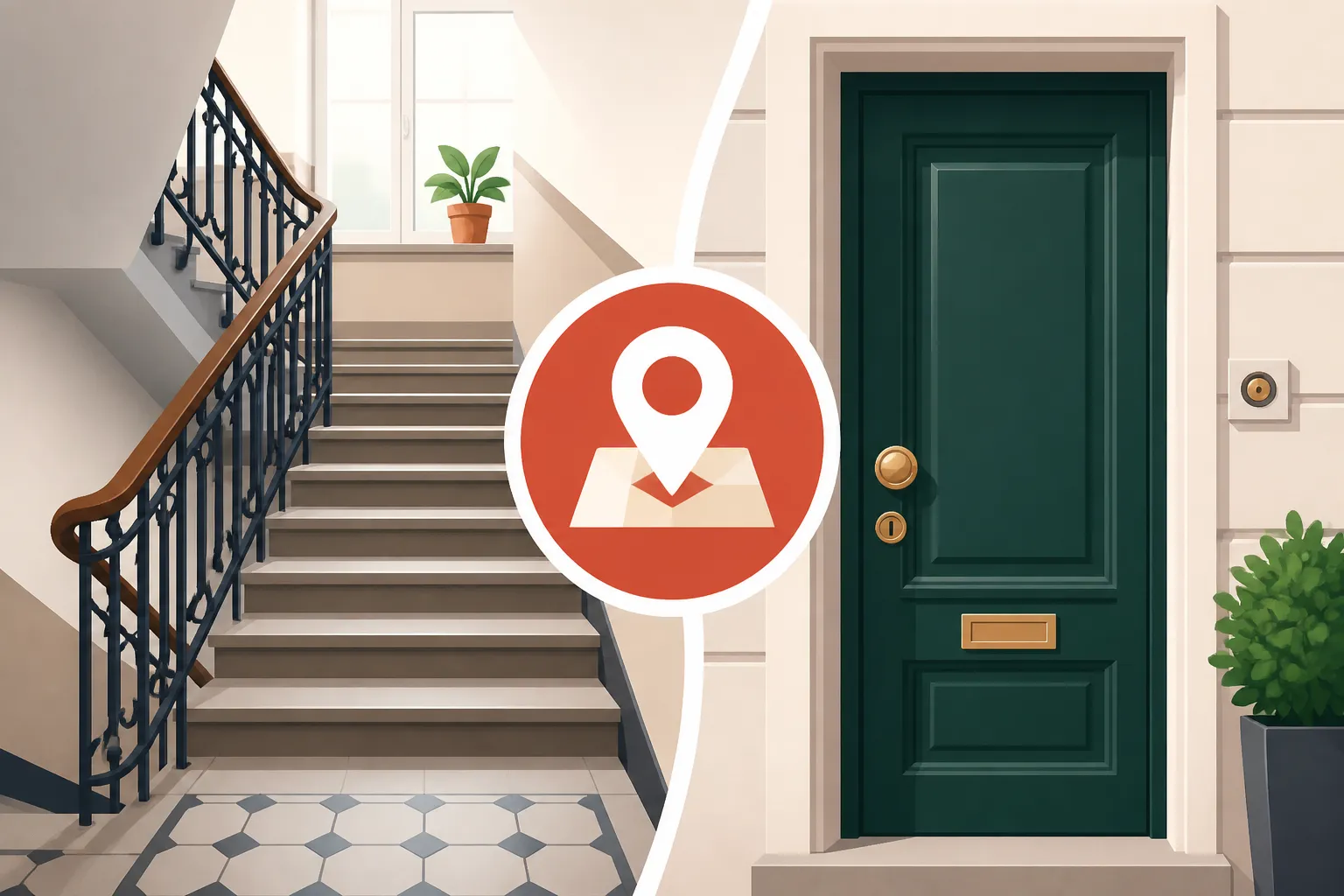
Austrian Address System: Staircases (Stiege) and Door Numbers
Standing in a courtyard with four identical-looking doors, clutching a delivery bag while a neighbor's dog barks at you from a balcony, is the ultimate welcome to Austria moment. I spent my first three weeks in Vienna accidentally giving my address without the staircase number, wondering why my Amazon packages were disappearing into the void. This guide will decode the Austrian address system—from the Stiege to the Tür—ensuring you actually get your mail and your guests find your door.
The Anatomy of an Austrian Address
Understanding the specific components of an Austrian address is the first step toward administrative literacy. Unlike the relatively straightforward "House Number, Street, City" format used in many Anglo-Saxon countries, the Austrian system is hierarchical and highly granular. It reflects the architectural history of the country, particularly in cities where massive apartment blocks (Zinshäuser) were designed with multiple internal sections. When you are Renting in Austria: MRG Laws, Leases, and Bestellerprinzip, your contract will list your address with surgical precision, and it is vital that you replicate this exactly on every form you sign.
Street Names and House Numbers
The first part of the address is the street name (Straße, Gasse, or Platz), followed immediately by the house number. In Austria, the house number refers to the entire building complex, not necessarily a single entrance. For example, "Musterstraße 10" might be a single-family home in the suburbs, but in Vienna or Graz, it is more likely a massive stone building with dozens of apartments inside.
The house number is the foundational anchor for your location. When you are looking for a property, keep in mind that even-numbered houses are usually on one side of the street and odd numbers on the other, though the numbering can sometimes take unexpected turns in older, winding districts. If you are exploring the Vienna Neighborhood Guide: Best Districts for Expats, you will find that the house number is often the only thing visible from the sidewalk, while the subsequent details are tucked away inside the foyer or courtyard.
The Staircase or Stiege
The Stiege (staircase) is perhaps the most confusing element for newcomers. In larger Austrian apartment complexes, one street address can house hundreds of people. To manage this, buildings are divided into staircases. If your address is "Musterstraße 10/2," the "/2" indicates you are at Staircase 2. These are not always logically placed; Stiege 1 might be at the front, while Stiege 2 and 3 are located in a rear courtyard (Hof) accessible only through a narrow tunnel or "Durchgang."
I remember the frustration of my first winter here, trying to find a friend's house for a dinner party. I found the house number, but I didn't realize that Stiege 4 was actually located behind a heavy wooden door that looked like a utility closet. I spent fifteen minutes pacing the sidewalk until a kindly neighbor pointed me through the "Zweite Hof" (second courtyard). Always check for the Stiege number on the intercom (Gegensprechanlage) at the main entrance; it is your map to the internal layout of the building.
Door Numbers or Tür
The final piece of the puzzle is the Tür (door) number, often abbreviated as "T" or "Top." This is the specific number on your apartment door. An address usually looks like this: Musterstraße 10/2/15. This translates to House Number 10, Staircase 2, Door 15. If you omit any of these numbers, the postal service will struggle to deliver your mail, and you may find yourself searching for a Missed a Post.at Delivery? Where to Find Your Yellow Slip on the communal noticeboard instead of getting your package at your door.
In modern buildings or commercial settings, you might see the word "Top" instead of "Tür." This is effectively the same thing, though "Top" is frequently used when referring to office units or high-end modern developments. When you are Finding a Shared Room (WG) via WG-Gesucht.de, make sure the person listing the room gives you all three numbers, or you will be left buzzing every button on the intercom hoping for the best.
Navigating the Physical Building
Once you understand the numbers on paper, you have to find them in the real world. Austrian architecture, especially the "Altbau" (old construction) style, is famous for its "hidden" geography. You might enter a building through a magnificent, vaulted lobby only to find that the staircase you need requires you to walk through three different courtyards, past a row of bicycles, and up a tiny, ancient elevator.
Courtyards and Multiple Entrances
Many buildings in Austrian city centers are designed around a series of courtyards (Höfe). This was originally done to provide light and air to internal rooms. Consequently, an address might not be accessible from the street. If you see a sign that says "Stiege 3-6," you will likely have to pass through a gate or a "Durchhaus" to find them.
This is particularly common in social housing projects like the famous Gemeindebau complexes in Vienna. These are often like small cities within themselves. When you are Moving to Austria with Family: Schools and Logistics, you might choose one of these areas for the communal green spaces, but be prepared to guide your delivery drivers via phone the first few times. They will often call you from the street, confused by the labyrinth of "Stiege" entrances.
Floor Numbering: Stock vs Etage
The floor numbering in Austria follows the European standard but with a few local quirks. The ground floor is called the Erdgeschoss (EG). The floor above it is the 1. Stock (First Floor). This is a common point of confusion for Americans, who would call the ground floor the first floor. However, it gets more complicated in older buildings that feature a Mezzanin or a Hochparterre.
A Mezzanin is a "half-floor" located between the ground floor and the first floor, often with lower ceilings. A Hochparterre is a ground floor that is elevated slightly above street level to prevent pedestrians from looking directly into your windows. If you live on the "1. Stock" of an Altbau with both a Hochparterre and a Mezzanin, you are actually three flights of stairs up from the street. This is vital to remember if you are Finding Medical Care: Clinics, Hospitals, and Referrals, as some older clinics may be on higher floors without a modern elevator.
Finding the Intercom and Nameplates
In Austria, nameplates (Namenschilder) are legally and culturally significant. Most intercom systems at the main building entrance will list the inhabitants' last names alongside the door number. If your name is not on the bell, people won't be able to find you. This is a common hurdle for sub-letters or people in shared flats.
When you move in, one of your first tasks should be ensuring your name is correctly displayed on the "Gegensprechanlage." In some buildings, the Hausbesorger (caretaker) handles this; in others, you must do it yourself. This is also true for your mailbox. If the postman doesn't see your name on the box, they are technically allowed to return the mail to the sender as "undeliverable," even if the door number is correct.
| Address Component | Austrian Term | Example | Usage Tip |
|---|---|---|---|
| Street Name | Straße / Gasse | Mariahilfer Straße | Always includes the street type. |
| House Number | Hausnummer | 10 | The main building entrance. |
| Staircase | Stiege | 2 | Crucial for large complexes. |
| Floor | Stock / Etage | 1. Stock | Remember: EG is Ground Floor. |
| Door Number | Tür / Top | 15 | Your specific apartment number. |
| Postal Code | Postleitzahl (PLZ) | 1070 | First digit is the region; middle two are districts. |
Official Requirements and Registration
The precision of your address isn't just for the convenience of your friends; it is a legal requirement. Austria maintains a central residents' register (ZMR), and every person living in the country must be registered at a specific address. If your registration is inaccurate by even a single digit, it can cause a domino effect of bureaucratic headaches.
The Meldezettel Connection
The "Meldezettel" is the form you use to register your address at the Meldeamt (registration office). This must be done within three days of moving into a new residence. On this form, you must provide the exact Stiege and Tür. If you just write "Hauptstraße 5," the clerk will likely ask you for the specific door number. You cannot leave this blank.
This registration is the "key" to your life in Austria. You need it to open a bank account, get an e-card, or apply for a residence permit. Newcomers sometimes accidentally swap the Stiege and Tür numbers on their initial registration. Such a mistake can take months to fix, because an insurance company may be unable to verify the address against the central database. For a smooth transition, follow the steps in The Meldezettel Process: Registering Your Address Legally carefully.
Formatting for Mail and Packages
When ordering items online or giving your address to family abroad, there is a specific way to write it to ensure it clears the automated sorting systems at the Post. The standard format is:
Name
Street Name House Number / Staircase / Door
Postal Code City
AUSTRIA
Example:
Max Mustermann
Mustergasse 12/4/22
1010 Wien
AUSTRIA
Using the slashes (/) is the standard shorthand for separating house, staircase, and door. If you are Correctly Formatting an Austrian Address for International Mail, avoid adding extra words like "Apartment" or "Unit," as these can sometimes confuse the local sorting machines which are optimized for the numeric slash format.
Digital Address Verification and ID Austria
Many administrative tasks have moved online. Using "ID Austria," you can often update your address or pull an official residence certificate without visiting a government office. However, the system relies on the "Address GWR" (Building and Housing Register). If your building was recently renovated or split into new units, there might be a delay in the digital system recognizing your specific door number.
If you are Buying Property in Austria as a Foreigner: Legal Process, your notary will ensure the property is correctly registered in the Land Registry (Grundbuch). This registration is what the post office and the municipal authorities use as their "source of truth." If you find that websites don't recognize your address, it may be because it hasn't been updated in the GWR yet, a common issue with brand-new "Neubau" developments.
Practical Tips for Daily Life
Beyond the paperwork, living with the Austrian address system requires a bit of practical strategy. Whether you are ordering pizza or calling a plumber, being able to describe your location clearly will save you a lot of time and frustration.
Directing Delivery Drivers and Guests
When you invite people over, don't just send them the Google Maps pin. Give them "the code." A helpful text would look like: "Hey, it's Street 10, Staircase 2 (it's the second courtyard on the left), Door 15. The name on the bell is 'Mustermann'."
This is especially important for Comparing Grocery Prices: Billa vs Spar vs Hofer delivery services. These drivers are often on a very tight schedule. If they have to wander around a dark courtyard looking for "Stiege 3," they might get frustrated and leave your groceries at the main gate. A little extra detail goes a long way in ensuring your frozen goods actually make it to your freezer.
Emergency Services and Clarity
In an emergency, every second counts. If you have to call 144 (Ambulance), the dispatcher will need your exact address. They are trained to handle the Stiege/Tür system, but in a moment of panic, it is easy to forget. I recommend writing your full address (including staircase and door) on a piece of paper and sticking it to your fridge or near your front door.
This ensures that anyone in the house—even a guest or a babysitter who doesn't live there—can relay the exact location to emergency responders. This is a small but vital part of Moving to Austria with Family: Schools and Logistics. If you have young children, teach them not just the street name, but the "three numbers" that lead to their home.
Labeling Your Mailbox (Briefkasten)
Your mailbox is your primary link to the Austrian state. Fines, insurance cards, and official notices all arrive via physical mail. In many apartment buildings, the mailboxes are located in the foyer, grouped by Stiege. Ensure your mailbox is clearly labeled with:
- Your Last Name
- Your Door Number (Tür)
- If applicable, the name of your co-habitants.
If you are expecting an important document, such as your residency card or a bank statement, and your name isn't on the box, the postman is required to take it back to the branch. You will then have to go to the post office with your ID to claim it, which is an unnecessary chore. Proper labeling is the simplest way to avoid the dreaded "receiver unknown" return-to-sender status.
Cultural Nuances and Historical Context
The address system isn't just about logistics; it’s a reflection of how Austrian society has organized its living spaces for centuries. From the imperial grandeur of the Ringstraße to the functionalism of the post-war era, the way buildings are numbered tells a story.
Altbau vs Neubau Numbering
In an "Altbau" (pre-war building), the numbering can be quite chaotic. You might find "Door 1" next to "Door 20" because the apartments were subdivided or merged over the last century. Sometimes, the "Stiege" refers to a grand marble staircase, while "Stiege 2" is a tiny, hidden service stair once used by domestic staff.
In a "Neubau" (modern construction), the numbering is usually much more logical, often following a floor-based system (e.g., Door 101 on the first floor, 201 on the second). However, the "Stiege" concept still exists in modern complexes to break up the "communal" feel and provide more private entrances. Whether you prefer the charm of high ceilings or the logic of modern plumbing, you will have to master the address system regardless.
The Role of the Zählsprengel
For the data nerds among us, the address system also includes a hidden layer called the "Zählsprengel." This is a statistical district used for census data and urban planning. While you will never need this for a dinner party, you might see it on highly technical government documents. It’s just another example of how Austria loves to categorize and sub-categorize its geography.
Understanding the Vienna Neighborhood Guide: Best Districts for Expats helps you realize that while the city is divided into 23 districts, the real life happens at the "Grätzel" level—the immediate neighborhood around your Stiege. Each Grätzel has its own vibe, and your specific address is your entry ticket into that micro-community.
Disclaimer
The information provided in this guide is for general informational purposes only and does not constitute legal or professional advice. While we strive to keep the details accurate and up-to-date for 2026, Austrian administrative rules and regional variations can change. Always verify specific address requirements with your local Meldeamt or legal advisor.