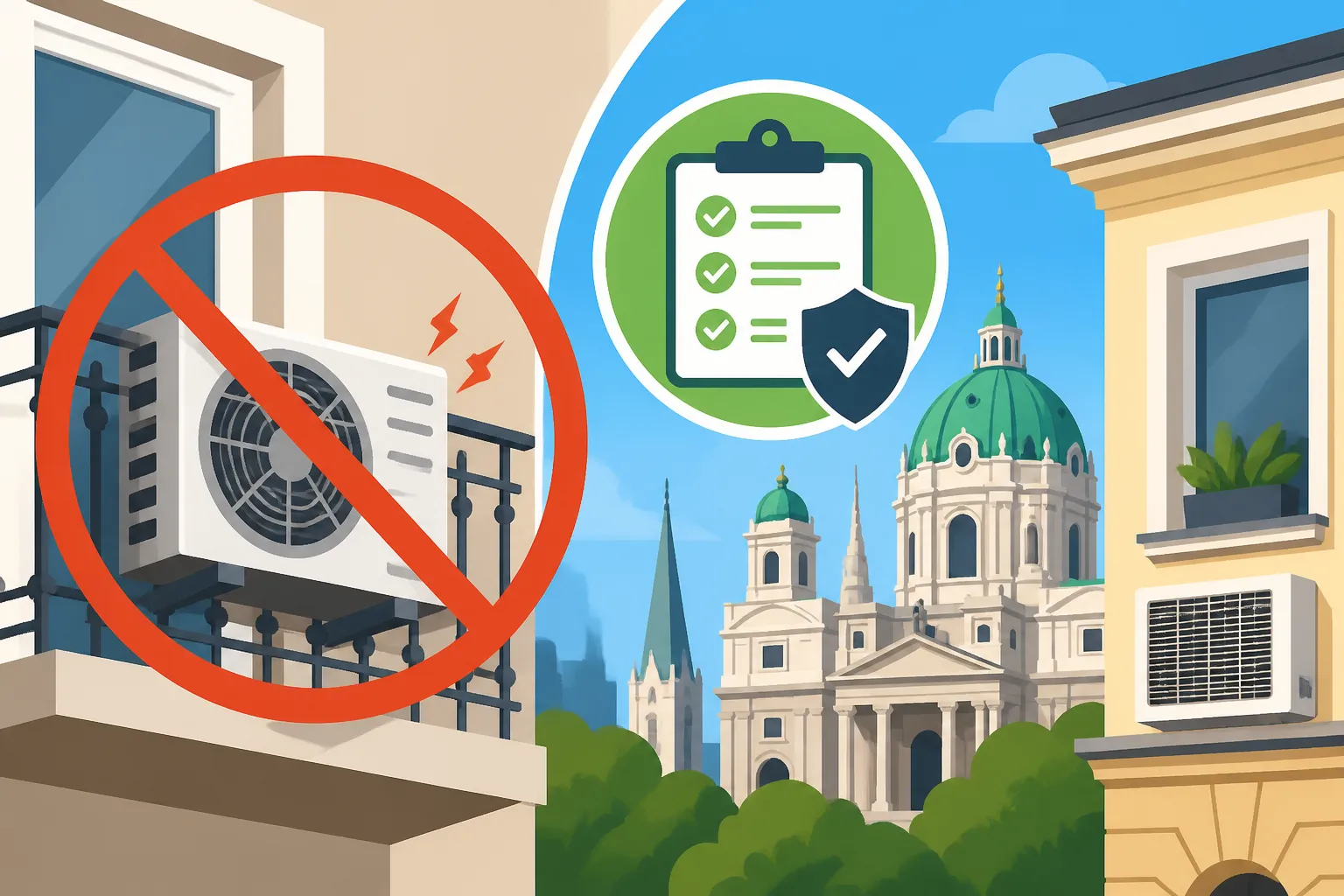
Air Conditioning Rules in Vienna: Balcony Unit Restrictions
Waking up at 3 AM in a puddle of sweat while your bedroom wall radiates heat like a pizza oven is a rite of passage for many expats in Vienna. I remember my first summer in a top-floor flat in the 7th district, where the thermometer hit 36 degrees and stayed there for a week; I felt utterly trapped by the heat and the bureaucracy. This guide solves the confusion around Air Conditioning rules in Vienna, specifically focusing on the complex web of balcony unit restrictions and how to navigate them legally.
The Reality of Summer in Vienna and the Need for Cooling
The Viennese summer has changed significantly over the last decade. What used to be a few weeks of "pleasant warmth" has transformed into prolonged heatwaves where the city’s concrete and brick architecture acts as a massive thermal battery. If you are living in an Altbau vs Neubau: Differences in Rent, Charm, and Heating, you already know that these historic buildings are magnificent at keeping heat in during the winter but become absolute ovens once the walls soak up the July sun. Unlike modern buildings in Southern Europe or North America, most Viennese apartments were never designed for active cooling.
The primary hurdle for any expat wanting to install a split-unit AC is that you are technically altering the "outer appearance" of the building. In Vienna, this is not just a suggestion; it is a strictly regulated legal matter. The city places a high value on its aesthetic heritage and historical facade. Even if your balcony faces an inner courtyard (Innenhof), the rules remain surprisingly rigid. Before you even look at price tags for a Daikin or Mitsubishi unit, you must understand that the legal framework for Renting in Austria: MRG Laws, Leases, and Bestellerprinzip heavily favors the preservation of the building's integrity over the tenant's thermal comfort.
Furthermore, the noise factor is a major point of contention. Vienna is a city of quiet courtyards. A humming external compressor can echo between the walls of a "Hof," turning a minor convenience for you into a major nuisance for your neighbors. This is why the City of Vienna (Magistrat 37) and the building management (Hausverwaltung) are so protective of the status quo. If you install a unit without the proper permissions, you aren't just risking a fine; you could be legally compelled to remove the unit at your own expense and restore the wall to its original state within days.
Navigating Balcony AC Rules: What is Allowed
When we talk about "balcony unit restrictions," we are usually referring to the external compressor of a split-system air conditioner. This is the part that sits outside and does the heavy lifting. In Vienna, having a balcony does not give you carte blanche to put whatever you want on it. The rules vary depending on whether the unit is visible from the street, how much noise it produces, and whether you own or rent the apartment.
External vs. Internal Units
A "split-unit" consists of an indoor blower and an outdoor compressor connected by refrigerant lines. To install this, a hole must be drilled through the exterior wall. This hole is considered a structural intervention. If you are looking for a solution that requires zero permits, you are limited to portable monoblock units. These are the ones with a thick hose that you stick out of a window. While they are loud and inefficient, they don't require building authority approval. However, for a permanent, quiet, and effective solution, you must face the split-unit regulations.
The Balcony Restrictions: Visual and Noise Impacts
The "Ma 37" (Building Inspection) generally prohibits any external units that are visible from the public street. If your balcony is on the facade of a protected historic building, getting approval is nearly impossible unless the unit can be completely hidden behind a decorative screen that matches the architecture. Even on balconies facing the back of the building, the unit must often be placed on the floor of the balcony rather than mounted high on the wall to minimize visual impact.
Noise is the second "killer" of AC dreams. The local Quiet Hours (Ruhezeit) and Apartment Neighbor Etiquette are taken very seriously. An external AC unit must not exceed specific decibel levels at the boundary of your neighbor’s open window. In many quiet residential districts, this limit is so low that only the most expensive, ultra-quiet modern units stand a chance of being approved. You will often be required to provide a technical data sheet from the manufacturer proving the noise levels before the building management even considers your request.
| Feature | Portable Monoblock | Split-Unit (Balcony) | Multisplit (Whole Home) |
|---|---|---|---|
| Approval Needed | No | Yes (High Complexity) | Yes (Very High Complexity) |
| Cooling Efficiency | Low | High | Very High |
| Noise (Indoor) | High | Very Low | Very Low |
| Typical Cost | €300 – €800 | €2,500 – €5,000 | €7,000+ |
| Structural Changes | None | Core drilling required | Significant drilling/piping |
Step-by-Step Guide to Getting Approval for a Balcony Split-Unit
If you’ve decided that you can’t survive another summer without real AC, you need a strategy. Do not buy the unit first. The process in Vienna is slow, often taking three to six months from initial request to installation. Many expats lose their security deposits or face lawsuits because they assumed "it’s my balcony, I can do what I want."
Getting the Landlord's Written Consent
The first step is always the landlord. If you are renting, you have no legal standing to apply for building permits without the owner's explicit written permission. Most landlords are hesitant because they fear liability for water damage (condensate leaks) or noise complaints. To win them over, offer to use a certified Austrian installation company and prove that you have Personal Liability Insurance (Privathaftpflicht): A Must-Have that covers "Mietersachschäden" (damage to rented property). You should also check your Household Insurance (Haushaltsversicherung) Explained policy to see if it covers the external unit against storm damage or theft.
The Neighbor Consensus Rule
In a "Wohnungseigentum" (condominium) building where apartments are owned by different people, you often need the "Einstimmigkeit" (unanimous consent) of all owners in the building to make a change to the facade. This is the hardest hurdle. If one person in a 20-unit building says no because they dislike the look of AC units, your project is effectively dead. However, recent changes in Austrian law have made it slightly easier to bypass a "no" if you can prove the AC is a basic necessity for health reasons (e.g., extreme heat in a top-floor flat), but this usually requires a lawyer and a trip to court. Having Legal Protection Insurance (Rechtsschutzversicherung) Overview can be a lifesaver here if you need to challenge a stubborn neighbor.
Dealing with the Building Authority (MA 37)
Once you have the landlord and the neighbors on board, you (or your technician) must submit a "Bauanzeige" or apply for a "Baubewilligung" depending on the district and the unit's size. You will need:
- A site plan showing where the unit will sit on the balcony.
- A photo-montage of what the facade will look like after installation.
- Technical specifications regarding noise (Schallschutznachweis).
- A plan for the condensate water drainage (it cannot simply drip onto the street or the neighbor below).
Alternatives and Compromises When You Can't Install a Split Unit
If the MA 37 or your landlord says a firm "Nein" to a balcony split-unit, don't give up. There are several ways to lower the temperature without breaking the law or your lease agreement. While they aren't as powerful as a dedicated AC, they can make the difference between sleeping and suffering.
Portable Monoblock Units: The No-Approval Path
As mentioned, these are legal because they are not "installed." To make them effective, you must buy a proper window sealing kit. If you just stick the hose through a cracked window, the hot air from outside will rush back in, negating the cooling. Note that these units will increase your Electricity Providers in Austria (Wien Energie, Verbund) bill significantly, as they are far less efficient than split-systems. Also, be mindful of Estimating Average Utility Costs (Electricity/Gas) in Winter and summer; AC can easily add €50–€100 per month to your bill during a heatwave.
External Blinds and Heat Protection Films
In Vienna, preventing heat from entering is often more effective than trying to remove it. Many landlords are much more open to approving "Außenrollläden" (external shutters) or "Markisen" (awnings) than AC units. External blinds can block up to 90% of solar heat before it even touches the glass. If you can't get external shutters, look into high-quality heat-rejection window films. These are clear or slightly tinted films applied to the glass that reflect infrared light. Just ensure they are removable so you don't run into issues when moving out.
Mastering the Art of Passive Cooling
Austrians are experts at Lüften: The Austrian Art of Ventilating Rooms in Winter, but they also have a summer version. The rule is simple: windows must be hermetically sealed and shaded from 8 AM to 9 PM. Only when the outside temperature drops below the inside temperature should you open everything to create a "Durchzug" (cross-breeze). This won't help during a "Tropennacht" (a night where it stays above 20 degrees), but it is the baseline for survival in a Viennese flat. Also, be careful with humidity; failing to ventilate properly at night can lead to stagnant air, which is a precursor to Preventing Mold (Schimmel) in Old Altbau Apartments.
Summary Checklist for AC Installation in Vienna
- Check your lease: Does it explicitly forbid structural changes?
- Talk to your neighbors: Would they object to a quiet unit on your balcony?
- Hire a professional: Find a "Kältetechniker" who understands Vienna’s specific MA 37 requirements.
- Get written consent: Do not rely on verbal "OKs" from a building manager.
- Consider the costs: Between the unit, the installation, the permits, and the electricity, a legal split-unit in Vienna is a €4,000+ investment.
Navigating the heat in Vienna is as much about understanding local law as it is about finding the right hardware. While the balcony unit restrictions are frustratingly strict, following the legal path ensures that your cool apartment remains a sanctuary rather than a source of legal stress.
Disclaimer
This article is provided for informational purposes only and does not constitute legal or professional advice. Building regulations (Bauordnung) in Vienna are subject to change, and rules may vary significantly between districts and specific building types. Always consult with a qualified legal professional and a certified HVAC technician before performing any structural modifications to your residence.