Household Insurance (Haushaltsversicherung) Explained
Imagine coming home to your beautiful Altbau apartment in Vienna's 7th district, only to find a burst pipe has turned your vintage parquet flooring into a swimming pool and ruined your expensive work laptop. I remember the panic I felt when a similar mishap happened to me years ago, realized I was woefully underinsured, and had to pay out of pocket for damages that weren't even my fault. This guide demystifies the world of Austrian household insurance, ensuring you protect your belongings and your bank account from the unexpected administrative and financial headaches of local living.
Understanding the Basics of Austrian Household Insurance
When you first move into a flat here, you will likely be overwhelmed by the sheer volume of paperwork, from The Meldezettel Process: Registering Your Address Legally to setting up your Utilities Setup: Electricity, Gas, Water, and Internet. Among these documents, you will almost certainly encounter a request for a Haushaltsversicherung. In its simplest form, this is insurance for the contents of your home. While the building owner usually has Gebäudeversicherung (building insurance) to cover the structure itself, that policy stops at your front door. Everything inside—your furniture, clothes, electronics, and even the glass in your windows—falls under your responsibility.
A common point of confusion for many new arrivals is exactly what constitutes "household contents." In the Austrian market, the general rule of thumb is that if you could turn your apartment upside down and shake it, everything that falls out is covered by your household insurance. This includes items in your cellar (Kellerabteil), provided they are properly locked away. However, it is vital to distinguish between your personal property and the fixed elements of the building. If you are Renting in Austria: MRG Laws, Leases, and Bestellerprinzip, you need to know that your landlord is responsible for the "bones" of the apartment, but you are responsible for the life you build inside it.
Furthermore, these policies are almost always packaged with a very specific and culturally significant component: private liability insurance. In Austria, the "I'm sorry" culture is backed by a "you broke it, you pay for it" legal reality. If you accidentally trip a cyclist while walking your dog or cause a leak that damages the neighbor's ceiling downstairs, you are personally liable for those costs. Your household insurance is the shield that prevents a simple mistake from becoming a financial catastrophe.
What Exactly Does Haushaltsversicherung Cover?
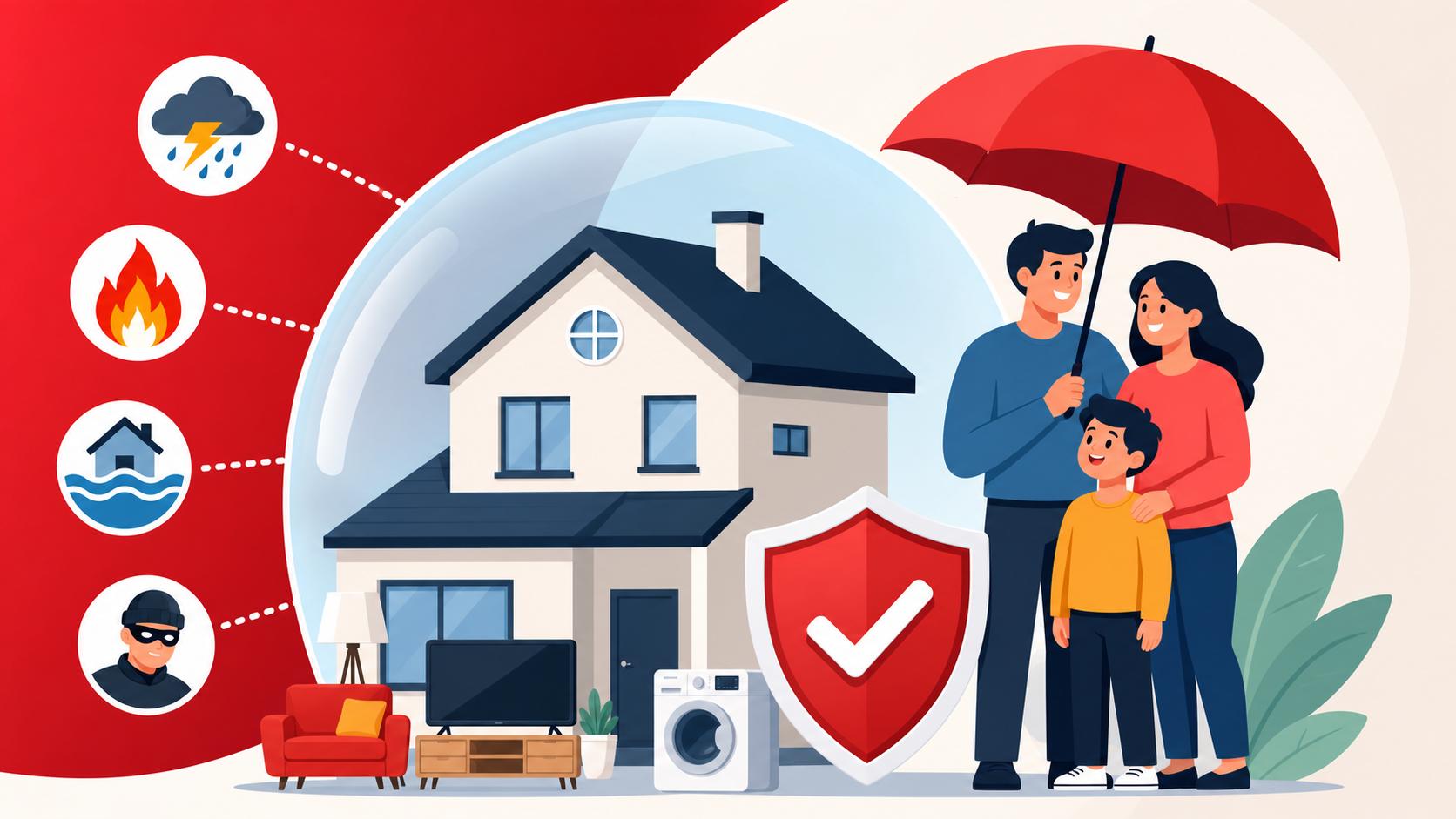
A standard policy in Austria is designed to protect you against a specific list of "perils." These usually include fire, lightning strikes, explosions, and damage from aircraft (rare, but always included). More commonly, you are looking at protection against "Leitungswasser" (tap water damage). This is a frequent issue in older buildings where pipes might be decades old. If a hose on your washing machine snaps while you are at work, the insurance covers the damage to your rugs and furniture, as well as the cost of the water lost.
Beyond fire and water, the policy covers "Einbruchdiebstahl" (burglary) and vandalism following a break-in. It is important to note the distinction here: simple theft (like someone grabbing your bag in a cafe) is often not covered unless you have a premium add-on, but if someone breaks into your locked apartment, you are protected. Many expats find it surprising that "Glasbruch" (glass breakage) is often a separate or highly specific module. This covers everything from your ceramic stovetop to large window panes and even mirrors.
Finally, most modern policies include coverage for "Sturm und Hagel" (storm and hail). While this might seem less relevant if you live on the third floor of a city apartment, it covers damage to items on your balcony or terrace. As climate patterns shift, heavy summer storms in cities like Graz or Vienna have become more frequent, making this coverage increasingly valuable for those with outdoor furniture or potted plants.
The Legal Requirement Myth: Is It Actually Mandatory?
Strictly speaking, there is no federal law in Austria that forces a private individual to have household insurance. However, the reality of the rental market is quite different. Almost every standard lease agreement prepared by a [Makler] or a property management company (Hausverwaltung) will include a clause requiring the tenant to maintain a valid household insurance policy for the duration of the lease. They do this to ensure that if you cause damage to the property—like a kitchen fire—there is an insurance company they can claim against rather than trying to squeeze money out of an expat who might move back home.
During the process of Understanding Kaution (Deposit) and Provision (Commission), you might find that the landlord asks for proof of insurance before handing over the keys. Even if it isn't explicitly in the contract, skipping it is a massive risk. Without it, your security deposit (Kaution) is the only thing standing between the landlord and a lawsuit if you accidentally damage the apartment. In my experience, having a policy is simply a part of being a "responsible tenant" in the eyes of Austrian society.
Moreover, if you are applying for certain types of financing or proving your financial stability for the KSV1870 Credit Score: How It Affects Loans and Rentals, having these basic protections in place shows a level of local integration and financial literacy. It’s one of those "hidden" costs of living in Austria that actually saves you thousands in the long run.
Altbau vs Neubau: How Building Type Affects Your Policy
The type of building you live in significantly influences your risk profile and, consequently, your premium. Living in a classic Altbau vs Neubau: Differences in Rent, Charm, and Heating isn't just about high ceilings and crown molding; it’s about navigating the risks of 100-year-old infrastructure. Insurers know that Altbau apartments are more prone to water damage due to aging plumbing systems. Conversely, a Neubau (new build) might have better security systems and modern fire protection, which can lead to slightly lower premiums for the same amount of coverage.
In an Altbau, the "square meter" rule is the standard way to calculate coverage. Because these apartments often have unconventional layouts and very high ceilings, insurers use the floor space as a proxy for how much stuff you likely own. If you have a 100-square-meter Altbau, the insurer assumes a certain value of contents per square meter (often around €600 to €800). This prevents "underinsurance," a common trap where you insure your flat for €20,000 but actually own €50,000 worth of designer furniture and tech.
Neubau residents often have different needs, such as coverage for expensive built-in kitchens or smart home systems. If you have spent a lot of money on a modern "Einbauküche," you must ensure your policy specifically includes it, as some basic plans consider the kitchen part of the building, while others see it as a tenant's household content. Always clarify this with your provider, especially if you paid a "replacement fee" (Ablöse) to a previous tenant for the kitchen.
Deep Dive into Coverage Components
To truly understand what you are paying for, we need to look beyond the basic marketing brochures. Many expats treat insurance as a "tick-the-box" exercise for their landlord, but when you look at the Money in Austria 2027: Banking, Payments, and Financial Setup, you’ll see that insurance is a cornerstone of personal wealth protection. A good policy doesn't just replace a broken TV; it protects you from the astronomical costs of legal liability in the European Union.
In 2026, many Austrian insurers have modernized their offerings to include "cyber-protection" or "e-bike" modules. These additions reflect how our lives have changed. If you use your [Klimaticket] to commute but use an expensive e-bike for the "last mile," you need to know if that bike is covered while parked at the U-Bahn station. Standard policies usually only cover the bike if it is stolen from your locked cellar or from inside the apartment itself.
Personal Liability (Privathaftpflicht): The Secret Superpower
The most important part of your household insurance isn't actually for your stuff—it’s for your actions. Personal Liability Insurance (Privathaftpflicht): A Must-Have is almost always bundled into your household policy. This covers you if you accidentally cause bodily injury or property damage to a third party. In Austria, there is no limit on the amount of damages an individual can be sued for in a civil case. If you accidentally knock someone over while skiing or if your overflowing bathtub ruins the art collection of the neighbor downstairs, you are on the hook for every cent.
Most standard policies today offer liability coverage between €1.5 million and €5 million. This might sound like an absurd amount, but consider a scenario where you cause a fire that renders an entire apartment block uninhabitable for months. The costs of temporary housing for twenty families plus the restoration of the building would easily cross the million-euro mark. This coverage usually extends to your spouse/partner and children living in the same household, provided they are listed on the policy.
One nuance to watch out for is "Grob fahrlässigkeit" (gross negligence). Older or very cheap policies might refuse to pay if you were "grossly negligent"—for example, if you left a candle burning and went to the supermarket, or if you left the front door unlocked. It is highly recommended to choose a policy that explicitly includes a waiver for gross negligence, ensuring you are protected even if you make a human mistake.
Natural Disasters and the Austrian Climate
Austria is a land of mountains and rivers, which brings specific natural risks. While standard policies cover "natural hazards" like lightning, they often have very low limits for "Hochwasser" (flooding) and "Vermurung" (mudslides) unless you buy an extra module. If you live near the Danube in Vienna or the Mur in Graz, this is not an academic concern. Even if you are on a high floor, a flood can cut off utilities or damage the basement where your storage unit is located.
Snow load is another uniquely Austrian factor. If you live in a top-floor apartment (Dachgeschoss) or a single-family home, the weight of the snow on the roof can cause structural damage or lead to leaks. Standard household insurance covers the contents damaged by such leaks, but again, check the limits. Many basic policies cap "extraordinary natural event" payouts at a relatively low figure, such as €5,000 or €10,000, which might not cover the replacement of a high-end interior.
Theft, Vandalism, and Bicycles
As mentioned earlier, burglary (Einbruchdiebstahl) is covered, but only if there are physical signs of a break-in. If you lose your keys and someone finds them and enters your home without damage, many insurers will fight the claim. This is why many expats also look into "Schlüsseldienst" (locksmith) coverage. If you lock yourself out on a Sunday night in Vienna, a locksmith can easily cost €300 or more. Some premium household policies include a "home assistance" service that covers this cost once a year.
Bicycles are a major point of contention. The "Fahrraddiebstahl" (bicycle theft) clause in a standard policy usually only applies if the bike was in your locked cellar. If you want coverage for your bike when it's locked in the street, you usually have to pay an extra €2 to €5 per month. Given the high rate of bike theft in cities like Salzburg and Innsbruck, this is often a wise investment. Make sure you keep the original receipt and a record of the frame number, as the insurance company will demand these before paying out.
| Feature | Basic Policy | Premium Policy |
|---|---|---|
| Liability Limit | €1.5 Million | €5 Million+ |
| Gross Negligence | Often Excluded | Usually Included |
| Bicycle Coverage | Only in the Cellar | Worldwide / Outdoor |
| Glass Breakage | Limited (Windows) | Full (Ceramic/Mirrors) |
| Cyber Protection | None | Identity Theft/Phishing |
| Emergency Locksmith | Out of Pocket | Included (1x per year) |
Navigating Costs and Contracts
One of the biggest culture shocks for expats is the duration of Austrian insurance contracts. Unlike some countries where you can cancel monthly, many Austrian providers historically pushed for ten-year contracts. Thankfully, EU and Austrian consumer protection laws have shifted this landscape, but you still need to be very careful about the "Kündigungsfrist" (notice period). Understanding these timelines is as crucial as understanding your Social Insurance Deductions: Where Does Your Gross Pay Go?.
Premiums are generally quite affordable compared to the US or UK. For a standard 60-square-meter apartment in a major city, you can expect to pay anywhere from €8 to €15 per month. This cost is usually deducted automatically from your Austrian Bank Account via a SEPA direct debit (Dauerauftrag). If you pay annually instead of monthly, many companies offer a 3% to 5% discount, which is a small but easy way to save money.
How Premiums are Calculated in 2026
The primary driver of your premium is the "Versicherungssumme" (sum insured). As discussed, this is usually calculated based on the square footage of your home. However, you can also opt for a "first loss" (Erstes Risiko) policy or a "sum-based" policy where you manually list the value of your items. For 90% of expats, the square-meter model is the safest bet because it includes an "Unterversicherungsverzicht"—a guarantee from the insurer that they won't reduce your payout if they discover you were underinsured.
Location also plays a role. Postcodes are rated by risk. Living in a quiet suburb of Lower Austria will generally be cheaper than living in a ground-floor apartment in a high-crime district of Vienna (though "high crime" in Austria is still very safe by global standards). If your apartment has a security door (Sicherheitstür) or an alarm system, make sure to mention this, as it can trigger a significant discount on the theft portion of your premium.
Understanding the Small Print: Deductibles and Exclusions
The "Selbstbehalt" (deductible) is the amount you pay out of pocket for every claim. A common tactic to lower your monthly premium is to accept a higher deductible, such as €150 or €250. This is great if you only plan to claim for major disasters. However, if you are prone to small accidents (like cracking a window), a "zero deductible" policy might be worth the extra couple of euros a month.
Exclusions are where most heartbreaks happen. Standard policies almost never cover damage caused by pets (like a dog chewing a sofa), though the liability portion will cover the dog biting someone. War, nuclear energy, and intentional damage are also standard exclusions. Furthermore, if your apartment is left "unoccupied" for more than 30 or 60 consecutive days, your coverage might be suspended unless you notify the insurer. This is crucial for expats who return home for long summer or winter breaks.
Switching and Canceling: The Three-Year Rule
If you signed a long-term contract (e.g., 10 years) to get a discount, you aren't actually stuck for a decade. Under Austrian law, you have the right to cancel any consumer insurance contract at the end of the third year, and every year thereafter, with a one-month notice period. This is known as the "3-year rule."
There is one major exception: moving. If you move house, you have a special right to cancel your policy on the day you hand over the keys. You must provide proof of your move (like a copy of your new lease or a deregistration from the [Meldezettel]). This is the most common way expats "break" their insurance contracts when leaving the country or moving to a new flat. Just remember that the insurance usually follows the "person," not the "flat," so if you are staying in Austria, it’s often easier to just update the address on your existing policy.
Practical Steps for Expats
Navigating the Austrian insurance market as a non-German speaker can be intimidating. While the major players like Uniqa, Wiener Städtische, and Generali have massive infrastructures, their online interfaces aren't always available in English. This is why many expats turn to "InsureTech" startups or specialized brokers who cater to the international community.
When you are setting up your household, think of insurance as a "Day 1" task, right alongside getting your [e-card] or signing your work contract. It takes about five minutes to set up online but provides years of peace of mind.
How to Choose the Right Provider
Don't just go with the first company your bank recommends. While it’s convenient to have your insurance with Erste Bank or Raiffeisen, you might be paying a "convenience tax." Use comparison portals like Durchblicker.at. Even if you have to use a browser translator, these sites are excellent for seeing the market spread. Look specifically at the "ratings" for claim handling speed, as a cheap policy is worthless if they take six months to pay out for a flooded kitchen.
Consider your specific lifestyle needs. Are you a digital nomad with €10,000 worth of camera gear? You might need a "Valuables" (Wertsachen) add-on. Do you have a collection of expensive Austrian wine? Check the "cellar coverage" limits. If you are a student, look for "Studentenversicherung" packages, which are stripped-down, ultra-cheap versions of household insurance designed for dorm rooms or small shared flats (WGs).
The Claims Process: What to Do When Disaster Strikes
If something goes wrong, the first rule is: Document everything. Do not throw away damaged items before the insurance company has seen them or given you written permission to dispose of them. Take high-resolution photos and videos of the damage from multiple angles. If there was a theft, you must report it to the police (Polizei) immediately and get a "Diebstahlsanzeige" (police report). The insurance company will not even open a file without that report number.
Most Austrian insurers now have apps where you can upload photos and file a claim. If you aren't fluent in German, this is often easier than calling a hotline. Once the claim is filed, they may send a "Gutachter" (adjuster) to inspect the damage. Be honest and have your receipts ready. If you don't have receipts for older items, find similar items online to prove the replacement value. In Austria, household insurance usually pays "Neuwert" (replacement value), meaning they pay what it costs to buy a new version today, not the depreciated value of your five-year-old sofa.
Integrating Insurance into Your Financial Setup
As you build your life here, your insurance needs will evolve. When you transition from a small flat to a family home, or perhaps move from a Student Visa to a Red-White-Red Card, your "sum insured" needs to keep pace with your growing collection of belongings. It’s a good habit to review your policy every two years.
Also, consider bundling. Many companies offer "multi-policy" discounts. If you have your household insurance, car insurance, and a private legal insurance (Rechtsschutz) with the same provider, you can often save 10% to 20% across the board. Just ensure that the bundle doesn't lock you into a single provider that is weak in one specific area. For most expats, keeping the household insurance separate but high-quality is the best strategy.
Summary of Key Coverage Limits (2026 Averages)
The following table provides a snapshot of what a "good" standard policy looks like in 2026 for a typical apartment in an Austrian city.
| Coverage Type | Recommended Minimum | Notes |
|---|---|---|
| Sum Insured | €650 per m² | Avoids "Underinsurance" penalties. |
| Private Liability | €5,000,000 | Essential for "Gross Negligence" cases. |
| Burglary/Theft | Full Sum | Must show signs of forced entry. |
| Bicycle (Outdoor) | €1,000 – €2,000 | Usually a paid add-on module. |
| Simple Theft | €500 | Covers theft of strollers or coats from hallways. |
| Natural Hazards | €10,000 | Check this if you live in a flood-prone area. |
| Fire/Water/Storm | Full Sum | The core of every policy. |
Disclaimer
The information provided in this guide is for educational and informational purposes only and does not constitute professional financial, legal, or insurance advice. Insurance products, terms, and conditions in Austria are subject to change and vary significantly between providers. Always read the specific "Allgemeine Bedingungen" (Terms and Conditions) of any policy before signing. The author is an expat sharing personal experiences and market observations, not a licensed insurance broker. For specific advice tailored to your situation, please consult a certified insurance professional in Austria.