Etiquette at Austrian Christmas Markets (Christkindlmarkt)
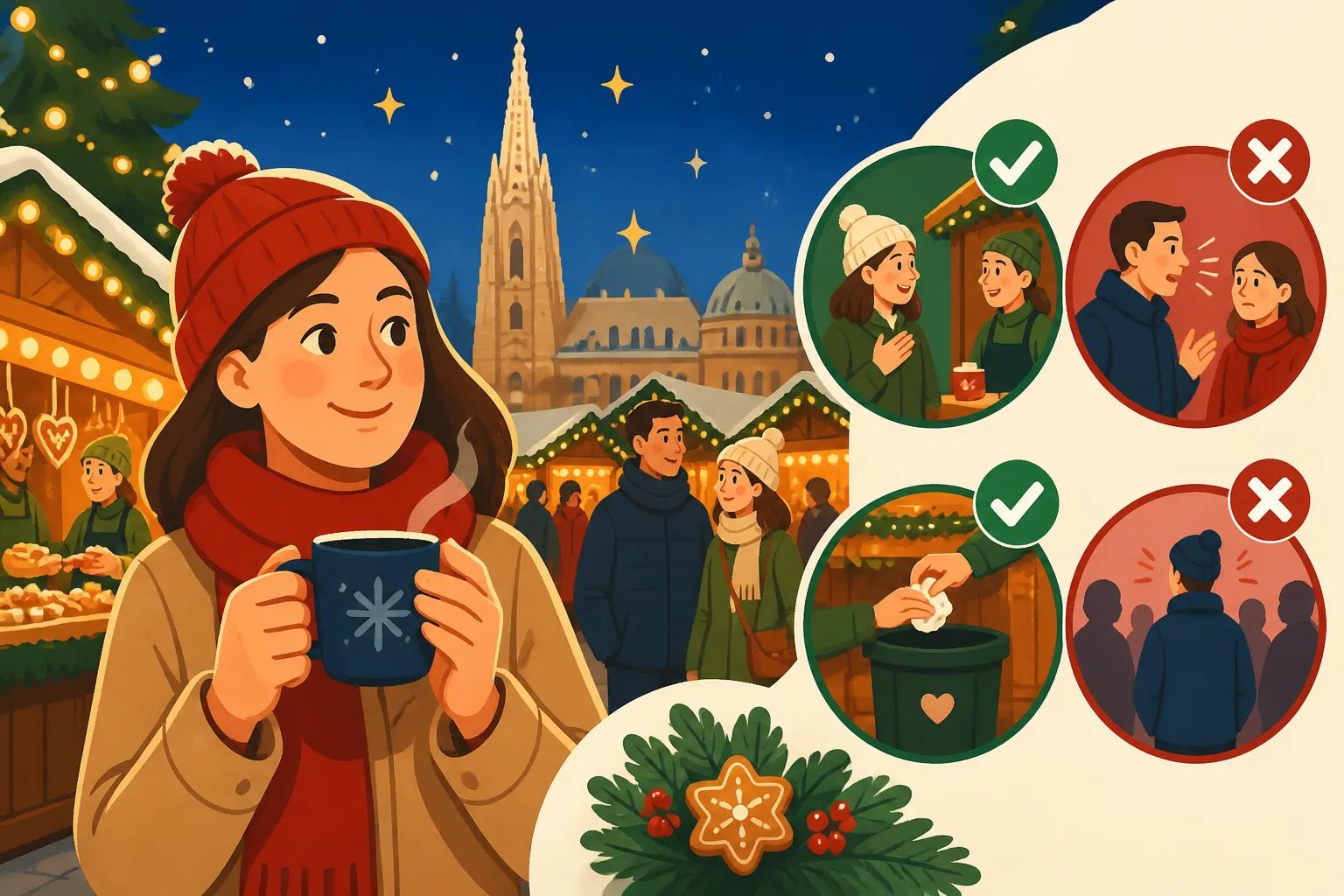
Trying to navigate the sea of wool coats at Rathausplatz without knowing the unwritten rules of the mug deposit system can turn a festive evening into a stressful nightmare. I’ll never forget the sheer embarrassment of trying to walk away with a mug I hadn't "paid" for properly during my first freezing winter in Vienna, only to be barked at by a very direct stall owner. This guide breaks down the essential etiquette of Austrian Christmas markets so you can navigate the crowds, the food, and the social norms like a seasoned local.
Navigating the Crowd and Social Flow
The first thing you’ll notice about an Austrian Christkindlmarkt is that they are not just tourist attractions; they are the living rooms of the city during December. For expats, this means the markets become a primary social hub. However, the physical layout can be overwhelming. Austrians have a specific way of moving through these spaces that prioritizes flow over individual wandering.
The Art of the Standing Table
In most markets, you won't find many places to sit. Instead, the "Stehtisch" (standing table) is king. The etiquette here is simple but often misunderstood by newcomers: these tables are communal. If you see a small gap at a table where four people are already standing, it is perfectly acceptable—and expected—to ask, "Ist hier noch frei?" (Is this spot free?). You don't need to engage in deep conversation with the others, but a polite nod is standard.
Blocking the main arteries of the market is the cardinal sin of Christkindlmarkt etiquette. If you are waiting for friends or checking your phone, step toward the stalls or find a standing table. Nothing earns a local's "Grante" (grumpiness) faster than a group of people standing in the middle of a narrow path at the Spittelberg market. If you are still scouting for the perfect area to call home, check our Vienna Neighborhood Guide: Best Districts for Expats to see which markets align with your local vibe.
Timing Your Visit for Sanity
If you want to experience the "Gemütlichkeit" (coziness) without the crushing weight of a thousand tourists, timing is everything. Locals generally avoid the big markets like Rathausplatz or Schönbrunn on Saturday nights. Instead, they visit on weekday afternoons or immediately after work. Between 4:00 PM and 6:00 PM on a Tuesday, you’ll find a much more relaxed atmosphere.
Understanding Public Holiday Closing Times: Navigating Feiertage Errands is also crucial, as market hours can shift slightly on December 24th and 25th. Most markets actually close their doors on the evening of the 23rd or early on the 24th, transitioning into "New Year's Markets" shortly after. Don't be the person showing up on Christmas Day expecting a bustling scene; by then, the city has retreated indoors for family celebrations.
The Culinary Code: Drinks and Mug Etiquette
The most important "mechanical" aspect of a Christmas market is the drink system. Whether you are drinking Glühwein (mulled wine), Punsch (a sweeter, often spirited fruit punch), or Kinderpunsch (non-alcoholic), you are entering into a temporary rental agreement for your glassware.
Mastering the Pfand System
Every drink you order will include a "Pfand" (deposit), usually ranging from 3 to 5 Euros. This is added to the price of the drink. When you finish, you have two choices: return the mug to any drink stall in that specific market to get your deposit back in cash, or keep the mug as a souvenir.
The etiquette trap here involves where you return the mug. You generally cannot return a mug from the Maria-Theresien-Platz market to a stall at the Belvedere market. They have different designs and different accounting. When returning your mug, wait your turn and place it clearly on the counter. The staff is often under immense pressure, so having your return ready without a long story is appreciated. Since many stalls are increasingly adopting digital payments, it’s worth reviewing Cashless Payments vs Cash Culture in Austria Today to see why having a few Euro coins for the Pfand is still the safest bet.
| Item | Estimated Price (2025/2026) | Pfand (Deposit) | Total Initial Outlay |
|---|---|---|---|
| Glühwein | €4.50 – €6.00 | €4.00 – €5.00 | €8.50 – €11.00 |
| Punsch (Alcoholic) | €5.00 – €7.00 | €4.00 – €5.00 | €9.00 – €12.00 |
| Kinderpunsch | €3.50 – €4.50 | €4.00 – €5.00 | €7.50 – €9.50 |
| Maroni (Chestnuts) | €3.50 – €5.00 | N/A | €3.50 – €5.00 |
Eating Etiquette and Shared Spaces
Food at the markets ranges from "Maroni" (roasted chestnuts) to "Bratkartoffeln" (roasted potatoes) and "Langen" (flatbreads). The etiquette of eating is very informal, but there is one rule: clean up after yourself. Because these markets are often in historic squares, the city takes cleanliness seriously. You’ll find specific bins for different types of waste. If you're unsure where your greasy Langos paper goes, look for the "Restmüll" bin, and for more on the country's strict habits, see Managing Household Waste: Strict Recycling Rules Explained.
When it comes to the social side of drinking, Making Local Friends Outside the Austrian Drinking Culture can be a challenge in December, as so much of the interaction revolves around the Punsch stand. If you don't drink alcohol, don't worry—ordering a "Beerenpunsch" (berry punch) without rum is perfectly normal and no one will judge you for it.
Shopping Manners and Social Interaction
The "Handwerk" (craft) stalls are the heart of the markets. These are often small business owners or artists who have spent months preparing their goods. Treating them with respect is paramount.
Browsing vs. Buying
In some cultures, heavy haggling is expected. In Austria, specifically at Christmas markets, haggling is generally considered rude. The prices are fixed and usually reflect the cost of the stall rental and the manual labor involved. If you are buying ten hand-painted ornaments, you might politely ask if there is a "Set-Preis," but for single items, pay the listed price.
Additionally, be mindful of "window shopping" during peak hours. If a stall is crowded, don't block the counter for ten minutes while you decide. Step back, let others pay, and step forward when you are ready. If you find yourself struggling with the directness of the vendors, remember that it isn't personal; it's a cultural trait you can learn more about in Culture Shock: Adapting to Direct Austrian Communication. They value efficiency over small talk when there’s a line of twenty people behind you.
Photography and Privacy
It is tempting to photograph every beautiful stall and twinkling light. While photography is generally allowed, avoid taking close-up photos of people’s faces or the specific proprietary designs of artisans without asking. Some craftspeople are protective of their designs to prevent mass-market copying. A quick, "Darf ich ein Foto machen?" (May I take a photo?) goes a long way.
Also, be aware of the "Ruhezeit" (quiet time) logic. While markets are festive, they are often located right next to residential apartments. If you are visiting a neighborhood market like the one in the 7th or 18th district, keep your volume at a respectful level after 9:00 PM. Austrians take their evening peace seriously, as detailed in Everyday Etiquette: Garbage Sorting, Noise, and Ruhezeit.
Logistics for the Veteran Expat
Beyond the social "dos and don'ts," surviving a market trip requires a bit of tactical planning. If you are hosting visitors or taking your family out, these practical etiquette tips will save your evening.
Bathroom Breaks and Public Transport
Public toilets at Christmas markets are famously busy and often require a small fee (usually 50 cents to 1 Euro). The etiquette is to have your change ready and to be quick. Don't expect to use a nearby cafe's bathroom for free; they often have "Nur für Gäste" (only for guests) signs and a very vigilant staff during the Christmas season.
To get to the markets, always use the U-Bahn or Tram. Parking near major markets like Rathausplatz is an absolute impossibility in December. Ensure your Public Transport Passes: Weekly, Monthly, and Annual Options are valid before you board, as ticket inspectors are particularly active on routes leading to the major tourist hubs.
Tipping at the Stalls
Do you tip the person pouring your Glühwein? In a formal restaurant, the Tipping Etiquette: How Much to Tip in Restaurants suggests 5-10%, but at a market stall, it is more casual. If your drink is €4.60 and you give the vendor €5.00, saying "Stimmt so" (keep the change) is a nice gesture but not strictly required. However, if you are at a food stall where they provide table service (rare but possible in some heated "Stüberls"), a standard tip is expected.
Finally, remember the "Kälteschutz" (protection against the cold). No amount of Punsch will keep you warm if you aren't dressed in layers. The unspoken etiquette of the market is that everyone is a little bit cold and a little bit crowded—patience and a "Servus" go much further than pushing and shoving. Since many markets operate on Sundays, you should also be aware of Sunday Shopping Laws: Why Everything is Closed for other errands, making the market one of the few places where you can actually "shop" on a Sunday in December.
Disclaimer
The information provided in this guide is for informational purposes only and reflects the cultural norms and market conditions as of the 2025/2026 season in Austria. While we strive for hyper-local accuracy, rules regarding specific market operations, deposit amounts, and public health protocols can change. Always follow the posted signs and instructions of local authorities and market staff during your visit.