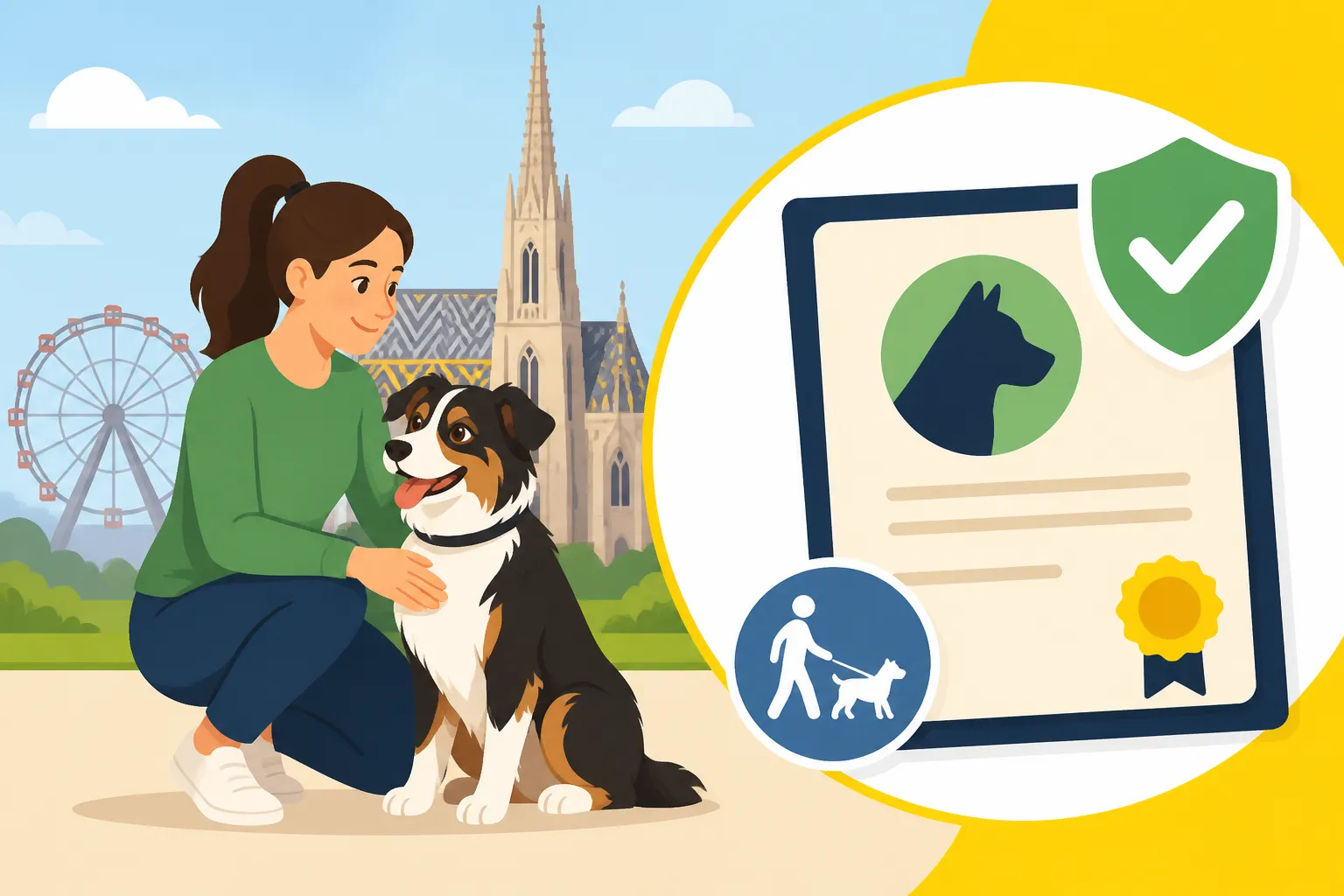
Obtaining a Mandatory Dog License (Hundeführerschein) in Vienna
Navigating the labyrinth of Viennese bureaucracy is a rite of passage for every expat, but doing it with a four-legged friend adds a whole new layer of complexity. I remember standing in a park in the 2nd District, clutching a leash and feeling a wave of panic because I couldn't tell if the passing "Dog Watch" officer was about to fine me for my pup's behavior or my lack of paperwork. This guide is designed to strip away that anxiety by explaining exactly how to obtain the Vienna Dog License, ensuring both you and your furry companion remain on the right side of the law.
Understanding the Types of Dog Licenses in Vienna
When you first arrive, you’ll hear several terms tossed around: Sachkundenachweis, Hundeführerschein, and Hundeabgabe. It is enough to make any newcomer’s head spin. In Vienna, the city takes "responsible ownership" very seriously. There are essentially two paths you might take regarding the dog license, and which one you choose depends entirely on the breed of your dog and your desire to save money on your annual taxes.
The first thing to understand is the mandatory Sachkundenachweis. Since 2019, every new dog owner in Vienna who has not owned a dog in the previous two years must complete a four-hour "proof of competence" course. This is not the same as the license, but it is the prerequisite. Once you have that, you move on to the actual license. The mandatory version is for "listed breeds," while the voluntary version is open to everyone else. Trust me, even if it isn't mandatory for your Golden Retriever, there are some major perks to doing it anyway.
If you are just settling into your new home, you might also want to check out the Vienna Neighborhood Guide: Best Districts for Expats to see which areas have the best dog parks (Hundezonen) before you commit to a lease.
The Mandatory License for Listed Breeds
If you own what the city classifies as a "Listenhund" (listed dog), the geprüfter Stadthund (tested city dog) license is not optional. You have a strict timeline to follow. You must take the exam within three months of registering your dog or once the dog reaches six months of age. Owners can get hit with hefty fines simply because they thought they had a year to "settle in."
The city’s logic is that certain breeds require a higher level of social control in a dense urban environment. This means that both the dog and the owner are tested as a team. If you fail, you generally get a second chance, but the pressure is certainly on. It is also important to note that for listed breeds, the person walking the dog must always carry the license and be over 16 years old.
The Voluntary License for Non-Listed Breeds
For those of us with breeds not on "The List," the license is a voluntary way to prove your dog is well-adjusted to city life. Why would you do extra homework if you don't have to? The most immediate reason is the financial incentive. If you pass the voluntary Wiener Hundeführerschein, you are exempt from the Dog Tax (Hundeabgabe) and Mandatory Registration Costs for the following year.
Beyond the money, it is a fantastic way to bond with your pet and ensure you both understand Everyday Etiquette: Garbage Sorting, Noise, and Ruhezeit in Vienna. Austrians take public order seriously, and a dog that can sit calmly on a crowded U-Bahn is a dog that reflects well on the entire expat community.
The List of Breeds Requiring the Mandatory Exam
The "List" is a specific legal document, and it is non-negotiable. Even if your dog is a "total sweetheart" who wouldn't hurt a fly, if their DNA says they belong to one of these categories, you are going to the testing center.
Which Breeds are on the Dangerous List
The current list includes twelve specific breeds and their crosses. These are:
- Bull Terrier
- Staffordshire Bull Terrier
- American Staffordshire Terrier
- Pit Bull Terrier
- Rottweiler
- Bullmastiff
- Tosa Inu
- Dogo Argentino
- Fila Brasileiro
- Mastiff
- Mastino Napoletano
- Mastín Español
If you are unsure if your dog qualifies, it is always better to ask the MA 60 (the Veterinary Services of the City of Vienna) than to guess. I’ve known people who moved here with a "mixed breed" from a shelter abroad, only to find out during a routine check that the city considered their dog a Staffordshire mix.
Mixed Breeds and DNA Testing
Vienna's authorities are quite adept at identifying breed traits. If your dog looks like a Pitbull mix, they will likely treat it as one. If you genuinely believe your dog is not a listed breed but the authorities disagree, you may be required to provide a DNA test or a pedigree certificate.
Before you even worry about the breed list, make sure you have handled your basic residency paperwork. You cannot register a dog without a The Meldezettel Process: Registering Your Address Legally being completed first. The city needs to know where you and the dog are living before they can issue any licenses.
Step-by-Step Guide to the Vienna Dog License Process
The process isn't necessarily difficult, but it is sequential. You cannot skip to the end. I learned the hard way that trying to book an exam before your dog is microchipped is a fast way to lose an afternoon to paperwork.
Step 1: Registration and Microchipping
Every dog in Austria must be microchipped and registered in the federal database (Heimtierdatenbank). Your vet can usually do this for you, but you must ensure your data is linked to your Austrian e-card: Registration, Photo Rules, and Usage Guide or your ID Austria profile.
Once chipped, you must register the dog with the city for the dog tax. This is where you get your "Hundemarke" (the little metal tag). If you are new to the country, this should be one of the items on your Healthcare Checklist for Your First 30 Days in Austria, as many vets also handle the initial health checks required for registration.
Step 2: Finding a Certified Examiner
You don't just go to any park and show off tricks. You must book an appointment with an authorized examiner. The City of Vienna maintains a list of certified dog trainers who are licensed to conduct the Hundeführerschein.
When searching for a trainer, I highly recommend looking for someone who offers "Expat-friendly" sessions. While the official exam is in German, many trainers are happy to explain the nuances in English during the preparation phase. Finding English-Speaking Doctors in Austria's Major Cities is often a priority for expats, and finding an English-speaking dog trainer should be right up there on the list.
Step 3: Theoretical and Practical Exams
The exam itself is split into two distinct parts. You must pass the theory before you can move on to the practical. If you have been living here for a while and have already navigated things like Public vs Private Health Insurance in Austria Explained, you are likely already accustomed to the "test and certificate" culture of Austria. This is just one more certificate to add to your folder.
What to Expect During the Test
The test is designed to see how you and your dog handle the real-world stresses of a city like Vienna. It isn't about high-level agility; it’s about safety and social harmony.
The Theoretical Part (The Quiz)
The theory part consists of about 30 multiple-choice questions. They cover topics like dog health, legal requirements, and how to read dog body language. For example, you might be asked what to do if your dog is approached by an unleashed child or how to properly dispose of waste.
Many people find the German terminology the hardest part. I spent nights with flashcards learning words like Beißkorbzwang (mandatory muzzling) and Leinenpflicht (leash duty). It is worth noting that for listed breeds, the Beißkorbzwang is quite strict in public places, so knowing these rules is vital for the test.
The Practical Part (The Walk)
This is the "show me" part of the exam. You will walk with the examiner through a public area. They will look for:
- How the dog reacts to loud noises (like a passing tram).
- How the dog behaves when a cyclist or jogger passes closely.
- Whether the dog can remain calm when another dog walks by.
- Your ability to keep the dog under control without using excessive force.
One of the most common reasons for failing isn't actually the dog—it's the owner's leash handling. Make sure you are using a standard leash; retractable leashes are often frowned upon during the exam because they offer less control in tight crowds.
Costs, Fines, and Financial Incentives
Let's talk about the "Geld" (money). Keeping a dog in Vienna isn't free, but the city does offer ways to mitigate the costs if you are a responsible owner.
| Item | Estimated Cost | Frequency |
|---|---|---|
| Sachkundenachweis Course | €40 | One-time |
| Dog License Exam Fee | €25 – €50 | Per attempt |
| Annual Dog Tax (First Dog) | €72 | Annual |
| Annual Dog Tax (Additional Dogs) | €105 | Annual |
| Mandatory Liability Insurance | €30 – €60 | Annual |
Breakdown of Fees
The exam fee itself is relatively low, usually around €20 to €25 for the administrative side, plus whatever the trainer charges for their time. However, the real cost of ownership comes from the Mandatory Liability Insurance for Dog Owners in Vienna. You must have insurance that covers at least €725,000 in damages. I recommend looking into Personal Liability Insurance (Privathaftpflicht): A Must-Have to see if your existing household policy already includes dog liability—many "premium" policies do!
Tax Exemptions for Passing the Test
If you take the voluntary test and pass, you get a "Steuerfreistellung" (tax exemption) for the following year. This saves you €72. Considering the test costs less than that, the exam literally pays for itself in the first year. It is one of the few times Austrian bureaucracy actually puts money back into your pocket.
Important Resources and Regulations
Staying compliant means keeping up with the rules as they change. For instance, the rules regarding muzzling on public transport are non-negotiable. Every dog, regardless of size or breed, must wear a muzzle and be on a leash when on the U-Bahn, S-Bahn, or buses.
If you are a freelancer or self-employed, you might be used to managing your own SVS Health Insurance: Rules for Freelancers and Self-Employed, and managing your dog's "career" in Vienna is very similar—it requires a bit of self-organization and a lot of record-keeping.
Comparison of Mandatory vs. Voluntary License
| Feature | Mandatory (Listenhunde) | Voluntary (All other breeds) |
|---|---|---|
| Who needs it? | Owners of Bull Terriers, Rottweilers, etc. | Any dog owner in Vienna. |
| Timeline | Within 3 months of registration. | Any time. |
| Muzzle Rule | Mandatory in public places. | Only on public transport/crowds. |
| Tax Benefit | None (it is a requirement). | 1-year tax exemption upon passing. |
| Age Limit | Owner must be 16+. | No specific owner age limit. |
Before you head out to the park, make sure you are also aware of the local rules regarding Pet Ownership: Dog Registration, Taxes, and Leash Laws. Each district can sometimes have slightly different "dog-free" zones, especially near playgrounds.
Finally, if you ever find yourself in a situation where your dog is involved in an incident or if you need emergency vet care, knowing the Emergency Services in Austria: 144, Hospitals, and Crisis Steps for humans is good, but keep a local 24-hour vet's number programmed into your phone as well. The city's "Tierrettung" (animal rescue) can also be reached via the city's emergency numbers if an animal is in immediate distress.
Disclaimer
This guide is for informational purposes only and reflects the regulations in Vienna as of early 2026. Laws and fees regarding dog ownership and the Hundeführerschein can change frequently. Always consult the official City of Vienna (Stadt Wien) website or the MA 60 department for the most up-to-date legal requirements and breed lists. Passing a dog license exam does not exempt owners from general liability for their pet's actions.