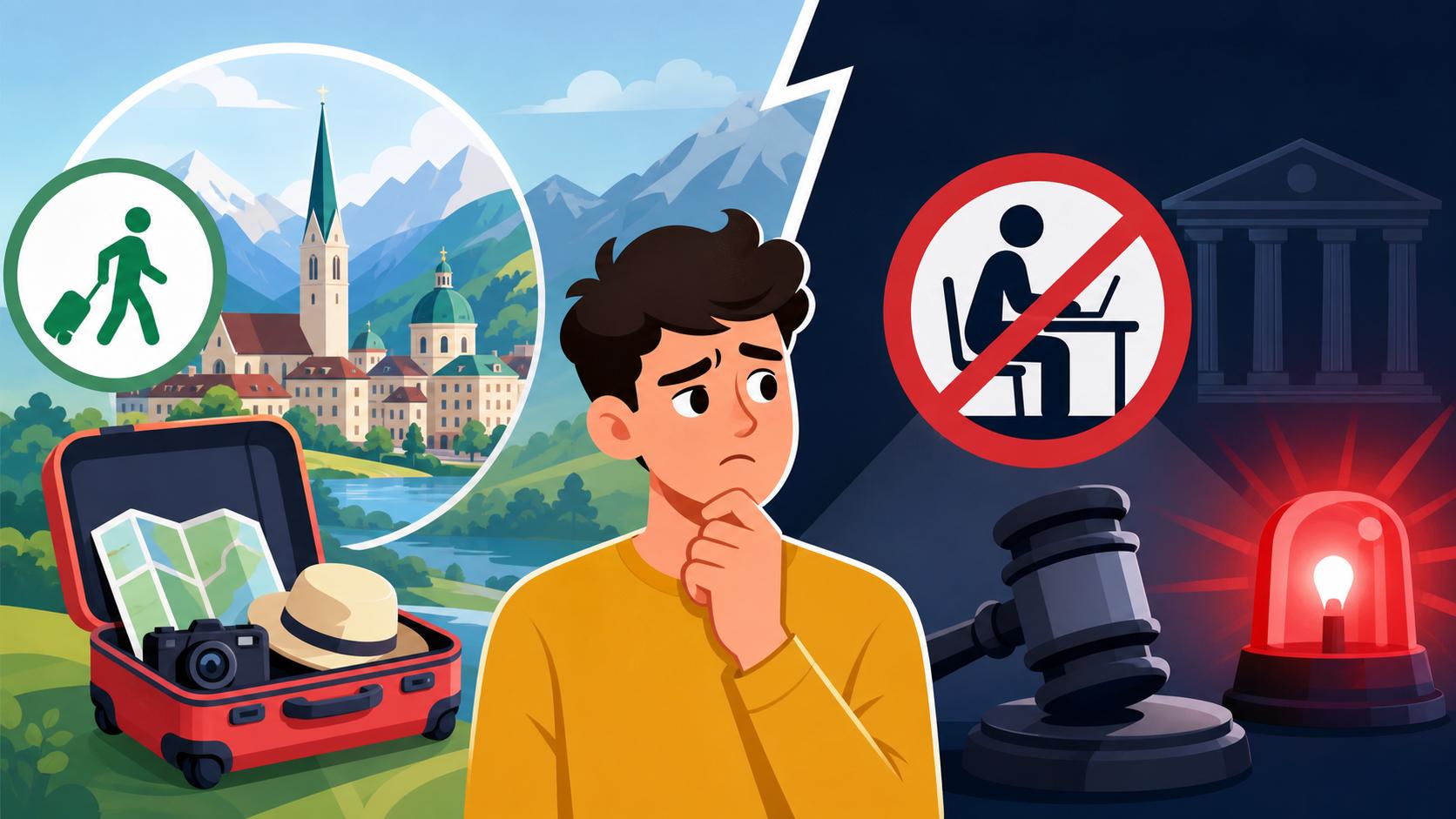
Legal Consequences of Working on a Tourist Visa
The temptation to "just get started" with a side gig or handle remote tasks while visiting Vienna on a tourist visa is a trap many expats fall into. I personally watched a talented developer get escorted to a police station because he thought a three-week freelance contract didn't count as real work. This guide clarifies the severe legal consequences of working on a tourist visa in Austria and details the risks to your future residency.
The Illusion of the Digital Nomad Loophole in Austria
Many travelers arrive in Austria under the impression that as long as their employer is based in the US, UK, or Asia, and the money never touches an Austrian bank account, they aren't "working" in the eyes of the law. This is a dangerous misconception. In Austria, the legal definition of work is tied to your physical presence. If your feet are on Austrian soil and your fingers are on a keyboard performing a revenue-generating task, you are technically engaging in employment.
The Austrian authorities are increasingly vigilant about this, especially as "work-from-anywhere" culture has exploded. Legal experts emphasize that the visa-free entry for tourists (or a standard C-type Schengen visa) is strictly for leisure, family visits, or very specific business meetings like attending a conference. It does not grant the right to perform professional services, even if those services are delivered entirely online. This is a common point of confusion for those looking into The Best Digital Nomad Visa Alternatives Available in Austria.
Furthermore, the Schengen 90/180 rule is often misinterpreted. While it allows you to stay in the country for up to 90 days, it is purely a residency allowance, not a work permit. Attempting to bypass this by "border hopping" to Bratislava or Munich doesn't reset your work rights; it only manages your physical presence. If you are caught performing labor, the Legal Consequences of Working on a Tourist Visa will apply regardless of how many days are left on your Schengen clock.
Defining Work Under Austrian Law
In Austria, "Erwerbstätigkeit" (gainful employment) is defined broadly. It encompasses any activity that is usually performed for remuneration. This includes traditional office jobs, freelance consulting, and even "unpaid" internships that provide a benefit to a company. The authorities look at the nature of the activity rather than the method of payment. If you are providing a service that someone would typically be paid for, you are working.
Why Remote Work Is Not a Safe Haven
The rise of the "Laptop Lifestyle" has led many to believe they are invisible. However, Austria’s social security and tax systems are highly integrated. If you are living in an apartment—even a short-term rental—and you are frequently seen working from cafes or co-working spaces, you are visible. The Can Digital Nomads Legally Work in Austria on a Tourist Visa? question is frequently asked at embassies, and the answer remains a firm "no" without a proper residence permit that allows for self-employment or remote work.
The Myth of Voluntary or "Trial" Work
Another common pitfall is the "trial period." some expats take on a week of unpaid labor to "prove their worth" to a local startup while on a tourist visa. This is highly illegal for both the individual and the company. Even if no money changes hands, the act of working without a permit is a violation of the Foreigners' Employment Act (Ausländerbeschäftigungsgesetz). If you are looking for a legitimate path, you should instead investigate the Red-White-Red Card (RWR): Application and Requirements to ensure you are protected.
Immediate Legal and Administrative Penalties
If the Finanzpolizei (Finance Police) or the Fremdenpolizei (Aliens Police) discover you are working illegally, the consequences start immediately. They do not give "friendly warnings" to those violating labor laws. The first step is usually an administrative fine, which can range from a few hundred to several thousand euros depending on the duration and nature of the work. For the individual, this is a financial blow, but for an Austrian employer, the fines are astronomical, often starting at €2,000 and scaling up to €50,000 for repeat offenses.
The administrative process is handled by the local MA 35 and Bezirkshauptmannschaft Procedures for Expats. Once a file is opened in your name for illegal employment, it becomes a permanent part of your record in the Central Aliens Register (Fremdenregister). This "black mark" is shared across the Schengen Information System (SIS), meaning a violation in Vienna could potentially flag you for secondary screening when you land in Paris or Rome.
Worst-case scenarios involve deportation and an entry ban. An "Einreiseverbot" (entry ban) can last anywhere from 18 months to 10 years. During this time, you are prohibited from entering any country in the Schengen Area. Some people have had to leave their partners and belongings behind in Austria with only 48 hours' notice because they were caught working a "cash-in-hand" bar job while on a tourist stay.
Impact on Future Residence Permit Applications
This is perhaps the most heartbreaking consequence. If you ever plan to move to Austria legally, a history of working on a tourist visa will almost certainly result in a rejection of your application. Whether you are applying for a Student Visa (Aufenthaltsbewilligung Student) Comprehensive Guide or seeking Austrian Citizenship and Naturalization (Staatsbürgerschaft) years down the line, the authorities will check your compliance history.
The Difficulty of Appealing a Decision
Appealing a deportation or a fine for illegal work is notoriously difficult and expensive. You would likely need to hire specialized legal counsel, and even then, the burden of proof lies with you to show that the activity was not "work." For most, the cost of the legal battle far outweighs the income they earned from the illegal gig. It is always better to follow the Red-White-Red Card Employment Journey from Offer to Start properly from the beginning.
Forfeiture of Earnings
In many cases, the state may also seize the earnings identified as resulting from illegal work. This is part of the "unjust enrichment" principle. If you cannot prove the source of your funds or if they are tied to unauthorized labor, the Taxes in Austria: Finanzamt, Returns, and Brackets 2026 compliance teams may coordinate with the police to ensure those funds are penalized.
| Penalty Type | Target | Minimum Consequence | Maximum Consequence |
|---|---|---|---|
| Administrative Fine | Individual | €500 | €5,000+ |
| Employer Fine | Company | €2,000 per worker | €50,000+ |
| Entry Ban (Schengen) | Individual | 1.5 Years | 10 Years |
| Visa/Permit Rejection | Individual | Immediate Denial | Permanent Ineligibility |
| Deportation | Individual | Voluntary Departure | Forced Removal (Escorted) |
Social and Financial Risks You Haven't Considered
Beyond the police and the fines, there is a massive personal safety net that disappears when you work illegally. In Austria, the Austria Healthcare System 2027: Complete Guide for Foreign Residents is world-class, but it is built on social insurance contributions. When you work on a tourist visa, you are not paying into the system, which means you have zero coverage for workplace accidents.
I remember a story of a young woman working "under the table" at a cafe who burned herself badly with a steam wand. Because she was working illegally, she was terrified to go to the hospital. When she finally did, she was billed thousands of euros because she didn't have an Austrian e-card: Registration, Photo Rules, and Usage Guide. Furthermore, her "employer" refused to help with costs because acknowledging the accident would mean admitting to illegal hiring practices.
There is also the matter of Taxation of Foreign Rental Income While Living in Austria and general income tax. If you are working illegally, you are engaging in tax evasion. The Finanzamt (Tax Office) has broad powers to audit your lifestyle. If you are living in a nice district of Vienna but have no declared income, they will eventually ask questions. The digital trail left by bank transfers and online platforms makes it harder than ever to hide these activities.
The Danger of "Schwarzarbeit" (Black Market Work)
Working without a contract or permit puts you at the mercy of unscrupulous employers. Without a legal basis for your employment, you have no recourse if your boss decides not to pay you. You cannot go to the Arbeiterkammer, Contracts, and Leave (Chamber of Labour) for help, as reporting the wage theft would be reporting your own illegal status. This leads to a dynamic of exploitation that many expats find themselves trapped in.
Lack of Professional Liability
If you are a freelancer working on a tourist visa and you make a mistake that costs a client money, your professional liability insurance (if you have it from your home country) will likely be void. Most insurance policies require that you are legally authorized to perform the work in the jurisdiction where it takes place. One small error could lead to a personal lawsuit that you are financially unprepared to handle.
Social Isolation and Stress
The psychological toll of "hiding" your work is significant. Constant anxiety about a knock on the door or a random check at a co-working space ruins the experience of living in such a beautiful country. It prevents you from fully integrating into the community because you can't be honest about what you do for a living. To live a stress-free life, it is vital to understand the Austrian Work Culture: 14 Salaries, Meetings, and Etiquette and join the workforce legally.
Legal Alternatives to Working on a Tourist Visa
If you want to work in Austria, there are numerous legal pathways that don't involve risking your future. The Austrian government has made significant strides in 2026 to attract international talent through the points-based system. Instead of sneaking around on a tourist visa, look into the Job Seeker Visa for University Graduates and Professionals. This visa allows you to stay in Austria for six months specifically to find a job that meets the requirements for a residence permit.
For those with a concrete job offer, the EU Blue Card Austria: Eligibility and Salary Thresholds is an excellent option for highly skilled workers. It provides a relatively fast track to residency and includes the right to work for a specific employer. If you are a graduate of an Austrian university, you have even more flexibility, as you can transition to a Post-Graduation Job Seeker Permit Rules for Alumni which allows you to work up to 20 hours while searching for a full-time role.
Finally, if your heart is set on being your own boss, you should explore the Gewerbe (Trade) and Freelance Licenses for Expats. While the administrative hurdles can be high, having a Trade License (Gewerbeschein) Step-by-Step ensures that you are paying your taxes, contributing to your pension, and—most importantly—sleeping soundly at night knowing you are fully compliant with Austrian law.
Utilizing the Points Calculator
Before you even arrive, you can use the official migration portal to see if you qualify for a permit. The Red-White-Red Card Points Calculator System Breakdown is your best friend here. It takes into account your age, education, work experience, and language skills. Often, expats realize they are only a few German lessons away from qualifying for a legal work permit, making the risk of working on a tourist visa even more unnecessary.
Engaging with the AMS
The Arbeitsmarktservice (AMS) is the public employment service. While they primarily help those already legal in the country, their website and local offices provide wealths of information on Job Hunting Strategy for English Speakers in Austria. Understanding which industries are in high demand through the List of Shortage Occupations for RWR Card 2026 can help you tailor your legal visa application for a much higher chance of success.
Seeking Professional Guidance
If your situation is complex—perhaps you are a digital nomad with clients in five different countries—it may be worth the investment to consult an immigration lawyer. They can help you navigate the SVS vs ÖGK: Key Differences for New Freelancers and find a creative but legal solution, such as a residency permit for "Settlement without Gainful Employment" if you have significant savings, though this specifically prohibits work in Austria.
Mandatory Legal Disclaimer
The information provided in this guide is for informational purposes only and does not constitute professional legal advice. Immigration laws, salary thresholds, and enforcement policies in Austria are subject to frequent change. While every effort has been made to ensure accuracy as of 2026, you should always consult with the official Austrian migration authorities (MA 35, BMI, or your local embassy) or a qualified legal professional before making decisions that affect your legal status. Working without a valid permit is a serious offense with long-term consequences.