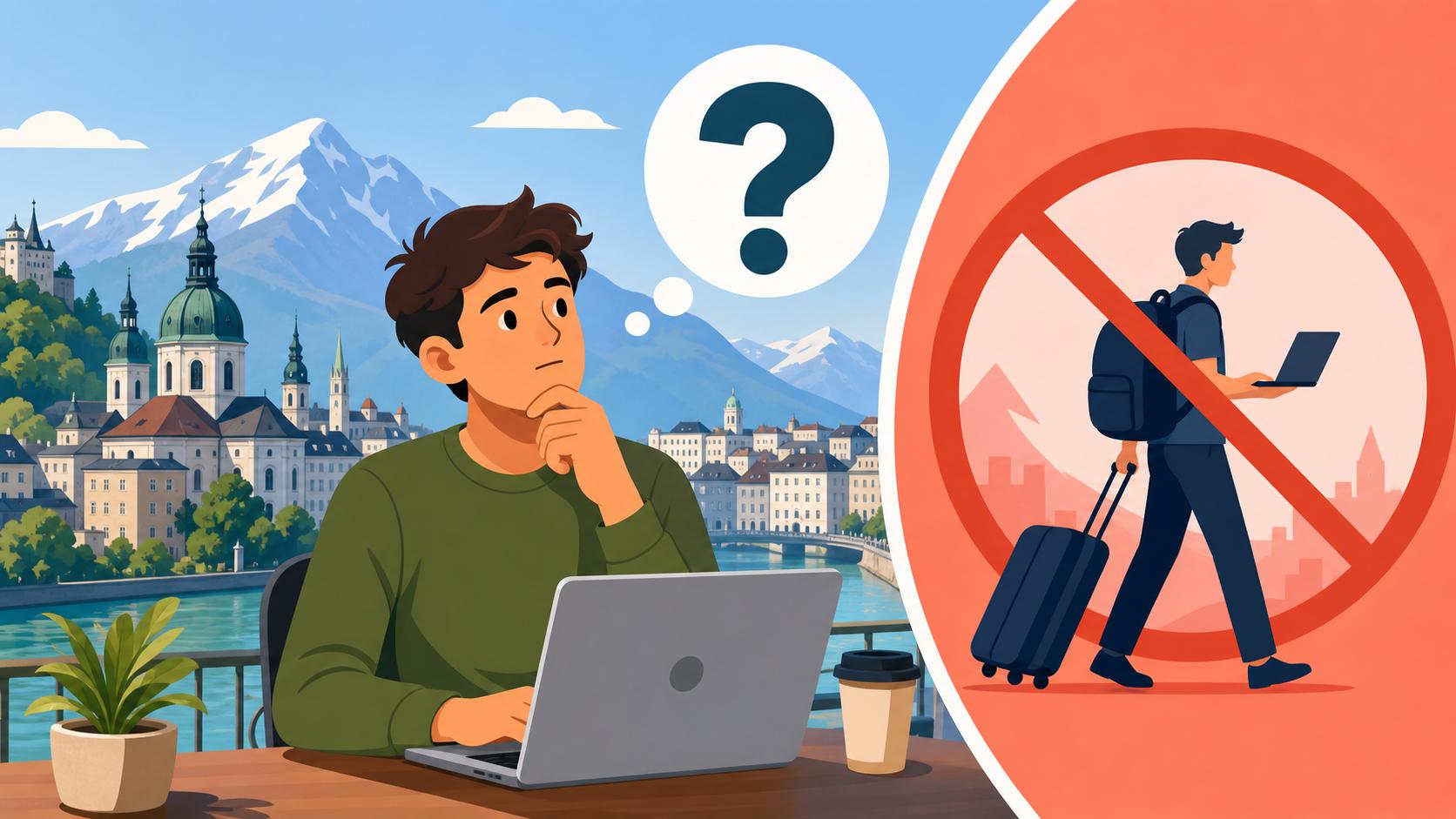
Can Digital Nomads Legally Work in Austria on a Tourist Visa?
The dream of sipping a Melange at a traditional Viennese coffee house while casually coding your way through a freelance project is a powerful one, but the Austrian legal system often views this laptop-lifestyle through a much more rigid lens. I remember my first month in the 7th district, nervously hiding my laptop every time a waiter walked by because I wasn't sure if my "tourist" status allowed me to even check a work email. This guide breaks down exactly where the legal lines are drawn so you can navigate the complex world of Austrian immigration without risking a permanent ban from the Schengen area.
The Legal Reality of Remote Work on a Tourist Visa in Austria
When you enter Austria as a tourist—whether you are from a visa-free country like the US or Canada, or you have a formal Schengen Visa C—the primary condition of your stay is that you are there for "recreational purposes." Austrian law is quite specific about what constitutes work. In the eyes of the Ministry of the Interior, any "gainful employment" (Erwerbstätigkeit) performed while physically on Austrian soil generally requires a specific work permit. This is the biggest hurdle for digital nomads: the law doesn't care if your employer is in New York or London; it cares where your feet are under the desk.
Many travelers assume that because their income is paid into a foreign bank account and their clients have no presence in Austria, they are invisible to the authorities. While it is true that the police are not raiding cafes to check your browser tabs, the legal risk remains high if you are ever questioned during a routine stop or at the border. Technically, performing your regular job duties—even remotely—on a tourist visa is a violation of your entry conditions. This can lead to the Legal Consequences of Working on a Tourist Visa which range from heavy fines to immediate deportation and a multi-year entry ban for the entire Schengen zone.
Reports describe many expats who tried to "fly under the radar," and while many succeeded for a few weeks, the stress of living in a gray area eventually took its toll. Austria is a country that runs on paperwork and clear definitions. If you are caught working, the authorities don't just look at your visa; they look at your intent. If you arrived with the intention to work, even remotely, you were technically supposed to apply for a different class of visa before you ever left your home country.
Defining Gainful Employment in the Austrian Context
The definition of work in Austria is broader than most realize. It isn't just about a 9-to-5 office job. It includes freelance consulting, software development, and even managing an online shop. The core issue is that Austria views the act of working as a privilege reserved for those with the correct residency status. If you are creating value or earning income while utilizing Austrian infrastructure (like the high-speed rail or public libraries), the state expects you to be properly documented and, eventually, taxed.
There is a very narrow exception for "business trips." If you are in Vienna for a three-day conference or a single meeting with a local partner, that is generally permitted under a tourist visa. However, the moment that stay stretches into weeks of regular remote work, you have crossed the line from a "business traveler" to an "unauthorized worker." This distinction is where many nomads get into trouble, as they often struggle to explain to immigration officers why they have been in a Neubau Airbnb for 85 days with a dual-monitor setup.
The Problem with Visa-Free Entry (90-Day Rule)
For citizens of countries like Australia or the United Kingdom, the 90-day visa-free stay feels like an open invitation to settle in for a while. However, this is strictly for tourism. If you are using this time to maintain your career, you are essentially working "black" (schwarz) in the eyes of the Austrian Finanzamt. The authorities are increasingly aware of the digital nomad trend and are looking for signs of long-term residency in what should be short-term stays.
If you plan on staying longer or want to do things properly, you must look into Austria Visas & Residence Titles 2027: Complete Guide to see which category actually fits your situation. Relying on the 90-day "Schengen shuffle" is a precarious strategy that often ends in heartbreak at the Vienna International Airport (VIE) when an officer notices your pattern of entry and exit.
Why Austria Does Not Have a Dedicated Digital Nomad Visa
Unlike Spain, Portugal, or Croatia, Austria has been famously slow to adopt a specific "Digital Nomad Visa." There is no single application that allows you to live in the Alps for a year while working for a company in San Francisco. This is largely due to the way the Austrian social system is structured. The government prides itself on a "contributory" model—if you live here, you must be part of the social insurance system (SVS or ÖGK), and the administrative overhead of creating a visa for people who don't fit into standard employment categories has been a sticking point for years.
The lack of a nomad visa means that foreigners are often forced into more complex categories like the "Settlement Permit – Gainful Employment Excepted." This permit allows you to live in Austria if you have significant savings, but—and this is the catch—it strictly prohibits you from working at all, even for a foreign company. If you are caught working on this permit, you risk losing your residency. For those who need to work to support themselves, the only "legal" path is usually much more difficult and involves proving your value to the Austrian economy.
Comparison of Options for Remote Workers
| Visa Type | Allowed to Work Remotely? | Duration | Primary Requirement |
|---|---|---|---|
| Tourist Visa (C) | No | Up to 90 Days | Tourism/Leisure only |
| Visa D (National) | No (Usually) | 91 to 180 Days | Special travel or short study |
| Settlement Permit (No Work) | No | 1 Year (Renewable) | High liquid savings + Health Insurance |
| Red-White-Red Card | Yes | 2 Years | High-skill job offer from Austrian firm |
| Self-Employed RWR Card | Yes | 2 Years | Proof of €100k+ investment or job creation |
Because there is no "easy" middle ground, many find themselves looking for The Best Digital Nomad Visa Alternatives Available in Austria which usually involve setting up a local freelance business. This is a massive administrative undertaking that requires you to dive deep into the world of the WKO (Economic Chamber) and the SVS.
The Role of MA 35 and Local Authorities
If you do decide to pursue a legal residency to work remotely, you will inevitably encounter MA 35 (in Vienna) or the local Bezirkshauptmannschaft (in smaller towns). These offices are the gatekeepers of Austrian residency. They are notoriously strict about documentation. If you cannot produce a lease, a clean criminal record from your home country, and proof of Austrian health insurance, your application will likely be stalled. Dealing with these authorities requires a level of patience that many nomads, used to the "fast" digital world, find incredibly frustrating.
The Risks of the Gray Area: Taxes, Insurance, and Fines
Even if you manage to stay in Austria for a few months without being stopped by immigration, you are still stepping into a minefield regarding taxes and health insurance. Austria has a "universal" healthcare system, but it is not free for visitors. If you have an accident while hiking in the Tyrol and you only have basic travel insurance, you might find that your policy doesn't cover "work-related" injuries if they discover you were actually in the country to work.
Furthermore, the moment you spend more than 183 days in Austria (or if Austria becomes your "center of vital interest"), you become a tax resident. At this point, the Finanzamt will expect a cut of your global income. Failing to report this can lead to massive back-taxes and interest. Understanding the 183-Day Tax Residency Rule is vital for anyone trying to push the limits of a tourist stay.
Social Insurance and the SVS
In Austria, health insurance is tied to your employment or residency. If you are working as a freelancer, you are legally required to pay into the social insurance system for the self-employed. If you are on a tourist visa, you cannot join this system. This creates a dangerous gap. If you are working remotely and get sick, you are in a legal vacuum where you are technically an unauthorized worker with no local insurance coverage. For those who want to be fully protected, it's worth reading about SVS Health Insurance: Rules for Freelancers and Self-Employed to see how much the monthly contributions actually cost (spoiler: they aren't cheap).
The "Center of Vital Interest" Trap
The Austrian tax authorities use a concept called the "center of vital interests" (Lebensmittelpunkt). This means that even if you haven't hit the 183-day mark, you could still be considered a tax resident if you have a long-term lease, a local partner, or a membership in a local club. If you are acting like a resident while on a tourist visa, the government will eventually want to treat you like one for tax purposes, but without giving you the rights of a resident worker. It is the worst of both worlds.
Path to Legitimacy: Valid Residency Options for Remote Workers
If you truly love Austria and want to make it your base, the most honest way to do it is to stop pretending to be a tourist. The most common path for digital nomads is to apply for a Red-White-Red Card as a self-employed key worker, although the bar is incredibly high. You must prove that your work brings "macroeconomic benefit" to Austria, which usually means an investment of capital or the creation of jobs.
A more accessible (though still complex) route is the "Neue Selbständige" (New Self-Employed) status. This is for people whose work doesn't fall under a traditional trade license. If you are a writer, lecturer, or artist, you can sometimes use this status to secure residency, provided you can prove you earn enough to support yourself without being a burden on the state. You should explore Freelancing in Austria: The Neue Selbständige Legal Guide to see if your specific line of work qualifies.
The Steps to Getting a Trade License
For those whose work is more commercial (like marketing or IT consulting), you may need a Gewerbeschein (trade license). This involves registering with the WKO and proving you have the qualifications to perform the work. It is a rigorous process, but once you have it, you can legally live and work in Austria. You can follow the Getting a Trade License (Gewerbeschein) Step-by-Step guide to understand the bureaucratic hurdles involved, from the "Masters exam" requirements to the necessary insurance.
Settlement for Private Purposes
If you are a "wealthy" nomad who doesn't actually need to earn a salary while in Austria—perhaps you live off investments or rental income from back home—you might qualify for the Settlement Permit – Private Purposes. This is subject to a strict quota every year and requires you to have a significant amount of money in a bank account that is "at your disposal" in Austria. It’s important to note that this permit is one of the most sought-after, and you can learn more about Applying for a Residence Permit for Private Purposes (No Work) to see if you meet the financial thresholds for 2026.
Practical Tips for Staying Compliant While Visiting
If you choose to visit Austria and occasionally check your emails, the best way to stay out of trouble is to maintain the "spirit" of a tourist. Do not set up a permanent office in your apartment. Do not sign long-term contracts for utilities or memberships that suggest you are living there. Most importantly, do not attempt to "sell" your services to local Austrian clients while on a tourist visa. This is the fastest way to get flagged by the authorities.
If you need a professional environment for a few hours, look for coworking spaces rather than hiding in a cafe all day. Vienna has some incredible spots like Stockwerk or Impact Hub. These spaces are used to travelers, but even they will tell you that their memberships don't grant you the legal right to work. You can find a list of the Best Co-working Spaces in Vienna for Freelancers to find a community, but always remember that a desk rental is not a work permit.
Ultimately, the Austrian government is modernizeing, but the "digital nomad" is still a concept that the current legal framework struggles to categorize. Until a dedicated nomad visa is launched, the safest path is to enjoy your 90 days as a true tourist—take the trains, eat the Schnitzel, hike the Alps—and if you want to work, do the hard work of getting the right residency card. It takes time, it takes money, and it takes a lot of German-translated documents, but the peace of mind of being "legal" in such a beautiful country is worth every Euro.
Disclaimer
The information provided in this article is for informational purposes only and does not constitute legal or professional advice. Immigration laws and visa requirements in Austria are subject to frequent change. Always consult with the official Austrian embassy, the Ministry of the Interior (BMI), or a qualified immigration lawyer before making any travel or residency plans. Regardless of the content of this guide, the final decision on entry and work authorization rests solely with the Austrian authorities.