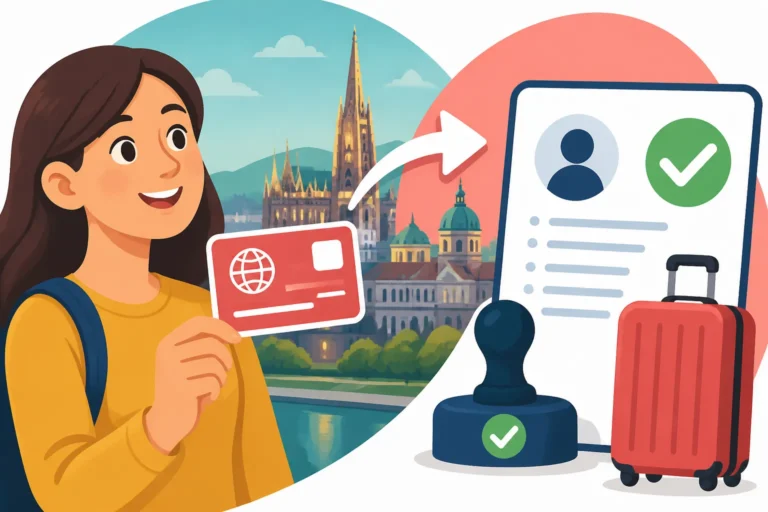
Job Seeker Visa for University Graduates and Professionals
Landing your dream role in Austria often feels like a race against a ticking clock, especially when you’re trying to coordinate interviews from a different time zone or while on a short-term tourist stay. I remember the sheer panic of realized my 90-day Schengen window was closing while I was still waiting for a second-round interview feedback in a rain-slicked Vienna. This guide provides the definitive roadmap for the Job Seeker Visa, ensuring you can legally stay in Austria for six months to focus entirely on your career transition without the looming fear of overstaying.
Understanding the Job Seeker Visa for Very Highly Qualified Workers
The Austrian Job Seeker Visa is a specific "Visa D" that grants you six months to find a job that matches your high-level qualifications. It is important to distinguish this from a standard residency permit. While a residency permit allows you to live here long-term, the Job Seeker Visa is a temporary bridge designed strictly for the "searching" phase. When I first navigated this, the distinction between a visa and a residence title was the most confusing part of the paperwork mountain. You aren't "living" here yet in the eyes of the permanent registry; you are a guest with a very specific, high-stakes mission.
This visa is specifically tailored for those classified as "Very Highly Qualified Workers." In the eyes of the Austrian government, this isn't just a fancy title; it is a legal category defined by a point-based system. If you aren't an EU citizen, this is often the most professional way to enter the country because it signals to potential employers that you are serious, legally compliant, and already vetted by the authorities. It removes the "visa sponsorship" hesitation many local HR managers feel when they see a foreign CV.
However, do not mistake this for a work permit. You cannot actually start working the moment you land. If you find a job on day ten of your six-month stay, you must still apply to convert your status into a Red-White-Red Card before you can legally sit at your desk and collect a salary. Understanding this sequence is vital to managing your finances and expectations during the transition.
Defining Very Highly Qualified Status
To qualify for this specific visa, you must reach a minimum of 70 out of 100 points on the Austrian eligibility scale. This isn't a subjective assessment; it’s a cold, hard calculation based on your degrees, your previous salary, your research output, and even your age. When I talk to professionals moving here, they often underestimate how much weight is placed on "special qualifications" like patents or recognized awards.
The system is designed to attract "top talent"—think senior engineers, specialized scientists, or high-level executives. If you fall into a shortage occupation but don't meet the "Very Highly Qualified" point threshold, you might actually be looking for a different path, such as applying for a job from abroad and going straight for the Red-White-Red Card (RWR): Application and Requirements. The Job Seeker Visa is the "VIP" entrance for those who want the freedom to interview in person at companies like OMV, Erste Bank, or the myriad of tech startups in Vienna's 4th district.
The Six Month Timeline Reality
Six months sounds like a long time until you realize that August is a "dead month" in Austria where everyone is at a lake, and December is essentially two weeks of Christmas markets followed by a total office shutdown. If you arrive in June, you effectively have two months of active hiring, one month of silence, and then a mad dash in September. It is wise to time arrival for either late January or early September to maximize the active hiring cycles.
During these 180 days, you are expected to be proactive. You’ll be navigating the MA 35 and Bezirkshauptmannschaft Procedures for Expats if you need to extend or change your status, and the pressure can be intense. You need to have your "Meldezettel" (address registration) sorted quickly, as many other administrative steps depend on it. This visa gives you the luxury of time, but the bureaucratic clock in Austria waits for no one.
The Points System Breakdown
The heart of your application is the points calculator. This is where most applicants either breathe a sigh of relief or hit a wall. The points are distributed across four main categories: Special Qualifications, Work Experience, Language Skills, and Age. You need 70 points to even be considered for the Job Seeker Visa. It’s a transparent system, but it requires meticulous documentation. You cannot simply claim you have ten years of experience; you need work certificates that prove it.
Even highly qualified professionals can be rejected when their "work certificates" are just simple letters of recommendation rather than formal documents stating their exact duties and duration of employment. In Austria, the "Dienstzeugnis" (service certificate) is a sacred document. If your previous employers are in the US or UK, you will likely need to coach them on how to write a letter that satisfies the Austrian consulate’s need for detail.
Category 1: Special Qualifications and Education
This is where the bulk of your points usually come from. A PhD or a doctorate from a recognized university immediately nets you 40 points. A Master's degree or equivalent in a subject like engineering, mathematics, or computer science (the MINT subjects) is also highly valued. If you graduated from an Austrian university, you should actually look into the Post-Graduation Job Seeker Permit Rules for Alumni instead, as that path is often smoother and involves different point requirements.
Beyond degrees, you can earn points for research and innovation. Have you published papers? Do you hold patents? These are worth 20 points each. Even your previous salary can help; if you earned more than 50,000 EUR gross annually in a senior management position, that’s another 20 points. This category is essentially looking for proof that you are at the top of your field globally.
Category 2: Experience, Language, and Age
Experience is calculated by year, with 2 points for every year of professional experience, and bonus points if that experience was gained in Austria. If you’ve spent five years as a senior dev in London, that’s 10 points. Language skills also play a role, though surprisingly, for "Very Highly Qualified" workers, German isn't always a dealbreaker if your English is fluent. You can get 5 to 10 points for English or German skills, but you must provide an official certificate like IELTS or ÖSD.
Age is the final factor. The system favors younger professionals but doesn't exclude veterans. If you are under 35, you get 20 points. Between 35 and 40, you get 15. Between 40 and 45, you get 10. It’s a "sliding scale" of sorts. When helping friends calculate their odds, we often find that a 42-year-old with a PhD and a high previous salary easily hits the 70-point mark, even without German skills. You can use the Red-White-Red Card Points Calculator System Breakdown to run your own scenarios before paying any application fees.
| Category | Maximum Points | Key Criteria |
|---|---|---|
| Special Qualifications | 40 | PhD/Doctorate or MINT Master's |
| Work Experience | 20 | 2 points per year |
| Language Skills | 10 | A1/A2 German or B1+ English |
| Age | 20 | Under 35 = 20 points |
| Study in Austria | 10 | If you completed part of your studies here |
Essential Eligibility Requirements
Beyond the points, there are "soft" requirements that can trip up even the most qualified applicant. These are the logistical pillars: money, insurance, and a place to sleep. The Austrian authorities want to be 100% certain that you will not become a "burden on the state" during your six-month search. They expect you to have a significant financial cushion already sitting in a bank account.
In my experience, the financial proof is where the "I've-been-there" frustration hits hardest. You can't just show a credit card limit. You need to show liquid funds. For 2026, the estimated requirement is around 1,273 EUR per month of your stay. For a six-month visa, that’s roughly 7,638 EUR that must be clearly visible and accessible. If you’re coming from a country with a weaker currency, this threshold can feel like a mountain, but it is non-negotiable.
Proof of Accommodation
You must prove you have a place to live for the duration of your stay. This is the ultimate "chicken and egg" problem. How do you get an apartment without a job, and how do you get a visa without an apartment? Most expats use "Serviced Apartments" or long-term Airbnb bookings for the first month or two, which the embassy usually accepts as long as there is a formal contract. A simple hotel booking for one week will likely result in a rejection.
Once you are here, you will need to register this address at the local Meldeamt to get your Meldezettel. This paper is the key to everything else—opening a bank account, getting a phone contract, and eventually applying for your residency card. Be aware that the Cost of Living Benchmarks for Singles, Couples, and Families in Vienna or Salzburg can be high, so ensure your "proof of funds" actually reflects the reality of renting in a modern district.
Health Insurance for Job Seekers
Standard travel insurance (the kind you buy for a 10-day holiday) usually isn't enough. You need "comprehensive" health insurance that covers all risks in Austria. This is often called "Gästekrankenversicherung" or expat insurance. It must have a high coverage limit (usually 30,000 EUR minimum) and include repatriation.
Finding the right policy is crucial because the consulate will check the fine print. It is advisable to look for providers that are specifically recognized by Austrian authorities to avoid delays. You can read more about Acceptable Travel Insurance Policies for a Visa D Application to make sure your policy won't be the reason your application gets sent back. Once you get a job, you'll transition to the public system, but for these six months, you are on your own.
Step-by-Step Application Workflow
The application process for the Job Seeker Visa happens outside of Austria. You must apply at the Austrian Embassy or Consulate in your home country or country of residence. You cannot fly to Vienna as a tourist and "switch" to a Job Seeker Visa at a local office. This is a common mistake that leads to expensive flights back home. The only exception is for people who are already allowed to enter Austria visa-free (like US, Canadian, or UK citizens), but even then, the paperwork must often be vetted through the embassy channels first.
The timeline is also something to watch. It can take anywhere from 4 to 12 weeks for the authorities to verify your points and documents. During this time, they might reach out to the AMS (the Austrian Labor Market Service) to confirm your qualifications. It is a slow, methodical process that requires patience and a very organized folder of "Certified Translations."
Gathering and Translating Documents
Every single document that isn't in German or English must be translated by a certified translator. This includes your birth certificate, your university degrees, and your work certificates. I remember spending a small fortune on translations back in the day, only to realize I’d missed one stamp on my marriage certificate. Don't be like me. Check every page for an "Apostille" or legalisation stamp.
The requirements for Certified Translations of Documents: What the Rules Demand are very strict. If you use a translator who isn't officially "sworn" in the eyes of the Austrian court or embassy, they might reject the paperwork. This is especially true for technical degrees where the terminology must be exact to match the Austrian equivalent.
The Embassy Interview and Biometrics
When you finally get your appointment at the embassy, treat it like a job interview. You’ll need to provide your fingerprints and a very specific biometric photo. They might ask you about your field of work and which companies you plan to target in Austria. Having a list of potential employers or even a few "cold outreach" emails printed out can show the consular officer that you are a serious professional and not just looking for a six-month holiday.
After the interview, the waiting game begins. You’ll be checking your email daily for that "Ready for Collection" notification. Use this time to polish your CV to the Austrian standard—yes, that usually means including a professional photo and your date of birth, which feels strange to those from the US or UK, but is standard practice here.
Transitioning from Job Seeker to Red-White-Red Card
The moment you receive a job offer, your mission changes. You no longer need the Job Seeker Visa; you need the Red-White-Red Card. This is a residency and work permit rolled into one, tied to your specific employer. The Job Seeker Visa makes this transition easier because you are already in the country and can visit the local immigration office (like MA 35 in Vienna) in person.
However, the "conversion" isn't instant. Your employer will have to fill out a set of forms confirming your salary and job description. The AMS will then perform a "Labor Market Test" in some cases, though for Very Highly Qualified workers, this is often a formality. You should be aware of Understanding the Difference: Visa vs Residence Permit during this phase, as your "Visa D" will eventually be replaced by a plastic ID card.
The Salary Threshold for 2026
To successfully transition to an RWR card, your job offer must meet certain criteria. For Very Highly Qualified workers, there isn't a fixed "minimum salary" in the same way there is for other categories, because your points already proved your value. However, the salary must be "customary for the location" and meet the legal minimums set by the "Kollektivvertrag" (Collective Agreement) for your industry.
In 2026, if you’re an IT professional or an engineer, you should expect to see offers well above the 4,500 EUR gross per month mark. If an employer offers you something significantly lower, the AMS might reject the application, fearing that they are "underpaying" foreign talent. This protection is actually a good thing for you, but it requires you to be firm in your salary negotiations.
Using ID Austria for the Switch
Austria is rapidly digitizing its bureaucracy. By the time you are switching from your Job Seeker Visa to your RWR Card in 2026, you will likely be using ID Austria and E-Government Tools for Foreign Residents. This digital ID allows you to track your application status online and even sign documents electronically. It’s a lifesaver compared to the old days of waiting by the mailbox for a physical letter.
Once the RWR card is approved, you will get an appointment to pick up your card. Only then can you officially start your first day of work. Make sure your employer understands this timeline; most Austrian companies are used to it, but international startups might need a reminder that you can't "just start" while the card is being printed.
Living in Austria During Your Search
While you are job hunting, you are effectively living the expat life on a trial basis. This is the best time to figure out which district suits you. Do you want the hipster vibes of Vienna’s 7th district, or the family-friendly parks of the 13th? Use your six months to "test drive" the city. You’ll also need to handle the basics like finding a doctor. If you get a cold or need a checkup while on your private insurance, you might want to look into Finding English-Speaking Doctors in Austria's Major Cities to make your first medical visit less stressful.
Networking is the "secret sauce" of the Austrian job market. While LinkedIn is great, many jobs are found through "Vitamin B" (Beziehungen, or relationships). Join expat groups, attend industry meetups at "WeWork" or "Talent Garden," and don't be afraid to ask for "coffee chats." Austrians can be reserved at first, but once you show you are a qualified professional committed to living here, they are incredibly helpful.
Learning the Language While Hunting
Even if your industry (like Tech) uses English as the primary language, your life will be 100% easier if you have basic German. Use your job-seeking months to enroll in an intensive German course. Not only does it look great on your CV, but it also helps you understand your rental contracts and supermarket labels.
If you eventually want to stay long-term, you’ll need to prove language proficiency anyway. Starting now is a strategic move. You can find out How to Prove German A1 Proficiency for Immigration to get a head start on the requirements for your next permit. Plus, nothing impresses a local interviewer more than a candidate who is already proactively learning the local tongue.
Budgeting for the Search Phase
The Job Seeker Visa requires a financial cushion for a reason. Austria is not a "cheap" place to live while unemployed. Between rent, the high cost of groceries at Billa or Spar, and the occasional "Melange" at a coffee house, your savings will deplete faster than you expect.
It is wise to budget at least 20% more than the official "proof of funds" requirement. Unexpected costs like "Provision" (agent fees) for apartments—though largely eliminated for tenants in 2026 thanks to the Bestellerprinzip—or "Kaution" (deposits) can take a huge chunk out of your initial capital. Being financially stressed is the worst way to head into a high-stakes interview.
Special Cases and Alternatives
Not everyone needs the Job Seeker Visa to find work in Austria. If you are a graduate of an Austrian university, you have a much easier path. You can stay for 12 months after graduation to find a job, and the point requirements are waived for you. This is why many people choose to do a Master's in Austria first as a "backdoor" into the labor market.
Similarly, if you already have a job offer from an Austrian company while you are still abroad, you should skip the Job Seeker Visa and go straight for the Red-White-Red Card. The Job Seeker Visa is a specific tool for a specific problem: needing to be on the ground to secure the offer.
The EU Blue Card Option
For Very Highly Qualified workers, the EU Blue Card is another alternative. It has a higher salary threshold but offers more mobility within the European Union. In 2026, the salary requirement for a Blue Card is updated annually. If your offer is particularly high, ask your immigration lawyer or HR contact if the Blue Card might be a better fit than the standard RWR Card.
The Blue Card often has a faster track to permanent residency in some scenarios, but it is less flexible if you want to switch to a lower-paying or more "creative" role later on. Always weigh the pros and cons of each permit before signing your contract.
What If You Don't Find a Job?
This is the question no one wants to ask. If the six months end and you haven't secured an RWR-compliant job offer, you must leave Austria. You cannot "reset" the visa by hopping over to Slovakia for a day. Usually, there is a waiting period before you can apply for a Job Seeker Visa again.
However, don't view it as a failure. The connections you make and the understanding of the market you gain in those six months are invaluable. Many people go back home, continue the search remotely with their new Austrian network, and return a few months later with a firm job offer and a direct Red-White-Red Card application.
Disclaimer
The information provided in this guide is for educational and informational purposes only and does not constitute legal or professional immigration advice. Immigration laws, salary thresholds, and point systems in Austria are subject to frequent change by the Ministry of the Interior and the AMS. Always verify current requirements with the official Austrian embassy or a qualified legal professional before making travel or financial arrangements.