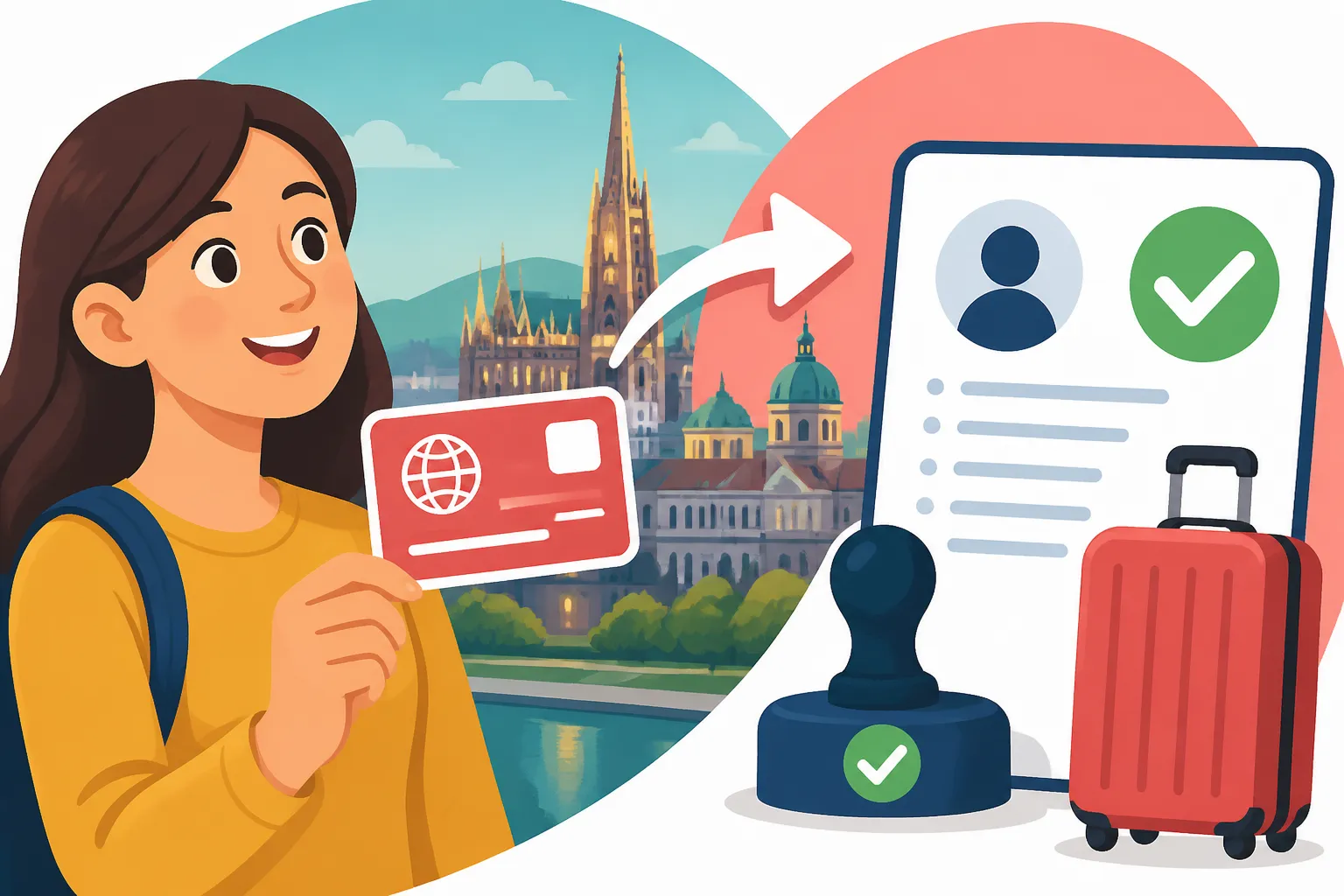
Why an e-card is Often Required Before Visa Approval
You arrive in Vienna, bags packed and dreams of coffee house culture in your head, only to realize that the immigration office (MA 35) is asking for an e-card before they’ll even think about handing over your residence permit. I remember the absolute panic I felt when a case officer told me my expensive international insurance wasn't enough. This guide solves the "chicken and egg" insurance paradox by explaining exactly why the e-card is mandatory and how you can bridge the gap legally.
The Insurance Paradox: Why MA 35 Demands an e-card Early
One of the most confusing aspects of moving to Austria is the requirement for "comprehensive" health insurance. When you apply for a residence title, whether it’s a Red-White-Red Card or a student permit, the law requires you to have insurance that covers all risks. In the eyes of the Austrian authorities, the gold standard for this is the public social insurance system, which is accessed via the e-card. They don't just want you to be covered; they want you to be integrated into the same system as every other resident to ensure no burden falls on the state.
The Concept of Comprehensive Healthcare and All-Risk Coverage
When you look at the fine print of your visa requirements, you will see the phrase "all-risk insurance coverage." This is where many expats get tripped up. Most international travel insurance policies have "limitations of liability" or "exclusions" for pre-existing conditions. The Austrian government views these exclusions as a potential liability. If you were to fall ill with a chronic condition that your private policy excludes, the Austrian taxpayer might end up footing the bill for your hospital stay.
To avoid this, the MA 35 and Bezirkshauptmannschaft Procedures for Expats are designed to push you toward the public system. Public insurance (like ÖGK) is mandatory for employees and covers everything from basic checkups to major surgeries without excluding pre-existing conditions. This is why the case officer is often looking for evidence that you are either already in the system or are in the process of being registered.
Shifting from Travel Insurance to Social Insurance
Most people enter Austria on a Visa D or under a visa-free regime using a standard travel policy. However, the moment you transition to a long-term residence permit, that travel insurance becomes invalid in the eyes of the immigration office. You are no longer a "traveler"; you are a "resident." This shift in status triggers a mandatory requirement to join the social security network.
Many people try to use "Expat Gold" plans from their home countries, only to be met with a stern "Nein" at the counter. The authorities want to see that you are paying into the Austrian system. If you are employed, this happens automatically through your paycheck, but for the visa approval process, you often need to provide a Getting Health Insurance Confirmation Before the e-card Arrives document from the insurance provider to prove that the coverage will kick in the moment your permit is valid.
Bridging the Gap: The Versicherungsbestätigung
Since you cannot get an e-card without a residence permit, and you often cannot get the permit without the insurance, how do you break the cycle? The answer is the "Versicherungsbestätigung" (confirmation of insurance). If you are coming to Austria for a job, your employer will register you with the health insurance fund (ÖGK, SVS, or BVAEB).
Even before your physical e-card arrives in the mail, the insurance fund can issue a digital confirmation or a paper letter stating that you are registered. This letter is the "magic key" for your visa application. It proves to the immigration office that you are covered by the social security net. If you are a freelancer or a student, you may need to apply for Mandatory Coverage: Who Must Register for Public Health Insurance voluntarily and present the application receipt as proof of intent to be covered.
The Logic Behind the Austrian Health System Requirement
Austria is a social welfare state, and its healthcare system is built on the principle of solidarity. This means everyone contributes based on their income, and everyone receives the same high level of care. When the government grants you a residence permit, they are essentially welcoming you into this "solidarity circle." They demand the e-card (or the underlying insurance) because it ensures that you are contributing your fair share and that you won't become a "social burden."
Burden on the Public Purse: Preventing Medical Debt
In some countries, medical debt is a leading cause of bankruptcy. Austria avoids this by ensuring that no resident is "uninsured." If you were to have a major accident on the ski slopes or a sudden cardiac event without comprehensive insurance, the cost of ICU care could reach tens of thousands of Euros. If you couldn't pay, the hospital (which is often state-funded) would have to absorb the loss.
By making the Austria Healthcare System 2027: Complete Guide for Foreign Residents a mandatory part of the visa process, the state mitigates this risk. The e-card is essentially a certificate of financial responsibility. It tells the government, "This person has the financial backing of the national insurance fund; they are safe to have in our country." This is why case officers are so pedantic about the specific wording of your insurance policy.
The Role of Social Insurance Carriers
In Austria, your insurance isn't just "the government." It is managed by specific carriers based on your profession. Most employees will be under the ÖGK (Österreichische Gesundheitskasse). If you are moving here to start a business, you will deal with the SVS (Sozialversicherung der Selbständigen).
Each of these carriers has different registration timelines. For instance, ÖGK Enrollment Step-by-Step for Employed Residents in Austria is usually handled by the HR department on your first day of work. However, the immigration office knows that there is a lag between your arrival and your first day of work. They often require a "pre-registration" or a statement from the employer promising that this registration will occur. Understanding which carrier you belong to is crucial for providing the right paperwork to the immigration office.
How Your Residence Title Dictates Your Insurance Path
Not all visas are created equal when it comes to insurance. A Red-White-Red Card holder has a clear path: employment leads to automatic insurance. However, if you are applying for a "Settlement Permit – Gainful Employment Excepted" (the so-called "retirement" or "wealth" visa), you are in a different boat.
In these cases, you must show that you have private, comprehensive insurance that "matches" the benefits of the public system. These policies are much more expensive and must be explicitly approved by the Austrian financial regulators. For students, the path is simpler but no less strict; they must often show Student Self-Insurance Requirements and Monthly Costs 2026 through the ÖGK to satisfy the residence permit requirements.
Step-by-Step: Moving from Application to e-card Activation
Navigating the timeline from your first visa appointment to holding that green-and-blue card in your hand is like a choreographed dance. If you miss a step, the whole process grinds to a halt. The administrative sequence is strict: you register your address, you submit your insurance proof, you get your permit, and finally, you receive your card.
The Initial Submission: Private vs. Long-term Coverage
When you first submit your application at the Austrian embassy in your home country (or at MA 35 if you are eligible to apply in-land), you usually provide a private travel insurance policy. This policy must have a minimum coverage of €30,000 and include repatriation of remains. This gets you the "Visa D" to enter the country.
Once you are in Austria, the clock starts ticking. You usually have a very short window to show that you have transitioned to a local insurance provider. If you are a student, you should head to the ÖGK office almost immediately. If you are an employee, ensure your HR department sends you the "Anmeldung zur Sozialversicherung" (Social Security Registration) on day one. You will need to scan and email this to your visa case officer to move your application from "pending" to "approved."
Registering Your Address: The Meldezettel and its Role
You cannot get an e-card without a Meldezettel (address registration). In fact, the social insurance system is linked to the Central Residence Register. When you go to the Magistrate to register your apartment, that data eventually flows to the insurance providers.
I remember being stuck because my name was spelled differently on my Meldezettel than on my passport—the insurance system couldn't "find" me, which delayed my e-card by three weeks. Always ensure your registration is 100% accurate. Once you have your Meldezettel and your insurance confirmation, you have completed the "holy trinity" of Austrian administration, and your residence card is usually printed shortly thereafter.
Employers and the e-card: The First Day of Work Protocol
For those on a Red-White-Red Card, your employer is your lifeline. In Austria, it is a legal requirement for an employer to register an employee with the social insurance fund before they start working. This is great for you because it means you are covered from 12:01 AM on your first day.
Ask your HR for the "Abfrage des Versichertenstatus" or the "Anmeldebestätigung." This document contains your 10-digit social security number. Even if you don't have the physical card yet, this number is what the MA 35 wants to see. It proves that you are now part of the Austrian workforce and, by extension, the healthcare system. This is a vital part of your Healthcare Checklist for Your First 30 Days in Austria to ensure you don't face any legal gaps in your residency status.
Comparison of Insurance Types for Visa Approval
| Insurance Type | Accepted by MA 35? | Best For | Main Drawback |
|---|---|---|---|
| Standard Travel Insurance | Only for entry (Visa D) | First 30 days | No coverage for chronic illness |
| Public Insurance (ÖGK/SVS) | Gold Standard | Employees, Students, Freelancers | Requires residence permit to finalize |
| Comprehensive Private (Local) | Yes (with certificate) | Wealth Visas, Self-funded | Very expensive; strict medical checks |
| International "Expat" Plans | Rarely (case-by-case) | Digital Nomads (short term) | Often rejected for having "caps" on care |
Common Hurdles and How to Bypass Them
Even with the best intentions, the Austrian bureaucracy can throw you a curveball. The e-card system has become increasingly high-tech over the last few years, and with that comes new digital requirements that can stall your visa if you aren't prepared.
The e-card Photo Requirement for Non-EU Citizens
In the past, you just got a card in the mail. Now, Austria requires a biometric photo for almost all e-cards to prevent fraud. If you are a non-EU citizen, the authorities usually pull this photo from your residence permit application. However, if there is a glitch, or if you are an EU citizen who doesn't have an Austrian driver's license, you must manually "register" a photo.
If the insurance office doesn't have a photo on file, they simply won't issue the card. This can be a nightmare if your case officer is asking why you haven't produced your e-card yet. You should proactively check The e-card Photo Requirement: How and Where to Register to see if you need to visit a registration office. For many of us, this means an extra trip to a specific police station or service center to have a photo scanned into the system.
Dealing with Delays: What if the e-card Doesn't Arrive?
The physical e-card can take 2 to 4 weeks to arrive at your mailbox after your insurance becomes active. If your residence permit is tied to showing this card, don't panic. The immigration office actually cares about the insurance status, not the plastic card itself.
You can log into "Meine SV" (the online portal for social insurance) using your ID Austria to download a "Versicherungsdatenauszug" (Insurance Data Extract). This official PDF shows your entire history of insurance in Austria. In my experience, MA 35 case officers actually prefer this document over a photocopy of the card because it's more current and harder to forge.
Handling Dependents and Co-insurance
If you are bringing a spouse or children, the e-card requirement applies to them too. You will need to apply for "Mitversicherung" (co-insurance). This doesn't happen automatically! You have to fill out a form to add your family members to your policy.
The immigration office will require proof that your dependents are covered before they issue their family reunification visas. Families sometimes get their permits at different times because the parents forgot to file the co-insurance paperwork for the kids. Be sure to read up on Co-insuring Family Members (Mitversicherung) on Your Policy to ensure your whole family is covered under one umbrella, satisfying the MA 35 requirements for everyone simultaneously.
Practical Tips for a Smooth Immigration Journey
The key to surviving the Austrian bureaucracy is being two steps ahead of your case officer. If you wait for them to ask for a document, you’ve already lost two weeks. Be proactive, be organized, and most importantly, be patient with the system.
Using Digital Tools: ID Austria and MySV
Austria has made massive strides in e-government. Once you have your Meldezettel and a mobile phone with a signature capability, you can set up ID Austria. This tool allows you to access your insurance records, change your address, and even track your visa status in some cases.
Being able to pull up your insurance confirmation on your phone during an appointment at MA 35 can save you from a "come back next week" dismissal. Use the digital tools available to you to prove that your The Austrian e-card: Registration, Photo Rules, and Usage Guide is active and valid. It shows the case officer that you are technologically integrated and taking your residency seriously.
Communicating with your Case Officer
Case officers at MA 35 are often overworked and deal with hundreds of applications a week. When they ask for "proof of insurance," they aren't trying to be difficult; they are checking a box required by federal law. If you are having trouble getting your e-card because of a technical delay, communicate this clearly and provide alternative proof (like the insurance data extract mentioned earlier).
Always bring a German speaker with you if your German isn't at a B1 level yet. Explaining the nuances of insurance "all-risk" clauses is hard enough in your native language; doing it in broken German while a line of fifty people waits behind you is a recipe for stress. A polite, well-documented explanation of your insurance status will go much further than an angry complaint about the system.
Financial Planning for Insurance Costs
Public insurance is not free, even if it feels "automatic." If you are an employee, about 7.65% of your gross salary goes toward health insurance (split between you and your employer). If you are a freelancer, the SVS will send you a bill every quarter.
You need to budget for these costs, as "failure to pay" insurance premiums can actually lead to the revocation of your residence permit. The immigration office can check if you have outstanding debts to the social insurance carriers. Keeping your accounts clean and your premiums paid is just as important as having the card itself. If you're a student, make sure you have the ~€70 per month set aside for your voluntary insurance so that your The Austrian e-card: Registration, Photo Rules, and Usage Guide stays active and your visa remains valid.
H2 Disclaimer
This guide is based on personal experience and general administrative practices in Austria. Immigration laws and insurance regulations are subject to frequent changes by the Austrian Federal Ministry of the Interior and social insurance carriers. The information provided here does not constitute legal advice. Always consult with the official MA 35 website, your local Bezirkshauptmannschaft, or a qualified immigration lawyer before submitting any official applications. Your specific circumstances may require different documentation or procedures.