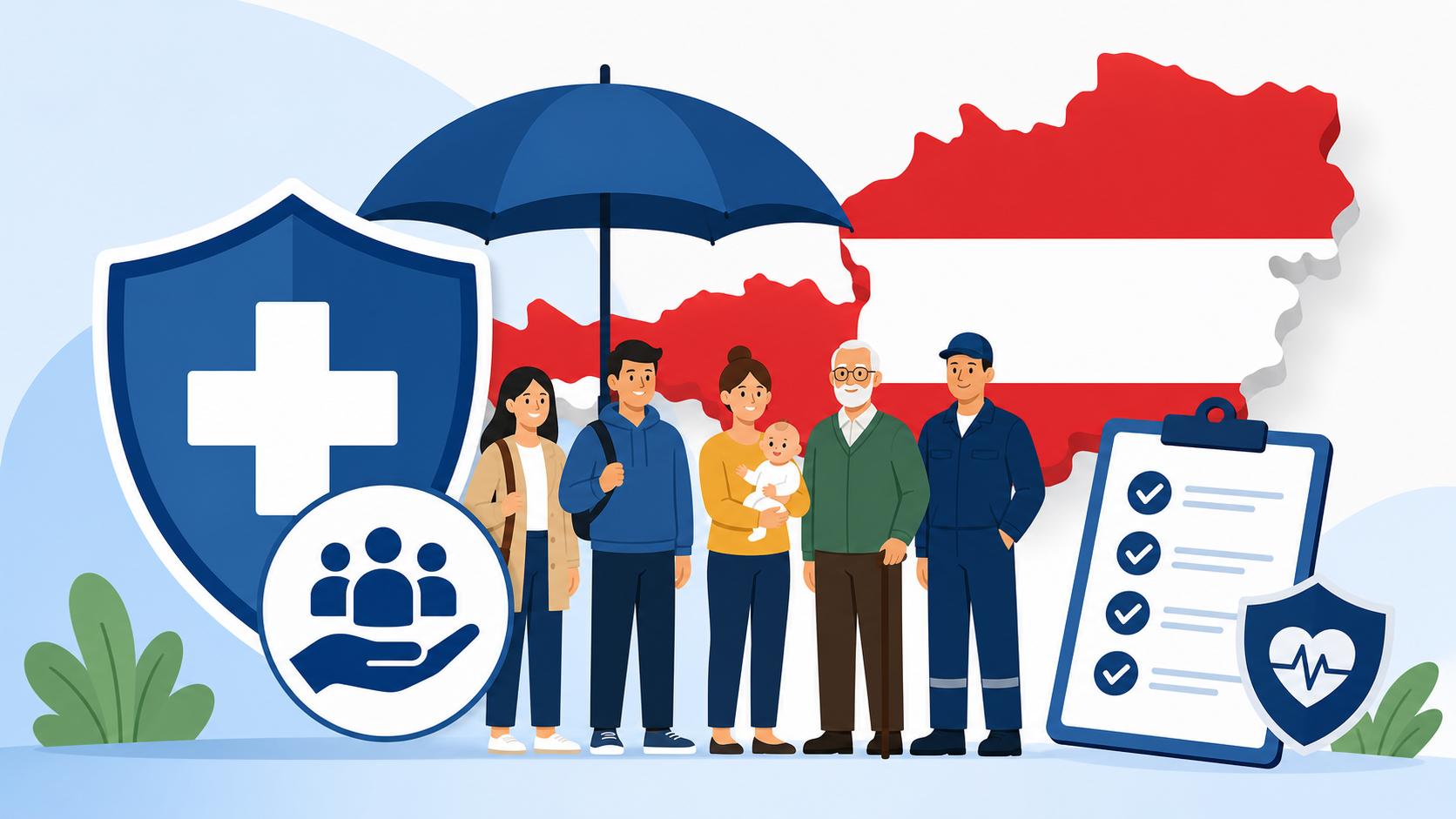
Mandatory Coverage: Who Must Register for Public Health Insurance
Arriving in Austria often feels like a high-speed collision with a wall of administrative paperwork, but nothing hits quite as hard as realizing health insurance is a mandatory legal obligation rather than a personal choice. I remember my first week in Vienna, staring at a confusing pay slip and wondering why so much of my salary had simply vanished before reaching my bank account. This guide breaks down exactly who must register for public health insurance to ensure you stay legally compliant and fully covered in this complex but rewarding system.
The Foundation of Social Solidarity in the Austrian Healthcare System
In Austria, health insurance is built on the principle of solidarity. This means the system is not designed as a "pay for what you use" model, but rather as a collective safety net where everyone contributes according to their means and receives care according to their needs. For an expat coming from a system where you pick and choose your coverage level, this can be a massive culture shock. You don't "shop" for public insurance here; if you meet certain criteria, you are legally compelled to be a member of a specific social insurance provider.
The Legal Basis for Compulsory Insurance
The Austrian social insurance system is governed by a strict legal framework that mandates coverage for almost every resident engaged in economic activity. This isn't just a recommendation from the Ministry of Health; it is a statutory requirement. When you take up a job or start a business, you are "automatically" insured by law. This compulsory membership ensures that the Austria Healthcare System 2027: Complete Guide for Foreign Residents remains solvent and capable of providing high-quality care to everyone, from newborns to retirees. The law effectively removes the risk of individuals "opting out" when they are young and healthy, only to seek entry when they become ill or aged.
From a practical perspective, this means that as soon as you enter a valid employment contract or register a business, the wheels of the social insurance machine begin to turn. You cannot waive this right, nor can your employer "agree" to pay you a higher gross salary in exchange for you providing your own private insurance. The Austrian authorities view health insurance as a public good and a personal protection that cannot be bargained away. This rigidity is what keeps the system stable, though it can feel restrictive to those used to more market-driven healthcare landscapes.
How the Social Insurance System is Funded
Funding for the mandatory public health insurance system comes directly from contributions based on income. If you are an employee, your contribution is split between you and your employer. These funds are funneled into one of the major insurance carriers, such as the ÖGK (Österreichische Gesundheitskasse) for most employees, or the SVS (Sozialversicherungsanstalt der Selbständigen) for those who are self-employed. Understanding Navigating Social Insurance: ÖGK, SVS, and BVAEB Overview is crucial because each carrier has slightly different contribution rates and administrative nuances.
The beauty—and the frustration—of this funding model is its invisibility for the average worker. Because the deductions happen at the source (your paycheck), many expats don't realize they are paying for insurance until they look at their Lohnzettel (pay slip). For the self-employed, however, the funding becomes very visible and often painful, as they must pay these contributions themselves, usually on a quarterly basis. Regardless of the method, these contributions grant you access to a vast network of doctors, hospitals, and specialists without the need for significant out-of-pocket payments at the point of service.
Employees and the Automatic Registration Path
For the vast majority of expats moving to Austria for a traditional job, the path to insurance is relatively smooth, at least on paper. The moment you sign an employment contract that exceeds a certain income threshold, your employer is legally required to register you with the social insurance provider. This is a non-negotiable step that must occur before you even start your first day of work.
The Employer Responsibility and the Registration Timeline
In Austria, the burden of registration for health insurance lies squarely on the shoulders of the employer. They must report your employment to the relevant insurance carrier (usually the ÖGK) before you commence work. Many newcomers worry about where to "sign up" for health insurance, but if you are a standard employee, you don't actually sign up at all. You provide your employer with your personal details, and they handle the digital filing. Once this is done, you are officially part of the Public vs Private Health Insurance in Austria Explained ecosystem, starting with the public tier.
It is worth noting that you should always ask your HR department for a copy of the "Abmeldung" and "Anmeldung" (registration) documents. These are your proof that you are legally covered. In the early days of your move, before your physical card arrives, these papers are your lifeline should you need to see a doctor. The employer is also responsible for deducting your portion of the social insurance contribution from your gross salary and forwarding it, along with their employer contribution, to the health insurance fund. This happens every single month, ensuring your coverage never lapses as long as you are employed.
Understanding the Mandatory Income Thresholds
Not every job automatically triggers full health insurance coverage. There is a specific boundary known as the Geringfügigkeitsgrenze. If you are working a very small part-time job or a "mini-job" where your monthly earnings are below this limit, you are only covered for accident insurance, not full health or pension insurance. This is a common trap for students or those picking up side gigs. If you find yourself in this position, you need to look into What is the Geringfügigkeitsgrenze (Marginal Earnings) for Health Insurance? to understand how to bridge the gap.
If you earn above this threshold (which is adjusted annually for inflation), you are "fully insured" (vollversichert). This status is what grants you the right to an e-card, access to general practitioners, and hospital care. For many expats, the goal is to always stay above this threshold to ensure they aren't hit with unexpected medical bills. If you have multiple small jobs that, when combined, exceed the limit, you will eventually be contacted by the insurance fund to pay back-dated contributions, which can be a nasty financial surprise if you aren't prepared for it.
Freelancers and the Self-Employed Mandate
If you are moving to Austria to work as a "Neue Selbständige" (new self-employed person) or if you are setting up a "Gewerbe" (trade), the rules for mandatory coverage change significantly. You are no longer under the umbrella of the ÖGK; instead, you fall under the jurisdiction of the SVS. This transition is often one of the most stressful parts of the expat journey because the safety net feels a lot thinner when you have to weave it yourself.
Registering with the SVS
Unlike employees, freelancers must take an active role in their registration. While the tax office (Finanzamt) and the Economic Chamber (WKO) often communicate with the SVS, you have a legal duty to notify the SVS of your self-employed activity within a month of starting. Failure to do so can result in fines and, more importantly, a lack of coverage during your first few weeks of operation. The SVS covers health, accident, and pension insurance in one package, and for most, this is not an optional "menu" where you can pick and choose.
The SVS Health Insurance: Rules for Freelancers and Self-Employed are distinct because they involve a "provisional" payment system. Since the SVS doesn't know exactly how much you will earn in your first few years, they charge a minimum contribution. Once your tax assessment (Einkommensteuerbescheid) is finalized a year or two later, they will calculate the actual amount you owed and either bill you for the difference or credit your account. This "look-back" system has bankrupted more than a few unsuspecting expats who didn't set aside enough money for the eventual back-payments.
Opting in vs. Mandatory Requirements for Small Freelancers
There is a nuance for freelancers who earn very little. Just like the Geringfügigkeitsgrenze for employees, there is an income floor for the self-employed. If your annual profit remains below this floor, you might not be mandatorily required to pay for full health insurance. However, this leaves you in a dangerous position: you would have no health coverage in Austria. In these cases, the SVS allows for "Opting-In," where you voluntarily pay a flat monthly fee to gain full health and accident insurance.
I highly recommend that any freelancer, even those just starting out with low revenue, looks into the How to Opt-in for Voluntary Health Insurance in Austria options. The peace of mind that comes with knowing a sudden appendicitis attack won't cost you €10,000 is worth the monthly premium. Remember, as an expat, your residency permit often depends on having proof of "all-risk" health insurance, and for the self-employed, the SVS Opt-in is usually the most legitimate and accepted way to satisfy the authorities at MA 35 or the local Bezirkshauptmannschaft.
Special Groups: Students, Families, and the Unemployed
Austria does not leave those outside the traditional workforce to fend for themselves, but the rules for mandatory registration for these groups require a bit more legwork. Whether you are here to study at the University of Vienna or you’ve moved to join a spouse, you must navigate specific registration pathways to ensure you aren't living in a "coverage gap."
Student Self-Insurance (Studierendenselbstversicherung)
International students from non-EU/EEA countries are usually required to show proof of health insurance to obtain and renew their student residence permit. While some use private travel insurance for the first few months, the gold standard is the student self-insurance provided by the ÖGK. This is a subsidized, mandatory-style insurance that offers the same benefits as a full-time employee but at a fraction of the cost.
To qualify for Student Self-Insurance Requirements and Monthly Costs 2026, you must meet certain criteria, such as a maximum number of semester changes and a proof of enrollment. If you exceed the age limit or stay in school for too many years without finishing, the price can jump significantly, or you may lose the right to this subsidized rate entirely. Many students are blindsided by a price hike because they didn't realize their "student status" for insurance purposes had expired even though they were still registered at the university.
Co-Insurance for Family Members (Mitversicherung)
One of the most generous aspects of the Austrian system is the ability to co-insure family members. If you are mandatorily insured through your job, you can often add your children and, under certain conditions, your spouse or partner to your policy at no extra cost (or for a small supplemental fee). This is known as Mitversicherung. This is not automatic; you must proactively apply for it with your insurance carrier.
The process of Co-insuring Family Members (Mitversicherung) on Your Policy involves submitting birth certificates, marriage certificates, and proof that the family member lives in the same household and does not have their own insurance. For children, it is almost always free and remains so until they finish their education (up to age 26 in many cases). For spouses, it is usually free if they are raising children or if they meet specific low-income requirements. If the spouse has no children and is simply not working, the primary insured person may have to pay an additional 3.4% of their gross income to cover them.
Coverage During Unemployment
If you lose your job in Austria, your health insurance does not immediately vanish. If you are eligible for unemployment benefits (Arbeitslosengeld) or the "Notstandshilfe," the AMS (Public Employment Service) effectively takes over the role of the employer. They will register you with the health insurance fund and cover the contributions. This ensures that a period of joblessness doesn't lead to a medical catastrophe. However, you must be registered with the AMS to trigger this coverage. If you simply quit and don't register, you could find yourself uninsured after a short grace period.
| Insurance Category | Primary Provider | Registration Trigger | Responsibility |
|---|---|---|---|
| Standard Employee | ÖGK / BVAEB | Salary > Geringfügigkeitsgrenze | Employer |
| Self-Employed | SVS | Business Registration / Profit | Individual |
| Student (Non-EU) | ÖGK | University Enrollment | Individual (Application required) |
| Marginal Earner | ÖGK (Partial) | Salary < Geringfügigkeitsgrenze | Employer (Accident only) |
| Family Dependent | Spousal/Parental Fund | Family Relationship | Primary Insured (Application required) |
The Logistics of Registration and the e-card
Once the registration process is initiated—whether by your employer, the SVS, or your own application—the tangible proof of your membership is the e-card. This little green (and sometimes blue) card is the most important piece of plastic in your wallet. It contains your social security number and serves as your "key" to the healthcare system.
When Registration Happens and the Social Security Number
Your social security number (Sozialversicherungsnummer) is a 10-digit code that stays with you for life in Austria. The first four digits are based on your birthdate, while the last six are assigned by the system. When you are first registered, this number is generated. If you have ever worked in Austria before, even years ago, you already have one, and you should provide it to your new employer or the SVS to avoid duplicate profiles in the system.
The Austrian e-card: Registration, Photo Rules, and Usage Guide is essential reading because, since 2020, almost all e-cards require a photo. For many expats, this means a trip to the police station or a specific registration office to have your photo linked to your social security number before the card can be issued. Without a photo on file, your card will not be sent, and while you are technically "insured" in the database, seeing a doctor becomes significantly more difficult as you'll constantly need to prove your identity with a passport and paper certificates.
Checking Your Insurance Status
One of the best tips I can give a new expat is to not just "assume" everything is fine. You can check your insurance status online via the "Meine SV" portal or by using the ID Austria app. This is particularly important for those in the freelance world or those working for smaller startups where administrative errors are more common. If you log in and see that your status is "nicht versichert" (not insured), you need to act immediately.
The e-card also acts as your European Health Insurance Card (EHIC) on the reverse side. This means that your mandatory Austrian coverage extends to emergency care in other EU/EEA countries. However, this is only valid if the fields on the back of the card are filled out. If they contain stars (****), it means your insurance hasn't been active long enough or there is an administrative issue. Keeping an eye on these details can save you a massive headache if you decide to take a weekend trip to Bratislava or Munich.
Avoiding the Gaps: Penalties and Late Registration
The Austrian system is efficient, but it can be unforgiving when it comes to delays. Because insurance is mandatory, "forgetting" to register is not seen as a simple mistake; it's viewed as a failure to comply with social law. The consequences of having a gap in your coverage can range from annoying administrative hurdles to significant financial penalties.
The Risks of Being Uninsured
If you are living in Austria and fall between the cracks—perhaps you quit your job and didn't register with the AMS, or you started freelancing but didn't tell the SVS—you are effectively "uninsured." If you need medical care during this time, you will be billed as a "Privatpatient." A single night in a public hospital can cost upwards of €800, and a standard GP visit can be €100 or more. Furthermore, if you later try to register, the insurance fund will often look back at the date you "should" have been insured and demand back-payments for all the months you missed.
These back-payments are not optional. The insurance fund has the legal right to garnish wages or take legal action to recover these funds. Expats can be hit with bills for €2,000 or more because they waited six months to register their freelance business. The system operates on the logic that since you had the right to care during that time (even if you didn't use it), you owe the contributions for that time.
Administrative Hurdles and Residency Permits
For third-country nationals (non-EU/EEA), a gap in health insurance can be a death knell for a residency permit. When you go to the MA 35 or your local authority to renew your Red-White-Red card or student permit, they will check your insurance history. If they see a gap where you were not covered by a mandatory or recognized private policy, they can deny your renewal on the grounds that you have become a "burden on the state" or have failed to meet the requirements of your stay.
Always ensure that one insurance policy overlaps with the next. If you are transitioning from a job to self-employment, don't wait for your first invoice to arrive to think about insurance. Contact the SVS the same day your employment ends. If you are a student graduating and moving to a job-seeker visa, ensure you know the exact date your student insurance expires. Staying proactive is the only way to navigate the mandatory coverage rules without falling into the "cold sweat" of an Austrian administrative audit.
Disclaimer
This guide is intended for informational purposes only and does not constitute legal or professional medical advice. While every effort has been made to ensure the accuracy of the information provided based on the 2026 Austrian health insurance regulations, laws and thresholds are subject to change. Readers should consult with official sources such as the ÖGK, SVS, or a qualified legal advisor regarding their specific circumstances. Be aware that individual cases, especially those involving cross-border employment or complex residency statuses, may require specialized consultation not covered in this general overview.