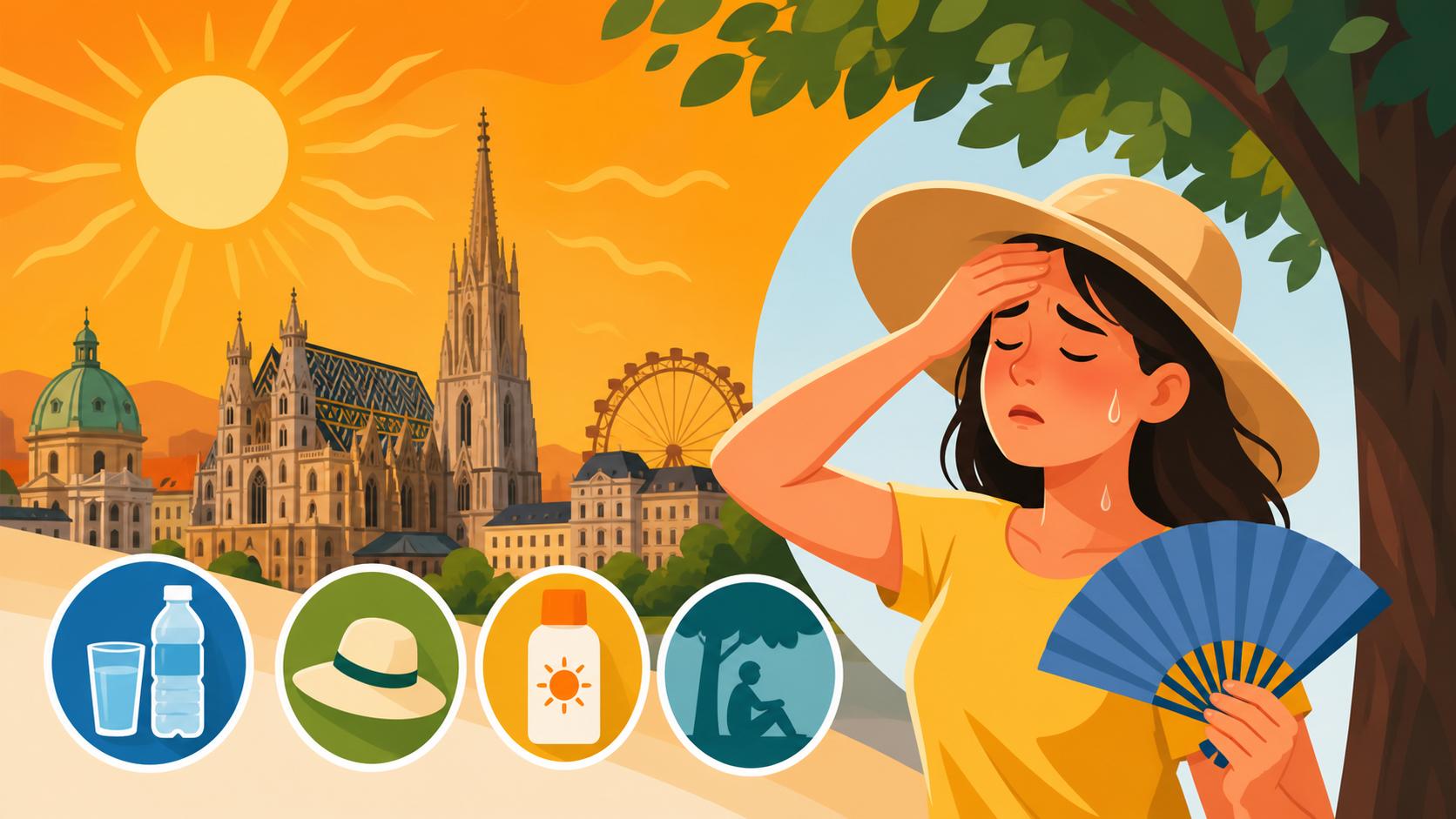
Preventing Summer Heatstroke During Vienna Heatwaves
Vienna’s charm often hides a sweltering reality: when a heatwave hits, the city’s stunning imperial architecture turns into a series of beautiful brick ovens. I remember my first August in a fourth-floor Altbau without air conditioning; I spent three nights sleeping on a damp towel just to catch an hour of rest. This guide provides the essential survival strategies and medical knowledge you need to navigate Austrian summers safely.
Understanding the Vienna Heat Island and Heatstroke Risks
The phenomenon known as the Urban Heat Island effect is particularly intense in Vienna. Because many of the central districts, such as the 6th, 7th, and 8th, are densely packed with stone buildings and have relatively few green spaces compared to the outskirts, the city stays significantly hotter than the surrounding Vienna Woods. During a heatwave, these buildings absorb solar radiation all day and release it slowly throughout the night, meaning your apartment might never actually cool down. This constant exposure to high temperatures is what leads to heat exhaustion and, eventually, life-threatening heatstroke.
As an expat, you might be coming from a climate where air conditioning is standard, or perhaps a place where it’s even hotter but the infrastructure is built for it. In Vienna, the lack of widespread cooling in residential buildings means your body is under constant stress. Heatstroke occurs when your internal cooling system—sweating—fails, and your core temperature rises above 40 degrees Celsius. It is a medical emergency that requires immediate intervention from Emergency Services in Austria: 144, Hospitals, and Crisis Steps.
Recognizing the Warning Signs
Before heatstroke sets in, you will likely experience heat exhaustion. The transition can be rapid, especially for children, the elderly, or those newly arrived who aren't yet acclimated to the local environment. Symptoms of exhaustion include heavy sweating, a rapid pulse, dizziness, and muscle cramps. If you start feeling nauseous or develop a throbbing headache, you are entering a dangerous zone.
When searching for Finding Medical Care in Austria: Clinics, Hospitals, and Referrals, it’s important to know that heat-related issues are taken very seriously by local practitioners. If you are unsure whether your symptoms require an emergency room visit, you should call the health advice line. Calling 1450: Austria's 24/7 Telephone Health Advice Line is staffed by medical professionals who can tell you if you should head to a clinic or wait for an ambulance.
| Symptom | Heat Exhaustion | Heatstroke |
|---|---|---|
| Body Temperature | Normal or slightly elevated | Above 40°C |
| Skin State | Cool, clammy, and pale | Red, hot, and dry (no sweat) |
| Pulse | Fast and weak | Fast and strong |
| Mental State | Tired or weak | Confused, dizzy, or unconscious |
| Nausea | Possible vomiting | Likely vomiting |
High-Risk Groups in the Expat Community
Expats who spend their first summer in Austria often underestimate the intensity of the sun in the mountains or the humidity in the city. If you are working a physically demanding job or if you are a student rushing between university buildings, you are at a higher risk. Additionally, those who have not yet navigated the Vienna Healthcare Guide: Top Expat Clinics and Hospitals might feel hesitant to seek help due to language barriers, but in a heatwave, delay can be fatal.
Staying Cool Using Vienna’s Public Infrastructure
The City of Vienna is well aware of its "oven" reputation and has invested heavily in cooling infrastructure. One of the best things about living here is the access to free, high-quality drinking water. There are over 1,300 drinking fountains (Trinkbrunnen) scattered across the city. You will see them in parks, at U-Bahn stations, and on busy street corners.
Hydration is your first line of defense. Many newcomers ask, Is Austrian Tap Water Really Safe to Drink Everywhere?, and the answer is a resounding yes. It comes directly from the Alps and is often cooler and fresher than bottled water. Carrying a reusable bottle and refilling it at every fountain you pass is a non-negotiable habit for surviving July and August.
Cooling Centers and Coole Straßen
During extreme heatwaves, the city opens "Cooling Centers." These are air-conditioned public spaces where anyone can go to sit and cool down for a few hours. These are often located in community centers or specific Red Cross locations. Additionally, Vienna designates certain streets as "Coole Straßen" (Cool Streets). These areas feature misting showers (Nebelstelen), more seating, and extra shade.
If you find yourself stuck in a district like Favoriten or Ottakring where trees are sparse, look for these misting stations. Even thirty seconds under a fine mist can lower your skin temperature enough to prevent the onset of heat dizziness. If you are feeling particularly unwell and cannot find shade, don't hesitate to enter a supermarket or a large pharmacy; these are almost always air-conditioned and can provide a temporary refuge.
Natural Cooling: The Danube and the Parks
When the city center becomes unbearable, residents flock to the water. The Donauinsel (Danube Island) and the Alte Donau (Old Danube) are essential for summer survival. These areas offer miles of shaded banks and clean water for swimming. However, be mindful that the journey to these spots on public transport can be hot itself.
Always check the Emergency Numbers: 144 Ambulance, 133 Police, 122 Fire if you see someone struggling near the water. Heat can cause sudden fainting, which is particularly dangerous near docks or steep banks. If you are planning a full day at the Alte Donau, ensure you are also aware of the locations of nearby Pharmacies (Apotheken) and Medication Rules in Austria to pick up rehydration salts or high-factor sunscreen.
The Art of Apartment Cooling: The Expat’s Dilemma
The most frustrating part of a Vienna heatwave is coming home to an apartment that is 30 degrees inside. Most traditional apartments (Altbau) do not have air conditioning, and installing it is a legal nightmare involving monument protection laws and the unanimous consent of all neighbors in the building. As a result, you have to master the Austrian art of "Lüften."
In the summer, Lüften: The Austrian Art of Ventilating Rooms in Winter is reversed. You must keep all windows and shutters (Außenrollläden) tightly closed from 8:00 AM until at least 9:00 PM. The goal is to trap the "cool" night air inside and prevent the sun from hitting the glass, which creates a greenhouse effect. If your apartment doesn't have external shutters, even heavy internal curtains or reflective foil on the windows can make a five-degree difference.
Managing Indoor Humidity and Mold
A common mistake expats make is leaving the windows "tipped" (auf Kipp) during the day. This just lets the hot air in. Only when the outside temperature drops below the inside temperature should you open everything wide to create a "Durchzug" (cross-breeze). This is also crucial for Preventing Mold (Schimmel) in Old Altbau Apartments, as stagnant, humid air in a hot apartment can lead to fungal growth in corners that don't get much circulation.
If you are struggling to sleep, use a fan, but don't point it directly at your face all night, as this can dry out your mucous membranes and lead to a "summer cold." A pro tip I learned from a local neighbor: hang a wet bedsheet in front of a running fan. The evaporation process pulls heat out of the air, providing a low-tech version of air conditioning that can help you drop off to sleep during those dreaded "Tropical Nights" (nights where the temperature stays above 20°C).
Legal Realities of Air Conditioning
If you decide you cannot live without AC, be prepared for a long process. Renters generally cannot install split-unit ACs without landlord permission, and in many districts, the external unit is prohibited for aesthetic reasons. Portable AC units (Monoblocks) are a common compromise, but they are loud and require a hose to be vented out a window—which often lets more heat in. If you are considering a permanent installation, consult with your landlord early, but be aware that the cost is entirely yours, and you may have to leave the unit behind when you move.
What to Do in a Medical Heat Emergency
If you or someone you are with starts showing signs of heatstroke—such as confusion, a lack of sweating despite the heat, or loss of consciousness—you must act immediately. This is not the time for a "wait and see" approach. In Austria, the emergency system is highly efficient, and the responders are trained for these seasonal spikes in cases.
First, call 144. If your German is limited, simply say "Notfall" (emergency) and "Hitzeschlag" (heatstroke). The dispatchers usually have English speakers available. While waiting for the ambulance, move the person to the coolest possible place. Remove excess clothing and apply cool (not ice-cold) water to their skin. Fan them vigorously. If they are conscious, give them small sips of water, but do not force them to drink if they are vomiting or confused.
Financial and Administrative Considerations
Many expats worry about the cost of emergency care. If you are registered and working here, you likely have ÖGK or another public insurer. You might wonder, Is Calling an Ambulance Free in Vienna?. Generally, if it is a genuine medical emergency like heatstroke, the costs are covered by your social insurance. However, if the situation is less dire, you might be billed a transport fee.
For those who are here as students or on specific visas, ensure your health insurance is active. If you lose your card during the chaos of a heatwave, you should follow the Lost e-card: Reporting and Replacement Process Explained steps as soon as you are recovered. Having your e-card or a photo of it on your phone makes the hospital intake process much smoother.
Post-Heatstroke Recovery
Recovering from heat exhaustion or heatstroke takes time. Your body’s temperature regulation will be sensitive for weeks afterward. It is vital to avoid direct sun and heavy exertion during this period. You should also schedule a follow-up with your Hausarzt (General Practitioner) to ensure there hasn't been any lingering strain on your kidneys or heart. This is a good time to use the Annual Free Health Checkup (Gesundenuntersuchung) Details to get a full blood panel and check your general health status after the stress of a heatwave.
Health and Medical Disclaimer
The information provided in this guide is for educational and informational purposes only and is not intended as professional medical advice, diagnosis, or treatment. Always seek the advice of your physician or other qualified health provider with any questions you may have regarding a medical condition. Never disregard professional medical advice or delay in seeking it because of something you have read in this guide. If you think you may have a medical emergency, call 144 or your local emergency services immediately. Operating in the high temperatures of an Austrian summer carries inherent risks, and individual health needs may vary significantly.