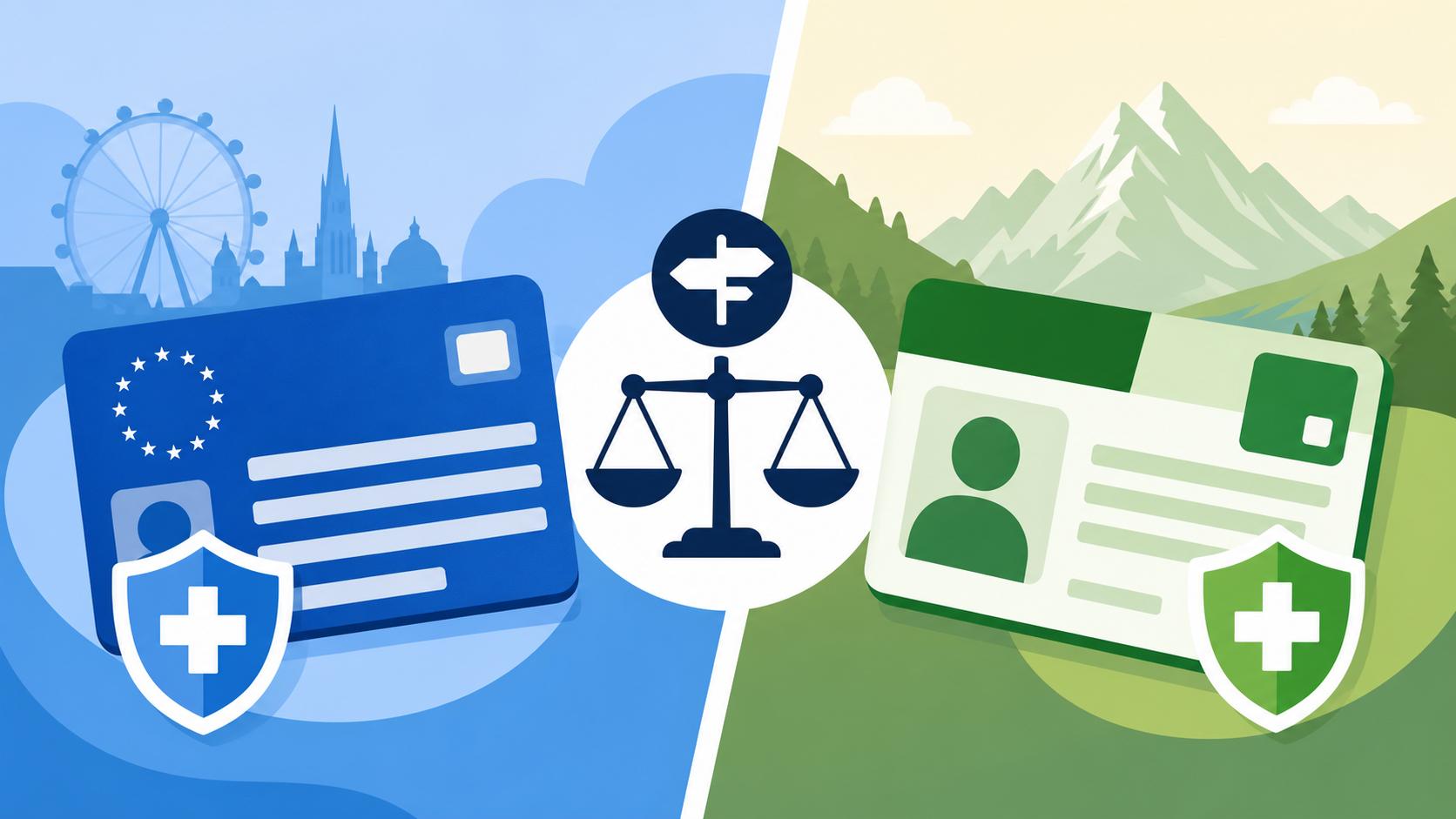
EHIC vs Austrian e-card: Which Do You Need?
Standing in line at a cold, clinical doctor's office in Vienna while feeling like you have the weight of the world in your sinuses is bad enough without the receptionist telling you your insurance card is invalid. I remember the panic of my first winter here, clutching a plastic card from my home country and being met with a confused head-shake that nearly sent me into a bureaucratic meltdown. This guide clarifies the massive differences between the European Health Insurance Card (EHIC) and the Austrian e-card so you never face that "payment required" sign when you are at your most vulnerable.
Decoding the Two Cards: What They Are and Who They Are For
At first glance, they both look like standard plastic ID cards, but their legal weight in the Austria Healthcare System 2027: Complete Guide for Foreign Residents is entirely different. The European Health Insurance Card (EHIC) is designed for travelers. It is a reciprocal agreement between EU/EEA countries and Switzerland that allows you to access state-provided healthcare during a temporary stay. If you are here for a three-week holiday or a short business trip, the EHIC is your primary safety net. It tells the Austrian state that your home country will eventually foot the bill for your emergency or necessary treatments.
The e-card, however, is the cornerstone of life as a resident. The moment you take up employment, start a degree, or settle down as a freelancer, you enter the realm of Public vs Private Health Insurance in Austria Explained. The e-card is not just a proof of insurance; it is a digital key. It contains your social security number, your insurance status, and, it is increasingly linked to your electronic health records. While the EHIC is about "getting by" until you go home, the e-card is about "living here" and accessing the full suite of preventive and long-term care.
Many expats fall into the trap of thinking their EHIC from their home country is "good enough" for their first year of residency. I tried this, and let me tell you, it backfires the moment you need a routine check-up. The EHIC does not cover elective procedures, dental hygiene, or chronic disease management in the same way a local policy does. If you are living here, you are legally required to be part of the local system, and that means getting your hands on a domestic e-card as soon as possible.
When the EHIC is Your Best Friend and When It Is Not Enough
The EHIC is a masterpiece of European cooperation, but it has very sharp boundaries. It covers "necessary care." This is a flexible term that usually includes anything that cannot wait until you return to your home country. Think of broken legs, sudden pneumonia, or an acute toothache. If you find yourself needing Emergency Services in Austria: 144, Hospitals, and Crisis Steps, the EHIC will ensure you are treated without an upfront bill that looks like a mortgage payment.
However, the EHIC is not a "get out of jail free" card for all medical costs. In Austria, even with an EHIC, you are subject to the same rules as locals. This means if locals pay a small co-pay for a hospital stay or a prescription fee at the pharmacy, you will too. Furthermore, the EHIC is strictly for public healthcare providers. If you accidentally walk into a private clinic (Privatordination), your EHIC is essentially a decorative piece of plastic. You will be billed as a private patient, and your home country will likely refuse to reimburse those costs.
For those moving here permanently, it is vital to know How to Renew Your European Health Insurance Card (EHIC) if you are still in a transition phase, but do not rely on it once your Meldezettel (address registration) is processed. Once you are an official resident, the Austrian authorities expect you to contribute to the local social security fund. If you continue using a foreign EHIC while working in Graz or Linz, you might eventually face a "competence conflict" where the Austrian insurance carrier realizes you should have been paying into their system all along.
Comparison of EHIC vs Austrian e-card
| Feature | EHIC (Foreign) | Austrian e-card |
|---|---|---|
| Primary Use | Temporary stays (Tourism/Business) | Residency (Work/Study/Living) |
| Coverage Scope | Necessary & Emergency care only | Full care, including preventive & chronic |
| Provider Access | Public doctors/hospitals only | Public doctors (Kassenärzte) |
| Digital Features | None (Visual verification) | e-Rezept, ELGA, Social Security ID |
| Residency Requirement | Must be a resident of issuing country | Must be a resident of Austria |
| Validity | Defined by home country (usually 1-5 years) | Permanent while insured in Austria |
The Austrian e-card: The Golden Ticket for Residents
Once you are registered with the ÖGK (Austrian Health Insurance Fund) or SVS (for the self-employed), you will receive your e-card in the mail. This card is arguably the most important document in your wallet after your residence permit. It facilitates The Austrian e-card: Registration, Photo Rules, and Usage Guide process, which has become significantly more regulated in recent years. Specifically, since 2024, almost everyone must have a photo on their e-card to prevent insurance fraud.
If you are an EU citizen or a third-country national with a residence permit, the system usually pulls your photo from the passport or ID database automatically. But if you are like me and your photo was taken a decade ago, or if you don't have a local driving license, you might need to visit a registration office. Don't make that mistake; ensure you understand The e-card Photo Requirement: How and Where to Register to keep your access seamless.
Using the card is incredibly simple. When you are Booking a Kassenarzt (Public Doctor): Wait Times and Tips, you simply hand the card to the receptionist. They "swipe" it, and the system instantly verifies that you are currently insured. This eliminates the need for complex paperwork or reimbursement claims for most standard visits. The e-card also powers the "e-Rezept" system. When a doctor prescribes medication, it is uploaded to your card digitally. You then go to any pharmacy, present your e-card, and they pull up your prescription immediately.
Practical Scenarios: Which Card Should You Flash
Navigating the transition between being a "visitor" and a "resident" is where most of the confusion happens. If you are a student, for example, your situation depends entirely on your insurance status. If you are here for a single Erasmus semester and remain insured in your home country, your EHIC is your primary tool. However, most long-term students find it much easier and more comprehensive to opt for Student Self-Insurance Requirements and Monthly Costs 2026, which grants them a full Austrian e-card and covers them for routine check-ups and local specialists.
If you have just arrived and started a job, you are in a "gray zone" for the first week or two. Your employer is legally required to register you with the health insurance fund on your first day. However, the physical e-card can take 10 to 14 days to arrive in your mailbox. During this gap, your foreign EHIC can still be used for emergencies, but for anything else, you should ask your employer for your "Versicherungsnummer" (social security number). Most doctors can look you up in the system using just that number and your ID until your physical card arrives.
For those who are self-employed or freelancers, the rules change slightly. You will likely be under the SVS umbrella rather than the ÖGK. This means you have different co-payment structures, but the physical card looks exactly the same. It is part of the Mandatory Coverage: Who Must Register for Public Health Insurance framework that ensures no one living in Austria is left without a safety net. Even if you are "Geringfügig" (earning below the marginal limit), you can opt into voluntary insurance to get your e-card.
Transitions and Troubleshooting: Going From EHIC to e-card
The moment your Austrian e-card is issued, the EHIC on the back of your foreign card technically becomes secondary or void for use within Austria. Interestingly, the Austrian e-card actually has an EHIC on the back of it as well! This is for when you travel away from Austria to other EU countries. It’s a full-circle system: you use the front of the card (the e-card part) inside Austria, and the back of the card (the EHIC part) when you go on holiday to Italy or back home to visit family in Ireland or Spain.
If you ever lose your card, do not panic, but act quickly. A Lost e-card: Reporting and Replacement Process Explained involves calling the e-card service hotline or reporting it via the "Meine SV" portal. They will block the old card and send a new one for a small fee. In the meantime, you can get a "replacement document" (Ersatzbeleg) from your insurance provider that acts as a temporary pass so you can still see a doctor that afternoon.
Finally, as you settle in, make sure your first month's admin includes checking your insurance status. I highly recommend looking at a Healthcare Checklist for Your First 30 Days in Austria to ensure you haven't missed a registration step. The Austrian system is incredibly efficient once you are "in," but getting the right card in your hand is the first and most vital hurdle to clear. Whether you are using a foreign EHIC as a newcomer or your shiny new e-card as a resident, knowing the limits of each will save you from both physical and financial headaches.
Social Insurance and Usage Restrictions
It is important to remember that the e-card is a personal document. Sharing it with a friend or family member who isn't insured is a serious legal offense in Austria and can lead to heavy fines or the loss of your own insurance benefits. If you have family members moving with you, they generally do not "share" your card. They must be either co-insured on your policy or have their own independent coverage.
Furthermore, the e-card does not automatically mean every single treatment is free. Austria uses a "Kassen" system where certain doctors have contracts with the public insurance (ÖGK/SVS) and others do not. If you go to a "Wahlarzt" (private doctor), you will still use your e-card for the prescription part (e-Rezept), but you will have to pay the doctor's bill upfront and then submit it for a partial refund. Always check if a doctor is a "Kassenarzt" before you book if you want to avoid out-of-pocket expenses.
Healthcare Card Comparison and Usage Summary
To wrap up the technicalities, always look at the expiration date on the back of your card. Even if the e-card on the front has no expiration date, the EHIC portion on the back does. If you are an Austrian resident traveling abroad and that date has passed, your card won't work in a German or French hospital. You can check your status online via the ID Austria app, which has become the primary way to manage all government and health-related data.
Managing your healthcare cards is one of those small but significant "adulting" tasks in Austria. Once you have the right plastic in your wallet and you've verified your photo is on file, the system works like a well-oiled machine. You'll find that doctors are thorough, pharmacies are everywhere, and the peace of mind that comes with knowing you’re covered is worth every bit of initial paperwork.
Disclaimer
This article is for informational purposes only and does not constitute legal or medical advice. Healthcare regulations and insurance laws in Austria, including the rules regarding the EHIC and e-card, are subject to change. For the most current information, please consult the official portal of the Austrian Social Security (Sozialversicherung) or contact your specific insurance provider (ÖGK, SVS, or BVAEB). Always verify your insurance status with a qualified professional before seeking non-emergency medical treatment.