Converting a US Driver’s License to an Austrian One
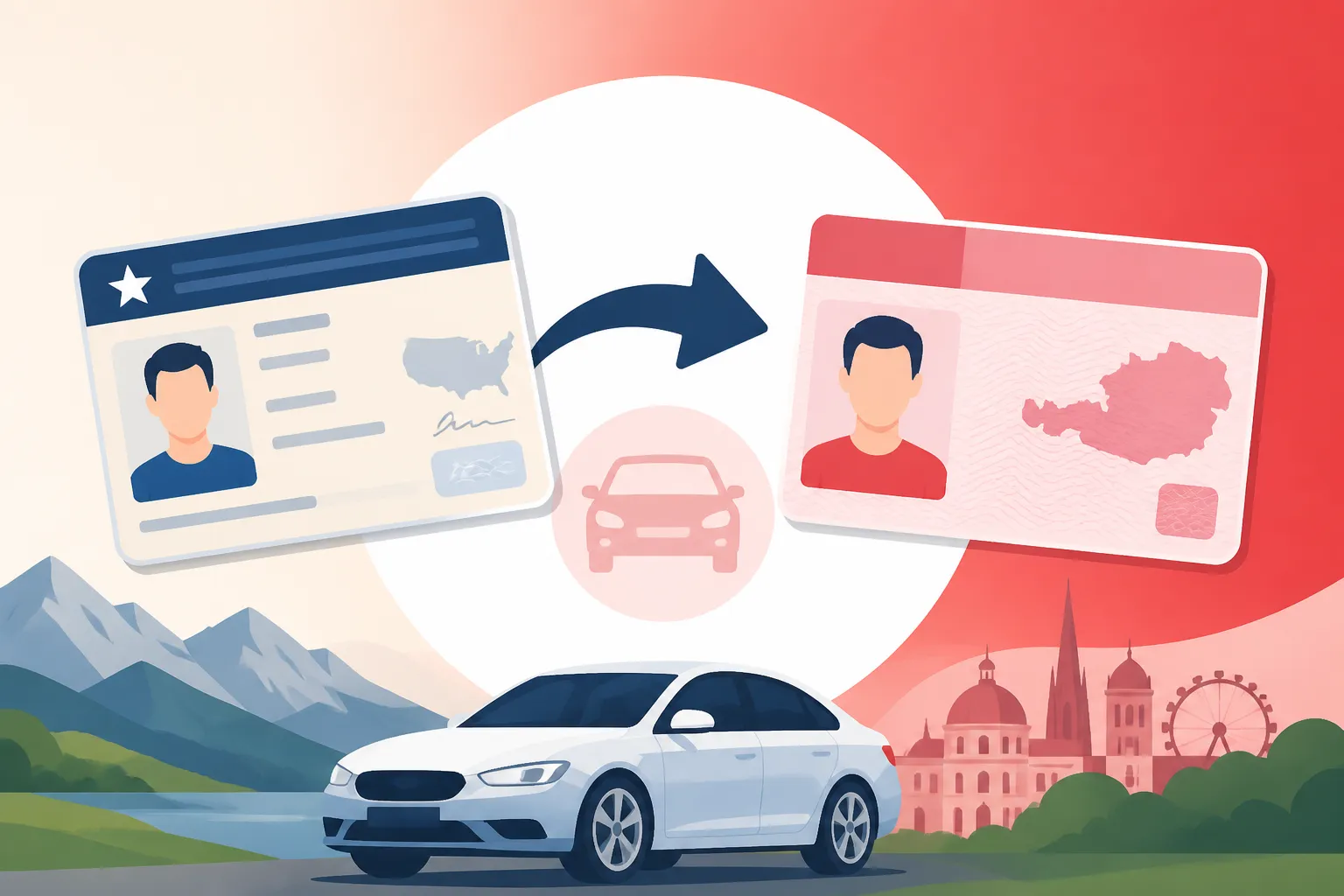
The moment you realize your shiny US driver’s license is about to become a decorative piece of plastic in your wallet is a rite of passage for every American expat here. I remember the cold sweat I broke into when I found out my Virginia license would only be legal for six months after my Meldezettel date. This guide is your roadmap to navigating the "Umschreibung" (conversion) process without losing your mind to the bureaucracy.
The Brutal Reality of the 6-Month Deadline
If you have established your "center of life" in Austria, the clock starts ticking the very day you register your address. You are legally allowed to drive with your valid US license and an International Driving Permit (IDP) for exactly six months. After that, if you are caught behind the wheel without having started the conversion process, you aren't just a "tourist with a lapse in paperwork"—you are driving without a license. This can lead to massive fines and, more importantly, it completely voids your insurance coverage if you get into an accident.
Why the Meldezettel Date is King
Your residency officially begins on the date printed on your first registration form. Some expats try to argue that they were "just visiting" for the first three months, but the authorities look at one thing: The Meldezettel Process: Registering Your Address Legally. From that date, you have 180 days to drive legally. However, the conversion process itself can take several weeks or even months if the offices are backed up, so I highly recommend starting the application at the four-month mark.
The Problem with US State Reciprocity
Unlike some countries that have a "full reciprocity" agreement with Austria (like South Africa or Canada), the United States is a patchwork of state-level rules. Most US states do not have a full exchange agreement. This means that while you can "convert" your license, you will almost certainly be required to take a practical driving test (but usually not the theory exam). This is a major pain point because Austrian driving standards are significantly more rigorous than what most of us experienced at sixteen back in the States.
Driving During the Transition
One of the most frequent questions I get is whether you can keep your US license while the application is pending. The answer is yes, you keep your physical US license while they process the paperwork. However, once they issue your new Austrian credit-card style license, you must surrender your US license. They send it back to the issuing authority in the States (or keep it in a file at the LPD). I found this heart-wrenching, but it’s the law—you aren't supposed to hold two different licenses simultaneously in the EU.
The Paperwork Mountain: Documentation and Translations
Austrian bureaucracy thrives on "Originale und Kopien" (originals and copies). You cannot show up to the Verkehrsamt (Traffic Office) or the Bezirkshauptmannschaft (District Authority) empty-handed. If you are in Vienna, you’ll be heading to the Landespolizeidirektion (LPD) at Dietrichgasse. If you’re in a smaller town, you’ll go to your local BH.
Essential Document Checklist
To ensure you don’t get sent home for a missing staple, prepare the following:
- Your valid US Driver’s License (original plus a high-quality color copy of the front and back).
- A certified German translation of your license (more on this below).
- Your Passport (original plus copy).
- Your current Meldezettel.
- Your Residence Permit (e.g., Red-White-Red Card or EU Blue Card).
- One passport-sized photo (standard EU dimensions, 35x45mm, no smiling!).
- A medical certificate from a designated doctor (Amtsärztliches Gutachten).
The "Certified Translation" Requirement
You cannot just translate your license yourself or have a bilingual friend do it. It must be a "beglaubigte Übersetzung" performed by a court-certified translator in Austria. They will bind the translation to a copy of your license with a special seal. This usually costs between €30 and €60. If your license doesn't clearly state the vehicle classes you are allowed to drive (which most US licenses don't in a way Europeans understand), the translator will clarify that "Class D" in your state equals "Class B" in Austria. Check the rules for Certified Translations of Documents: What the Rules Demand to find a reputable provider.
Proving Your Original Issue Date
Sometimes, US licenses only show the "renewal date" rather than the "original issue date." Austria needs to see that you’ve held your license for at least two years to avoid being put on a "Probationary License" (Probeführerschein) status. If your card doesn't show the original date, you may need to order a "Driving Record" or "Abstract" from your home state's DMV before you leave the US. Getting this while already in Austria is a nightmare, so grab a digital copy before you move.
The Medical Check and Finding a Doctor
Before you even submit your application, you must pass a basic medical screening. You cannot simply go to your Finding an English-Speaking Hausarzt in Your District. It must be a doctor who is officially authorized to perform "Führerscheinuntersuchungen."
What Happens During the Exam?
The exam is relatively straightforward but surprisingly old-school. They will check your eyesight (bring your glasses or contacts!), test your hearing, check your blood pressure, and ask about any chronic conditions like diabetes or epilepsy. They also check your mobility—I had to hop on one foot and touch my nose with my eyes closed. It feels a bit like a field sobriety test, but it’s just to ensure you have the physical coordination to operate a vehicle.
Costs and Validity
The fee for this exam is fixed by law. For a standard Class B license, it usually costs around €35. You will receive a paper certificate that is valid for 18 months. Make sure you don't lose this! You’ll need to submit the original with your application. If you have any medical complexities, the doctor might refer you to a specialist or the "Amtsarzt" (the government’s head medical officer), which can add weeks to your timeline. This is why Healthcare Checklist for Your First 30 Days in Austria is so important—getting your health paperwork in order early saves you from these bottlenecks.
| Fee Type | Estimated Cost (2026) | Notes |
|---|---|---|
| Certified Translation | €40 – €60 | Must be a court-certified translator. |
| Medical Examination | €35 | Fixed price for Class B. |
| Application Fee | €60.50 | Paid to the LPD or BH. |
| Practical Test Fee | €130 – €200 | Includes driving school car rental. |
| Passport Photo | €10 – €15 | Must meet EU biometric standards. |
Surviving the Practical Driving Test (Praktische Prüfung)
Because most US states lack full reciprocity, you will likely be required to take a "Praktische Fahrprüfung." Don't let your ego get in the way here; even if you’ve been driving for 20 years, the Austrian test is different. In the US, we're used to wide lanes and automatic transmissions. In Austria, the examiners are looking for "Active Driving" and strict adherence to European rules.
Why You Should Take 1-2 Lessons First
I highly recommend contacting a local "Fahrschule" (driving school) and asking for a couple of "Refresher" hours. Why? Because you need to learn the "Schulterblick" (the deep shoulder check). In Austria, if you don't visibly turn your head to check your blind spot every single time you turn or change lanes, you will fail instantly. You also need to understand "Priority from the Right" (Rechtsregel), which is a concept that barely exists in American suburbia but is the law of the land in European residential areas.
The Test Vehicle
Unlike the US, where you can bring your own car to the DMV, in Austria, the test is usually conducted in a driving school car. If you take your test in an automatic, your license will be restricted to "Automatic Only." If you want the freedom to rent those cheap manual cars for a weekend trip to the Alps, you must take the test in a manual (stick-shift) vehicle. If you aren't comfortable with a clutch, stick to the automatic—it’s not worth failing over a stalled engine at a stoplight. While you're at it, consider Buying a Car vs Using Car-sharing (ShareNow, Miles) to see which option fits your lifestyle better after you get your license.
Common Reasons for Failing
The examiner will sit in the back, and your driving instructor will sit in the passenger seat. They aren't looking for "good" driving; they are looking for "legal" driving.
- Failure to yield: Not stopping fully at a stop sign or ignoring a pedestrian at a zebra crossing.
- Speeding: Even going 53 km/h in a 50 km/h zone is a fail.
- Eco-driving: They actually check if you are shifting gears at the right time to save fuel.
- Winter readiness: If you're testing in winter, they might ask you about Mandatory Winter Tires Rule: November 1 to April 15.
Costs, Timelines, and Picking Up Your Card
Once you pass your test (congrats!), the examiner will give you a temporary paper permit. This is only valid in Austria! Do not try to drive across the border into Germany or Italy until your actual plastic card arrives in the mail.
The Waiting Game
Your permanent license usually arrives via post within two weeks. It is valid for 15 years, after which you just need to update the photo (no new test required). Make sure your name is clearly on your mailbox; the Austrian Post is notorious for returning government mail if the name doesn't match perfectly. If you are moving soon, check Informing MA 35 When Moving to a Different Vienna District to ensure your records are updated.
Total Investment
Expect the entire process to cost between €300 and €500 depending on how many driving lessons you take and the cost of your translator. It’s a significant investment, but when you consider the cost of Public Transport Passes: Weekly, Monthly, and Annual Options versus the freedom of having a car for mountain trips, it’s worth every cent.
What Happens to Your US License?
As mentioned, the Austrian authorities are technically required to take your US license. Some expats report that their home state never received it back, while others had their home state cancel the license immediately. If you plan to return to the US for a visit, you can usually drive there on your Austrian license as a "tourist," or you can apply for a replacement license back in the States if you maintain a US address. Just be aware that holding both can be a legal grey area in the eyes of Austrian traffic police.
Final Tips for Staying Legal on Austrian Roads
Once you have that card in hand, the rules of the road are quite different from the US. For instance, you can't turn right on red—ever—unless there is a specific green arrow sign. Also, the "Vignette" is a non-negotiable if you plan on hitting the highway. Many expats get slapped with a €120 fine on the spot for forgetting their Buying the Autobahn Vignette Toll Sticker Digitally 2026.
Insurance and Maintenance
In Austria, insurance is tied to the car, not the driver, but your premium can be affected by your "Malus/Bonus" level. Since you are a new driver in the Austrian system, you will start at Level 9 (the most expensive). Some insurance companies will give you a discount if you can prove your "claim-free" years in the US with a letter from your previous American insurer. Also, don't forget the yearly "Pickerl" (inspection). You can read more about it in The Pickerl (Car Inspection): Frequency and Cost.
Safety First
Austria has very strict drink-driving laws (0.5 mg/ml limit). For those on a probationary license (the first 3 years), the limit is a strict 0.1 mg/ml—essentially zero. If you’re heading out for a night in the city, leave the car at home. The public transport system is world-class, so check if Is the Klimaticket Worth It? Cost and Benefit Analysis might be a better financial move for your daily commute.
Disclaimer
This guide is provided for informational purposes only and does not constitute legal advice. Immigration and traffic laws in Austria are subject to change, and specific requirements may vary based on your individual citizenship status, the Austrian province you reside in, and the specific US state that issued your original license. Always verify the latest requirements with the Landespolizeidirektion (LPD) or your local Bezirkshauptmannschaft before submitting your application. The author is a lifestyle blogger, not a legal professional or government official.