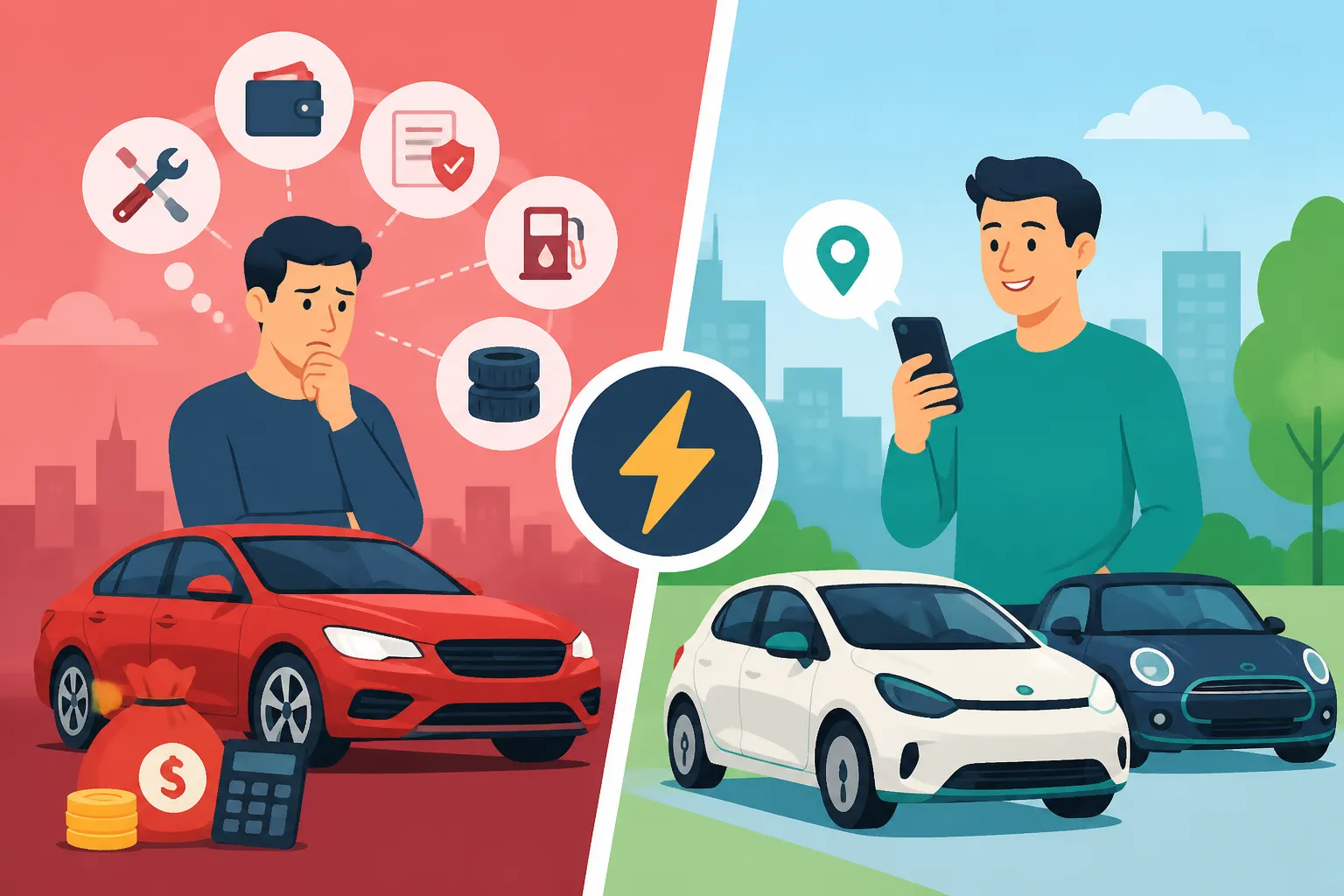
Buying a Car vs Using Car-sharing (ShareNow, Miles)
Trying to figure out if you actually need a car in a city like Vienna can feel like solving a Rubik’s Cube where the stickers keep changing every time you turn them. I remember spending my first winter here frantically brushing snow off a car I barely used, only to realize I was paying more in monthly parking and insurance than I was on my actual grocery bill. This guide breaks down the true costs of car ownership versus the growing convenience of sharing services to help you decide what fits your Austrian lifestyle.
The Financial Reality of Owning a Car in Austria
Owning a vehicle in Austria is often viewed as a luxury, not because of the status of the car itself, but because of the sheer volume of administrative and recurring costs the state mandates. If you are coming from a country where car ownership is cheap and loosely regulated, the Austrian system will be a significant culture shock. Beyond the sticker price, you are entering a world of specialized taxes, mandatory safety checks, and insurance premiums that can fluctuate wildly based on your driving history.
Upfront Costs and the Infamous NoVA Tax
When you buy a car in Austria, the price you see on the dealership floor includes something called the NoVA (Normverbrauchsabgabe). This is a CO2-based tax that can significantly inflate the price of a vehicle, especially for high-emission models. In 2026, the thresholds for NoVA have become even stricter as part of Austria’s green transition. If you are importing a car from abroad, you will likely have to pay this tax upon registration, which can often amount to thousands of euros.
Before you even turn the key, you also need to factor in the registration fees. Setting up your license plates and getting your Zulassungsschein (registration certificate) involves a trip to a registration office, usually handled through an insurance provider. It is during this stage that you will also need to ensure you have a Checklist for Your First 30 Days in Austria ready, as car registration is often tied to having your Meldezettel and proper insurance in place.
The Monthly Drain: Insurance and Engine-Related Tax
In Austria, you don’t just pay for insurance; you pay a combined bill that includes the "motor-related insurance tax" (motorbezogene Versicherungssteuer). This tax is calculated based on the kilowatts (kW) of your engine. The more powerful your car, the more you pay the state every single month. This is on top of your actual insurance premium.
Most expats start at the highest "bonus-malus" level (Level 9), meaning you will pay the most expensive premiums possible until you prove you are a safe driver over several years. While some insurers might recognize your driving history from your home country, it is a notoriously difficult negotiation. You’ll need to decide between Haftpflicht (mandatory third-party liability) and Vollkasko (fully comprehensive). For a new car, Vollkasko is highly recommended, but it can easily add 150 to 200 euros to your monthly expenses. If you are still budgeting, check our guide on Money in Austria 2027: Banking, Payments, and Financial Setup to see how these recurring payments will hit your Austrian bank account.
The Annual Pickerl and Maintenance
Every year (or every two years for newer cars), you must subject your vehicle to the §57a inspection, colloquially known as the "Pickerl." This is not a suggestion; it is a strict legal requirement. Austrian mechanics are thorough, and if your car has even minor rust on structural parts or a small oil leak, you will fail. The cost of the inspection itself is relatively low—usually between 50 and 90 euros—but the cost of the required repairs to get that little white sticker can be astronomical.
Additionally, don't forget the seasonal tire change. In Austria, you are legally required to have winter tires from November 1st to April 15th if there are "winterly conditions." Most people own two sets of rims and tires, paying a garage to swap and store them twice a year. This "tire hotel" service and the labor for the swap usually cost around 100 to 150 euros per season.
Car-Sharing in Austria: The Flexibility Revolution
If the thought of the NoVA tax and the Pickerl makes your head spin, car-sharing has become a lifesaver for expats, particularly those living in major hubs like Vienna, Graz, or Linz. The market is dominated by two major players, ShareNow and Miles, each offering a slightly different philosophy on how you should pay for your mobility.
ShareNow vs. Miles: Knowing the Difference
The biggest difference between these two giants is their billing model. ShareNow generally operates on a per-minute basis. This is fantastic if the roads are clear and you’re zipping from the 7th district to the 22nd. However, if you get stuck in Vienna’s notorious rush-hour traffic on the Gürtel, those minutes start to feel very expensive.
On the other hand, Miles bills by the kilometer. This is a game-changer for many expats because it removes the "traffic stress." You can sit in a jam for forty minutes, and your price remains the same as if the road were empty. Miles also tends to have a wider variety of vehicles, including vans (Transporters), which are incredibly useful if you’ve just had a successful trip to IKEA and need to get a new wardrobe home without hiring a moving company. If you're navigating these logistics, you might also want to look into Sourcing Cheap Used Furniture on Willhaben Safely to see how a shared van can save you even more money.
The Perk of Free Parking and Fueling
The "Hero" feature of car-sharing in Austria is undoubtedly the parking. In most cities, the "Parkpickerl" (short-term parking zone) rules are a nightmare. If you own a car, you can only park for free in your home district. If you drive to another district, you have to pay by the half-hour. With ShareNow and Miles, you can park the car in any legal street parking space within the "home zone" for free. You simply end your rental and walk away.
Fueling is also included in the price. If the tank gets low, you use a fuel card provided in the car to fill up at partner stations. In fact, most services will give you a credit of 5 to 10 euros for your next ride if you take the time to fuel a car that is below 25% capacity. This eliminates the volatility of petrol prices from your daily life, something that is particularly valuable given the Cost of Living in Vienna: Singles vs Families in recent years.
Limitations and the "Out of Zone" Trap
Car-sharing isn't a perfect solution. The biggest frustration for expats is the boundary of the "Home Zone." If you live on the outskirts of Vienna—say, deep in the 21st or 22nd districts—you might find that the sharing cars aren't allowed to be "ended" near your house. You can drive them there, but you have to keep the rental active (and pay for it) until you return the car to the designated zone.
Furthermore, these cars are generally not designed for long-distance travel. While both Miles and ShareNow offer 1-day or weekend packages, they are often more expensive than traditional car rental companies like Sixt or Europcar if you’re planning a trip to the Alps. If you are heading out for a weekend of skiing, you should definitely consider Skiing Etiquette and Lift Line Rules in the Austrian Alps and perhaps look into a traditional rental or the train instead.
The Infrastructure Struggle: Parking and Urban Living
One of the most significant factors in the "buy vs. share" debate is where you actually plan to put the car when you aren't using it. Austria, and Vienna in particular, has become increasingly hostile to private car storage on public streets.
Navigating the Parkpickerl System
The "Parkpickerl" is a resident parking permit. If you own a car and live in Vienna, you must apply for this permit for your specific district. It costs around 10 euros a month (usually paid as a lump sum for one or two years) plus some administrative fees. However, this permit only allows you to park in your home district. If you work in the 1st district but live in the 10th, your Parkpickerl is useless at your office.
This system is designed to discourage people from driving across the city. Many expats find themselves paying for a Parkpickerl for their home and then an additional 150 to 300 euros a month for a private garage spot near their workplace. When you add this to your Average Monthly Grocery Budget for a Couple in Vienna, the financial weight of the car becomes heavy very quickly.
Garage Costs and Street Parking Risks
If you live in an Altbau (older building), it is unlikely your building has an underground garage. This means your car is at the mercy of the elements and parallel parking artists. Scuffed bumpers and broken side mirrors are par for the course with street parking in Vienna.
If you decide to rent a permanent garage space, you are looking at a significant monthly commitment. In central districts like the 6th, 7th, or 8th, a garage spot can cost as much as a small room in a WG (shared apartment). Before committing to a lease that includes a parking space, make sure you understand the Altbau vs Neubau: Differences in Rent, Charm, and Heating to see if the building infrastructure even supports your needs.
Comparison Table: Car Ownership vs. Car-Sharing (2026 Estimates)
| Feature | Private Car Ownership | Car-Sharing (Miles/ShareNow) |
|---|---|---|
| Monthly Fixed Cost | €350 – €600 (Tax, Ins, Parking) | €0 (Pay-as-you-go) |
| Parking in the City | Restricted to home district | Free in all legal street spots |
| Fuel / Charging | Paid by you (Market rates) | Included in the price |
| Maintenance & Tires | Your responsibility (€500+/year) | Included in the price |
| Spontaneous Use | High (Car is always there) | Medium (Subject to availability) |
| Long-Distance Trips | Best for frequent travel | Expensive (Better for short hops) |
| Bureaucracy | High (Registration, Pickerl) | Low (App registration only) |
Regional Differences: Vienna vs. The Rest of Austria
The advice in this guide changes dramatically depending on which Bundesland (federal state) you call home. Austria is a country of two halves: the hyper-connected urban centers and the rugged, car-dependent Alpine regions.
Why Vienna is the Anti-Car King
In Vienna, owning a car is arguably more of a burden than a benefit. The city’s public transport network, the Wiener Linien, is world-class. With a 365-euro annual pass (or the Is the Klimaticket Worth It? Cost and Benefit Analysis if you travel nationally), you can get anywhere faster than a car during peak hours.
Car-sharing fills the gaps when you need to transport something heavy or want to visit a friend in a suburban area not well-served by the U-Bahn. For most expats in the capital, the combination of a Jahreskarte (annual pass) and a car-sharing account is the "gold standard" for mobility. It provides the freedom of a vehicle without the administrative "dead weight." If you are just moving to the city, check our Vienna Neighborhood Guide: Best Districts for Expats to see which areas have the best sharing coverage.
Rural Living: When a Car is Non-Negotiable
If your job or lifestyle takes you to a smaller town in Lower Austria, Styria, or the Vorarlberg, the math shifts. Car-sharing services are almost non-existent outside of the major cities. While the ÖBB (national rail) is excellent for traveling between cities, getting from a small village to a regional office can be impossible without your own wheels.
In these areas, parking is rarely an issue, and the "Parkpickerl" nightmare doesn't exist. You will still face the high costs of NoVA and engine taxes, but the utility of the car increases tenfold. If you are commuting from a rural area, you may also be eligible for the Claiming the Commuter Allowance (Pendlerpauschale), which is a tax deduction designed to offset the costs of driving to work when public transport isn't a viable option.
Making the Choice: A Step-by-Step Decision Framework
Still on the fence? Newcomers are usually advised to follow a "six-month rule." Don't buy a car the moment you arrive. Austria’s bureaucracy is a lot to handle in the first month, and you don't want to add vehicle registration to your plate.
Frequency of Use vs. Cost
Calculate how often you actually need a car. If it’s just for a weekly grocery run and the occasional trip to the mountains, car-sharing wins every time. A typical "big shop" using a Miles car might cost you 8 to 12 euros. Doing that four times a month is less than 50 euros. Compare that to the 400 euros you would spend just keeping a private car parked on the street.
If you find yourself using a sharing car more than 15 days a month, or if your daily commute to a place like Linz Job Market: Engineering, Manufacturing, and IT requires a 40-minute drive that public transport can't cover, then ownership starts to make sense.
Travel Patterns and Lifestyle
Consider your hobbies. Are you an avid hiker or skier who heads to the mountains every single Saturday? If so, the "package prices" of car-sharing will eventually irritate you, and the lack of dedicated winter equipment (like roof racks for skis) on sharing cars will become a hurdle. In this case, buying a reliable used car might be the better path. Just make sure you are aware of the Mandatory Winter Tires Rule: November 1 to April 15 to avoid massive fines during your Alpine adventures.
Practical Tips for New Arrivals
If you do decide to buy, don't rush into a new car. The second-hand market in Austria is very active, and platforms like Willhaben are the go-to for finding a deal.
Converting Your License and Registration
If you are a non-EU citizen, you generally only have six months to use your foreign driver's license before you must convert it. This process can involve anything from a simple administrative swap to a full practical driving exam, depending on your home country. For more details on this, see Converting a US Driver's License to an Austrian One.
When you buy a car, the registration office will give you your plates immediately once you show proof of insurance. It is a surprisingly efficient system compared to the rest of the Austrian bureaucracy, provided you have all your documents (Meldezettel, Kaufvertrag, and insurance confirmation) in order.
Why Many Austrian Rentals Come Without a Kitchen Installed
This might seem unrelated, but it's part of the "logistics puzzle." Many expats move into apartments and realize they need to buy and transport an entire kitchen. This is exactly the scenario where having a car-sharing account with access to vans is a lifesaver. Before you buy a car just to handle your move-in logistics, remember that Why Many Austrian Rentals Come Without a Kitchen Installed is a common quirk that you can solve with a one-day van rental from a sharing service.
Disclaimer
The information provided in this guide is for informational purposes only and does not constitute legal or financial advice. Tax rates, insurance premiums, and car-sharing prices in Austria are subject to change based on government policy and market conditions in 2026. Always verify current regulations with the Austrian Federal Ministry for Climate Action, Environment, Energy, Mobility, Innovation and Technology (BMK) or a qualified insurance advisor before making significant financial commitments.