Supermarket Etiquette: Checkout Speed and Packing Own Bags
The "checkout panic" is a rite of passage for every newcomer in Austria, characterized by that frantic heart-racing moment when the cashier begins scanning your groceries at what feels like terminal velocity. I vividly remember my first week in Vienna, standing paralyzed as a mountain of yogurt and apples piled up while a line of stoic locals stared at my fumbling hands. This guide will teach you the unspoken rules of the Austrian supermarket to help you navigate the aisles and the tills like a seasoned resident.
The Cultural Philosophy of the Austrian Supermarket
In many countries, the supermarket is a social hub where you might exchange a few words with the cashier about the weather or your weekend plans. In Austria, the grocery store is a high-efficiency machine designed for one purpose: moving goods from shelves to homes as quickly as possible. Understanding this mindset is the first step toward reducing your stress levels.
Efficiency over Small Talk
The Austrian approach to grocery shopping is rooted in a deep respect for efficiency and the collective time of the community. When you are at the register, the cashier is not being rude by skipping the "How is your day?" formalities; they are being professional by ensuring that you and the twenty people behind you get home as soon as possible. This directness is a core part of the local culture, which you can read more about in our guide on Culture Shock: Adapting to Direct Austrian Communication.
Expect a "Grüß Gott" or "Hallo" at the start and a "Schönen Tag" or "Wiederschauen" at the end. Anything in between should strictly be about the transaction. If you try to strike up a long conversation while others are waiting, you will likely feel the weight of several disapproving "Gschaut" (intense Austrian stares). This efficiency is also why you need to be prepared for Coping with Supermarket Checkout Speeds in Austria before you even enter the store.
The Concept of Self-Reliance
Austrian society places a high value on personal responsibility and self-reliance. This manifests in the supermarket as a "do-it-yourself" environment. No one will offer to pack your bags, and no one will help you carry them to your car. The system assumes you are a capable adult who has arrived prepared. This extends to weighing your own produce in many stores (though this is changing in some chains) and managing your own cart logistics.
This self-reliance is also reflected in how people handle their own waste and packaging. You are expected to know the rules, follow the flow, and not require hand-holding from the staff. It might feel cold at first, but once you master the rhythm, you will realize it is actually a very liberating and fast way to shop. You will see this same level of self-sufficiency in other areas of life here, such as Everyday Etiquette: Garbage Sorting, Noise, and Ruhezeit.
Sunday Shopping Laws and the Saturday Rush
One of the biggest shocks for expats is the realization that almost all supermarkets close on Sundays and public holidays. This is governed by strict labor laws designed to ensure a day of rest for workers. I learned the hard way that if you forget to buy milk on Saturday evening, you are likely waiting until Monday morning unless you want to pay premium prices at a gas station or a train station "mini-market."
Because of this, Saturdays in Austrian supermarkets are an experience in managed chaos. Everyone is stocking up for the Sunday closure, and the tension at the checkout can be significantly higher. If you can avoid shopping on Saturday afternoons, your stress levels will thank you. For a deeper dive into why the country grinds to a halt once a week, check out our article on Sunday Shopping Laws: Why Everything is Closed.
Navigating the Aisles: Pre-Checkout Etiquette
The etiquette begins long before you reach the register. How you move through the store and interact with the physical space dictates how smoothly your entire trip will go. Austrians are generally very orderly, and they expect the same from you.
Cart and Basket Logistics
When you arrive at a store like Hofer, Billa, or Spar, you will notice the shopping carts are locked together in a row. To release one, you need a "Pfand" (deposit), usually a 1 or 2 Euro coin or a plastic token. This ensures that shoppers return their carts to the designated area rather than leaving them in the middle of the parking lot. If you forget your coin, you might find yourself struggling to carry a week's worth of groceries in your arms.
Inside the store, be mindful of "Verkehr" (traffic). Avoid leaving your cart in the middle of the narrow aisles while you compare different brands of pumpkin seed oil. If you need to stop and read a label, pull your cart to the side. If someone is blocking your way, a polite "Entschuldigung" (excuse me) is usually enough to get them to move. Austrians value their personal space, even in a crowded Billa, so try not to crowd the person in front of you.
Weighing Produce and Handling Items
In many Austrian supermarkets, particularly the larger ones or discount chains like Lidl, you are responsible for weighing your own fruits and vegetables before heading to the checkout. You place your items on the scale, find the corresponding number or icon on the screen, and print out a sticky barcode to attach to the bag. If you arrive at the register with unweighed produce, the cashier will have to stop the entire line, and the collective sigh from the queue behind you will be audible.
When handling items, be purposeful. If you decide you don't want a refrigerated item, do not simply leave it on a shelf with the dry pasta. This is considered highly disrespectful to the staff and the food itself. Always return items to their proper place. If you are shopping on a budget, you might want to look at Comparing Grocery Prices: Billa vs Spar vs Hofer to see which stores fit your needs best before you start filling your cart.
Navigating Crowds and The Unspoken Queue
Lines at Austrian supermarkets can get long, but they move fast. One unique quirk is the "Zweite Kasse" (second register) phenomenon. If a line gets too long, a staff member will often shout "Zweite Kasse bitte!" or a customer will politely request it. When a new register opens, the person who was second or third in the original line doesn't necessarily get priority. It is often a sprint to the new till.
While it might seem aggressive, it is just the way the system works. If you are quick, you can save five minutes of waiting. Just be sure not to cut off someone who was clearly ahead of you in a way that violates basic fairness. In these moments of high-density shopping, keep your Average Monthly Grocery Budget for a Couple in Vienna in mind so you don't make impulsive purchases just to get out of the store faster.
The Main Event: Surviving the Checkout Blitz
This is where the magic (and the stress) happens. The Austrian checkout is a high-performance sport. The goal is to get your items scanned, paid for, and cleared from the small bagging area as fast as humanly possible.
The Divider Stick (Waren-Trenner)
The "Warentrenner" is perhaps the most important tool in the Austrian supermarket. It is the plastic bar used to separate your groceries from the person behind you on the conveyor belt. There is an unspoken rule: the person who finishes placing their groceries on the belt is responsible for putting the divider down for the next person.
If you fail to do this, you are seen as inconsiderate. It signals to the person behind you that they can start loading their items. Conversely, if the person in front of you doesn't put one down, it is perfectly acceptable for you to reach over and do it yourself. It keeps the cashier's flow uninterrupted, which is the ultimate goal.
The Unspoken Speed Record
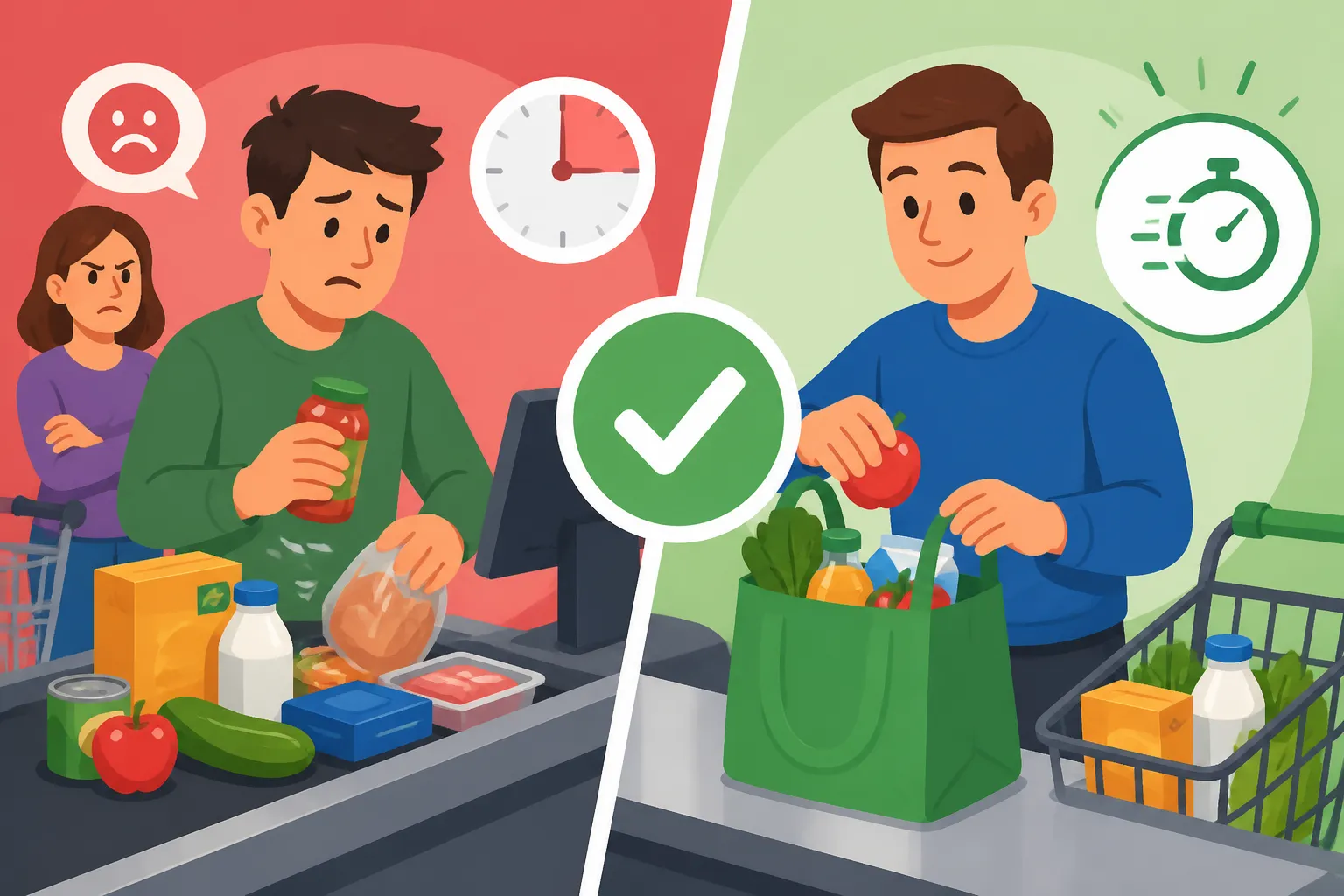
As soon as the cashier starts scanning, the clock is ticking. Unlike in the US or UK, there is almost no counter space at the end of the register. There is usually just a tiny triangular area where items pile up. Your job is to move those items back into your cart or bag immediately. Do not wait for the cashier to finish scanning everything before you start packing.
If you are buying many items, the best strategy is to put them back into your shopping cart loose. You can then move to a side counter (usually located past the registers) to pack your bags at your own pace. This keeps the line moving and prevents the dreaded "grocery mountain" from overflowing onto the floor. If you are a student on a tight schedule, you might also be interested in The Best Platforms to Find Part-Time Student Jobs to help fund your grocery trips.
Payment Methods and Kassenbon
Once the scanning is done, the cashier will announce the total. This is the moment to be ready with your payment. While Austria has a reputation for being a "cash is king" country, this is rapidly changing. Most supermarkets now prefer "Bankomat" (debit card) or contactless payments. If you are using cash, try to have small bills or the exact change ready.
The cashier will ask, "Brauchen Sie den Beleg?" or "Kassenbon?" (Do you need the receipt?). Most people say "Nein, danke" unless they need it for business expenses or a potential return. If you do take it, move quickly. Every second you spend fumbling with your wallet is a second the next person has to wait. For more on how to handle your money here, see Cashless Payments vs Cash Culture in Austria Today.
Packing Strategies: Mastering the Bag
Packing your own bags is an art form in Austria. It requires foresight, speed, and the right equipment. If you wait until you are at the register to think about how to pack, you have already lost the battle.
The Art of Post-Checkout Shuffling
As mentioned, the pros do not pack at the till. They "shuffle." This means quickly throwing items back into the trolley in the order they come off the belt. Hard and heavy items like milk cartons and canned goods should go onto the belt first so they end up at the bottom of your pile, with eggs and bread coming last.
Once you have paid, push your cart to the packing benches located near the exit. Here, you can take all the time you need to organize your groceries into your bags without the pressure of a line behind you. This is also a great time to check if you have any Gluten-Free (Zöliakie) Shopping Options in Austria in your bag if you are shopping for specific dietary needs.
Bringing Your Own Bag (Beutel)
Austrian supermarkets are very environmentally conscious. While they sell sturdy plastic or paper bags at the register, almost everyone brings their own "Stoffbeutel" (cloth bag) or a "Rucksack." Using your own bags is not just better for the planet; it’s also cheaper. Those paper bags at the till can cost anywhere from 30 to 70 cents each, which adds up over time.
If you do need to buy a bag, grab it from under the conveyor belt and put it on the belt with your groceries so the cashier can scan it first. This ensures you have the bag ready as soon as the first items are scanned. If you are ordering groceries online, you might wonder Do You Tip Grocery Delivery Drivers (Billa, Gurkerl)?, which is a different etiquette entirely.
Dealing with Heavy Items and Fragiles
The "heavy items first" rule is vital. The resulting mess was embarrassing and a waste of money. Always organize your belt so the cashier receives the "bricks" first. This allows you to build a solid foundation in your cart or bag.
For fragile items like berries or soft pastries, keep them in your hand or at the very end of the belt. Most Austrian cashiers are surprisingly careful with fragile items, but their speed can sometimes work against you. If you are buying specialty items, perhaps from a local market, you might find more tips in Finding Halal Butchers and Supermarkets in Vienna.
Comparison of Major Austrian Supermarkets
Not all supermarkets are created equal in Austria. Depending on where you shop, the "vibe" and the speed requirements can vary significantly.
| Supermarket | Typical Speed | Best Feature | Expat Tip |
|---|---|---|---|
| Hofer (Aldi) | Extreme | Lowest Prices | Be the fastest; there is zero space for packing here. |
| Lidl | High | Weekly Specials | Great for non-food items and bakery products. |
| Billa / Billa Plus | Moderate | Convenience/Selection | Use the "Jö" card for discounts. |
| Spar / EuroSpar | Moderate | Quality/Local Goods | Look for the "S-Budget" brand for savings. |
| Penny | High | Discount Staples | Often located in residential neighborhoods for quick trips. |
Billa vs. Spar vs. Hofer
Billa and Spar are the two "big" traditional retailers. They offer a more relaxed shopping experience compared to the discounters. Billa is everywhere, especially in Vienna, while Spar often has a slightly more "premium" feel in their larger stores. Both have loyalty programs that are worth joining if you plan on staying in Austria long-term.
Hofer (the Austrian branch of Aldi Süd) is a different beast. It is the undisputed king of efficiency. The cashiers at Hofer are famously fast—some say they are trained to hit a certain number of scans per minute. If you shop at Hofer, you must have your cart ready and your packing strategy perfected. It is the best place for a Average Monthly Grocery Budget for a Couple in Vienna to go further, but it requires the most "etiquette" discipline.
Self-Checkout Kiosks vs. Traditional Tills
In recent years, many stores (especially Billa and Spar in urban areas) have introduced self-checkout kiosks. These are a godsend for expats who want to avoid the "speed pressure" of a human cashier. You can scan your items at your own pace and pack as you go.
However, be aware that these machines often have "weight sensors" in the bagging area that can be finicky. If you are buying alcohol or items with security tags, you will still need to wait for a staff member to verify your age or remove the tag. Even at the self-checkout, keep an eye on the line; if people are waiting, don't use the kiosk to slowly reorganize your entire life.
Common Mistakes and How to Avoid Them
Even with the best intentions, you might slip up. Here are a few common pitfalls that can mark you as a "tourist" or an "unprepared expat."
Forgetting the Euro for the Cart
It happens to the best of us. You arrive at the store, realize you only have a 50-Euro note, and can't get a cart. While some stores have baskets you can carry, a full grocery run without a cart is miserable. Pro tip: many Austrians keep a plastic "Einkaufschip" (shopping chip) on their keychain specifically for this purpose. You can often get these for free from banks or insurance companies.
If you truly find yourself stuck, you can go to the "Feinkost" (deli) counter or the register and ask very politely if they can change a note for a coin, but during busy hours, this might be met with a bit of frustration. Being prepared is always better. Preparation is key for everything here, including Healthcare Checklist for Your First 30 Days in Austria.
The "Wait, I Forgot Something" Faux Pas
In some cultures, it is okay to leave your place in line to grab a forgotten gallon of milk while the cashier is scanning. In Austria, this is a major breach of etiquette. If you have already started the checkout process, you stay in the checkout process.
Leaving the line causes a delay that ripples through the entire queue. If you forgot something essential, finish your current transaction, pay, leave, and then go back into the store to buy the forgotten item. It might seem like more work, but it is the polite way to handle the situation. If you are frequently forgetful, perhaps a delivery service is better; see Do You Tip Grocery Delivery Drivers (Billa, Gurkerl)? for how to handle those interactions.
Disclaimer
The information provided in this guide is based on cultural norms and personal experiences in Austria as of 2026. Rules and supermarket policies can change, and individual experiences may vary by region or specific store branch. This content is for informational purposes and does not constitute legal or professional advice.