Electricity Providers in Austria (Wien Energie, Verbund)
Moving into your first Austrian apartment is a whirlwind of paperwork, but few things are more frustrating than realizing the previous tenant took their light bulbs and the power is disconnected. I still remember sitting in my dark Vienna flat on night one because I assumed utilities were automatically included in my rent. This guide solves the complex puzzle of navigating electricity providers, registration, and billing in Austria.
Understanding the Austrian Electricity Market Structure
The Austrian energy market is liberalized, which sounds great in theory but can be incredibly confusing for a newcomer. Unlike some countries where one company handles everything, Austria splits the responsibility between the grid operator (Netzbetreiber) and the energy supplier (Stromanbieter). You don't get to choose your grid operator—they are determined by your geographic location—but you have total freedom to choose who actually sells you the electricity.
Grid Operators vs. Energy Suppliers
The grid operator is the entity that physically maintains the wires, poles, and meters in your building. If you live in the capital, your grid operator is Wiener Netze. They are the ones who will send a technician if your meter breaks. However, you do not pay them directly for the "energy" itself; you pay them "network fees" (Netzkosten). Your energy supplier, such as Verbund, is the company that buys electricity on the wholesale market and sells it to you. You will often receive two separate bills—one for the network and one for the energy—unless you choose a provider that offers "combined billing" (Gesamtrechnung).
In my first year, I was baffled by why I was getting letters from two different companies. It is vital to understand that even if you switch your supplier to get a better rate, your grid operator stays the same. This is part of why the Cost of Living in Vienna can vary significantly depending on which district you reside in and how efficient your appliances are.
The Default Provider Phenomenon
When you first sign a lease, the apartment is usually tied to the "Landesenergieversorger" or the regional default provider. In Vienna, this is almost always Wien Energie. These companies are stable and reliable, but they aren't always the cheapest option on the market. Most expats stick with the default provider because it’s the path of least resistance during the Meldezettel Process when you are already drowning in administrative tasks.
However, being a default customer often means you are on a standard tariff that might not be as competitive as newer, digital-only providers. While Wien Energie offers excellent customer service centers where you can speak to a human in person, you might pay a premium for that convenience. If you are looking to optimize your Budgeting in Austria: Accurate Cost of Living Benchmarks, shopping around is non-negotiable.
Why You Must Register Your Own Meter
In Austria, electricity is rarely "inclusive" in the rent (Warmmiete). Most leases are "Kaltmiete," meaning you are responsible for setting up your own accounts for electricity and gas. If you fail to register the meter (Zählernummer) in your name within a few days of moving in, the grid operator has the legal right to pull the plug.
Some newcomers lose power in the middle of winter because they assume the landlord handles it. When you receive your keys, you must perform a Move-in Checklist: Utilities, Meldezettel, and Internet Setup immediately. Take a photo of the meter reading on day one so you aren't charged for the previous tenant’s marathon gaming sessions or old, inefficient fridge.
Key Players in the Austrian Market
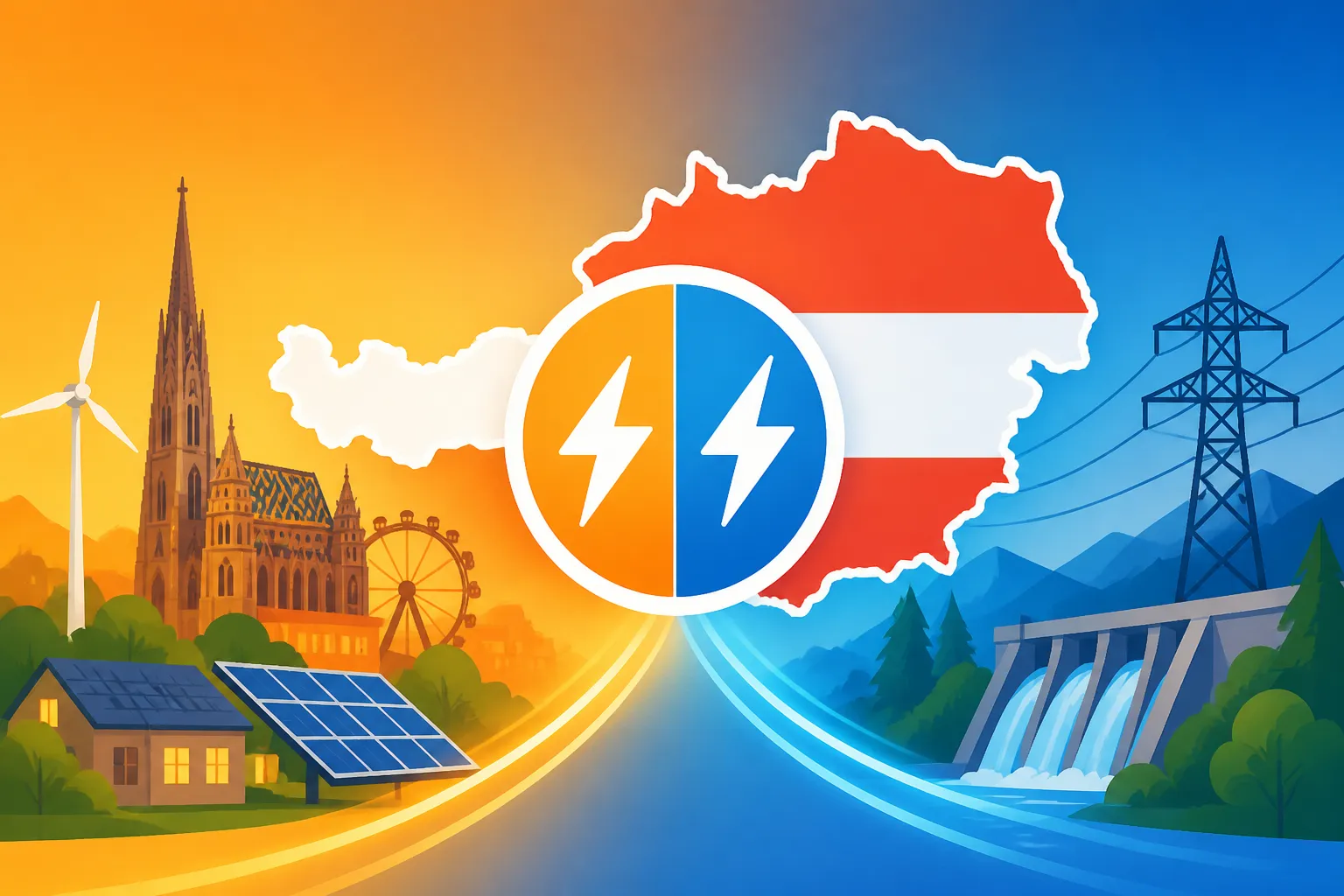
Austria prides itself on green energy, with a massive percentage of its electricity coming from hydropower. This influences the types of providers you will encounter. From regional giants to eco-focused startups, the options are plentiful, but they generally fall into three main categories.
Regional Giants (Wien Energie, EVN, Energie Steiermark)
Every province has its "hero" provider. Wien Energie dominates the capital, EVN handles Lower Austria, and Energie Steiermark serves Graz and the surrounding areas. These companies are often partially state-owned and provide more than just electricity; they often handle district heating (Fernwärme) and gas as well.
The advantage of using a giant like Wien Energie is the "one-stop-shop" feel. If you are also Setting Up Wien Energie Electricity Online in English, you can often bundle your services to simplify your monthly outgoings. They are also incredibly resilient during energy crises, though their pricing structures can be more rigid than smaller competitors. For a family living in a large Altbau vs Neubau: Differences in Rent, Charm, and Heating apartment, the reliability of a regional giant is often worth the extra few Euros a month.
National Specialists (Verbund and Salzburg AG)
Verbund is one of the most recognizable names in the country, primarily because they are Austria's largest producer of electricity from hydropower. They operate nationwide, meaning you can use them whether you are in a penthouse in the first district or a cabin in Tyrol. Verbund is often the go-to for expats who want a "green" brand that is established and has a robust digital interface.
Unlike the regional providers, these national specialists often run aggressive marketing campaigns with "switching bonuses" (Wechselbonus). This can lead to significant savings in your first year. If you are meticulously planning your Money in Austria 2027: Banking, Payments, and Financial Setup, keep an eye out for these sign-up credits, which are usually deducted from your first annual bill.
Green and Alternative Energy Providers
If environmental impact is your primary concern, companies like aWATTar or oekostrom AG offer 100% renewable energy. Some of these providers use "dynamic pricing," where the cost of electricity changes every hour based on the current market price. This is fantastic if you have a smart meter and can run your dishwasher or charge your electric car at 3:00 AM when prices are lowest, but it can be risky if you aren't paying attention.
Using an alternative provider often requires a bit more digital savvy. You won't find many physical walk-in centers for these brands. However, for the modern expat who manages everything via ID Austria and E-Government Tools for Foreign Residents, the cost savings and environmental benefits of these smaller players are highly attractive.
How to Register and Set Up Your Electricity
The registration process is surprisingly straightforward once you have the right numbers. Most companies allow you to do everything online, provided you have a valid Austrian bank account and your residency documents in order.
Finding the Meter Number (Zählernummer)
Your meter number is the "social security number" of your apartment's energy supply. It is a unique 6 to 10-digit number found physically on the meter, which is usually located in a cupboard in your hallway or in the basement of the building. Do not confuse the meter number with the "Zählerstand" (the current reading).
When you move in, the landlord or previous tenant should provide an "Übergabeprotokoll" (handover protocol) that lists this number. If they don't, you'll need to go hunting for it. Without it, the provider won't know which unit to activate.
The Online Registration Process
Once you have chosen a provider, head to their website. You will need your IBAN for a SEPA Transfers, Dauerauftrag, and Paying Rent setup, your meter number, and your estimated annual consumption. If you are unsure about your consumption, most sites have a calculator based on the square footage of your apartment and the number of people living there.
The provider will then contact the grid operator on your behalf to "register" the usage. In most cases, you don't even need a technician to visit; the power is simply assigned to your account digitally. If you are moving to a new city, such as following a Graz Neighborhood Guide: Family Areas vs Student Hubs, ensure you start this process at least 5-7 days before your move-in date to ensure the lights are on when you arrive.
Dealing with Previous Tenant Debts
One of the "I've-been-there" nightmares is trying to register a meter only to find out the previous tenant owes thousands of Euros, and the provider refuses to activate the account. Legally, you are not responsible for their debts, but the bureaucracy can be slow.
If this happens, you must provide your signed lease (Mietvertrag) as proof that you are a new occupant. This is why having your Proof of Accommodation for Your Residence Permit documents handy is useful for more than just immigration. Usually, a quick scan of the lease sent to the customer service department will clear the "block" on the meter, allowing you to start fresh.
Understanding Your Electricity Bill and Costs
Austrian electricity bills are notoriously difficult to read, even for native speakers. They are packed with abbreviations, legal jargon, and various tax components that can make your head spin.
| Component | Description | Who Receives It? |
|---|---|---|
| Energy Price | The cost of the actual electricity you consumed. | Your Supplier (e.g., Verbund) |
| Network Fees | The cost of maintaining the physical grid. | Your Grid Operator (e.g., Wiener Netze) |
| Electricity Tax | A federal tax on energy consumption. | The Austrian Government |
| Renewable Surcharges | Fees to fund the transition to green energy. | Various Green Funds |
| ORF-Beitrag | The mandatory broadcasting fee (often billed separately). | OBS (Broadcasting Service) |
Energy Price vs. Network Fees
As shown in the table, your bill is split. The "Energy Price" is the only part you can really influence by switching providers. The "Network Fees" (Netzkosten) are regulated by the government and are the same regardless of whether you use Wien Energie or a small green startup.
Expect the network fees to make up about 30-40% of your total bill. This is a shock to many expats who find a "cheap" energy rate only to realize the total monthly payment is much higher due to these mandatory grid costs. This is a standard part of Money in Austria 2027: Banking, Payments, and Financial Setup that everyone simply has to accept.
Taxes, Surcharges, and the ORF-Beitrag Connection
Austria has several energy-related taxes that are automatically added to your bill. Additionally, you should be aware of the ORF-Beitrag 2026: The New Broadcasting Household Levy Guide. While it used to be linked to having a TV or radio (the old GIS system), it is now a mandatory household fee.
While the ORF fee is usually billed separately via the OBS, sometimes third-party services or bundles might mention it. Always ensure you are Registering for the OBS Household Broadcasting Levy independently to avoid heavy fines, as electricity providers do not automatically "cover" this for you unless specifically stated in a luxury all-inclusive rental contract.
Annual Adjustments (Jahresabrechnung) and Monthly Deposits
This is the most critical part of the Austrian system. You do not pay for exactly what you used each month. Instead, the provider estimates your annual usage and divides it by 12 (or 10, depending on the billing cycle). You pay this "Teilbetrag" (partial amount) every month.
Once a year, someone (or you, via an app) reads the meter. If you used more than the estimate, you get a "Nachzahlung"—a bill for the difference that can sometimes be hundreds of Euros. If you used less, you get a "Guthaben" (credit). Expats should check their meter every few months and update their reading in the provider's app to avoid a nasty surprise.
Strategies for Switching and Saving Money
If you want to keep your Cost of Living in Vienna as low as possible, you should treat your electricity provider like a phone contract: review it every year and don't be afraid to leave.
Using Comparison Portals (Durchblicker)
The absolute best tool for an expat in Austria is a website called Durchblicker. It allows you to input your postal code and estimated usage to see a side-by-side comparison of every provider in the country. It even calculates the value of the "switching bonuses" so you can see the effective price for the first year.
When using these portals, look closely at the "price guarantee" (Preisgarantie). A cheap rate is no good if the company can double it after three months. Many savvy expats switch providers every 12 months to continually harvest the new customer bonuses, which is a perfectly legal and common way to manage Taxes in Austria: Finanzamt, Returns, and Brackets 2026 and other household expenses effectively.
Fixed vs. Floating Price Contracts
You will generally have to choose between a "Fixpreis" (Fixed Price) and a "Float" (Floating/Market) tariff. Fixed prices give you peace of mind; your rate per kWh stays the same for 12-24 months regardless of what happens in the global energy market.
Floating tariffs (often called "Index-based") track the market. If energy prices drop, your bill drops immediately. However, if there is a geopolitical crisis, your bill can skyrocket overnight. If you are on a tight budget while Studying in Austria: Admissions, Visas, and Student Life, a fixed-price contract is usually the safer bet to avoid volatility.
Termination Notice Periods and Contract Lengths
Before you sign, check the "Bindungsfrist" (commitment period). Many contracts lock you in for 12 months. If you try to leave early because you are Leaving Austria: Financial Exits, Pension Refunds, and Accounts, you might have to pay back your sign-up bonus.
The standard notice period (Kündigungsfrist) is usually two weeks to one month. However, if you are physically moving out of the apartment, you have a special right to terminate the contract on the day you hand back the keys, regardless of the commitment period. Just make sure to send the provider your "Abmeldebestätigung" (deregistration confirmation) from the city.
Living with Electricity in Austria: Tips and Etiquette
Once the lights are on, there are cultural and technical nuances to energy usage in Austria that can save you money and keep your neighbors happy.
Energy Efficiency and "Lüften"
Austrians are obsessed with "Stoßlüften"—opening all windows wide for five minutes rather than leaving one cracked open all day. This is actually a highly efficient way to manage Winterizing Your Austrian Apartment Against Drafts and preventing mold. If you leave your windows tilted (auf Kipp) while the electric heaters are on, you are essentially burning money.
In many Altbau vs Neubau: Differences in Rent, Charm, and Heating buildings, the insulation is poor. Investing in heavy curtains and ensuring your "Thermenwartung" (gas boiler maintenance) is done annually can drastically reduce the amount of electricity or gas you need to stay warm.
Night Rates and Smart Meters
Some older apartments still have "Nachtstrom" (night electricity) meters. These allow you to pay a lower rate for electricity used during the night hours (usually 10:00 PM to 6:00 AM). If you have one of these, that is the time to run your washing machine—provided it doesn't violate the Quiet Hours (Ruhezeit) and Apartment Neighbor Etiquette.
The government is currently rolling out Smart Meters across the country. These digital meters send your usage data automatically to the grid operator every day. This eliminates the need for estimated bills and ensures your Lohnzettel Breakdown: Gross vs Net Salary Explained—well, your energy spending—is always accurate to the cent.
Troubleshooting Power Outages
If your power suddenly goes out, don't panic. First, check your "Sicherungskasten" (fuse box), usually located above the front door inside your apartment. Austrian breakers are sensitive; if you try to run a kettle, a hairdryer, and a space heater at the same time, you will likely trip a fuse.
If the fuse is fine, check the hallway. If the hallway lights are also out, it’s a building-wide or neighborhood-wide issue. In this case, do not call Wien Energie or Verbund; you must call the "Störungsdienst" (emergency service) of your grid operator (e.g., Wiener Netze). They have 24/7 hotlines for power failures. Knowing who to call is a key part of Emergency Services in Austria: 144, Hospitals, and Crisis Steps for your home.
Disclaimer
This guide is intended for informational purposes only and does not constitute legal or financial advice. Energy prices, regulations, and provider offerings in Austria are subject to frequent changes. Always review the specific terms and conditions of any contract before signing. The author is an expat sharing personal experiences and research, not an official representative of the Austrian energy regulatory authorities.