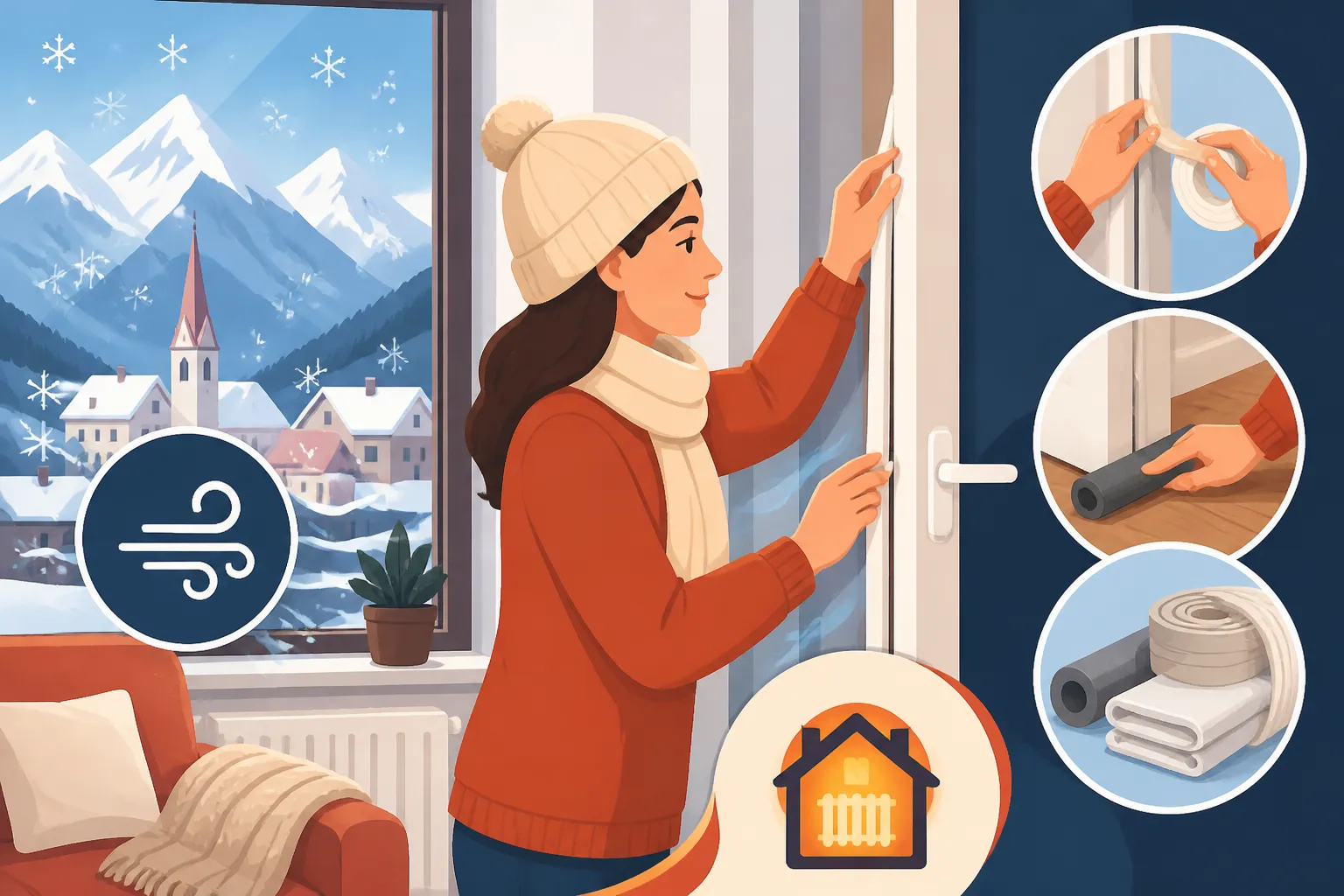
Winterizing Your Austrian Apartment Against Drafts
There is a specific kind of bone-deep chill that only an Austrian Altbau can provide, where the wind whistles through the window frames despite them being physically closed. I remember my first winter in Vienna, wearing a parka inside my living room because I simply did not understand how to fight the local drafts. This guide provides actionable steps to seal your home, lower your energy bills, and master the art of Austrian winter living.
Understanding the Austrian Apartment Architecture
The battle against the cold in Austria begins with understanding the bones of the building you live in. Depending on whether you have chosen a historic gem or a modern functional space, your strategy for winterizing will differ significantly. You should first identify the structural quirks of your home before spending a single Euro at the hardware store.
The High Ceilings and Double Windows of the Altbau
If you live in a classic Altbau, you are likely enjoying four-meter-high ceilings and beautiful parquet floors. However, these features are the primary enemies of thermal efficiency. Heat naturally rises, meaning the warm air you are paying for is hovering near the ceiling decorations while your feet remain freezing. Furthermore, the traditional Kastenfenster (box windows) consist of two separate sets of glass panes with a pocket of air in between. While this design was revolutionary for its time, the wood often warps over decades, leaving significant gaps where the freezing Alpine air can pour in.
I spent my first three winters in a 19th-century apartment in the 7th District, and I quickly learned that these windows are rarely airtight. The outer pane is designed to stop the rain, while the inner pane is supposed to keep the heat in. If the seals on the inner pane are compromised, you are essentially trying to heat the entire street. When choosing your home, you must weigh these aesthetic benefits against the reality of Altbau vs Neubau: Differences in Rent, Charm, and Heating to understand what you are truly signing up for.
Thermal Bridges and the Challenges of Old Construction
In many older Austrian buildings, the walls are thick—sometimes nearly a meter of brick—but they lack modern insulation. This leads to what engineers call thermal bridges, particularly in the corners of rooms or where the floor meets the external wall. These cold spots are not just uncomfortable; they are the primary breeding ground for condensation. When warm, moist air from your morning coffee or shower hits these freezing surfaces, it turns into water droplets.
If you do not manage these thermal bridges, you will find yourself dealing with a much larger problem than a simple draft. This structural reality is why many expats struggle with Preventing Mold (Schimmel) in Old Altbau Apartments during their first few years. The drafts are often the building's way of "breathing," and while sealing them is necessary for comfort, doing so without a strategy for air circulation can lead to a damp, unhealthy environment.
Neubau Efficiency and Modern Sealing Standards
If you reside in a Neubau, which generally refers to buildings constructed after 1945 (though more accurately after the 1980s for energy purposes), your draft issues will be different. These apartments usually feature triple-glazed windows and much tighter seals. Here, the "drafts" you feel are often not leaks from the outside but rather the movement of air caused by temperature imbalances within the room.
Modern Austrian apartments are built to be incredibly airtight. While this is great for your heating bill, it means that any minor failure in a window gasket or a poorly adjusted balcony door will be felt immediately as a sharp, cold jet of air. In these buildings, winterizing is less about "fixing" the structure and more about fine-tuning the existing high-tech seals and ensuring your ventilation habits are correct for the building's design.
Practical DIY Solutions for Sealing Windows and Doors
Once you have identified where the cold air is entering, it is time for a trip to a local Baumarkt like OBI, Bauhaus, or Hornbach. In Austria, the terminology for these items can be specific, so knowing what to look for will save you a lot of time and frustration.
Using Draught Excluders known as Zugluftstopper
The most traditional and immediate solution in an Austrian home is the Zugluftstopper. These are long, weighted fabric "sausages" filled with sand or heavy foam that you place along the bottom of doors or on the deep windowsills of an Altbau. I used to think these were just "grandma's decor" until I realized that a 5mm gap under a front door can let in as much cold air as a wide-open window.
When sourcing these, look for versions that are aesthetic but functional. Many local shops in Vienna's inner districts sell handmade versions that fit the long windowsills perfectly. If you have a significant gap under your apartment’s main entrance door, you might want to look for a "Doppeldichtung" or a double-sided draft stopper that slides under the door and moves with it. This is a crucial first step, especially since Renting in Austria: MRG Laws, Leases, and Bestellerprinzip generally places the responsibility for minor internal draft management on the tenant.
Sealing Tape and Window Gaskets
For the actual frames of the windows, you will want to look for Dichtungsband. This is self-adhesive sealing tape that comes in various materials. For an Altbau with uneven wooden frames, EPDM rubber profiles (often shaped like a 'P' or a 'D' in cross-section) are much more effective than cheap foam tapes. The foam tends to compress and lose its elasticity within one season, whereas rubber can handle the expansion and contraction of the wood throughout the winter.
Before applying any tape, you must clean the window frame with alcohol to ensure the adhesive sticks. I made the mistake once of applying tape to a dusty frame in November; it peeled off by Christmas, and I had to redo the entire living room in the middle of a snowstorm. If your windows are truly ancient, you might even consider "Fensterfolie," a shrink-wrap plastic that you tape over the entire window and heat with a hair dryer to create an extra layer of still air. It looks a bit strange, but the thermal difference is night and day.
The Art of External Shutter Usage
Many Austrian apartments are equipped with Rollläden (hard external shutters) or Außenjalousien (external blinds). While these are primarily used for shade in the summer, they are a powerful tool for winter insulation. In the village where I spent time in Styria, the locals would close their Rollläden the moment the sun went down. This creates a buffer zone of air between the shutter and the window glass, significantly reducing heat loss.
If you have these, use them religiously. Closing them at 4:30 PM when the darkness hits can keep your room several degrees warmer overnight. It also protects your window frames from the direct impact of freezing winds and snow. If your shutters are electric, ensure they are fully closed; even a tiny gap at the bottom allows a "chimney effect" where cold air is sucked upward against your window pane.
Optimizing Your Heating System for Efficiency
Sealing the drafts is only half the battle. You must also ensure that the heat you are protecting is being generated as efficiently as possible. In Austria, heating systems are often complex, involving gas boilers (Kombithermen) or district heating (Fernwärme).
Bleeding Your Radiators for Maximum Heat
If your radiators are hot at the bottom but cold at the top, or if they make a gurgling sound like a mountain brook, they have trapped air inside. This air prevents the hot water from filling the entire unit, meaning your boiler has to work twice as hard to reach the desired temperature. You need an Entlüftungsschlüssel, a small, square metal key available at any hardware store for about two Euros.
The process is simple: hold a small cup and a cloth under the valve at the top of the radiator, turn the key slowly until you hear a hiss of air, and wait until a steady stream of water comes out. I recommend doing this at the very start of the season in October. If you neglect this, you'll find your energy bills skyrocketing while your toes stay cold. This is part of your basic maintenance as a tenant, and if you're unsure about the broader system, check our guide on Gas Boiler Maintenance (Thermenwartung): Tenant Responsibility to see what else you are legally required to do.
Thermostat Management and Smart Controls
Most Austrian apartments have a central thermostat, often located in the "reference room" (usually the living room). A common mistake expats make is turning the radiators in the living room up to the maximum while setting the central thermostat to 22 degrees. This causes the boiler to run constantly because the reference room never reaches a "satisfied" state in the eyes of the sensor.
Instead, keep the doors between rooms closed if they have different temperature needs. If you have an older manual thermostat, consider asking your landlord if you can replace it with a digital, programmable one. Setting the heat to drop to 17 degrees while you are at work and rise to 20 degrees just before you get home can save you hundreds of Euros over a long winter. Understanding the costs associated with these systems is vital, particularly when comparing District Heating (Fernwärme) vs Gas Gas Heating Costs in different Austrian cities.
Radiator Reflective Foil and Air Circulation
In many older buildings, radiators are placed directly under windows or on external walls. This means a significant portion of the heat is being absorbed by the cold wall rather than radiating into the room. A very cheap and effective Austrian "life hack" is to install "Reflexionsfolie" (radiator reflective foil) behind the unit. This silver-colored foam sheet reflects the infrared heat back into the living space.
Additionally, make sure your heavy winter curtains do not hang over the radiator. While those floor-to-length velvet drapes are great for blocking window drafts, if they cover the heater, they trap all the warm air against the glass, where it cools down immediately. Tuck your curtains behind the radiator or use shorter ones during the coldest months. If you find the air feels too dry, which is common with Austrian heating, place a "Luftbefeuchter" (a ceramic water container) on the radiator to keep the humidity at a comfortable level.
| Solution | Difficulty | Cost | Longevity | Best For |
|---|---|---|---|---|
| Zugluftstopper | Very Easy | Low | High | Doors and Windowsills |
| Rubber Dichtungsband | Medium | Low | 2-3 Seasons | Window Frames |
| Radiator Bleeding | Easy | Very Low | 1 Season | All Radiators |
| Reflective Foil | Medium | Low | Permanent | External Walls |
| Window Film | Hard | Medium | 1 Season | Single-pane Windows |
The Cultural Art of Lüften and Humidity Control
One of the most surprising things for foreigners moving to Austria is the obsession with "Lüften." You might think that keeping the windows tightly shut all winter is the best way to stay warm, but this is a recipe for disaster in an Austrian apartment.
Stoßlüften vs Kippen
There is a right way and a wrong way to air out your home in winter. The "wrong" way is leaving a window "auf Kipp" (tilted open) for hours. This barely refreshes the air but manages to freeze the walls around the window, leading to massive heat loss and a high risk of mold. The "correct" Austrian way is Stoßlüften: opening all your windows and balcony doors completely for 5 to 10 minutes to create a cross-draft (Durchzug).
This "shock ventilation" replaces the humid, stale indoor air with dry, cold outdoor air. Because the fresh air is dry, it actually takes less energy to heat up than the humid air it replaced. I used to fight my Austrian roommates about this until I saw the hygrometer readings—Stoßlüften is the only way to keep your home healthy. For more on this essential cultural skill, read about Lüften: The Austrian Art of Ventilating Rooms in Winter.
Monitoring Humidity to Prevent Mold
In the winter, your apartment's humidity should ideally stay between 40% and 55%. If it goes higher, you risk mold growth on those cold "thermal bridges" we discussed earlier. If it goes lower, your mucous membranes dry out, making you more susceptible to the winter flu. Buy a simple digital hygrometer (available at shops like Conrad or Amazon.at).
If you see the humidity creeping above 60%, it is time for a Stoßlüftung, regardless of how cold it is outside. This is particularly important if you dry your laundry inside the apartment, which is common since many Austrian buildings lack communal drying rooms. If you ignore this balance, you may find yourself liable for damages when you move out, as Plumbing Leaks: Landlord vs Tenant Repair Responsibilities often extend to how the tenant manages the internal climate and prevents structural dampness.
Financial and Legal Considerations of Winterizing
Winterizing isn't just about comfort; it's about protecting your wallet from the dreaded "Nachzahlung" (additional payment) that arrives once a year when your actual energy usage is calculated against your monthly estimates.
Negotiating with Landlords for Repairs
If your windows are so drafty that they rattle in the wind, or if the frames are visibly rotted, this may fall under the landlord's responsibility for "Erhaltung" (maintenance). Under the Austrian Tenancy Act (MRG), the landlord is generally responsible for the external shell of the building, including the windows. However, the line between a "minor draft" and a "broken window" is thin.
If you plan to ask for professional sealing or window replacement, do it in writing. Document the temperature near the window versus the center of the room. If the landlord refuses to help, you may need to consult the Arbeiterkammer (AK) or the Mietervereinigung (Tenants' Association). Knowing your rights is essential, especially when dealing with Electricity Providers in Austria (Wien Energie, Verbund) and the high costs associated with inefficient heating.
Budgeting for Winter Heating Cost Spikes
In Austria, you pay a monthly "Teilbetrag" (estimate) for your gas and electricity. At the end of the billing cycle, a technician reads your meter, and you either get a refund or a bill for the difference. For many expats, this first "Nachzahlung" is a traumatic experience.
To avoid this, check your meter yourself once a month and compare it to the estimates on your bill. If you see you are using much more than predicted, you can ask your provider to increase your monthly payments so you aren't hit with a giant lump sum in the spring. Staying on top of this is a key part of Budgeting for Winter Heating Cost Spikes (Nachzahlung) and general financial survival in Austria.
Practical Tips for the Expat Winter Survival Toolkit
Beyond the hardware and the physics of the building, there are personal habits that make an Austrian winter much more bearable. These are the small things that local families have been doing for generations to keep their "Gemütlichkeit" high while the snow falls outside.
Sourcing Quality Supplies Locally
Don't wait until the first frost in November to look for supplies. By then, the "Dichtungsband" sections at OBI will be picked clean. Shop in September or October. For high-quality wool blankets and traditional "Hausschuhe" (house shoes/slippers), look for local markets or stores like Giesswein. In Austria, wearing slippers is not optional; floors—especially in Altbau apartments—are notoriously cold, and a good pair of boiled wool slippers will do more for your comfort than turning the thermostat up by two degrees.
Creating a Cozy, Draft-Free Zone
If you have a very large apartment that is impossible to heat entirely, choose one "warm room" (usually the bedroom or living room) and focus your winterizing efforts there. Use heavy rugs to insulate the floor—even cheap ones from IKEA make a massive difference. In the old days, Austrians would use "Portieren," which are heavy curtains hung specifically over the inside of the front door to stop drafts from the hallway. It might feel a bit medieval, but when it is -10 degrees in Vienna and the wind is whipping down the Danube, you will be glad for every extra layer of fabric between you and the elements.
Disclaimer
The information provided in this guide is for educational and informational purposes only. While every effort has been made to ensure accuracy based on local Austrian standards and regulations as of 2026, building codes and tenancy laws can vary by province and individual contract. Always consult with a professional craftsman before making structural changes to your rental property, and refer to your specific lease agreement or a legal advisor regarding landlord-tenant responsibilities.