Furnished vs Unfurnished Rentals: What is Included?
Walking into your first apartment viewing in Austria only to realize the "kitchen" is actually just a set of pipes sticking out of a bare wall is a rite of passage for every expat. I remember standing in a beautiful Altbau in the 7th district, staring at a pile of wires where I expected a stove to be, feeling utterly defeated. This guide solves the confusion by breaking down exactly what "furnished" and "unfurnished" mean in the Austrian market so you never have to face a kitchen-less surprise again.
The Brutal Reality of Unfurnished Rentals
When you browse listings on platforms like Willhaben or ImmobilienScout24, you will see the term unmöbliert or simply leer. In many English-speaking countries, an unfurnished apartment still includes "white goods" like a fridge, stove, and washing machine. In Austria, the definition is much more literal. If you aren't careful, you are renting a shell.
The Missing Kitchen and the EBK Search
In the world of Renting in Austria: MRG Laws, Leases, and Bestellerprinzip, the most significant shock for newcomers is the missing kitchen. It is entirely common for a landlord to provide an apartment with absolutely no cabinetry, sink, stove, or oven. You are expected to buy, install, and—when you move out—take the kitchen with you.
When searching for apartments, you must look for the acronym "EBK," which stands for Einbauküche (fitted kitchen). If those three letters are missing from the description, you need to budget at least 3,000 to 7,000 EUR and several weeks of lead time for a kitchen installation. Some newcomers end up living off a camping stove and a bathroom sink for a month because they didn’t realize their new home was "naked." This is particularly common in older buildings, so pay close attention to Altbau vs Neubau: Differences in Rent, Charm, and Heating to understand which building types are more likely to have modern amenities already installed.
Light Fixtures and Bare Wires
Another quirk of the Austrian unfurnished rental is the "dangling wire" aesthetic. Most landlords remove every single light fixture before a new tenant moves in. When you walk through the door for the first time with your keys, you will likely be greeted by bare copper wires hanging from the ceiling in every room.
You are responsible for buying your own lamps and, more importantly, installing them safely. If you are not handy with electrical work, you will need to find a professional. This adds an immediate layer of stress to your first night in a new city. You’ll be scrambling to find a hardware store like Obi or Bauhaus before they close at 6:00 PM on a Saturday. Always ensure you have a basic toolkit and a few simple "construction lights" (plain bulbs in plastic sockets) ready for day one.
Flooring and Window Treatments
While most apartments come with parquet or laminate flooring, very occasionally in lower-end or extremely old listings, you might even find the subfloor exposed. However, the more common "missing" item is curtain rods and blinds. Austrians value their Ruhezeit and privacy, but landlords rarely provide the means to block out the light. You will need to drill your own holes for curtain poles. Just be aware that when you move out, you are usually legally required to fill those holes with putty and paint over them to return the wall to its original state.
Navigating the Furnished Market
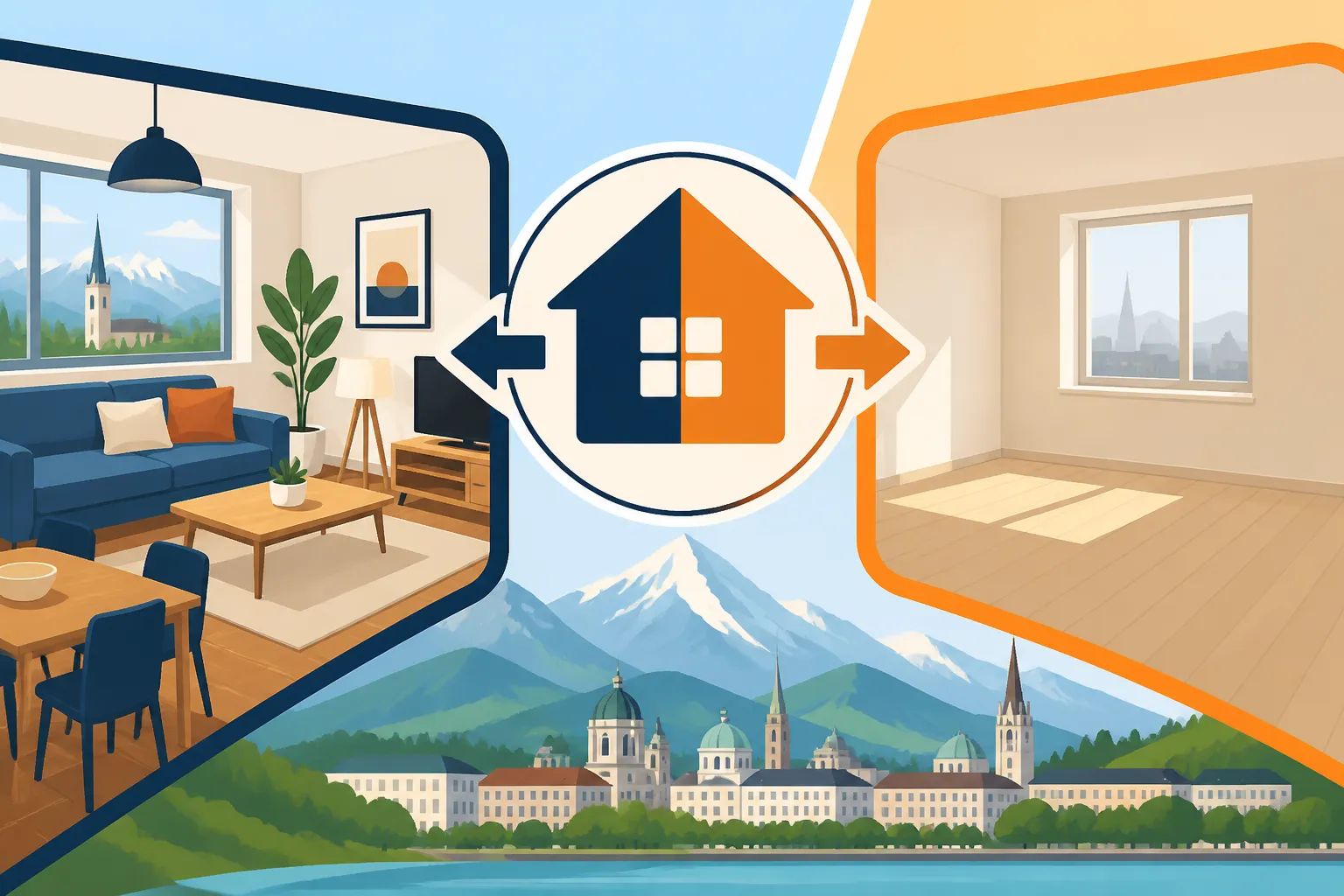
True furnished apartments, or möblierte Wohnungen, are less common for long-term stays in Austria and are often significantly more expensive. They are typically aimed at corporate expats, diplomats, or students who are only staying for a year or two. While they offer convenience, they come with a specific set of rules and costs.
What is Usually Included in a Furnished Flat
A fully furnished apartment in Vienna or Graz should, in theory, allow you to arrive with nothing but a suitcase. You can expect a bed (often with a mattress, though sometimes you’ll want to buy your own for hygiene), a sofa, a dining table with chairs, wardrobes, and basic lighting.
Higher-end "Business Apartments" take this a step further by including kitchenware, towels, and bed linens. If you are Moving to Austria with Family: Schools and Logistics, a furnished place can significantly lower the stress of the first 90 days. However, always ask for an Inventarliste (inventory list). This document is legally binding; if the list says there is a Nespresso machine and a toaster, ensure they are there and functioning when you sign the lease.
The Financial Surcharge for Furniture
Landlords in Austria are allowed to charge a "furniture supplement" on top of the base rent. This is often where they make their profit, especially in rent-controlled buildings where the base rent is capped by the government.
You need to evaluate if the monthly surcharge is worth the convenience. For example, if a landlord is charging an extra 150 EUR per month for furniture that looks like it came from a 1990s flea market, you are better off renting an unfurnished place and Sourcing Cheap Used Furniture on Willhaben Safely yourself. Within two years, you would have spent 3,600 EUR on that surcharge—enough to furnish a small apartment with brand-new items from IKEA or XXXLutz.
Short-Term Serviced Apartments
If you are still in the "searching" phase, you might look into Short-Term Rentals: WG-Gesucht, Serviced Flats, and Airbnb. These are always fully furnished and usually include utilities like internet and electricity in the "warm rent." This is a fantastic buffer while you navigate The Meldezettel Process: Registering Your Address Legally, but it is not a sustainable long-term financial strategy. These units can cost 40% to 60% more than a standard long-term lease.
The Semi-Furnished Middle Ground: The Ablöse
The most common scenario you will encounter in Austria isn't "furnished" or "unfurnished," but rather the "Ablöse" system. This is a uniquely Austrian cultural hurdle that can be a source of great frustration if you don't understand the rules.
Buying the Kitchen from the Previous Tenant
In many cases, the outgoing tenant paid for the kitchen installation themselves. Because they don't want to dismantle the cabinets and find a way to fit them into their new home, they will offer to leave the kitchen behind in exchange for a one-time cash payment, known as an Ablöse.
This is often a "take it or leave it" deal. If you want the apartment, the previous tenant might insist you buy their kitchen, their custom-fitted wardrobes, and perhaps even their washing machine. Tenants are sometimes asked to pay around 2,000 EUR for a kitchen and a hallway closet just to secure a flat in a popular district. It can feel like a ransom, but it spares you the nightmare of Finding English-Speaking Plumbers and Electricians to install a new one from scratch.
Negotiating a Fair Price
The Ablöse must be "proportionate." Legally, a tenant cannot charge you 5,000 EUR for a kitchen they bought ten years ago for 4,000 EUR. Furniture in Austria depreciates in value for legal purposes. If you feel the price is predatory, you can technically sign the agreement and later sue for the difference through the Mietervereinigung (Tenants' Association), though this will certainly sour your relationship with the neighbors and potentially the landlord.
It is always better to ask for original receipts. If the outgoing tenant can't prove what they paid, you have significant leverage to negotiate the price down. Remember, if you don't buy it, they are legally obligated to remove it and return the apartment to a "broom-clean" state, which is a massive chore they likely want to avoid.
The Handover Protocol
Regardless of whether you buy furniture via an Ablöse or rent a furnished place, the Übergabeprotokoll (handover protocol) is your most important document. This is when you walk through the flat with the landlord or agent and note every scratch on the floor, every chip in the paint, and the exact condition of the furniture. If you skip this, the landlord may try to keep your deposit when you leave, claiming you damaged the furniture that was actually broken three years before you arrived. Be meticulous. Take photos of everything.
Comparing Your Options: A Quick Guide
To help you decide which path fits your budget and timeline, use the table below to compare the typical inclusions and expectations.
| Feature | Unfurnished (Leer) | Semi-Furnished (Ablöse) | Fully Furnished |
|---|---|---|---|
| Kitchen (EBK) | Usually missing; must install | Included via one-time fee | Included in monthly rent |
| Light Fixtures | Bare wires; you buy & install | Often included or negotiable | Included |
| White Goods | None; you buy fridge/washer | Provided by previous tenant | Provided by landlord |
| Furniture | None | You buy specific items | All essentials provided |
| Upfront Cost | High (buying everything) | Medium (one-time fee) | Low (just the deposit) |
| Monthly Rent | Standard (Market/Cap) | Standard (Market/Cap) | High (Surcharge added) |
| Flexibility | Low (hard to move kits) | Medium | High (easy to leave) |
Maintenance, Repairs, and Legal Protection
Who pays when the washing machine floods the kitchen? This is the golden question in Austrian rentals. The answer depends heavily on who owns the appliance.
Landlord vs. Tenant Responsibilities
If you are in a furnished apartment, the landlord is generally responsible for the "wear and tear" of the furniture they provide. If the fridge dies of old age, they must replace it. However, if you break the glass table because you dropped a heavy vase, that is on you. This is why Personal Liability Insurance (Privathaftpflicht): A Must-Have is non-negotiable in Austria. Most "Household Insurance" policies include this, and many landlords won't even give you the keys without proof of coverage.
In an unfurnished or Ablöse scenario, you own the appliances. If the dishwasher breaks, it is your responsibility to fix it. This can lead to complex situations with Plumbing Leaks: Landlord vs Tenant Repair Responsibilities. If your own washing machine leaks and ruins the neighbor's ceiling, your insurance must handle it. If the building’s pipes burst, the landlord handles it.
The Role of the Deposit (Kaution)
The deposit for a furnished apartment is often higher than for an unfurnished one. While the standard is three months of "cold rent," for a high-end furnished place, it might push towards the legal limit of six months. Understanding Kaution (Deposit) and Provision (Commission) is vital here. The landlord will be much more eagle-eyed during the move-out inspection of a furnished flat because they are checking for stains on the sofa and scratches on the dining table.
Insurance for Your Belongings
If you choose the unfurnished route and spend thousands on a new kitchen and designer furniture, do not skimp on Household Insurance (Haushaltsversicherung) Explained. Austrian apartments, particularly the high-ceilinged Altbaus, can be prone to water damage from old pipes or even fire risks from outdated electrical systems. Your insurance should cover the "replacement value" of your furniture, not just what it’s worth at a thrift store.
Making the Final Decision
Choosing between these options usually comes down to your planned length of stay and your "start-up" capital.
When to Choose Unfurnished
If you plan to stay in Austria for three years or more, unfurnished is almost always the better financial move. It allows you to create a home that feels like yours, and you won't be paying a "convenience tax" every month to your landlord. You can take your time Using Willhaben and ImmobilienScout24 to Find Apartments that have an existing kitchen but are otherwise empty.
Also, consider the utilities. In an unfurnished flat, you will be responsible for Setting Up Wien Energie Electricity Online in English or choosing your own provider. This gives you more control over your monthly costs, especially with the Strompreisbremse 2026: How the Electricity Price Brake Works currently impacting energy bills.
When to Choose Furnished
If you are on a short-term contract, a student visa, or simply don't want the headache of a "logistical nightmare" move, choose furnished. It is the fastest way to get your The Austrian e-card: Registration, Photo Rules, and Usage Guide sorted and start your life. You won't have to deal with the stress of furniture deliveries or the physical labor of assembly.
Just be prepared for the fact that furnished apartments are often exempted from certain rent protections. You should read up on Rent Control (Altbau Richtwert): Calculating Fair Rent 2026 to see if the price you are being quoted is actually fair or if the "furniture" is just a loophole the landlord is using to overcharge you.
Summary of Moving Strategy
- The "Safe" Move: Rent a serviced apartment for 1 month.
- The "Search" Phase: View apartments and check specifically for "EBK."
- The "Negotiation": If the flat is perfect but empty, look for an Ablöse deal.
- The "Setup": If going unfurnished, book your kitchen measurement the day you sign the lease.
- The "Legal": Ensure your Befristet (Fixed) vs Unbefristet (Unlimited) Lease Contracts clearly state what is included to avoid deposit disputes later.
Disclaimer
This guide is provided for informational purposes only and does not constitute legal advice. Rental laws in Austria, specifically the Mietrechtsgesetz (MRG), are complex and subject to change. Always consult with a qualified legal professional or a tenant advocacy group like the Mietervereinigung before signing a lease agreement or paying an Ablöse. Conditions may vary significantly based on the age of the building and the specific province.