Disposing of Oversized Trash (Sperrmüll) at Waste Centers
Trying to figure out how to get rid of a broken sofa or a disintegrated wardrobe in Austria is one of those classic expat "welcome to the neighborhood" tests that nobody prepares you for. I still remember the sheer panic of my first move in Vienna, staring at a mountain of old IKEA boxes and a lumpy mattress, wondering if the neighbors would call the police if I left them by the bin for ten minutes. This guide solves that logistical headache by walking you through the strict, often confusing, but ultimately efficient world of Austrian waste centers.
Understanding Sperrmüll: What It Is and What It Isn’t
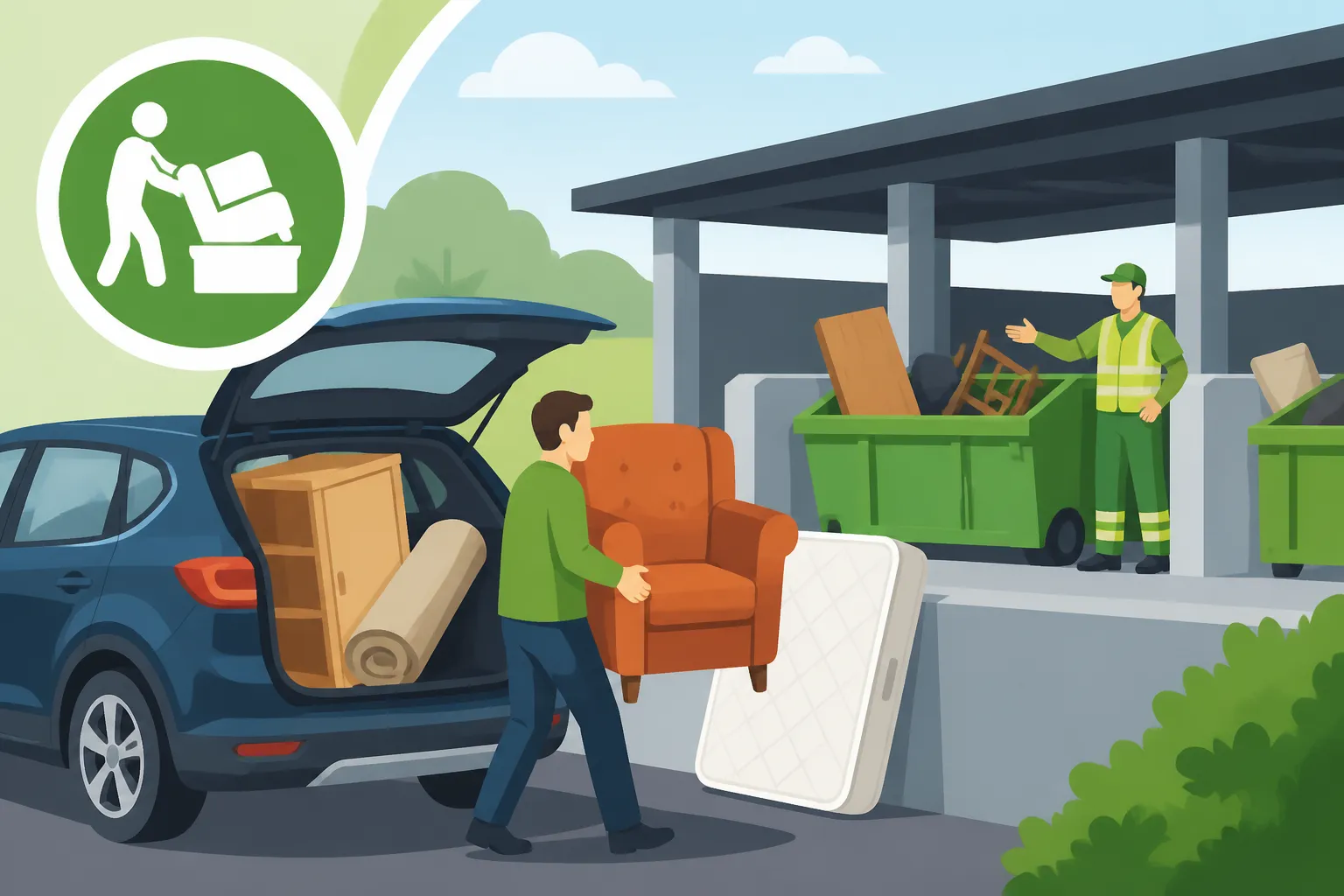
Navigating the waste management system in Austria requires a bit of a vocabulary shift. The term you will hear most often is Sperrmüll, which literally translates to bulky waste. This isn't just "extra trash"; it specifically refers to items that are too large to fit into your standard residential residual waste bin (the grey one). We are talking about the heavy hitters: old mattresses, dismantled wooden furniture, carpets, and those massive suitcases that didn't survive your last flight.
A common mistake many newcomers make is assuming that anything "big" is Sperrmüll. However, the Austrian system is meticulously categorized. If you have a broken washing machine or an old microwave, that falls under electronic waste (Elektroaltgeräte). If you have leftover cans of paint or old car batteries from a weekend DIY project, those are "problem substances" (Problemstoffe). Understanding these distinctions is crucial because when you roll up to a waste center, you’ll be directed to different containers for each.
Validation of your frustration is necessary here: yes, it is incredibly annoying that you can't just put everything in one "big stuff" pile. I have spent many Saturday mornings standing in the rain at a Mistplatz, meticulously separating the wooden legs of a chair from its fabric upholstery because the attendant insisted they belonged in different bins. It feels like a lot of work, but this level of sorting is why Managing Household Waste: Strict Recycling Rules Explained is such a fundamental part of the local culture and why the country remains so clean.
Finding and Navigating Your Local Waste Center
In Austria, these magical places where your unwanted clutter goes to die are usually called a Mistplatz (especially in Vienna) or an Altstoffsammelzentrum (ASZ) in other provinces. Finding one is the easy part—every major district or municipality has at least one. However, navigating them requires a bit of strategy. Most centers are open Monday through Saturday, but they are notorious for closing early on Saturdays or having very specific "midday breaks" where the gates simply shut.
When you arrive, expect a "gatekeeper" experience. There is almost always a staff member at the entrance who will peer into your car or van to see what you’re bringing. This isn't just curiosity; they are checking if you are a private resident or a commercial business. In most cases, as long as you are driving a standard passenger car or a small van, they will wave you through to the various unloading zones. If you look like a professional renovation crew, you might face some questions about where the waste came from.
One of the most important things to remember is that you might be asked for proof of residence. While it doesn't happen every time, having a digital copy of your The Meldezettel Process: Registering Your Address Legally on your phone can save you a massive headache if the attendant decides to be strict that day. They want to ensure that the taxes from your specific municipality are the ones funding the disposal of your trash.
Opening Hours and Peak Times to Avoid
If you value your sanity, do not go to a waste center on a Saturday morning right when they open, or on the first sunny day after a long winter. These are the "peak" times when every person in the district suddenly decides to clear out their cellar. You will find yourself in a long queue of cars, idling your engine while someone three cars ahead struggles to unload a grand piano.
The best time to visit is usually a Tuesday or Wednesday morning. If you can't make that work, try the "lunch hour" on a weekday. Many people assume the staff are on break, but most large centers in cities like Vienna stay open throughout the day. Checking the specific hours for your local center online is vital, as rural areas might only have their ASZ open twice a week.
Necessary Documentation and Resident Verification
In most urban areas, the staff are fairly relaxed if you have local license plates. However, if you have just moved and are still driving a car with foreign plates or plates from a different Austrian province, keep your paperwork handy. They may want to see that you actually live in the area.
Beyond residency, you should also be aware of the "quantity" rules. For most private households, disposing of Sperrmüll is free up to a certain volume (usually what fits in a standard car or a small trailer). If you show up with three truckloads of construction debris, you will likely be charged a fee. This is where Understanding Kaution (Deposit) and Provision (Commission) doesn't apply, but knowing your rights as a resident does.
| Waste Category | Examples | Disposal Location at Center |
|---|---|---|
| Sperrmüll | Sofas, Mattresses, Carpets | Large open-top containers |
| Altholz | Bookshelves, Bed frames, Tables | Dedicated wood bins |
| Elektroaltgeräte | Fridges, TVs, Toasters | Covered electronic zones |
| Problemstoffe | Paint, Chemicals, Batteries | Staffed "Hazardous" kiosks |
| Bauschutt | Bricks, Tiles, Concrete | Heavy-duty stone bins (Fees may apply) |
The Logistics of Transporting Oversized Items
Unless you own a large SUV, getting a three-seater sofa to the waste center is a physical impossibility. This brings us to the logistical hurdle of transport. Many expats find themselves in a bind because they don't have a car, let alone one that can haul furniture. In Austria, the most common solution is to rent a small van for a few hours.
If you have a standard EU driving license or have gone through the process of Converting a Foreign Driver's License in Austria, you are legally allowed to drive most "3.5-ton" vans. These are the typical Sprinter-style vehicles you see everywhere. Renting one for a "Sperrmüll run" is a rite of passage. I highly recommend checking out local hardware stores like Bauhaus or Hornbach, as they often have very cheap hourly rates for van rentals if you are a "customer" (even if you just buy a pack of lightbulbs).
Alternatively, if the thought of driving a massive van through narrow Austrian streets gives you hives, you can hire professional disposal services (Entrümpelung). These companies will come to your apartment, carry the heavy items down the stairs, and deal with the waste center for you. It is significantly more expensive, but for many, the saved stress on their back and brain is worth the price.
Renting a Transporter or Trailer
When looking for a rental, pay close attention to the terms. Some companies offer a "per kilometer" rate, while others offer a flat hourly fee. For a trip to the local waste center, the hourly fee is usually much better. If you decide to go this route, make sure you are comfortable with Renting a Moving Van (Transporter) with a Standard B License and that you understand how to park the beast.
Another option if you have a car with a tow hitch is to rent a Frachtanhänger (trailer). These are incredibly cheap—often less than 20 Euros for a half-day. However, be warned that reversing a trailer in a crowded waste center is a spectator sport for the staff, and they will not hesitate to give you "helpful" (read: sarcastic) advice if you struggle.
Professional Disposal Services vs. DIY
The DIY route is almost always cheaper, but it requires at least one strong friend and a lot of patience. If you are doing a "full clear out" because you are Terminating a Lease: Notice Periods and 3-Year Minimums, you might simply have too much for a car. In this case, hiring a "Man with a Van" service found on platforms like Willhaben can be a middle ground.
Just be careful with these "informal" services. Ensure they actually take the stuff to a legal waste center. If they "fly-tip" your sofa in the woods and the police find your old mail stuffed in the cushions, you are the one who will be receiving a very expensive fine. Always ask for a receipt from the waste center if you are paying someone else to take your trash.
Costs and Fees Associated with Bulk Disposal
One of the great things about living in Austria is that, for the most part, getting rid of your old stuff as a private individual is free. Your Money in Austria 2027: Banking, Payments, and Financial Setup advice likely didn't mention this, but your municipal taxes cover a significant amount of waste disposal. In Vienna, for example, you can drop off typical household quantities of Sperrmüll at the MA 48 Mistplätze without paying a cent.
However, "household quantities" is the operative phrase. The general rule of thumb is that if it fits in a car or a small van, it's free. If you arrive with a literal truck, the staff will classify you as a commercial delivery. There are also specific items that might incur a small fee or have strict limits, such as old tires (often limited to 4 or 5 per person) or large amounts of construction rubble.
If you are renovating an entire apartment, you cannot expect the local waste center to take all your old tiles and bricks for free. For these projects, you are usually required to rent a Mulde (a large skip bin) that sits outside your house for a few days. The cost for this includes the rental of the bin and the disposal fees based on the weight of the material inside.
Free Allowances for Private Households
For most of us, the free allowance is more than enough. You can generally take furniture, old clothes, scrap metal, and electronics as often as you want. The staff are trained to spot "professional" disposers who are trying to avoid commercial fees. As long as you look like a normal resident who is just finally getting rid of that broken exercise bike from 2014, you won't have any issues.
It's also worth noting that many waste centers have a "Re-Use" section. In Vienna, this is the famous "48er-Tandler" box. If your items are actually still in good shape—maybe a chair that just needs a new cushion—you can put them in this specific area instead of the trash. They will be sold at a deep discount in a city-run second-hand shop, which is a much more sustainable way to handle Everyday Etiquette: Garbage Sorting, Noise, and Ruhezeit.
Dealing with Hazardous Materials Surcharges
While Sperrmüll is free, "Problem Substances" (Problemstoffe) are handled with extreme care. You are generally allowed to bring small amounts of household chemicals, like half-empty paint cans or cleaning supplies, for free. However, if you are bringing large industrial quantities, you might be turned away or sent to a specialized disposal facility.
Never, ever try to hide hazardous waste inside a sofa or a cardboard box to avoid the "Problemstoffe" counter. The machines that crush the waste can cause fires or chemical leaks if batteries or pressurized cans are hidden inside. The staff take this very seriously, and getting caught can lead to immediate bans from the center and heavy fines.
Sustainable Alternatives Before Heading to the Mistplatz
Before you go through the hassle of hauling a heavy table down three flights of stairs and driving it across town, ask yourself: is this actually trash? Austria has a very robust "pre-loved" culture. Because the process of disposing of large items is a bit of a chore, many people prefer to give things away for free or sell them for a pittance just to have someone else come and carry them away.
This is a win-win scenario. You save the effort and the potential rental cost of a van, and someone else gets a functional item. This is particularly common in Vienna Neighborhood Guide: Best Districts for Expats, where students and young professionals are always on the hunt for cheap furniture. Just be prepared for the "Willhaben experience," which involves answering twenty messages asking if the item is still available, only for the person to never show up.
Selling or Giving Away on Local Platforms
Willhaben is the undisputed king of the Austrian second-hand market. If you list something as "Zu Verschenken" (for free), it will often be gone within the hour. Be very clear in your ad that the person must "Selbstabholung" (pick it up themselves) and "Selbstabbau" (disassemble it themselves). Even a massive wardrobe can be given away this way: the takers bring the tools and spend a couple of hours taking it apart themselves, which makes it one of the least stressful ways to dispose of bulky furniture.
Another great option is Facebook Marketplace or local "Free Your Stuff" groups. These are often more community-focused, and you are less likely to deal with the "professional" resellers who haunt Willhaben. If you are looking to buy as well, check out our tips on Sourcing Cheap Used Furniture on Willhaben Safely.
Donation Centers and Social Enterprises
If your stuff is in decent condition but you don't want the hassle of private buyers, consider donation centers. Organizations like Caritas (under their "Carla" brand) or Volkshilfe run large second-hand warehouses. Some will even offer a pickup service if you have several high-quality items, though their waiting lists can be weeks long.
When you donate to these organizations, you are helping fund social projects and providing affordable goods to people in need. It's a much better feeling than watching your old dining table get crushed by a hydraulic press at the Mistplatz. Just be honest about the condition—if a sofa is stained or broken, they won't take it, and you’ll be back to square one.
Regional Differences: Vienna vs. The Rest of Austria
While the general concept of the waste center is the same across the country, the execution varies wildly. Vienna is spoiled by the MA 48 system, which is incredibly efficient and even has its own cult following (the orange-clad workers are somewhat of a local icon). In Vienna, the Mistplätze are numerous, and the rules are quite standardized.
Once you move into the surrounding provinces like Lower Austria or Styria, things become a bit more "village-style." You might find that your local ASZ is only open on Friday afternoons and Saturday mornings. In some very rural areas, they don't even have a permanent center; instead, they have a "Sperrmüll collection day" once or twice a year where you can place your bulky items on the curb for pickup.
The MA 48 System in Vienna
If you live in the capital, you should download the "48er App." it tells you exactly which Mistplatz is closest to you, what their current opening hours are, and even has a "Profi-Check" feature where you can type in an item (like "old yoga mat") and it will tell you exactly which bin it belongs in. It takes all the guesswork out of the process.
The Vienna system also includes "mobile" problem substance collection points. These are small trucks that park in specific spots in your neighborhood once a month. You can bring your old batteries, medicines, and oils to them so you don't have to travel all the way to a large waste center. It's an incredible service that many expats overlook.
Waste Management in Graz, Linz, and Salzburg
In cities like Graz or Linz, the systems are run by the local holding companies (like Holding Graz). They often provide "vouchers" or a certain number of free "entry cards" per year as part of your residency. For example, in Graz Neighborhood Guide: Family Areas vs Student Hubs, you might receive a bulky waste voucher in the mail that allows you one or two free "large" disposals per year.
Always check your local municipality's website (the Gemeinde). They will have a waste calendar (Abfuhrkalender) that you can print out. This calendar is the bible of Austrian domestic life; it tells you when the plastic is collected, when the paper goes, and when the special Sperrmüll events happen. Following these rules is the fastest way to earn the respect of your Austrian neighbors.
Disclaimer
This guide is intended for informational purposes and reflects the general practices of waste management in Austria as of 2026. Local regulations, opening hours, and fees can vary significantly between municipalities and districts. Always consult your local "Magistrat" or "Gemeinde" website for the most current and specific rules regarding waste disposal in your area. The author is not responsible for any fines or legal issues arising from improper waste disposal.