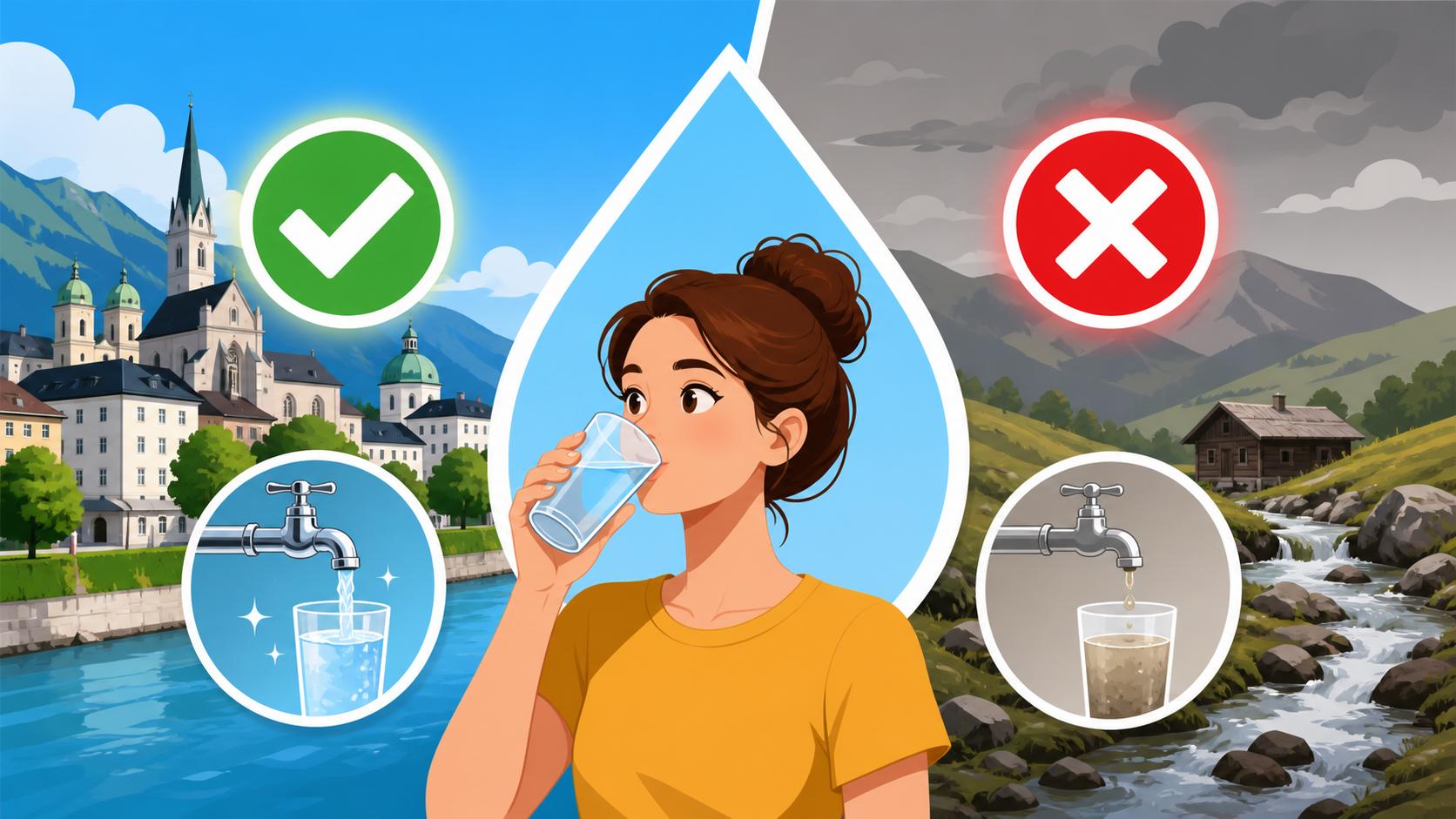
Is Austrian Tap Water Really Safe to Drink Everywhere?
One of the most common anxieties for newly arrived expats in Austria is standing in a local supermarket, staring at the endless aisles of bottled water, and wondering if the tap water back at the apartment is actually going to make them sick. I spent my first three weeks in a beautiful Vienna Altbau lugging heavy six-packs of sparkling water up four flights of stairs because I simply didn't believe the "mountain water" hype. This guide will solve the mystery of Austrian tap water quality, explaining exactly where it comes from, when you should be cautious, and why your kettle is probably covered in white crust.
The Alpine Source: Why Austrian Water is Globally Renowned
To understand why people in Austria take such pride in their tap water, you have to look at the geography. Unlike many other European nations that rely on heavily processed river water or treated groundwater, the vast majority of Austria’s drinking water comes from protected mountain springs and deep Alpine aquifers. In Vienna, for example, the water travels through two massive pipelines—the Hochquellleitungen—directly from the Schneeberg, Rax, and Hochschwab mountains.
The water is so pure at its source that it often requires very little treatment. It isn't sitting in massive chemical tanks for days; in many cases, the water you drink in your kitchen was high up in the Alps just 36 hours prior. This natural filtration through Alpine limestone gives the water a crisp, fresh taste that is often superior to expensive bottled brands. If you are just starting your journey here, checking off items on your Healthcare Checklist for Your First 30 Days in Austria should definitely include trusting the tap, as staying hydrated with high-quality water is the simplest form of preventive care.
The infrastructure behind this is a feat of engineering. The water flows to the cities primarily through gravity, meaning it doesn't even require massive electrical pumping stations. In fact, the pressure of the falling water is often used to generate hydroelectric power along the way. This is part of the broader Austria Healthcare System 2027: Complete Guide for Foreign Residents philosophy that emphasizes environmental health as a pillar of public well-being. When you turn on the tap, you aren't just getting hydration; you're getting a direct connection to the Alpine ecosystem.
Is it Always Safe? Navigating Altbau Pipes and Rural Areas
While the water leaving the reservoir is world-class, the journey through the "last mile"—the pipes in your specific building—is where things can get a bit more complicated for expats. If you are living in an older building, typically referred to as an Altbau, there is a slim but present possibility of legacy plumbing issues. Before the mid-20th century, lead pipes were sometimes used in construction.
While the Austrian government has been extremely proactive in mandating the replacement of these pipes, some very old, unrenovated buildings might still have sections of lead piping in the basement or within the walls. This is a topic often discussed when comparing Altbau vs Neubau: Differences in Rent, Charm, and Heating options. If the water has been sitting in lead pipes overnight, the lead content can leach into the water. As a veteran expat, my advice is simple: if you live in an old building, let the water run for about 30 to 60 seconds in the morning until it feels noticeably colder. This flushes out the water that was standing in the pipes.
In rural areas, particularly in parts of Lower Austria or Styria where agriculture is intensive, there are occasional concerns regarding nitrate levels in groundwater. However, the Austrian drinking water ordinance (Trinkwasserverordnung) is incredibly strict—often stricter than EU requirements. Local municipalities are required to publish water quality reports regularly. You can usually find these on your town’s official website or by searching for "Trinkwasserwerte" plus your postal code. If you are Finding Medical Care in Austria: Clinics, Hospitals, and Referrals for a specific health condition, you might even ask your GP if local mineral levels are something you should monitor.
| Water Feature | Typical Austrian Tap Water | Standard Bottled Water |
|---|---|---|
| Source | Alpine Springs / Aquifers | Various (Spring/Processed) |
| Chlorine Taste | Negligible to None | Low |
| Mineral Content | High (Calcium/Magnesium) | Varies by Brand |
| Cost per Liter | ~€0.002 | €0.25 – €1.50 |
| Environmental Impact | Zero Plastic Waste | High Plastic Waste |
| Testing Frequency | Daily/Weekly by State | Batch Testing |
The "Kalk" Conundrum: Hard Water and Your Health
If you have lived in Austria for more than a week, you have likely noticed a white, chalky residue in your kettle, on your showerhead, and on your glassware. This is Kalk (limescale), which is essentially calcium carbonate. Because the water filters through limestone mountains, it picks up significant amounts of calcium and magnesium.
From a health perspective, this is actually a benefit. Calcium and magnesium are essential minerals. Drinking "hard" water can contribute to your daily intake of these nutrients, which is excellent for bone health and cardiovascular function. When you are going through Preventive Care: Gesundenuntersuchung and Routine Checkups, your doctor will likely tell you that your mineral levels are influenced by your diet, and Austrian tap water is a great supplement.
However, from a lifestyle perspective, Kalk is the enemy of Austrian appliances. It can clog coffee machines, ruin washing machines, and make your hair feel slightly drier if you aren't used to it. Most expats eventually invest in a basic water filter jug, not because the water is "unsafe," but to soften it for better-tasting tea and to protect their expensive espresso machines. Understanding this balance is part of the Everyday Etiquette: Garbage Sorting, Noise, and Ruhezeit culture—taking care of your home environment is a very Austrian trait.
Public Fountains and "Kein Trinkwasser" Warnings
Austria is incredibly generous with its water. In cities like Vienna, Graz, and Salzburg, you will find hundreds of public drinking fountains (Trinkbrunnen). These are a lifesaver for Preventing Summer Heatstroke During Vienna Heatwaves, as they provide free, chilled Alpine water to anyone passing by. Some of these fountains are modern steel pillars, while others are ornate stone monuments that have been serving the city for centuries.
However, you must be aware of the "Kein Trinkwasser" sign. This is a standard warning label accompanied by a symbol of a glass with a red line through it. You will most commonly see this on:
- Fountains in parks that use recycled greywater for decorative purposes.
- Water taps in train station bathrooms (occasionally).
- Remote mountain troughs used for cattle.
- Old hand-pumps in rural gardens.
If a tap does not have this sign, in 99% of cases, it is perfectly safe to drink. This is especially true in the mountains. If you are hiking and come across a hut, the water from the tap is usually better than anything you can buy in a store. If you are Building a Standard First Aid Kit for an Austrian Home, remember that clean tap water is also your first line of defense for cleaning minor wounds, as its microbial quality is generally clinical-grade.
Environmental Impact and Cost Benefits for Expats
Switching from bottled water to tap water is one of the easiest ways to slash your Cost of Living Benchmarks for Singles, Couples, and Families in Austria. A family of four can easily save €50 to €100 a month just by using the tap. Moreover, Austria has a very specific Everyday Etiquette: Garbage Sorting, Noise, and Ruhezeit system for recycling. Lugging plastic bottles (PET) to the yellow bins is a chore that most veterans eventually abandon in favor of the tap.
Furthermore, the environmental cost of bottling and transporting water in a country that literally has it falling from the mountains is hard to justify. By drinking from the tap, you are supporting the local municipal infrastructure and reducing the carbon footprint associated with plastic production. If you ever have doubts about the specific chemistry of your water, you can order a "Trinkwasseranalyse" (water analysis) kit online or through a local pharmacy. This is a small price to pay for the peace of mind that Is Austrian Tap Water Really Safe to Drink Everywhere? is a resounding "Yes."
For those with specific health concerns, such as managing a Chronic Illness: Diabetes and Hypertension Care, the high mineral content is generally seen as a positive, though you should always consult with your specialist if you are on a restricted mineral diet. For everyone else, the advice is simple: buy a nice reusable bottle, fill it up at the sink, and enjoy some of the best water on the planet.
How to Test and Verify Your Building's Water Quality
If you still feel uneasy—perhaps because your water has a strange color after you’ve been away on holiday or the taste seems "off"—there are concrete steps you can take. First, identify the age of your building. This info is usually available in your rental contract or by checking the Utilities Setup: Electricity, Gas, Water, and Internet documentation provided by your landlord.
- The Visual Test: Fill a clear glass and hold it against a white piece of paper. It should be crystal clear. If it’s cloudy, it might just be air bubbles (which disappear after a minute) or Kalk. If it’s brown or reddish, that’s rust from old iron pipes, and you should notify your Hausverwaltung (property management).
- The Professional Test: You can contact the Apotheke (pharmacy). Some pharmacies offer water testing kits where you take a sample and send it to a lab. They will check for lead, copper, nitrates, and bacterial contamination.
- The Municipal Report: Look up the "Wasserbefund" for your specific district. These reports are updated constantly and will tell you the exact hardness (measured in Deutsche Härte or °dH) and pH level of the water in your area.
Most expats find that once they see the official lab results, their "fear of the tap" vanishes. Austria’s commitment to water quality is a matter of national pride, and as a resident, you are entitled to benefit from this liquid gold.
Disclaimer
This guide is for informational purposes only and reflects the general state of water quality in Austria as of 2026. While Austrian tap water is among the safest in the world, individual building plumbing or specific local conditions can vary. Always follow the advice of your local health authorities and consult with a medical professional if you have specific health concerns related to mineral intake or water safety.