Can I Leave My House During a Krankenstand?
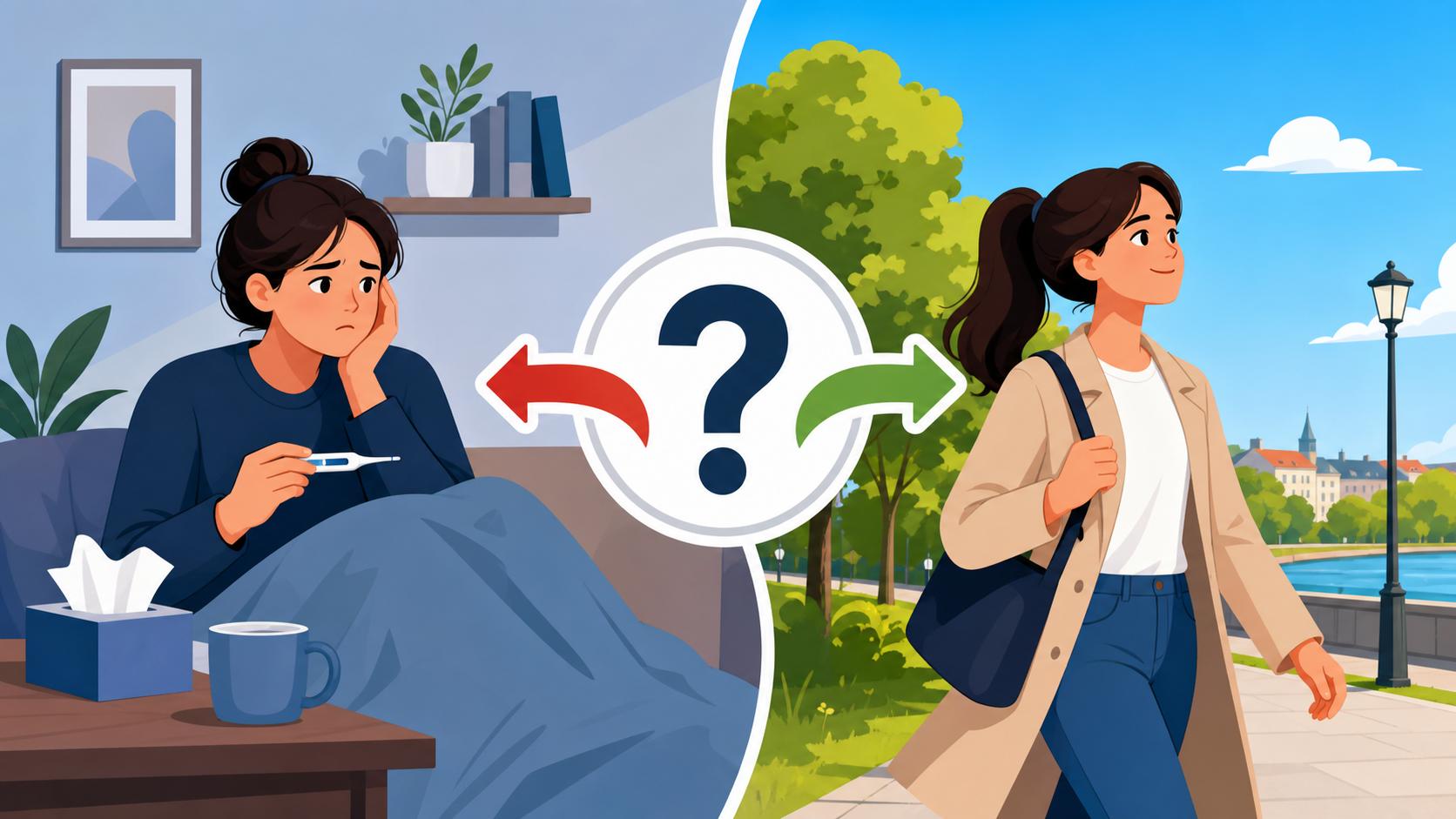
Getting sick in Austria often triggers a secondary fever of administrative anxiety: the fear of the "Sick Check" or being spotted at the grocery store by a colleague. I remember sitting in my dark Vienna apartment for three days with a mild cold, terrified to even take the trash out because I didn't want to lose my job. This guide clarifies the legal boundaries of your movement during a Krankenstand so you can recover without the unnecessary stress of breaking the law.
The Legal Foundation of Sick Leave in Austria
When you are on sick leave in Austria, your primary legal obligation is to do everything in your power to facilitate a speedy recovery. This concept is rooted in the "duty of loyalty" (Treuepflicht) you owe to your employer. In the eyes of the law, and more importantly, the eyes of the Austrian Health Insurance Fund (ÖGK), your behavior during this time must not be "conducive to delaying recovery." This is a broad term that creates a lot of gray areas for expats.
The first thing you must understand is that a Krankenstand is not a vacation. While you are being paid your salary through the Entgeltfortzahlung system, you are essentially under medical "house arrest" unless your doctor specifies otherwise. The process begins with the Krankmeldung, the official medical certificate issued by your GP. For many, the first point of confusion is how to initiate this properly. You should review the Exact Steps to Notify Your Employer of a Krankenstand to ensure you don't fall at the first hurdle of communication.
The doctor’s role is central here. They don't just diagnose your flu; they effectively set the rules for your freedom of movement. On your medical certificate, there is a section for "Ausgehzeiten" (permitted outing times). If this section is blank or specifically restricted, your default state should be at home. Understanding Sick Leave (Krankenstand): Employer Notification and Doctor Notes is vital because if the paperwork isn't perfect, the ÖGK might flag your case for a surprise visit.
Permitted Outing Times: Understanding Ausgehzeiten
In the Austrian medical system, "Ausgehzeiten" are specific windows of time—usually two hours in the morning and two hours in the afternoon—where you are explicitly allowed to be out of the house. For example, a doctor might write "09:00-11:00 and 15:00-17:00" on your slip. During these times, you can go for a walk, visit a pharmacy, or pick up essential groceries without fear of legal repercussion.
However, these times are not a "free pass" to go to the cinema or meet friends for coffee. The purpose of being out must still align with your recovery. If you have a severe lung infection, even being out during your permitted hours might be questioned if you are spotted at a smoky bar or hiking a mountain. Conversely, if you are on leave for burnout or depression, your doctor may actually prescribe "unlimited" outing times, as social interaction and fresh air are part of the therapy. In such cases, Mental Health in Austria: Counseling, Therapy, and Expat Support can provide more context on how the system handles psychological illness differently from physical ones.
If your doctor has not specified any Ausgehzeiten, you are generally expected to stay home. However, there are "necessary errands" that the law recognizes. You are always allowed to leave your house to:
- Visit the doctor or a medical facility for treatment.
- Go to the pharmacy to pick up prescribed medication.
- Purchase basic, essential food items if you live alone and have no one to help you.
What Constitutes a Necessary Errand?
A common question I get from fellow expats is whether "essential groceries" includes a trip to a large shopping mall. The answer is a firm no. A necessary errand is the shortest possible trip to the nearest available provider. If you live in the 7th district of Vienna and are spotted at a shopping center in the 22nd district, your "necessity" argument will likely fail during an audit.
When you are out for these essential reasons, always keep your The Austrian e-card: Registration, Photo Rules, and Usage Guide with you, as well as the receipt from the pharmacy or doctor's office. These serve as your "alibi" if an inspector happens to visit your home while you are out. It is also wise to check How to Check if Your e-card is Active Online before you head to the doctor, as an inactive card can complicate the registration of your sick leave.
The Dreaded Home Visit: The ÖGK Kontrollor
Austria still employs "Krankenbesucher" or "Kontrolloren"—inspectors whose job is to verify that people on sick leave are actually at home and following medical advice. While it feels like something out of a spy novel, it is a very real part of Navigating Social Insurance: ÖGK, SVS, and BVAEB Overview. These visits are usually unannounced and can happen at any time during the day, though they rarely occur late at night or on Sundays.
If the inspector knocks and you aren't there, they will leave a slip in your mailbox. This slip is a formal request for you to justify your absence. If you were at the doctor, you simply provide the confirmation of your visit (Zeitbestätigung). If you were at the supermarket during your Ausgehzeiten, that is also usually fine. However, if you were at a gym or a birthday party, you are in significant trouble.
| Activity | Permitted? | Conditions/Notes |
|---|---|---|
| Visiting the GP/Specialist | Yes | Always permitted; get a Zeitbestätigung. |
| Going to the Apotheke | Yes | Permitted for necessary medication. |
| Grocery Shopping | Partial | Only for essentials; best done during Ausgehzeiten. |
| Going to a Restaurant | No | Generally seen as counter-productive to recovery. |
| Physical Exercise | Case-by-case | Permitted only if prescribed by a doctor (e.g., for back pain). |
| Traveling out of the city | No | Requires explicit permission from the ÖGK. |
| Walking in the park | Yes | Usually allowed during Ausgehzeiten for fresh air. |
If you missed the inspector because you were sleeping or in the shower, don't panic. You should immediately contact the number on the slip to explain. The ÖGK is staffed by humans, and they understand that people on sick leave are often sleeping heavily or taking long baths. However, repeated missed visits will trigger a "Ladung" (summons) to a medical examiner (Chefarzt) to verify your inability to work.
Employer Rights and Termination Risks
A common misconception among expats is that you cannot be fired while on sick leave in Austria. This is unfortunately a myth. While there are some protections, an employer can legally terminate your contract during a Krankenstand, provided they observe the correct notice periods and legal requirements. For a deeper dive into this, I highly recommend reading Can an Employer Fire You During Sick Leave in Austria? to understand your rights and the limits of employer power.
If your employer suspects you are "faking it" or "acting against recovery," they can hire private investigators, though this is rare and usually reserved for high-salary positions or long-term disputes. More commonly, they will report their suspicion to the ÖGK, which then triggers the home visit mentioned earlier. If you are caught doing something that clearly contradicts your sick status—like posting photos of yourself at a music festival on Instagram—this is considered a "breach of trust" and can be grounds for "Entlassung" (immediate dismissal without notice).
Even if you aren't fired, your employer might ask Do I Need a Doctor's Note from Day One? depending on your specific contract or the company’s collective agreement (Kollektivvertrag). If you fail to provide the note or if the note is invalidated because you were caught at a bar, the employer can stop paying your salary for the duration of the absence.
Traveling and Special Permissions
What happens if you are sick but want to recover at your parents' house in another city or country? This is a frequent scenario for the expat community. The rule is strict: you must remain at your registered residence (Meldeadresse) during your sick leave. If you wish to change your location, you must obtain prior permission from the ÖGK.
This process involves your doctor writing a recommendation that "recovering elsewhere" is beneficial for you. For example, if you live in a small apartment and your parents can provide full-time care in a house with a garden, the ÖGK might approve it. Without this approval, leaving the country is a major violation. You can find more details on the logistics in Traveling Outside Austria During a Krankenstand.
For those covered by private schemes, the rules might be slightly different, but the core principle of "not delaying recovery" remains. You can compare the differences in Public vs Private Health Insurance in Austria Explained to see if your specific policy offers more flexibility.
Practical Tips for Staying Out of Trouble
To navigate a Krankenstand safely, a useful rule of thumb is to follow the "Grandmother Rule": If you wouldn't want your grandmother to see you doing it while you're supposed to be sick, don't do it.
- Keep your phone on: If your employer or the ÖGK tries to reach you and you are unreachable for 24 hours, it looks suspicious.
- Collect receipts: If you go to the Pharmacies (Apotheken) and Medication Rules in Austria, keep the receipt. It has a time stamp that proves where you were if an inspector came by.
- Be careful with social media: This is the number one way expats get caught. Even a "throwback" photo posted while you are sick can be misinterpreted by a disgruntled colleague or boss.
- Ask for Ausgehzeiten: When you are at the doctor, specifically ask them to write your outing times on the certificate. Don't assume they will do it automatically.
- Check your mail: If you are sick for more than a few days, make sure you (or a neighbor) are checking your mailbox for ÖGK slips.
Recovering in a foreign country is hard enough without the fear of the "Sick Police." By knowing your Ausgehzeiten and staying within the bounds of "necessary errands," you can focus on getting better and returning to work without a legal headache.
Disclaimer
The information provided in this article is for informational purposes only and does not constitute legal or medical advice. Labor laws and social insurance regulations in Austria are subject to change, and specific cases may vary based on individual employment contracts or collective agreements. Always consult with a qualified legal professional, the Arbeiterkammer (Chamber of Labour), or your health insurance provider regarding your specific situation.