Recycling Bins Color Code: Altpapier, Plastik, Restmüll
Standing in front of a row of multi-coloured bins with a greasy pizza box in one hand and a plastic yogurt pot in the other can feel like a high-stakes exam you didn't study for. I remember my first week in Vienna, paralyzed by the fear that my elderly neighbour was watching from behind her lace curtains, ready to report my "trash crimes" to the building management. This guide solves the mystery of the Austrian recycling system, ensuring you master the color codes and avoid those dreaded passive-aggressive notes.
Understanding the Austrian Recycling Philosophy
Recycling in Austria, or Mülltrennung, is not merely a suggestion; it is a deeply ingrained cultural expectation and a cornerstone of civic duty. When you move here, you quickly realize that how you handle your rubbish is often seen as a reflection of your respect for the community. This is part of the broader Everyday Etiquette: Garbage Sorting, Noise, and Ruhezeit that defines life in the Alpine republic. The system is designed to be highly efficient, feeding into a sophisticated circular economy where waste is transformed into energy or new products.
The Cultural Weight of Mülltrennung
To an outsider, the Austrian obsession with sorting might seem excessive, but for locals, it is a point of national pride. You will find that even small children are taught the nuances of bin colors before they can ride a bike. If you are still in the process of Moving to Austria with Family: Schools and Logistics, getting your children involved in the sorting process is actually a fantastic way to help them integrate into the local mindset. It signals to your neighbours that you are making a conscious effort to adopt Austrian values.
In my early days, I made the mistake of throwing a half-full juice carton into the general waste. Within twenty-four hours, a politely worded (but firm) note appeared in the hallway reminding residents of the "proper procedures." It wasn't just about the juice carton; it was about the collective effort. The Austrian system relies on everyone doing their part to keep processing costs low and environmental standards high.
Fines and Neighborly Oversight
While it is rare for the police to knock on your door over a misplaced tin can, the management of your apartment building (Hausverwaltung) can and will issue warnings. If a building consistently fails to sort correctly, the city may increase the waste collection fees for the entire block. This is why neighbours can be so vigilant; your mistake literally costs them money. In some districts, "waste advisors" occasionally inspect bins to ensure compliance.
Beyond the financial aspect, there is the social cost. In smaller communities or traditional Altbau buildings, being the person who ruins the compost bin with plastic bags can lead to frosty relations at the mailbox. Mastering the system early is essential for Community Integration: Making Friends and Adapting in your new home. It is one of those small, daily actions that proves you are a reliable member of the "Hausgemeinschaft."
Environmental Impact and Circular Economy
Austria is one of the world leaders in waste management, with a recycling rate that consistently ranks near the top of EU charts. A significant portion of what cannot be recycled is sent to state-of-the-art thermal waste treatment plants, such as the famous Spittelau in Vienna, which provides district heating to thousands of homes. By sorting correctly, you are directly contributing to the heating of your own city.
This system is also linked to the high quality of life here. The cleanliness of the streets and the purity of the environment are protected by these rigorous standards. It even ties into the water cycle; because hazardous materials are kept out of the general waste stream, the groundwater remains pristine. This is one reason why people often ask Is Austrian Tap Water Really Safe to Drink Everywhere?—the answer is a resounding yes, and the recycling system plays its part in that.
The Color Code System: Breaking Down Each Bin
The core of the system is the color-coded bins found in every apartment courtyard (Hof) or at central collection points (Sammelinseln). While there are slight regional variations, the general logic remains consistent across the country. Knowing what goes where is the first step toward becoming a recycling pro.
Altpapier: The Red Bin
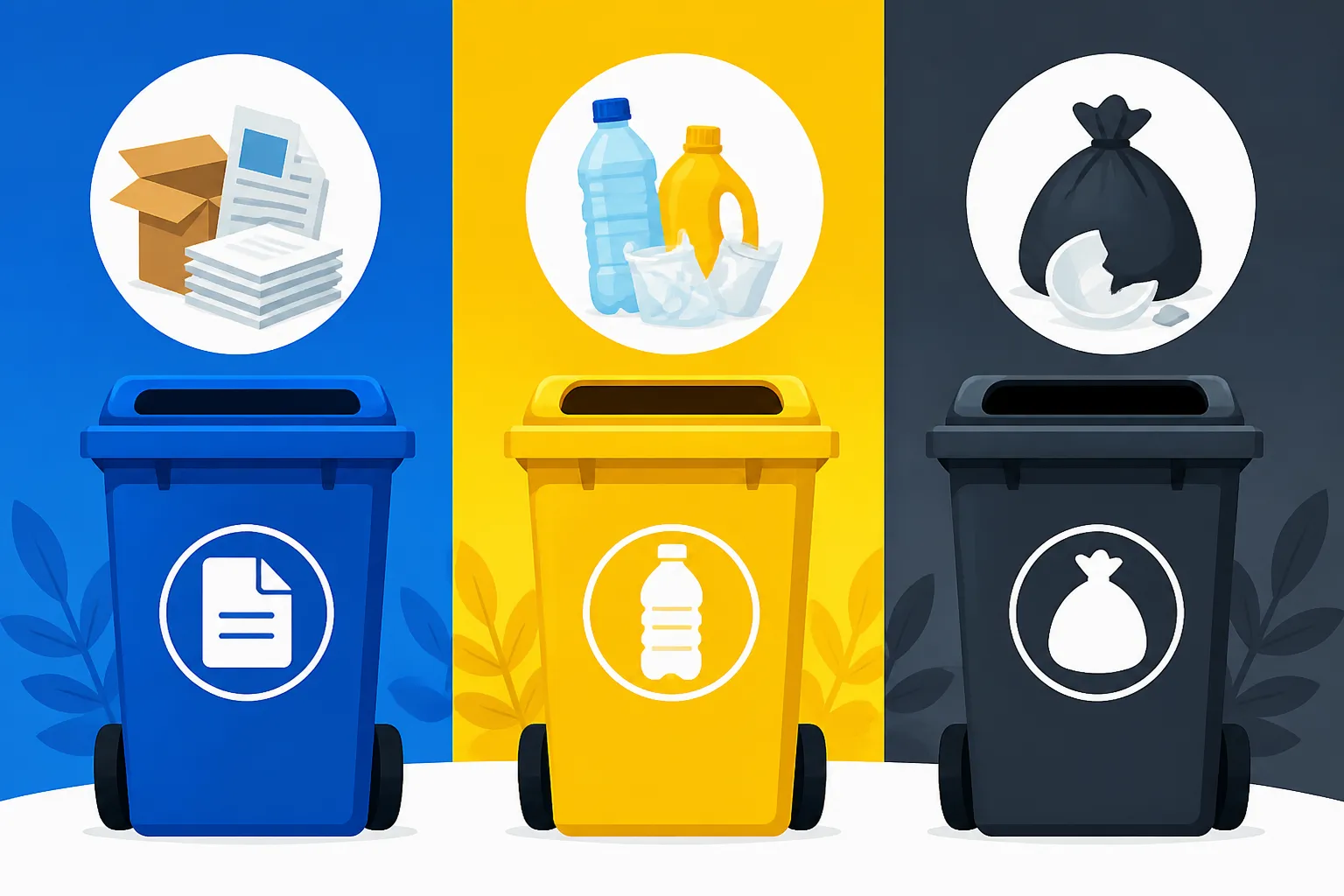
The red bin is reserved for paper and cardboard, known as Altpapier. This is arguably the most common bin you will interact with, especially with the prevalence of online shopping. However, not everything that feels like paper belongs here. You should include newspapers, magazines, brochures, letters, and clean cardboard boxes. It is vital to flatten your boxes to save space; an unflattened Amazon box is a major faux pas in an Austrian bin room.
The "Pizza Box Dilemma" is a classic expat trap. If the cardboard is soaked in grease or covered in cheese, it cannot be recycled as paper. In that case, it must go into the residual waste. Similarly, thermal receipts (like the ones from supermarkets), wax paper, and plastic-coated gift wrap are forbidden in the red bin. These contaminants can ruin an entire batch of recycled paper, so when in doubt, throw it in the Restmüll.
Plastik and Metal: The Yellow Bin or Yellow Bag
As of 2025 and 2026, Austria has moved toward a unified system where the Gelbe Tonne (Yellow Bin) or Gelber Sack (Yellow Bag) accepts all lightweight packaging. This includes both plastics and metals. Previously, some regions had separate blue bins for metal, but the trend is now toward "Lightweight Packaging" (Leichtverpackung). This is a huge relief for anyone who struggled with Yellow Bin vs Blue Bin: Sorting Plastics and Metals in the past.
In this bin, you should place plastic bottles (PET), yogurt pots, plastic film, tetrapaks (juice and milk cartons), tin cans, aluminum foil, and metal bottle caps. A pro tip from a veteran: you do not need to scrub your yogurt pots with soap—that wastes water. They just need to be "spoon clean." Also, avoid nesting different plastics inside each other (like putting a yogurt lid inside a plastic tub), as the automated sorting machines at the plant won't be able to separate them.
Restmüll: The Black or Grey Bin
The Restmüll bin is for residual waste—anything that is not hazardous and cannot be recycled. If you have followed the other rules, this bin should be the least full. It is for items like vacuum cleaner bags, cigarette butts, cat litter, old sponges, heavily soiled paper, and feminine hygiene products. This is often the most expensive waste stream for the city to process, which is why the bins are usually smaller or collected less frequently.
Many expats mistakenly use the Restmüll as a "catch-all" for things they are too lazy to sort. This is a mistake. In many districts, the cost of your building's waste collection is calculated based on the volume of residual waste. If you are trying to manage your Cost of Living in Vienna: Singles vs Families, being diligent about sorting can actually help keep your building’s Betriebskosten (operating costs) lower.
Beyond the Standard Bins: Glass, Bio, and Hazardous Waste
While paper, plastic, and general waste are usually found right outside your door, other materials require a bit more effort. These are often located at a central Sammelinsel on your street corner.
Altglas: White and Green Bins
Glass recycling is taken very seriously and is split by color. The Weißglas bin is for clear glass only, while the Buntglas bin is for colored glass (green, brown, blue). If a bottle is slightly tinted, it goes in the green bin. Before you toss your wine bottles, remember to remove the corks or metal caps (which go into the yellow bin).
A crucial rule for glass disposal is the timing. Because dropping glass into a metal bin is incredibly noisy, there are strict "quiet hours." You should never dispose of glass on Sundays, public holidays, or between 8:00 PM and 7:00 AM on weekdays. Doing so is a surefire way to irritate your neighbours and violate local Quiet Hours (Ruhezeit): Can I Vacuum on a Sunday? rules. Also, remember that drinking glasses, mirrors, and window panes are not "packaging glass" and should never go in these bins; they have a different melting point and must be taken to a waste centre.
Biotonne: The Brown Bin
The Biotonne is for organic waste that can be composted. This includes fruit and vegetable scraps, coffee grounds (including paper filters), tea bags, and garden waste. In many cities, this organic waste is turned into high-quality compost for public parks or used to generate biogas. This is the "greenest" part of the system, but it is also the most sensitive to contamination.
The biggest mistake people make with the brown bin is using "biodegradable" plastic bags. While the box might say they are compostable, most industrial composting facilities in Austria cannot break them down fast enough, and they end up as a contaminant. It is much better to use a dedicated paper bag or simply wrap your organic waste in a small amount of old newspaper. For a deeper look at this, check out Bio-Waste (Biotonne) Rules: What Goes in the Brown Bin? for a full list of "dos and don'ts."
Problemstoffe: Hazardous Waste and Batteries
Hazardous waste, or Problemstoffe, should never, ever go into the regular bins. This includes batteries, light bulbs, old medicines, paint, chemicals, and electronics. For small batteries, almost every supermarket in Austria has a collection box near the entrance. It is a simple habit to bring your old AA batteries with you when you go for your weekly shop.
For larger items or hazardous chemicals, you must visit a Problemstoffsammelstelle. These are often located at the local Mistplatz (recycling centre). Many cities also have a "mobile collection" truck that visits different neighbourhoods on a fixed schedule. Proper disposal of these items is essential for environmental safety; a single lithium battery in a regular bin can cause a fire in a garbage truck or processing plant.
Quick Reference Table: What Goes Where?
| Bin Color | Name | Common Items | Veteran Tip |
|---|---|---|---|
| Red | Altpapier | Paper, newspapers, flattened cardboard | No grease-soaked pizza boxes! |
| Yellow | Gelbe Tonne | Plastic bottles, cans, tetrapaks, foil | "Spoon clean" is enough; don't nest items. |
| Brown | Biotonne | Veggie scraps, coffee grounds, eggshells | Avoid "compostable" plastic bags; use paper. |
| White | Weißglas | Clear glass bottles and jars | Remove lids; observe quiet hours. |
| Green | Buntglas | Green, brown, or blue glass bottles | No window glass or mirrors. |
| Black/Grey | Restmüll | Nappies, ash, cold cigarette butts, dirt | The last resort for non-recyclables. |
Disposal Logistics and Local Variations
Depending on whether you live in a modern apartment in the city or a house in the suburbs, your interaction with the waste system will vary.
Apartment Living vs. Private Houses
In an apartment building, you are usually provided with shared bins for Altpapier, Restmüll, and sometimes Plastik. These are located in the Müllraum or the courtyard. The cost is included in your monthly rent as part of the Betriebskosten. It is your responsibility to carry your sorted waste to these bins. If your building doesn't have a yellow bin, you will need to find the nearest collection point on your street.
If you live in a single-family house, you are responsible for your own bins. You will have a calendar provided by the municipality showing when each type of waste is collected. In some rural areas, you might use "Yellow Bags" (Gelber Sack) for plastics, which you place on the curb on specific mornings. Failing to put your bin out on time means waiting another two to four weeks for the next collection, so the "garbage calendar" becomes a vital document in your household.
Using the Mistplatz for Oversized Items
When you are moving in or out, you will inevitably have items that are too large for the bins—think old mattresses, broken furniture, or large electronics. This is called Sperrmüll. You cannot simply leave these on the sidewalk; doing so is illegal and will result in a hefty fine. Instead, you must take them to a Mistplatz (waste collection centre).
In Vienna, the MA 48 operates these centres, and they are impressively organized. Most locations allow you to drop off household quantities of bulky waste for free if you have a local address. If you don't have a car, you can look into How to Book a Free Sperrmüll (Bulky Waste) Pickup in Vienna, which is a service provided by the city once or twice a year, or for a small fee upon request. It is a much better alternative than trying to stuff a sofa into a red bin.
Regional Differences
While the system is becoming more standardized, there are still quirks. For example, in Graz, the sorting of plastic and metal might feel slightly different than in a small village in Tyrol. Some regions are more aggressive about "Bio-bins," while others focus heavily on glass. Always check the website of your local Gemeinde (municipality) when you move to a new town. They usually have a downloadable PDF guide in multiple languages that explains the local variations of the color codes.
Practical Tips for the Expat Household
Setting up a functional system at home is the only way to survive the Austrian recycling regime without losing your mind.
Setting Up Your Kitchen for Success
Most Austrian kitchens are designed with built-in sorting systems under the sink. If yours isn't, I highly recommend visiting IKEA or XXXLutz to buy a multi-compartment bin. Trying to sort after the fact is a nightmare. I keep a small bin for "Bio," a large one for "Plastic/Metal," and a bag for "Paper." Once you have the infrastructure in place, it becomes second nature.
Another tip: wash out your bins regularly. Because the Restmüll and Bio bins might only be collected once a week (or less), they can become smelly, especially in the summer. Keeping your indoor bins clean and using small amounts of newspaper to absorb moisture in the bio-bin will prevent unpleasant odors and fruit flies.
The Pfandsystem: Bottle Deposits
Not every bottle goes in the bin! Austria has a robust Pfandsystem (deposit system). Many beer bottles, some water bottles, and even yogurt jars are "Mehrweg" (reusable). You pay a small deposit (usually 9 to 25 cents) when you buy them, and you get it back when you return the empty bottle to a "Reverse Vending Machine" at the supermarket.
Look for the words "Pfand" or "Mehrweg" on the label. If you see them, don't throw the bottle in the glass bin—keep it in a separate crate and take it back on your next shopping trip. It’s better for the environment and keeps a few extra Euros in your pocket. This is a key part of managing your household finances effectively.
Dealing with Schimmel and Hygiene
In the winter, Austrians are very concerned about "Lüften" (ventilating) to prevent mold (Schimmel). This extends to the bin area too. If you keep your bins in a closed cupboard, make sure to wipe it down occasionally. For your outdoor bins, especially the brown one, make sure the lid is closed tightly to avoid attracting pests or letting in rain, which speeds up decomposition and causes smells.
Common Mistakes and How to Avoid Them
Even after years here, I still have to double-check things occasionally. Here are the most common errors that drive Austrian neighbours crazy.
Contamination of the Bio Bin
I cannot stress this enough: do not put plastic in the bio bin. Not even "compostable" bags, unless your specific municipality explicitly says they are allowed (and even then, many prefer you don't). Also, avoid putting cooked food, meat, or bones in the brown bin in most cities, as these can attract rats and don't compost the same way as raw vegetable scraps. Meat and leftovers usually go in the Restmüll.
The "Green Dot" Misconception
You might see a "Green Dot" symbol (Der Grüne Punkt) on packaging. Many expats assume this means the item is definitely recyclable. In reality, the symbol just means the manufacturer has paid a financial contribution to a national packaging recovery system. It doesn't change the sorting rules. You still have to decide: is it paper? Is it plastic? Is it metal? Follow the material, not the dot.
Misplaced Small Electronics
Never throw a singing birthday card, an old electric toothbrush, or a vape pen into the Restmüll. These contain batteries and circuit boards. They are a massive fire hazard. These belong in the "Small Electronics" collection or should be handed back to a shop that sells electronics. Most shops that sell vapes or batteries are legally required to take the old ones back.
Mastering the colors of the Austrian recycling system is more than just a chore—it’s an initiation ritual. Once you can confidently navigate the red, yellow, and brown bins without hesitation, you can truly say you’ve settled in. It brings a strange sense of peace to know exactly where that yogurt lid goes, and your neighbours will certainly appreciate the effort.
Disclaimer
The information provided in this guide is for general informational purposes only and reflects the waste management standards in Austria as of 2026. Sorting rules and color codes can vary significantly between different federal states (Bundesländer) and municipalities (Gemeinden). Always consult your local city council or waste management authority (e.g., MA 48 in Vienna) for the specific regulations applicable to your area. The author is not responsible for any fines or disputes arising from the misinterpretation of local recycling laws.