What is the Yearly e-card Service Fee for 2026?
Navigating the cryptic abbreviations on an Austrian payslip can feel like decoding a secret government message, especially when unexpected fees appear out of nowhere. I spent weeks worrying I had been overcharged before I realized it was just a standard health insurance administrative cost. This guide breaks down the yearly e-card service fee for 2026, ensuring you understand exactly what you are paying for and why.
The Anatomy of the 2026 e-card Service Fee
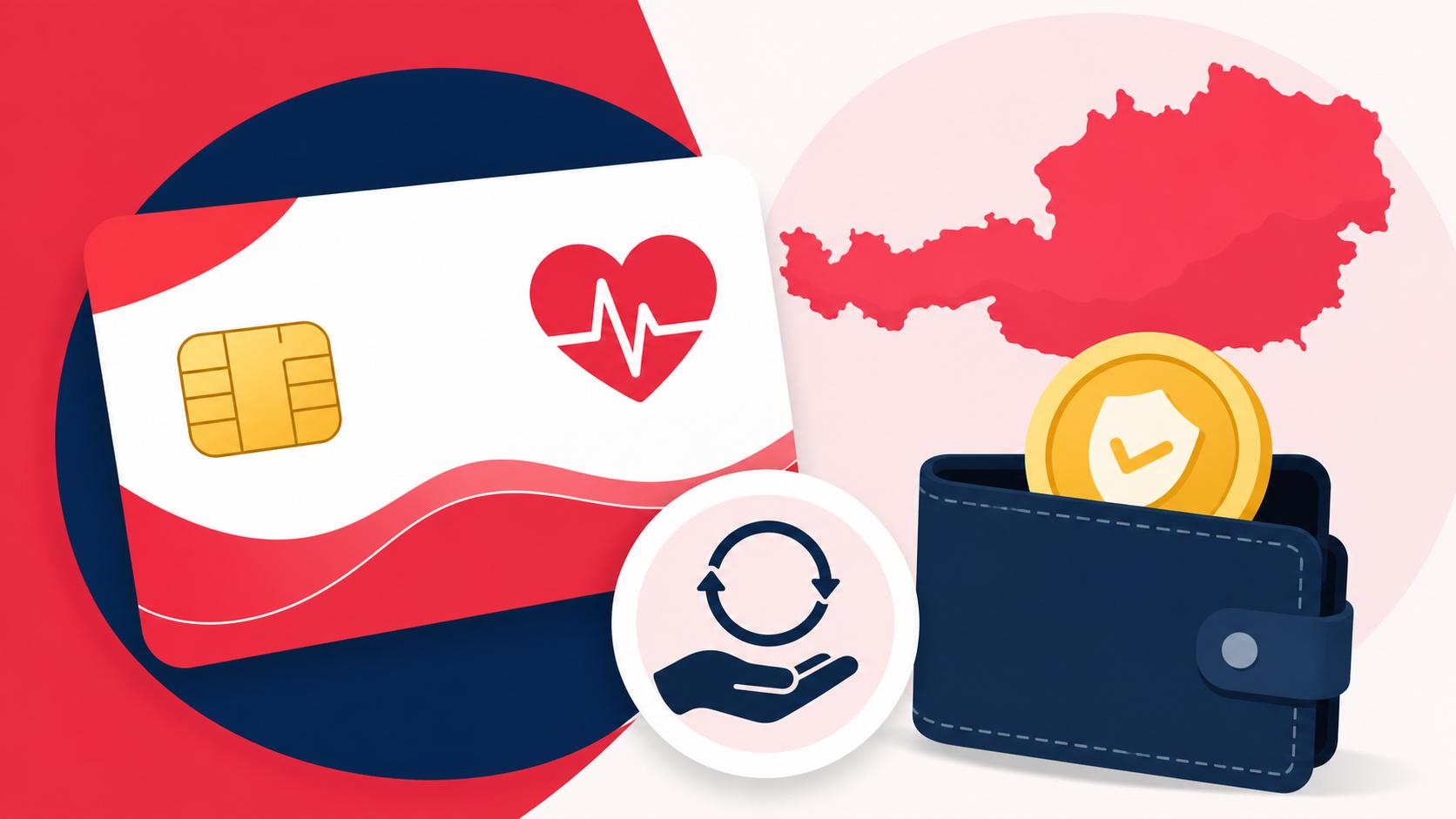
In Austria, the e-card is much more than just a piece of plastic; it is your digital key to the entire Austria Healthcare System 2027: Complete Guide for Foreign Residents. Whether you are visiting a general practitioner or picking up medicine, the card holds the data required to prove you are covered by social insurance. However, maintaining this sophisticated digital infrastructure isn't free. The "Service-Entgelt," or service fee, is a mandatory annual charge applied to nearly everyone integrated into the public health system.
For the calendar year 2026, the e-card service fee is set at €13.80. While this might seem like a nominal amount, it often catches expats off guard because it is deducted automatically and often well in advance. Usually, if you are employed, you will see this deduction on your November payslip of the previous year. This means that in November 2025, you likely already paid for your 2026 coverage. This "pay-it-forward" system ensures that the social insurance funds have the necessary capital to update card readers, maintain the ELGA (Electronic Health Record) database, and manage the infrastructure for electronic prescriptions.
It is important to differentiate this fee from your standard social security contributions. While your monthly insurance premiums are based on a percentage of your income, the e-card fee is a flat rate. It does not matter if you are a high-earning CEO or a part-time retail worker; if you are subject to the fee, the amount remains a consistent €13.80. This flat-rate approach is part of the "solidarity principle" that underpins Public vs Private Health Insurance in Austria Explained, though it can feel slightly frustrating when you are trying to budget every Euro during your first few months in the country.
Who Pays and Who Stays Exempt
One of the biggest sources of confusion I encountered was figuring out who is actually responsible for this payment. It isn't a "one-size-fits-all" rule, and the Austrian government provides several exemptions for those in specific life stages or financial situations. Generally, if you are actively working and earning above the marginal limit (Geringfügigkeitsgrenze), you are a "payer." However, the nuances are where things get interesting.
First, let’s talk about the lucky ones who do not have to pay. Children and teenagers are generally exempt, as the system views them as dependents who should not be burdened with administrative costs. Similarly, pensioners are exempt from the e-card fee in most cases, as are individuals who are receiving certain types of social welfare or disability benefits. If you have chosen the path of Co-insuring Family Members (Mitversicherung) on Your Policy, your dependents—such as a non-working spouse or your children—will usually receive their own card without you having to pay an additional €13.80 for each of them. This is a massive relief for expat families who are navigating the high cost of relocation.
Students also find themselves in a unique position. If you are enrolled in a degree program and have opted for Student Self-Insurance Requirements and Monthly Costs 2026, the service fee is typically bundled or waived depending on the specific nature of your insurance contract and your income level. However, if you are a student working a part-time job that exceeds the marginal earnings limit, you might find that the fee is suddenly deducted from your wages. It is always worth Deciphering Abbreviations on an Austrian Lohnzettel to see if the "Service-Entgelt" has been applied to your specific case.
| Resident Category | 2026 Fee Amount | Typical Deduction Month |
|---|---|---|
| Employed (Standard) | €13.80 | November (Preceding Year) |
| Self-Employed (SVS) | €13.80 | Annual Billing Cycle |
| Pensioners | Exempt | N/A |
| Children under 18 | Exempt | N/A |
| Co-insured Spouses | Exempt | N/A |
| Low-income Earners | Exempt | N/A |
How the Fee is Collected Across Different Insurance Carriers
In Austria, your insurance provider is determined by your profession. Whether you are with the ÖGK (the most common for employees), the SVS (for the self-employed), or the BVAEB (for public sector workers), the fee exists, but the "how" and "when" can vary. This is often where the "I've been there" frustration peaks, as moving between jobs can sometimes lead to double-deductions if the bureaucracy doesn't catch up with your status.
If you are a standard employee, the ÖGK handles the deduction via your employer. You don't have to do anything; it just disappears from your net pay. However, if you are a freelancer, the SVS will include the fee in your quarterly or annual account statement. I've noticed that for freelancers, the timing can feel more random, which is why keeping a buffer in your business account is essential. If you are navigating the transition from employment to freelancing, you should be aware of Navigating Social Insurance: ÖGK, SVS, and BVAEB Overview to understand how these entities communicate with one another.
A common question I get is: "What happens if I change jobs in the middle of the year?" Legally, you should only pay the e-card service fee once per year. If you worked for Company A in November 2025 and they deducted the fee for 2026, and then you moved to Company B in February 2026, Company B should not deduct it again. If they do, it is usually an automated error in the payroll software. In such cases, you don't need to panic. The social insurance provider usually reconciles these overpayments automatically at the end of the year, or you can point it out to your HR department to get a correction on your next Lohnzettel. For those in the public sector, you might also want to look into Understanding BVAEB Deductibles (Selbstbehalt) to see if other administrative costs apply to your specific insurance bracket.
Beyond the Fee: Maintaining Your e-card in 2026
Paying the €13.80 is only half the battle. To ensure your card actually works when you arrive at a clinic, you must comply with the ongoing administrative requirements. The most significant of these is the photo requirement. Since 2020, Austria has been phasing in e-cards that include a passport-style photo of the holder to prevent identity fraud. If your card does not have a photo and you are not in an exempt category (like being over 70 or having a high level of disability), your card might be deactivated, regardless of whether you paid the fee.
You should proactively check The e-card Photo Requirement: How and Where to Register to see if your data is up to date. For most expats, if you have an Austrian residence permit or a driver's license, the system pulls your photo automatically from the central register. However, if you are a new arrival from the EU, you might need to physically go to an office to have your photo registered. I remember the annoyance of having to book an appointment just for a photo, but it is better than being turned away at the pharmacy because your card wouldn't scan.
If you happen to lose your card, the €13.80 fee you paid doesn't usually cover the cost of the replacement card itself, but rather the "right" to use the service for the year. For details on getting a new one, see Lost e-card: Reporting and Replacement Process Explained. Additionally, keep in mind that the card itself has physical limitations. While many ask Does the e-card Have an Expiration Date?, the answer is that while the insurance "right" is annual, the physical card usually has a validity period listed on the back (often 5-10 years) which corresponds to the European Health Insurance Card (EHIC) functionality.
Understanding The Austrian e-card: Registration, Photo Rules, and Usage Guide is the best way to avoid stress. The system is more integrated than ever. Your card now links directly to your e-prescriptions, meaning you no longer need a paper slip from the doctor to get your meds at the Apotheke. This convenience is ultimately what that €13.80 fee supports—a streamlined, paperless healthcare experience that, despite the initial "fee-shock," makes life in Austria significantly easier in the long run.
Managing Multiple Roles and Potential Refunds
The Austrian labor market is increasingly flexible, with many expats holding a "Geringfügig" (marginal) job alongside a main profession or perhaps balancing two part-time roles. This complexity can sometimes lead to the social insurance system flagging you twice for the e-card fee. If you notice two deductions of €13.80 within the same year, do not simply write it off as "the cost of doing business" in Europe.
The social insurance institutions are generally quite good at catching these double payments during their annual "Aufrollung" (recalculation) process, but it can take months. If you are in a rush to get that money back, you can contact the ÖGK or your specific provider directly via their online portal using your ID Austria. Proactive communication is often the key to resolving these minor bureaucratic glitches. I’ve found that a polite email in German (or using a translation tool) usually gets the ball rolling much faster than waiting for the automated system to catch up.
Lastly, remember that the e-card fee is technically a tax-deductible expense in some contexts for the self-employed, as it is a mandatory part of your professional insurance costs. While €13.80 won't change your tax bracket, every bit helps when you are filing your first comprehensive tax return in a foreign country. By staying informed about these small details, you transition from being a "confused tourist" to a "savvy resident" who knows exactly where every cent of their hard-earned money is going.
Disclaimer
This guide is for informational purposes only and does not constitute legal, financial, or professional medical advice. While every effort has been made to ensure the accuracy of the 2026 fee amounts and regulations, Austrian social insurance laws are subject to change. Always verify current rates and exemption criteria with your official insurance provider (ÖGK, SVS, or BVAEB) or a qualified tax professional.