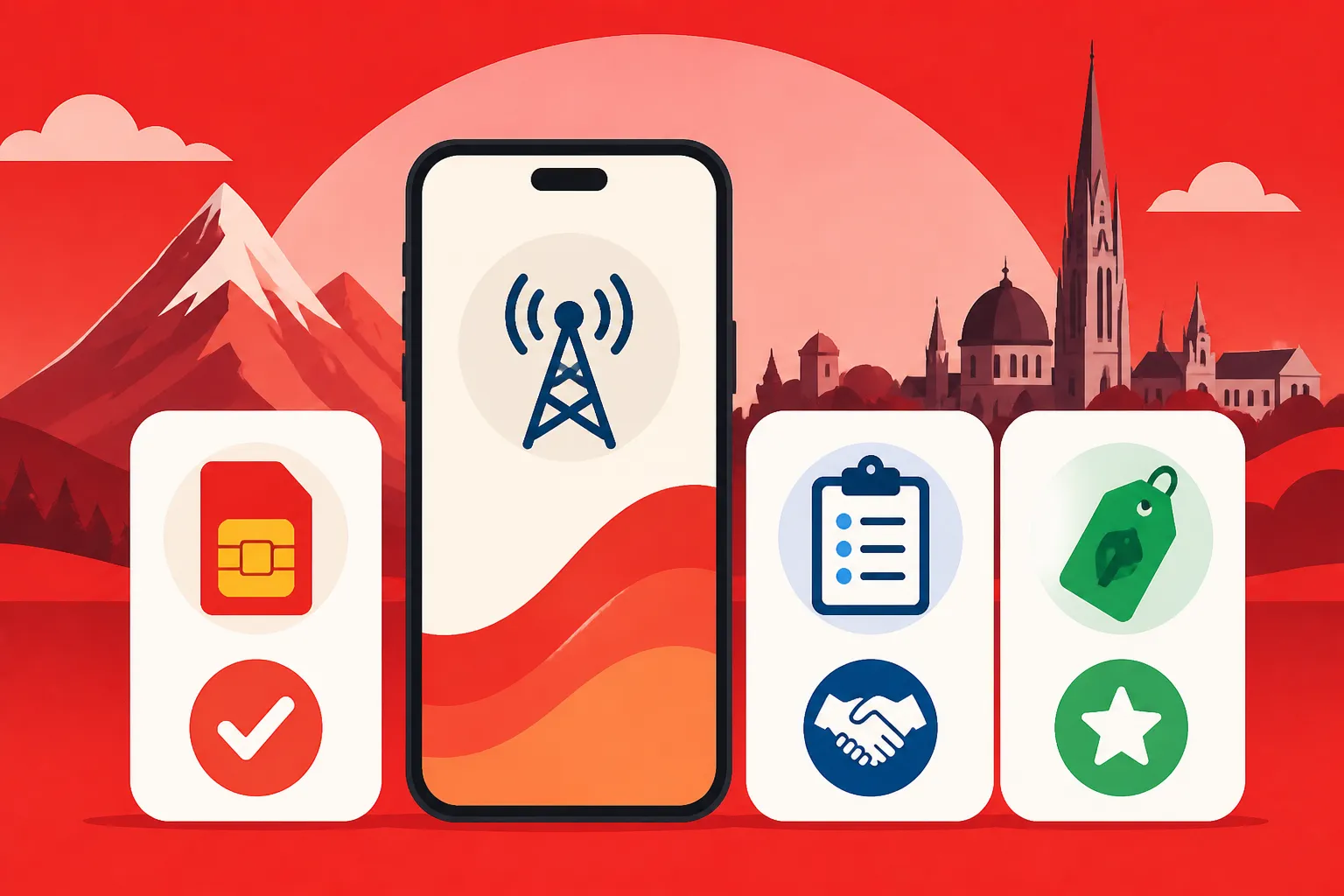
Mobile Phone Plans: Prepaid, Contracts, and Discount Carriers
Finding a way to stay connected is usually the very first thing you do after landing in Vienna or Graz, but the sheer number of options can make your head spin. I remember standing in a shop on Mariahilfer Straße, staring at a wall of SIM cards and feeling completely paralyzed by the fine print about activation fees and service charges. This guide cuts through that noise to help you find the perfect mobile plan so you can focus on more important things, like finding your way home.
The Three Pillars of the Austrian Mobile Market
To understand the mobile landscape here, you first need to understand that the market is divided between the network giants and the nimbler discount carriers. Austria has three major physical network operators that own the actual towers: A1, Magenta (owned by Deutsche Telekom), and Drei (Hutchison Drei). While these three provide the backbone of the country's infrastructure, most savvy expats eventually find their way to the MVNOs (Mobile Virtual Network Operators), which lease space on these networks but offer significantly lower prices.
The Big Three Networks A1 Magenta and Drei
A1 is often considered the "premium" choice. It has the most extensive coverage, particularly in remote Alpine regions, and is the choice for many corporate accounts. However, you will pay a premium for that reliability. Magenta is a close second, often bundled with Home Internet Options: Magenta, A1, and 5G Routers for significant discounts. Drei is known for being aggressive with its data pricing and has a very strong presence in urban centers, though its rural coverage has historically lagged slightly behind A1.
When you sign with one of these giants, you are often looking at a 24-month commitment. This can be a major hurdle if you are here on a shorter visa or if you aren't sure where you'll be living in two years. They do offer premium 5G speeds that are truly impressive, but for the average person scrolling through Instagram or using Google Maps, the difference might not justify the higher monthly bill and the lack of flexibility.
The Rise of the Discount Carriers
This is where things get interesting for the budget-conscious resident. Companies like Spusu, HoT (Hofer Telekom), and Bob have revolutionized the Austrian market. These providers don't have their own shops on every corner, which allows them to keep overhead low. Spusu, for example, is famous for its "data gift" system, where unused data from one month carries over to the next.
HoT is arguably the most popular among expats because of its simplicity. You can buy a SIM card at the checkout of any Hofer supermarket, and Setting up HoT (Hofer Telekom) Mobile Service Quickly is a process that takes minutes online without requiring a complicated credit check. These discounters typically use the Drei or Magenta networks, meaning you get the same signal strength for a fraction of the cost. Most importantly, they rarely require a minimum contract duration.
Network Coverage and Regional Differences
While Austria's overall mobile infrastructure is excellent, your experience will vary depending on where you live. In Vienna, Salzburg, or Linz, you will likely have 5G signal regardless of your provider. However, if you are moving to a smaller village in Tyrol or Vorarlberg, network testing becomes vital. A1 generally wins the "mountain test," but Drei has made massive strides in recent years.
Before committing to a long-term contract, I highly recommend buying a cheap prepaid SIM from a few different networks to see which one actually works in your specific apartment. Some of those beautiful old Altbau buildings have thick stone walls that can act like a lead shield for mobile signals. It is better to spend 10 Euro on a test SIM than to be stuck in a two-year contract with a phone that only works when you stand on your balcony.
Comparing Contract Types for Your Lifestyle
Deciding between a fixed-term contract and a prepaid plan is less about the technology and more about your legal and financial status in Austria. If you have just arrived, you might find that the "best" plans are technically out of reach until you have a few documents in order.
Long Term Contracts with Bindung
A standard contract (Vertrag) in Austria usually comes with a "Mindestlaufzeit" of 24 months. These plans are attractive because they often include a "subsidized" high-end smartphone for zero or very few Euros upfront. However, nothing in life is truly free. You will pay for that phone through a higher monthly fee, and if you try to leave the country or cancel early, you will be hit with massive exit fees.
To sign a contract like this, you almost always need a Meldezettel and an Austrian bank account. If you are still in the process of Opening an Austrian Bank Account: Requirements and Top Banks, you won't be able to sign up for a traditional monthly contract. Furthermore, these companies often run a credit check through KSV1870, the Austrian credit bureau. As a new arrival with no financial history, you might be rejected or asked for a high deposit, which is why it is usually wise to avoid these for your first six months.
Prepaid Plans or Wertkarte
Prepaid plans are the ultimate "no-strings-attached" option. You buy credit, you use it, and when it's gone, you top it up. In the past, prepaid was seen as the "poor cousin" of contracts, with higher rates and slower speeds. That is no longer the case. Many prepaid plans now offer 5G access and data packages that are competitive with monthly contracts.
The main benefit of a Wertkarte is that it doesn't require a bank account or a long-term commitment. You do, however, have to register your identity. Since 2019, anonymous SIM cards are illegal in Austria. You will need to show your passport or use a digital ID to activate the card. This is a one-time process and is much simpler than the multi-page contracts of the major carriers.
Monthly Cancelable Plans: The Middle Ground
In my opinion, this is the "sweet spot" for most expats. Most MVNOs offer plans that are paid via "Lastschrift" (automatic debit from your bank account) but can be canceled at the end of any month. You get the convenience of a contract—no need to manually top up credit—without the 24-month prison sentence.
Providers like Spusu or Lidl Connect offer these plans for as little as 10 to 15 Euro per month, often including 30GB to 50GB of data and plenty of minutes. If you find a better deal later or decide to move to another country, you just send a quick email or click a button in an app, and you're free. This flexibility is invaluable during the often-unstable first year of relocation.
Understanding the Hidden Fees and Fine Print
Austrian mobile providers are generally transparent, but there are a few local quirks that can result in "bill shock" if you aren't prepared for them. The price you see on the billboard isn't always exactly what you'll see on your bank statement.
Activation Fees and the Servicepauschale
When you sign a new contract, you will almost certainly be charged an "Aktivierungsentgelt" (activation fee), which can range from 40 to 70 Euro. Some providers run "No Activation Fee" promotions, especially in the late summer (back-to-school season) and around Christmas. If you can time your move to coincide with these windows, you can save a significant chunk of change right off the bat.
Then there is the "Servicepauschale." This is an annual fee, usually around 27 to 33 Euro, that is charged once a year for "network maintenance." It is a controversial fee that many consumer rights groups have fought against, and in 2026, many discount carriers have started to drop it entirely to stay competitive. When comparing plans, always check if the monthly price includes a hidden annual service fee.
Indexation and Annual Price Adjustments
Most major Austrian providers include an "Indexierung" clause in their contracts. This means they are legally allowed to raise your monthly price once a year based on the Consumer Price Index (inflation). If inflation is high, your 20 Euro plan might suddenly become a 22 Euro plan without you signing anything new.
This is another reason why I am such a fan of the discount carriers. Many of them, like HoT or Spusu, have a "no price increase" guarantee. They pride themselves on the fact that if you sign up for 10 Euro, you stay at 10 Euro. In an era of rising costs, having one predictable bill is a small but meaningful comfort.
| Provider Type | Examples | Contract Term | Best For |
|---|---|---|---|
| Major Network | A1, Magenta, Drei | 12-24 Months | Bundling with home internet, getting a new iPhone |
| Premium Discounter | Bob, Yesss! | Monthly/None | Reliability without the high price tag |
| Hard Discounter | HoT, Spusu, Lidl | None | Maximum flexibility and data per Euro |
| Specialist | LycaMobile, Lebara | Prepaid | Frequent international calling outside the EU |
Choosing the Best Plan for Your Specific Needs
Not every expat uses their phone in the same way. A student who lives on TikTok has very different needs than a business professional who spends four hours a day on international conference calls.
Data Heavy Plans for Digital Nomads
If you are working remotely and haven't set up your home fiber yet, you will need a plan with "Unlimited" data. Be careful here: "Unlimited" in Austria often comes with speed tiers. You might get unlimited data, but if it's capped at 20 Mbps, you'll struggle with high-def video calls.
I suggest looking at "Data Only" SIM cards if you need a backup for your laptop. You can get a 5G data SIM for about 30 Euro a month that provides speeds fast enough to replace a traditional landline. Just make sure your router or phone is 5G capable, as the older 4G bands in high-density areas like Vienna's 7th District can get very congested during peak evening hours.
International Calling and Roaming
One of the great things about living in the EU is "Roam Like at Home." Your Austrian data and minutes work in Germany, Italy, and France just like they do in Vienna. However, there is a catch: calling from Austria to another country (even within the EU) is usually not included in your standard "domestic" minutes.
If you have family in the US, UK, or India, standard calling rates are extortionate. You are much better off using WhatsApp or Signal for these calls. If you absolutely must have a traditional phone line to call abroad, look for specific international add-on packages. Some discount providers offer "EU + 100 minutes" for a few extra Euro, which can save you from a 50 Euro surprise on your next bill.
Student Discounts and Youth Plans
If you are under 26 (or sometimes under 27), you are in luck. All major providers have "Jugendtarife" (Youth Plans) that offer significantly more data and higher speeds for a lower price. When applying, you'll need to show your ID. If you are here for university, check if your school has a partnership with a provider.
Students should also look into Student Bank Accounts: Perks, Age Limits, and Free Fees, as some banks offer mobile plan vouchers or cash-back deals when you open an account. Being a student in Austria comes with many administrative hurdles, but the mobile phone discounts are a genuine perk that you should absolutely exploit.
The Step-by-Step Logistics of Signing Up
Once you've picked a provider, the actual process of getting your SIM card and your new Austrian number is relatively straightforward, provided you have your paperwork ready.
Required Documents and ID Verification
For a prepaid SIM, you only need your passport. You can do the registration in a shop, at a post office, or via a "Video-Ident" process on your phone where you hold your passport up to the camera and talk to an agent. It's a bit awkward, but it works.
For a monthly contract, the list is longer. You will generally need:
- A valid Passport or EU ID card.
- Your Meldezettel (residence registration).
- An Austrian IBAN (though some providers now accept SEPA accounts from other EU countries like Germany).
- Proof of income (rare, but sometimes requested for high-end phone subsidies).
If you are a non-EU citizen, make sure your visa or residence permit has at least 6-12 months of validity remaining. Some providers are hesitant to give 24-month contracts to someone on a 6-month D-Visa.
Porting Your Number (Rufnummernmitnahme)
If you start with one provider and realize their signal is terrible in your bedroom, you don't have to change your phone number. Austria has a very efficient number porting system called "NÜV" (Nummernübertragungsverordnung).
You simply request a NÜV-Information document from your old provider (they might charge a small fee, usually around 10 Euro), and give that code to your new provider. Within a few working days, your number is moved over. This is particularly helpful if you have already shared your number with the Finanzamt or your employer and don't want the hassle of updating everyone.
Moving to eSIM for Convenience
Almost all Austrian carriers support eSIM. This is a game-changer for expats. If your phone supports it, you can sign up for a plan online and be connected within ten minutes without waiting for the postman to deliver a physical piece of plastic.
It also allows you to keep your "home country" SIM in your phone (as a physical card or another eSIM) while using the Austrian SIM for your daily data. This way, you can still receive those vital SMS codes for your bank back home while enjoying local Austrian rates. Just be careful to go into your settings and ensure that "Data Roaming" is turned off for your home SIM to avoid accidentally spending 100 Euro on a single background update.
Managing Your Plan and Avoiding Common Traps
Getting the SIM card is just the beginning. To keep your costs low and your sanity intact, you need to be proactive about managing your account.
Using the Provider Apps
Every Austrian provider has an app (like "Mein Magenta" or the "Spusu App"). Download it immediately. These apps allow you to track your data usage in real-time, which is crucial because "overage" charges for data can be very expensive.
The apps are also where you will find your "Drittanbietersperre" settings. This is a vital security step. It blocks third-party companies from charging "subscription services" to your mobile bill—a common scam where clicking a link on a website results in a 5 Euro weekly charge for "premium content" you never wanted. Turn this block on the moment you activate your SIM.
Canceling Your Contract Correctly
When the time comes to leave Austria or switch providers, you must follow the "Kündigungsfrist" (notice period). For most monthly-cancelable plans, the notice period is one month. For 24-month contracts, you usually have to give notice three months before the end of the term, otherwise, it might automatically renew for another year.
Always cancel in writing. An email is usually sufficient for the discounters, but for the Big Three, I recommend sending a registered letter (Einschreiben) via the post or using the ID Austria and E-Government Tools for Foreign Residents to sign a digital cancellation document. Keep the receipt. There are many reports of people moving back to the UK or US only to find that A1 is still charging their dormant Austrian bank account six months later.
Avoiding Hidden Costs in 2026
Be wary of "Service Numbers." In Austria, numbers starting with 0800 are free, but numbers starting with 0900 or 0180 can cost several Euros per minute. Many newcomers mistake these for standard landline numbers. If you need to call a government office or a utility company, check if they have a standard geographic number (starting with 01 for Vienna, 0316 for Graz, etc.) instead of a premium service line.
Also, keep an eye on your "Roaming" settings if you live near the borders. If you are hiking in the mountains near the Swiss border, your phone might accidentally jump onto a Swiss network. Since Switzerland is not in the EU, you are not protected by the "Roam Like at Home" rules, and a few megabytes of data could cost you as much as a nice schnitzel dinner. Most providers send a warning SMS when you change networks—don't ignore it.
Healthcare and Safety Integration
While a mobile phone is for social media and work, in Austria, it is also a vital safety tool. Make sure you have the emergency numbers saved. If you ever find yourself in a medical crisis, your phone is your lifeline. You can even use it to access Emergency Services in Austria: 144, Hospitals, and Crisis Steps or call the 1450 health advice line if you aren't sure if your situation warrants a trip to the hospital.
Furthermore, your mobile number is increasingly tied to your legal identity in Austria. The ID Austria system, which has replaced the old Handy-Signatur, uses your smartphone as a second factor for logging into government portals. Without a working Austrian mobile number, managing your taxes, registration, or even checking your Austria Healthcare System 2027: Complete Guide for Foreign Residents status becomes significantly more difficult.
Disclaimer
This guide is intended for informational purposes only. While I strive to keep all details, including fees and provider names, accurate for the year 2026, the Austrian telecommunications market is subject to frequent regulatory changes and pricing updates. Always verify the specific terms and conditions of a mobile plan directly with the provider before signing any legally binding agreement. I am a veteran expat sharing my personal experiences and research, not a licensed financial or legal advisor.