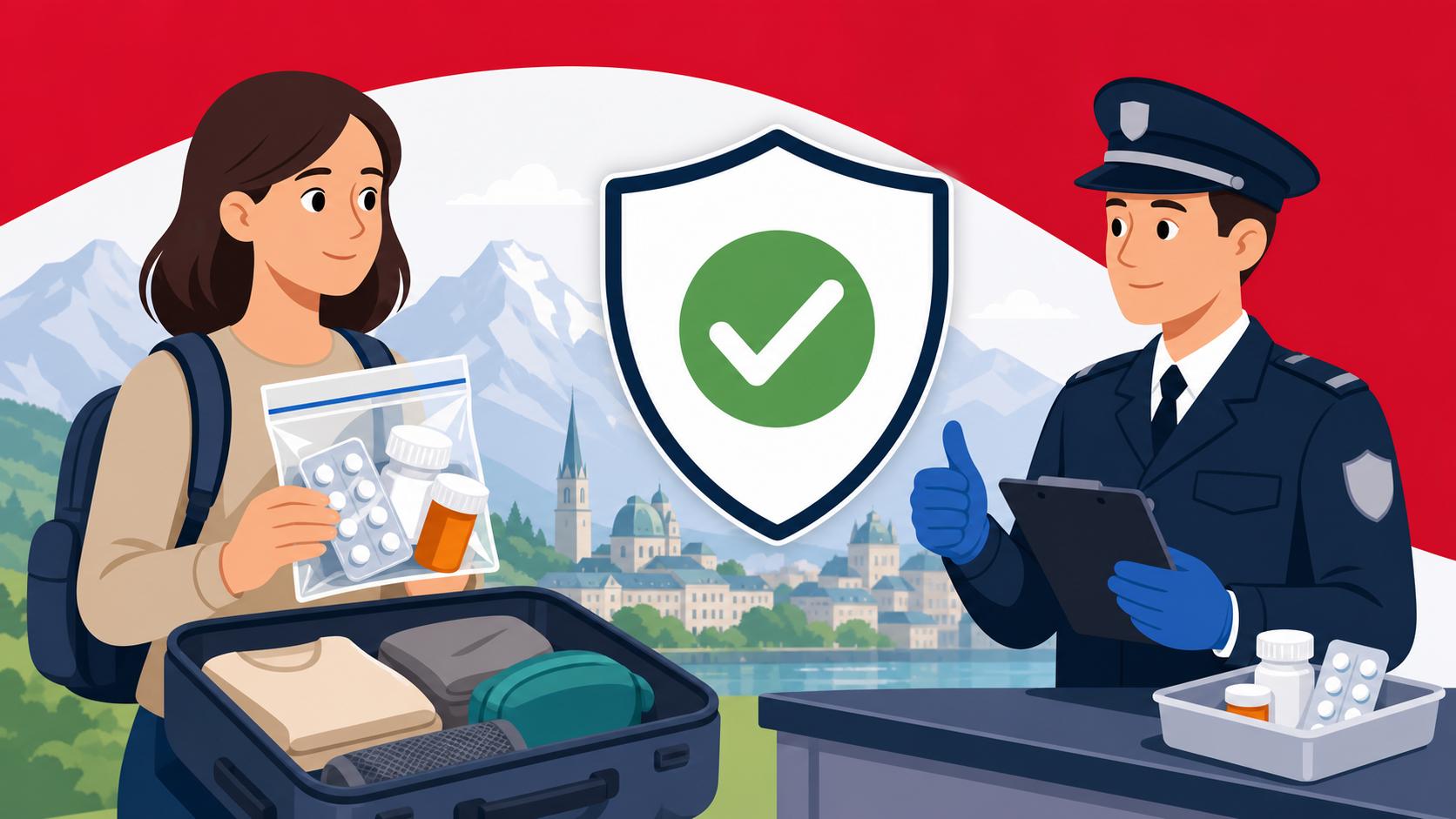
Bringing Foreign Medication into Austria: Customs Rules
Packing your entire life into a few suitcases is stressful enough without worrying if your essential prescriptions will be confiscated at the Vienna Airport customs gate. I still remember the pit in my stomach when I first moved here, clutching a six-month supply of asthma inhalers and praying I wouldn't be flagged. This guide simplifies the complex Austrian customs rules for medication to ensure your transition is seamless.
Understanding the Basic Personal Use Rules
When you land at an Austrian airport or cross the border by train, the most important concept to grasp is "personal need." The Austrian authorities are not trying to stop you from staying healthy; they are trying to prevent the illegal trade of medicinal products. Under the Arzneiwareneinfuhrgesetz (Medicinal Product Import Act), travelers are generally permitted to carry medications that are necessary for their personal use during their stay or for their immediate needs upon arrival.
The Definition of Personal Need for Travelers
In 2026, Austrian customs defines "personal need" based on the duration of your travel and your residency status. For the average tourist or a newly arriving expat, you are typically allowed to bring a supply that lasts for up to one month if you are arriving from a non-EU country. However, if you are a resident returning to Austria, this limit can sometimes be interpreted more strictly depending on whether the medication is available locally. The key is that the quantity must be plausible for a single person.
If you are carrying a suitcase full of the same pill, even if it is over-the-counter in your home country, customs officers will likely suspect you are planning to distribute it. Newcomers are generally advised to stick to a three-month maximum for non-controlled substances if they have a residency permit, but even then, you must have the paperwork to back it up. If you exceed these limits without a specific import license, which is nearly impossible for a private individual to get, the items will be seized and destroyed.
Traveling from EU vs. Non-EU Countries
The rules diverge significantly depending on where your journey began. If you are traveling from within the European Economic Area (EEA), the movement of medications is much freer due to the principle of the single market. You can generally bring a supply for personal use without intense scrutiny, provided they are not narcotics. However, you should still carry your prescriptions to avoid any misunderstandings during random checks.
For those of us arriving from the USA, Canada, the UK, or Australia, the scrutiny is higher. Since these countries are "third countries" in the eyes of EU law, every pill and cream is subject to the strict import regulations of the Austrian Ministry of Health. This is where most expats get into trouble, assuming that a bottle of Tylenol with Codeine from home is treated the same as it is back there. In Austria, many substances that are over-the-counter elsewhere are strictly prescription-only or even controlled substances.
Quantitative Limits and How Much is Too Much
While the "one-month rule" is the standard guideline for visitors, expats moving here often need a bridge supply while they wait for their The Austrian e-card: Registration, Photo Rules, and Usage Guide to be processed. Customs officials at Schwechat are usually empathetic to moving situations, but they have a limit. Bringing a six-month or year-long supply is a major red flag.
If you are found with an excessive amount, the officers will apply the "Arzneiwareneinfuhrgesetz" strictly. They may allow you to keep a one-month portion and seize the rest. To avoid this, plan to bring a 90-day supply of your most critical maintenance medications and make finding a local doctor your top priority. You can consult our guide on Finding Medical Care in Austria: Clinics, Hospitals, and Referrals to help you book an appointment early so you don't run out of your home-country supply.
Dealing with Controlled Substances and Restricted Medications
This is the area where you absolutely cannot afford to wing it. Controlled substances, which include many strong painkillers, ADHD medications (like Ritalin or Adderall), and certain psychotropic drugs (like benzodiazepines), fall under the "Suchtgiftverordnung" (Narcotic Drugs Ordinance). If you bring these into Austria without the correct legal certificates, you aren't just facing a customs fine; you could be facing criminal charges for drug smuggling.
The Schengen Certificate for Narcotics and Psychotropic Substances
If you are a resident of a country within the Schengen Area, there is a specific document known as the "Article 75 Certificate." This form must be filled out by your prescribing physician and then "validated" or stamped by your local health authority before you travel. This certificate allows you to carry a supply of controlled medications for up to 30 days.
When I traveled between Germany and Austria during my first year, I made sure to have this stamped paper in my carry-on. Even though there are rarely border checks, if you are involved in a traffic stop or a random train inspection, this paper is your only legal protection. It must state the exact dosage, the active ingredient, and the duration of the trip. Without that official stamp from your home country's health office, the doctor's signature alone is technically insufficient for narcotics.
Requirements for Non-Schengen Travelers
For those coming from the UK, the US, or other non-Schengen nations, the process is slightly different but equally rigorous. You need a highly detailed letter from your doctor. This letter should be on official letterhead, signed, and preferably stamped. It needs to clearly state the patient's name, the medical necessity of the drug, the generic name of the substance (as brand names differ wildly in Austria), and the daily dosage.
I highly recommend having this letter translated into German, though English is usually accepted at major airports like Vienna or Salzburg. If you are bringing a significant supply of something like medical cannabis or high-dose opioids, you may even need to have the doctor's letter notarized or apostilled to prove its authenticity. It sounds like overkill until you are standing in a small room at the airport trying to explain your ADHD diagnosis to a skeptical official.
ADHD Medications and Medical Cannabis Specific Rules
ADHD medications are a particular pain point for expats. Substances like Adderall are actually not even marketed in Austria; the local equivalent is usually Vyvanse (Elvanse) or Ritalin. Bringing a large supply of Adderall can be tricky because it is viewed differently by the Austrian "Suchtgift" laws. You must have your prescription and a very clear doctor’s note explaining that this specific brand is required for your treatment.
Medical cannabis is legal in Austria only in very specific pharmaceutical forms (like Sativex or Dronabinol). Bringing actual flower or "buds" from a legal dispensary in California or Canada into Austria is illegal, regardless of whether you have a prescription. It is treated as an illegal narcotic. If you rely on medical cannabis, you must consult our section on Mental Health in Austria: Counseling, Therapy, and Expat Support to find a specialist here who can transition you to a locally legal pharmaceutical alternative.
Essential Documentation and the Physician Letter
The difference between a smooth exit from the airport and a two-hour interrogation often boils down to the quality of your paperwork. In my experience, Austrian officials love stamps, official letterheads, and clear, structured information. A handwritten scrawl on a prescription pad will not cut it here. You need a formal declaration that leaves no room for interpretation.
What Your Doctor Letter Must Include
Your physician's letter is your most important shield. It should be written in a way that a non-medical professional (the customs officer) can understand. It must include:
- Your full name and date of birth (matching your passport).
- The diagnosis (in simple terms).
- The trade name and the international non-proprietary name (INN) or generic name of the medication.
- The dosage form (tablets, spray, injection).
- The exact daily dose and the total quantity you are carrying.
- The doctor’s contact information and an official clinic stamp.
It is often advised that patients ask their doctors to include a sentence stating, "The patient is required to carry this medication for their personal health needs during international travel." This specific phrasing aligns with the language used in the Austrian Emergency Services in Austria: 144, Hospitals, and Crisis Steps protocols, showing that the medication is an immediate necessity.
Language and Translation Requirements
While most customs officers at the Vienna International Airport speak excellent English, the law technically requires documents to be in German. If you are bringing something routine, an English letter is usually fine. However, if your medication is for a chronic, complex condition or is a controlled substance, getting a certified translation is a wise investment.
You can find more information on how to handle this in our guide to Medical Translation Services: Interpreters for Hospital Visits. Remember, if an officer cannot understand what the medication is or why you have it, their default action is to "sicherstellen" (secure/seize) it until it can be verified. That verification process can take weeks, during which you will be without your medication.
Validating Your Prescription at the Border
One tip that helped me immensely: never pack your medication or your documentation in your checked luggage. If your bag is lost or delayed, you lose both your health and your legal proof. Keep your original prescriptions and the doctor’s letter in your carry-on bag, ideally in a clear folder.
If you are stopped, be proactive. Don't wait for them to find the pills. If you know you are carrying a large amount or a controlled substance, you can even walk through the Red Channel and declare it. Often, if you show the paperwork immediately and the quantity matches the letter, they will simply wave you through. It’s the "discovery" of undeclared pills in a hidden pocket that leads to the biggest headaches.
| Medication Category | EU/Schengen Rules | Non-EU Rules | Documentation Needed |
|---|---|---|---|
| Over-the-Counter | Unrestricted (personal use) | Up to 1-month supply | None (Receipt helpful) |
| Standard Prescription | Up to 3-month supply | Up to 1-month supply | Copy of Prescription |
| Narcotics/Psychotropic | Schengen Cert (Art. 75) | Strictly 1-month limit | Validated Doctor's Letter |
| Medical Cannabis | Pharmaceutical only | Strictly Prohibited (Flower) | Specialized Permit |
| Performance Enhancers | Strictly Prohibited | Strictly Prohibited | Not allowed |
Prohibited Substances and Common Pitfalls
Austria has some of the strictest "Anti-Doping" and medication safety laws in the world. What you might consider a "supplement" back home could be classified as a prohibited medicinal product here. This is a trap many expats fall into, especially those who are into fitness or alternative medicine.
Banned Performance Enhancers and Counterfeits
The Austrian "Anti-Doping-Gesetz" makes it a crime to import certain substances even for personal use. This includes various steroids, growth hormones, and even some high-strength asthma medications if you don't have a proven medical need. Customs officers are trained to look for these in mail packages and suitcases. If you are a competitive athlete moving here, you must be extremely careful.
Counterfeit medications are another major focus. If you are bringing "branded" medications purchased from questionable online pharmacies or markets abroad, and the packaging looks suspicious, customs can seize them under the suspicion of being "fälschungsverdächtig." Austria takes the integrity of its Pharmacies (Apotheken) and Medication Rules in Austria very seriously, and they will not risk a counterfeit drug entering the country.
Vitamins and Supplements: Are They Medication?
This is the most common area of confusion. In the US, you can buy 10,000 IU Vitamin D or 10mg Melatonin at any grocery store. In Austria, these are often classified as medications because of their high dosage. Melatonin, for instance, is a prescription-only drug in Austria for most dosages.
If you arrive with a massive "Value Size" bottle of supplements, customs may classify them as unauthorized medicinal imports. Generally, if it's for your own use and the bottle is open or clearly used, they will let it go. But if you have five sealed bottles of high-dose supplements, they might be seized. Always check the dosage against Austrian standards if you plan on bringing a year's supply of "vitamins."
Mail-Ordering Medication from Abroad
Let me be very clear: Do not try to mail your medication to your new Austrian address from outside the EU. It is almost always illegal for a private individual to receive medication via post from a non-EU country. Even if you have a valid prescription, Austrian customs will intercept the package, seize the contents, and send you a very scary letter (and a fine).
The only exception is for very specific "Apotheken" (pharmacies) within the EEA that have a special license to ship to Austria. If you need a refill from home, you cannot simply have your mom mail it to you. You will need to see a Kassenarzt vs Wahlarzt Differences Explained and get a local prescription. This is a hard lesson many expats learn the expensive way.
Arriving in Austria: Airport Procedures and Customs
When you land at Vienna International Airport (VIE), you will see two exits: the Green Channel (Nothing to Declare) and the Red Channel (Goods to Declare). Most people instinctively head for the green one, but if you are carrying significant medication, you need to think twice.
Red Channel vs. Green Channel Decisions
If you are carrying a standard one-month supply of birth control or blood pressure medication, the Green Channel is fine. However, if you are carrying any narcotic listed on your doctor’s letter, or if you have a supply that looks like it might exceed the one-month "tourist" limit, I highly recommend going to the Red Channel.
When you walk into the Red Channel, you are essentially saying, "I have something that might be restricted, and I want to clear it legally." The officers are generally much more helpful when you come to them. They will look at your Healthcare Checklist for Your First 30 Days in Austria, check your doctor’s letter, and if everything matches, they will give you the green light. If you go through the Green Channel and they pull you for a random check, the vibe changes from "helpful official" to "enforcement officer."
Dealing with Customs Officers at Schwechat (VIE)
The officers at the airport are thorough. They might ask you to open your pill organizers or explain what each medication is for. Stay calm and polite. Have your Finding English-Speaking Doctors in Austria's Major Cities list or your local residency proof ready. If you can show that you have already initiated your move—such as showing your The Meldezettel Process: Registering Your Address Legally—they will understand why you have a larger supply.
One thing to avoid is being argumentative about the laws in your home country. Saying "But this is legal in New York!" doesn't matter to an Austrian official. They are bound by the Arzneiwareneinfuhrgesetz. Focus on the facts: the diagnosis, the prescription, and the personal nature of the supply.
What to Do if Your Medication is Seized
If the worst happens and your medication is seized, do not panic. Ask for a formal receipt (Sicherstellungsprotokoll). This document will list exactly what was taken and why. You can sometimes appeal this if you can provide additional documentation within a certain timeframe.
However, your immediate concern should be your health. If your life-saving medication is taken, you need to head straight to a hospital or an Emergency Services in Austria: 144, Hospitals, and Crisis Steps facility. Show them the seizure receipt; it serves as proof of what you were taking and why you are now in an emergency situation. They can often provide a temporary supply or an equivalent local prescription.
Long-Term Solutions for Residents
Once you have cleared customs and settled into your new apartment in Vienna or Graz, your goal should be to stop relying on "imported" medicine. The Austrian healthcare system is world-class, and once you are registered, getting your medications locally is much cheaper and safer.
Bridging the Gap: Moving Your Prescriptions to Austria
Within your first week, you should register for your e-card. While you wait for the physical card, you can often use a "Versicherungsdatenauszug" (insurance data extract) to see a doctor. You will need to find a [Hausarzt] (General Practitioner) who can review your foreign medical records and "translate" them into the Austrian system.
Bring your foreign bottles and your doctor’s letter to this first appointment. The doctor will check the Pharmacies (Apotheken) and Medication Rules in Austria database to find the exact brand or the closest bio-equivalent available here. Once they enter it into the system, it’s saved on your e-card, and you can pick up refills at any Apotheke in the country.
Navigating Local Pharmacies and the e-card System
The Austrian e-card: Registration, Photo Rules, and Usage Guide is your golden ticket. When the pharmacist swipes it, they can see your "e-Rezept" (electronic prescription). In Austria, you don't usually pay the full price for medication; you pay a small "Rezeptgebühr" (prescription fee), which is around €7.10 per item as of 2024/2025.
If you are used to the American system of "pharmacy chains" in grocery stores, the Austrian system will be a surprise. Pharmacies are independent, highly regulated shops. They are the only places allowed to sell even basic things like aspirin or high-dose cough syrup. You can find more details in our guide on Apotheken in Austria: Prescription Workflow and Night Shifts.
Finding Equivalents for Foreign Brands
Don't be surprised if your pill looks different or has a different name. For example, "Paracetamol" is what everyone here calls Acetaminophen (Tylenol). "Ibumentin" is a common brand for Ibuprofen. If you have a specific allergy to fillers or binders, make sure to mention this to your Austrian doctor.
If you find that a specific medication you need is not marketed in Austria at all, your doctor can sometimes apply for a "Fernimport" (special import) through a pharmacy. This is expensive and involves a lot of paperwork, but it is the legal way to continue a treatment that has no local alternative. For more on navigating these costs, check out our breakdown of Healthcare Costs: Kassenarzt vs Wahlarzt Differences Explained.
Disclaimer
This guide is for informational purposes only and does not constitute legal or medical advice. Customs regulations in Austria, specifically the Arzneiwareneinfuhrgesetz and the Suchtgiftverordnung, are subject to change. Always verify the latest requirements with the official website of the Austrian Ministry of Social Affairs, Health, Care and Consumer Protection or the Austrian Customs Administration (Finanzamt Österreich) before your travel. Neither the author nor this website is responsible for any items seized by customs or any legal issues arising from the import of medications.