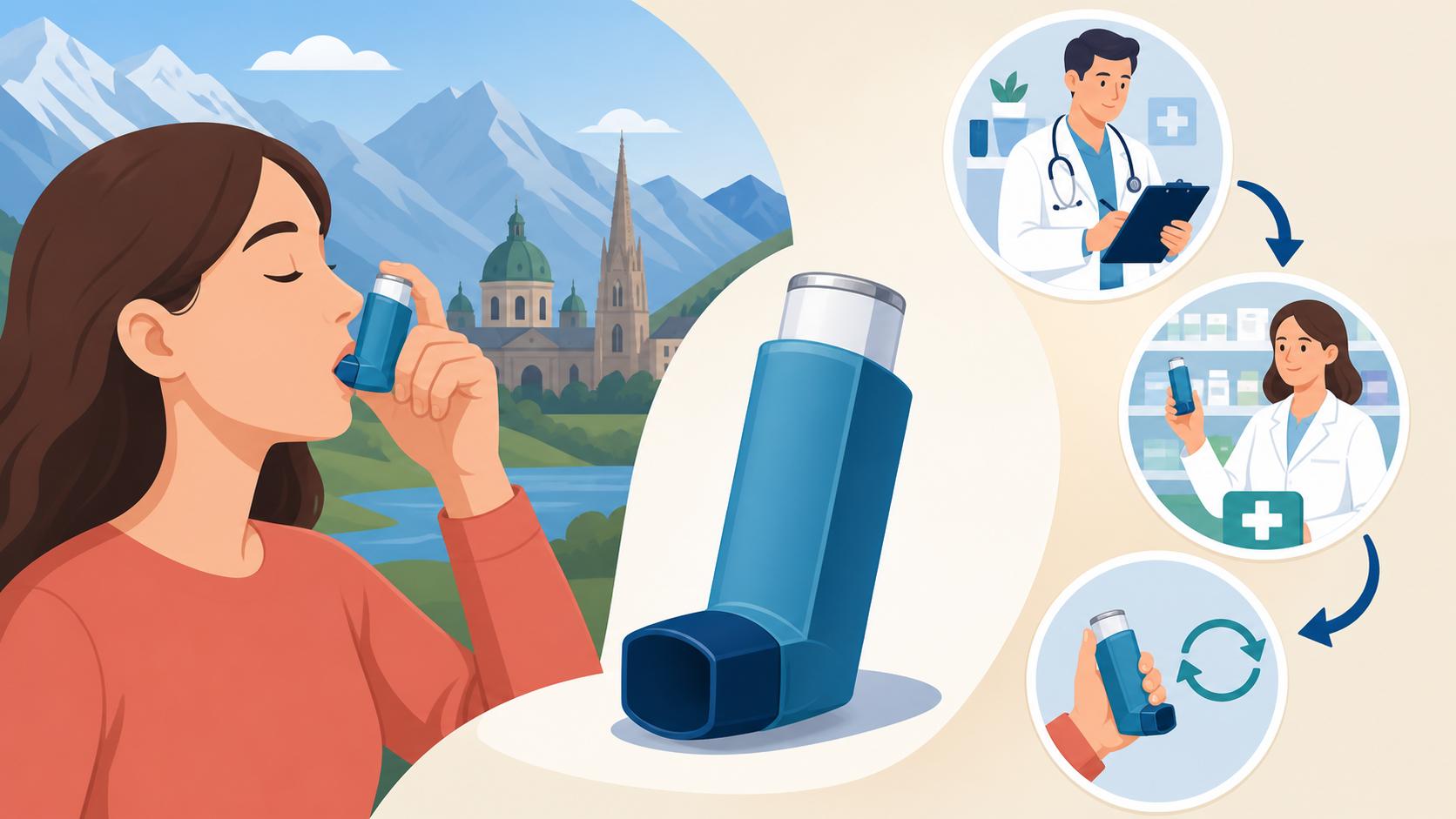
Asthma Inhalers in Austria: Prescription and Refill Process
Waking up at 3 AM in a new Vienna apartment with a tight chest and realizing your last Salbutamol inhaler is empty is a rite of passage I wouldn't wish on anyone. When I first moved here, I assumed a quick trip to the pharmacy would fix it, but I quickly learned that Austria takes its prescription laws very seriously. This guide covers exactly how to get your asthma medication legally, quickly, and affordably.
Understanding the Austrian Prescription Landscape
Coming from a country where you might be able to buy certain inhalers over the counter or where prescriptions are purely paper-based, the Austrian system can feel like a high-tech fortress. The first thing you need to realize is that almost all asthma medications—whether they are "relievers" like Salbutamol or "preventers" like Budesonide—are strictly prescription-only. You cannot simply walk into an Apotheke and ask for one because you feel wheezy.
The system revolves entirely around your social insurance and your e-card. Whether you are covered by the ÖGK, SVS, or BVAEB, your medical history and your prescriptions are increasingly digitized. Navigating Social Insurance: ÖGK, SVS, and BVAEB Overview is the first step to understanding how your costs are covered. Once you are in the system, your doctor will issue an e-Rezept, which is essentially a digital "ticket" attached to your social security number. You don't even need a piece of paper anymore; the pharmacist simply scans your card, and your prescribed medication pops up on their screen.
However, the "veteran expat" reality is that while the digital system is efficient, getting that first entry into the system is where most foreigners hit a wall. If you arrive with a suitcase full of inhalers from home, you are fine for a while. But the moment you need a local refill, you must establish a relationship with a local doctor. You cannot use a foreign prescription from outside the EU at an Austrian pharmacy, and even EU prescriptions can sometimes be met with a skeptical squint from a tired pharmacist if they aren't formatted perfectly.
Getting Your First Asthma Prescription as an Expat
The journey starts with finding a Hausarzt (General Practitioner). This is your gatekeeper. In my first month, I made the mistake of trying to book a specialist (Pulmologe) right away, only to find out the wait times were three months long. A Hausarzt can handle your basic asthma needs and issue your initial local prescriptions while you wait for a specialist appointment.
Establishing Care and Diagnosis
When you visit a doctor for the first time, bring your current inhalers and any medical records you have from home. Austrian doctors are generally very thorough, but they are also pragmatic. If you can show them that you have been on a specific dosage of Fluticasone for five years, they will likely replicate that prescription in the Austrian system without much fuss.
However, be prepared for them to suggest a "Gesundenuntersuchung" or a routine check-up to ensure your asthma is well-controlled. They might also want to perform a simple lung function test (Spirometry) in the office. This isn't them being difficult; it's the Austrian medical standard of "accuracy over speed." If you are struggling to find someone who speaks your language, check out Finding an English-Speaking Hausarzt in Your District to avoid the stress of explaining your lung capacity through hand gestures.
The Kassenarzt vs. Wahlarzt Dilemma
In Austria, you have a choice between doctors who take your public insurance directly (Kassenarzt) and private doctors (Wahlarzt). A Kassenarzt is free at the point of service, but their waiting rooms are often packed, and you might only get five minutes of their time. If you are in a rush and can afford the upfront cost, a Wahlarzt will often see you the same day. You will pay around €100-€150 for the visit, but you can later claim a portion of that back. Understanding Healthcare Costs: Kassenarzt vs Wahlarzt Differences Explained is vital here, as it determines how quickly you get that inhaler in your hand.
The e-Rezept and the Pharmacy Experience
Once the doctor clicks "send" on their computer, your prescription lives in the cloud. You then head to the nearest Apotheke. You can recognize them by the large red "A" sign.
Picking Up Your Medication
In the pharmacy, you simply hand over your e-card. If you don't have your physical card yet (perhaps you are still waiting for your photo to be processed), the doctor can provide an e-Rezept code or a printed paper with a barcode. However, the card is the gold standard. For those new to the country, The Austrian e-card: Registration, Photo Rules, and Usage Guide explains exactly how to ensure your card is active and ready for use.
The pharmacist will scan the card and see exactly what the doctor ordered. A key tip: check the brand name. Austria often uses different brand names for the same active ingredients. For example, your "Ventolin" might be branded differently here, or the pharmacist might offer a "Generika" (generic version) which is cheaper for the insurance system. Don't worry—the active chemicals are identical.
Understanding the Prescription Fee
Unless you are exempt due to low income, you will pay a flat fee per item on your prescription. As of 2026, this "Rezeptgebühr" is roughly €7.10 to €7.50. Even if your inhaler actually costs the insurance company €80, you only pay this small fee. It’s one of the best parts of the Austrian system. If your doctor puts two different types of inhalers on one prescription, you will pay the fee twice. Pharmacies (Apotheken) and Medication Rules in Austria provides a deeper look into these costs and what to expect when you reach the counter.
| Inhaler Type | Common Active Ingredients | Austrian Brand Examples | Prescription Required? |
|---|---|---|---|
| Reliever (Symptom-free) | Salbutamol, Terbutaline | Sultanol, Bricanyl | Yes |
| Preventer (Controller) | Budesonide, Fluticasone | Pulmicort, Flixotide | Yes |
| Combination | Salmeterol/Fluticasone | Seretide, Foster | Yes |
| Emergency / Acute | Ipratropium bromide | Atrovent | Yes |
Long-Term Management and Refills
Once you are "in" the system, getting refills is significantly easier. You don't necessarily have to see the doctor in person every single time you run out of medication.
The "Dauermedikament" System
If your asthma is chronic, your Hausarzt can mark your medication as a "Dauermedikament" (permanent medication). This means you can often just call the doctor’s office or use their online portal to request a "Nachbestellung" (reorder). They will push the prescription to your e-card remotely, and you can go straight to the pharmacy. This is a life-saver for busy expats. You should definitely read up on How the e-Rezept (Electronic Prescription) System Works to understand how to manage this without needing an appointment every month.
Specialist Referrals
While a Hausarzt can handle the basics, if your asthma is severe, you need a Pulmologe. To have the insurance cover this, you usually need a "Überweisung" (referral) from your Hausarzt. Seeing a specialist is important for getting advanced biologics or specialized allergy testing. When searching for a specialist, Finding Medical Care in Austria: Clinics, Hospitals, and Referrals can help you identify the top-rated lung clinics in your city.
Emergency Situations and Out-of-Hours Refills
What happens if it's Sunday, you're gasping for air, and your inhaler just gave its last puff? This is the ultimate expat nightmare.
The Nachtapotheke (Night Pharmacy)
Every district has a rotating schedule of pharmacies that stay open 24/7. You will see a sign in the window of any pharmacy listing the nearest "Bereitschaftsdienst" (on-duty pharmacy). Be aware that after-hours visits carry a small "Nachtdienstgebühr" (night service fee), usually a few euros. However, the pharmacist still cannot legally give you a prescription inhaler without a prescription.
The 1450 Service and Emergency Doctors
If you are in a crisis and don't have a prescription, call 1450. This is the health advice line. They can tell you where the nearest "Ärztefunkdienst" (emergency doctor) is located. An emergency doctor can examine you and issue an emergency prescription that you can take to a night pharmacy immediately. If the situation is life-threatening, do not wait—call 144. Emergency Services in Austria: 144, Hospitals, and Crisis Steps is an essential resource to keep bookmarked for these exact moments.
Bringing Meds from Abroad
If you are moving to Austria soon, I highly recommend bringing a 3-month supply of your current medication. This gives you a buffer to find a doctor and get your e-card set up. Make sure you follow the Bringing Foreign Medication into Austria: Customs Rules to avoid any issues at the airport. Having your medication in its original packaging with your name on it is crucial for proving it is for personal use.
Navigating the Emotional Hurdle of "The System"
One thing no one tells you about living in Austria is that the administrative side of health can feel cold. You might encounter a "Sprechstundenhilfe" (medical receptionist) who seems annoyed that you're asking for a refill. Don't take it personally; it’s just the local communication style. Be direct, have your insurance number ready, and always say "Grüß Gott."
If you find that your public insurance isn't giving you the level of care or the specific "designer" inhaler brand you prefer, you might consider supplementary coverage. Many expats choose to use a private doctor for their asthma management to get more personalized care. If you go this route, Using a Wahlarzt (Private Doctor) and Claiming 80% Refunds explains how to navigate the reimbursement process so you aren't left paying the full bill out of pocket.
Managing asthma in Austria is a test of your patience with bureaucracy, but once you have your e-card in hand and a Hausarzt who knows your history, the system is incredibly reliable. You will never have to worry about the astronomical costs of medication seen in other parts of the world, and the quality of the drugs available is world-class.
Important Medical Disclaimer
The information provided in this guide is for informational purposes only and is based on personal experience and general knowledge of the Austrian healthcare system. It does not constitute professional medical advice, diagnosis, or treatment. Always seek the advice of a qualified physician or other licensed health provider in Austria with any questions you may have regarding a medical condition or the use of specific medications. Never disregard professional medical advice or delay in seeking it because of something you have read in this article. If you are experiencing a medical emergency, please call 144 or 112 immediately.