Legal Exceptions to the e-card Photo Registration Rule
Navigating the labyrinth of Austrian bureaucracy often feels like a full-time job, and the requirement to have a photo on your e-card is one of those hurdles that catches many of us off guard. I remember the panic of receiving a cryptic notice in the mail about my health insurance card being blocked just as I was trying to manage a nasty bout of the flu. This guide breaks down the specific legal exceptions to the e-card photo registration rule so you can stop worrying about your coverage.
Understanding the e-card Photo Mandate
When Austria first announced that the e-card—the central key to the Austria Healthcare System 2027: Complete Guide for Foreign Residents—would require a physical photograph, the expat community was understandably confused. The primary goal of this mandate was to curb social insurance fraud and ensure that the person receiving medical services is the actual policyholder. By 2026, the transition is largely complete, and for the vast majority of residents, an e-card without a photo is simply a piece of plastic that won't work at the doctor's office.
However, the law recognizes that not everyone can or should be forced to provide a digital portrait. The mandate is governed by the Social Insurance Organization Act, which explicitly lists several categories of people who are exempt. For most of us, getting the photo done is a matter of visiting a registration office, but if you are caring for an elderly relative or have young children, the rules change significantly. Understanding these nuances is part of The Austrian e-card: Registration, Photo Rules, and Usage Guide that every resident should master.
The process for those who do need a photo usually involves the system pulling your picture automatically from the Austrian passport or driver's license database. As a foreigner, if you don't have an Austrian license or passport, you typically have to go in person. But before you book that appointment and stand in line, you must verify if you fall into a legal exception. Nothing is more frustrating than waiting two hours at a service center only to be told you never needed to be there in the first place.
The Legal Exceptions: Who is Exempt From the Photo Rule?
The Austrian government has carved out specific exemptions based on age and health status. These exceptions are applied automatically in many cases, but it is always wise to check your status via the ELGA portal or by calling the social insurance hotline. If you fall into one of these categories, your e-card will remain valid even without a photo, and the insurance carrier will issue a card with a "photo-exempt" notation or simply leave the space blank.
Age-Based Exemptions: Children and Seniors
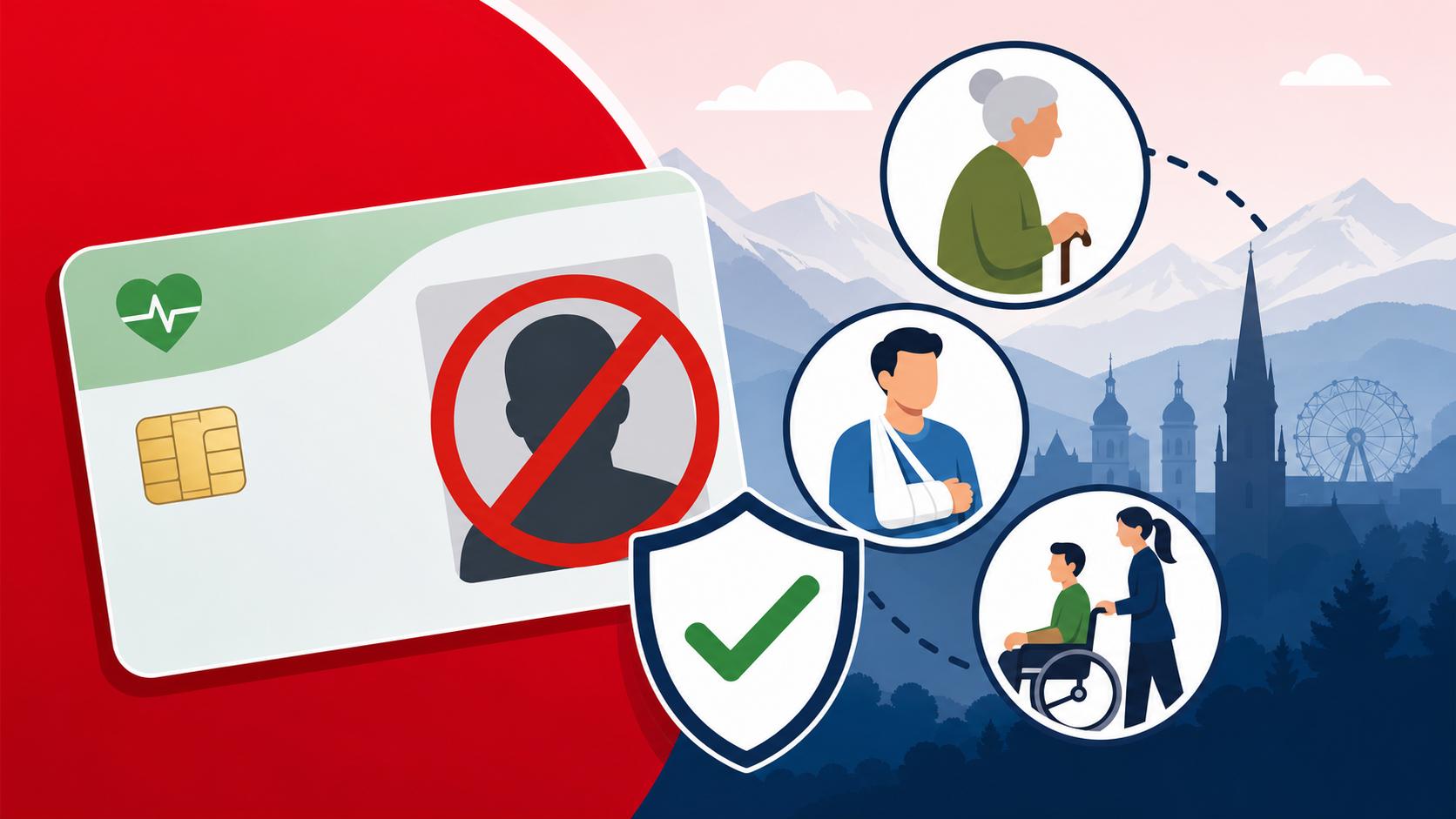
The most common exceptions are based on age. Children under the age of 14 are not required to have a photo on their e-card. This is a massive relief for parents who are already dealing with the complexities of the Family Health: Eltern-Kind-Pass 2026 and Maternity Care System. The logic here is simple: children's appearances change so rapidly that a permanent photo would become obsolete within months. Once a child turns 14, the requirement kicks in, and a photo must be provided for the next card issuance.
On the other end of the spectrum, seniors are also protected. Anyone who has reached the age of 70 is legally exempt from the photo registration requirement. If you are 70 or older, your current e-card remains valid until its natural expiration date, and any new card sent to you will not require you to visit a registration office. This is a sensible move to reduce the administrative burden on the elderly population.
Health and Care Level (Pflegestufe) Exemptions
Beyond age, the law provides exemptions for individuals with significant health challenges. Specifically, anyone who is classified in Care Level 4, 5, 6, or 7 is exempt from the photo requirement. This classification is tied to the Applying for Long-Term Care Allowance (Pflegegeld) system. If the social insurance carrier has a record of your care level, the exemption is applied automatically.
This is a critical protection for those with limited mobility or cognitive impairments who cannot easily visit a registration office. For expats who may be bringing elderly parents to live with them, understanding how these care levels interact with health insurance is vital. If your relative has a lower care level (Level 1-3) but is still unable to travel due to medical reasons, you can sometimes apply for a special hardship exemption, though this requires significant medical documentation and a direct appeal to your insurance provider like the ÖGK or SVS.
Technical and Diplomatic Exceptions
There are also niche categories involving diplomatic staff and certain cross-border workers. Some individuals who are covered under international social security agreements or who hold specific diplomatic statuses may be exempt. Additionally, if you are using an EHIC vs Austrian e-card: Which Do You Need? comparison because you are only in Austria temporarily, the photo rules for the domestic e-card may not apply to you in the same way. However, for anyone holding a long-term residence permit, the domestic rules almost always take precedence.
| Category | Age / Condition | Photo Required? | Action Needed |
|---|---|---|---|
| Children | Under 14 years old | No | None (Automatic) |
| Seniors | 70 years old and above | No | None (Automatic) |
| High-Level Care | Pflegestufe 4, 5, 6, or 7 | No | Ensure Pflegegeld is registered |
| Standard Residents | Age 14 to 69 | Yes | Register photo if not in DB |
| Disabled Individuals | Mobility impaired (low Pflegestufe) | Yes (usually) | Seek mobile registration if available |
What Happens if You Don't Qualify for an Exception?
If you've checked the list above and realized you don't fit into an exempt category, you must follow the standard registration protocol. For many expats, this is the part that feels like a "welcome to Austria" hazing ritual. If the authorities don't have a photo of you from an Austrian document, you have to provide one. You can't just upload a selfie; it has to be a high-quality passport-style photo that meets specific biometric standards.
The first step is checking The e-card Photo Requirement: How and Where to Register to find the nearest registration point. In large cities like Vienna, these are often located at police stations or specific social insurance service centers. You will need to bring your current e-card, a passport-sized photo, and your foreign passport. I highly recommend making an appointment if the office allows it; "walking in" in Austria is often a gamble with your afternoon.
For those living in the capital, Where to Register Your e-card Photo in Vienna provides a list of specific locations by district. If you are a non-EU citizen, the process can be slightly more rigorous as they need to verify your residency status (Meldezettel) alongside your identity. Once the photo is registered, it is entered into a central database, and your next e-card will arrive in the mail with your face clearly printed on the back.
Practical Implications of the Photo Rule at the Doctor
You might be wondering, "What happens if I show up at a clinic with an old, photo-less card?" The software used by doctors is very strict. If the system shows that you were required to register a photo and haven't done so, the receptionist might see a "blocked" status. This is when the stress starts. In most cases, the doctor can still treat you, but they will issue a temporary "service voucher" (Leistungsscheck).
This voucher usually costs a small fee or requires you to bring a valid card (or proof of photo registration) back to the office within a certain timeframe. It is not a permanent solution. If you find yourself in this situation, you should immediately look into Navigating Social Insurance: ÖGK, SVS, and BVAEB Overview to see how to unblock your status. For most people, the "block" is a soft one, meaning the insurance is still active, but the card itself is restricted until the administrative requirement is met.
It is also worth noting that if you are using a Public vs Private Health Insurance in Austria Explained model and you primarily see a "Wahlarzt" (private doctor), they may be more lenient with the physical card because you pay upfront and claim a refund later. However, even the refund process through the ÖGK portal may be hampered if your basic account has a pending "missing photo" flag. It is always better to be compliant.
Managing Your Healthcare Compliance as an Expat
Living in Austria requires a proactive approach to your documents. The e-card is not just for the doctor; it is also your key to Pharmacies (Apotheken) and Medication Rules in Austria. When you go to pick up a prescription, the pharmacist will swipe your card to access your "e-Rezept." If your card is invalid due to a missing photo, getting your medication can become a complicated ordeal involving manual overrides and phone calls to the insurance company.
To avoid these "administrative emergencies," I recommend logging into the "Meine SV" portal using your ID Austria. This digital tool allows you to see the status of your e-card in real-time. You can see if a photo is already on file and when your card was last issued. If you are unsure whether you fall under the Legal Exceptions to the e-card Photo Registration Rule, the portal will usually display your specific status.
If you are a student, you should also be aware of the Student Self-Insurance Requirements and Monthly Costs 2026. Students often think they are exempt because of their status, but the 14-to-69 age rule applies to everyone, regardless of whether you are working, studying, or just residing here. The only true "out" is being under 14, over 70, or having a high care level.
Handling Problems and Appeals
What if you believe you should be exempt, but the system is demanding a photo? This happens more often than it should, especially with the BVAEB Insurance Guide for Public Sector and Civil Servants or for those who have recently moved between insurance providers. If you are over 70 or have a high Pflegestufe and your card is still being blocked, you need to contact your "Versicherungsträger" (insurance carrier) directly.
Sometimes, the data sync between the pension office (PVA) and the health insurance office (ÖGK) lags. You may need to provide a copy of your "Bescheid" (official decision letter) regarding your care level or a copy of your passport to prove your age. While it feels like extra work, once the correction is made in the central system, you won't have to deal with it again. For expats, this is just part of the "integration" process—learning which office talks to which and how to nudge them when they stop communicating.
Always keep a record of your Healthcare Checklist for Your First 30 Days in Austria and ensure that your e-card is at the top of that list. If you are moving with family, remember that Co-insuring Family Members (Mitversicherung) on Your Policy also means you are responsible for ensuring their photos are registered (if they are over 14 and under 70). It is a team effort to keep the household's healthcare access smooth and uninterrupted.
Frequently Asked Questions About e-card Photo Exceptions
Does a foreign driver's license count for the automatic photo sync?
No. The Austrian system can only pull photos from Austrian national documents like the Austrian passport, the Austrian ID card (Personalausweis), or the Austrian credit-card-style driver's license. If you only have a license from your home country, you must register your photo in person.
I have a disability but don't have a 'Pflegestufe' 4-7. Am I exempt?
Legally, no. The exemption is strictly tied to the care levels 4 through 7. If you have a lower disability rating or a different type of health condition that makes travel difficult, you generally still need a photo. However, you can contact the ÖGK to ask about mobile registration services in exceptional circumstances.
Can I use the photo from my residence permit (Aufenthaltstitel)?
Starting recently, there have been efforts to sync the photo from the residence permit database (managed by the Ministry of Interior/MA35) with the social insurance database. However, this sync is not always successful. You should check your status online; if the system says "photo available," you are good to go. If not, a manual registration is required.
Disclaimer
This guide is for informational purposes only and does not constitute legal or medical advice. Regulations regarding the Austrian social insurance system and e-card requirements are subject to change by the Austrian Federal Ministry of Social Affairs, Health, Care and Consumer Protection. Always verify your specific status with your insurance provider (ÖGK, SVS, or BVAEB) or consult with a legal professional specializing in Austrian social law. Information presented here reflects the laws as of early 2026.