How to Use the Night Bell at an After-Hours Pharmacy
There is nothing quite like the spike of adrenaline that hits when you realize your child has a blazing fever or your own toothache has become unbearable at 3 AM in a silent Austrian city. I remember my first winter in Vienna, standing shivering outside a darkened pharmacy, wondering if I was supposed to just wait until 8 AM or if there was some secret code I hadn't learned in German class. This guide will walk you through the essential, slightly old-school process of using the night bell to get the medicine you need during off-hours.
The Austrian Pharmacy System and the Bereitschaftsdienst
To navigate an emergency, you first have to understand that the Austrian pharmacy system is built on a very specific type of tradition and regulation. Unlike some countries where you might find a 24-hour supermarket with an aspirin aisle, Austrian pharmacies, or Apotheken, are strictly regulated. They have standard opening hours, usually closing by 6:00 PM or 7:00 PM on weekdays and early on Saturdays, with almost everything shuttered on Sundays.
However, the "Bereitschaftsdienst" (on-call service) ensures that no district is left without medical coverage. This is a rotating shift system where one pharmacy in a specific area remains open through the night and all through the weekend. This is not a "convenience" service for buying toothpaste or luxury skincare; it is a vital medical resource. Understanding the Apotheken in Austria: Prescription Workflow and Night Shifts is the first step in realizing that while the lights may be off, someone is indeed home.
The pharmacists on night duty are often sleeping in a back room and are woken up by the bell. This is why the process feels a bit more personal and formal than a standard transaction. You are essentially asking a medical professional to provide urgent care outside of their normal rhythm. It is a highly efficient system, but it relies on you knowing how to locate the right door and what to expect when that tiny window finally slides open.
How to Locate an Open Pharmacy at Night
Before you start walking through the dark, you need to know which pharmacy is actually on duty. Do not assume your local shop is the one; the rotation changes daily. If you find yourself at a closed pharmacy, look at the door. By law, every closed Apotheke must display a sign in the window listing the nearest open "Bereitschaft" pharmacies. This sign usually includes a small map or at least the addresses and telephone numbers of the pharmacies currently on duty.
If you prefer a digital approach, there are several reliable ways to find your destination. The most common is the "Apo-App," which uses your GPS to show the nearest open location. You can also call the health advice line if you are unsure if your situation requires a pharmacy or a doctor. Mentioning your symptoms to the operators when Calling 1450: Austria's 24/7 Telephone Health Advice Line can help determine if you need to head to a pharmacy or if you should be seeking Emergency Services in Austria: 144, Hospitals, and Crisis Steps instead.
Another excellent resource is the website "apo24.at," which provides a real-time list of every on-call pharmacy in the country. For those living in smaller towns, the nearest open pharmacy might be in the next village over, so having a car or a reliable taxi number is essential. In major cities like Vienna or Graz, you will usually find one within a few districts of your home. If you are already in a state of pain or panic, knowing how to find After-Hours Medical Care: Weekend Clinics and Night Doctors can save you the trouble of visiting a pharmacy only to be told you need a prescription first.
Locating and Using the Nachtglocke
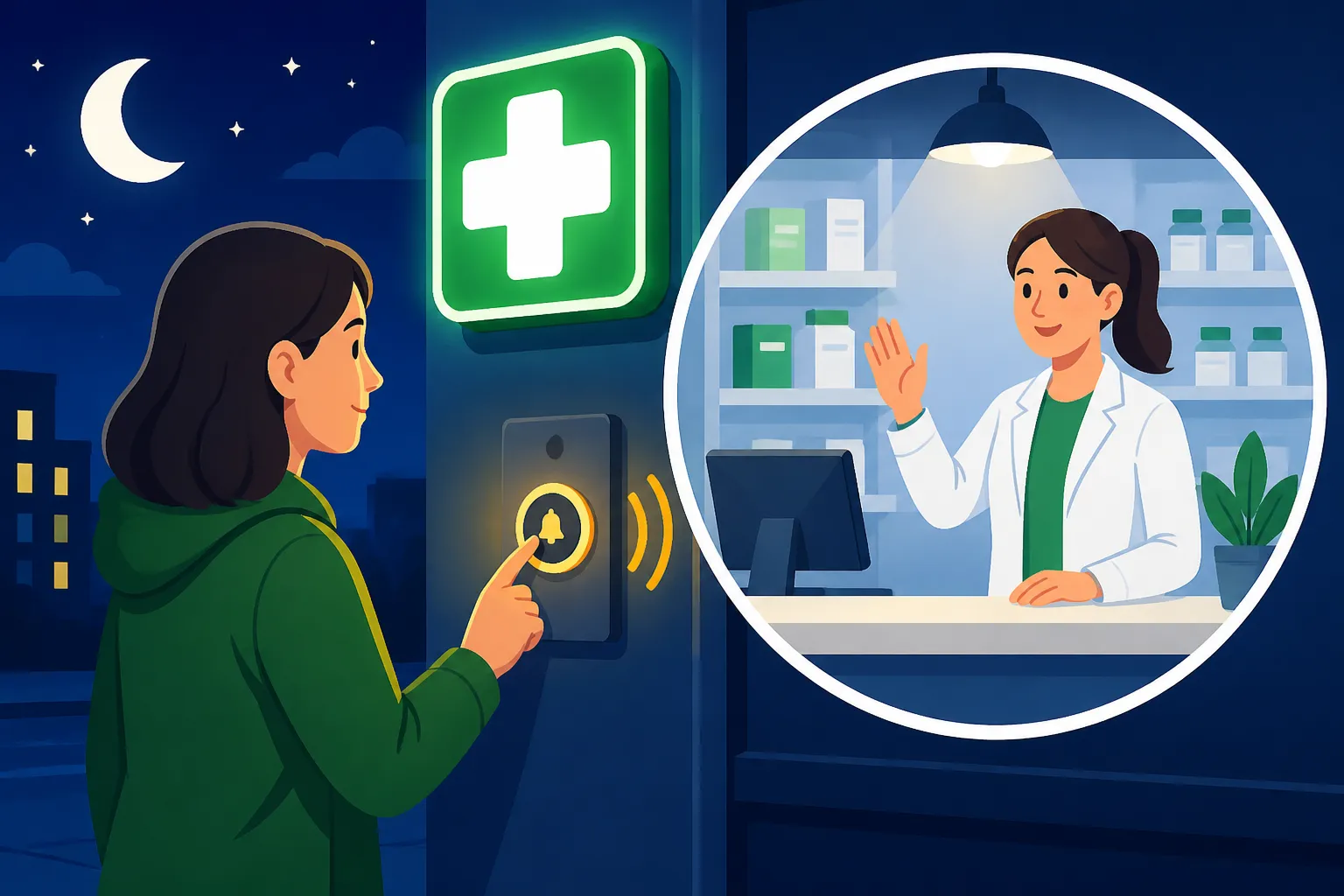
Once you arrive at the correct pharmacy, you will likely find the main doors locked and the interior lights dimmed. Do not panic and do not try to pull on the glass doors. Instead, look for the "Nachtglocke" (night bell). This is usually located near the side of the main entrance or next to a small, reinforced window known as the "Nachtschalter."
The night bell might look like a standard doorbell, or it might be a modern intercom system with a button and a speaker. When you press it, you may not hear a loud ring outside, but rest assured, a signal has been sent to the pharmacist on duty. It is incredibly important to be patient. Remember, the pharmacist might have been asleep or assisting another customer through a different window. Wait at least two to three minutes before pressing the bell a second time.
When the pharmacist answers, they will usually speak to you through an intercom first or simply slide open the small service window. This window is where the entire transaction will take place. You will not be allowed inside the pharmacy. This is a safety measure that has been in place for decades. You will hand over your prescription or explain your needs through the gap or a revolving tray. If you are looking for common items, it helps to know Paracetamol vs Ibuprofen: What to Ask For at the Apotheke so you can communicate clearly even if your German is shaky under pressure.
Fees and the Cost of Night Service
Using a pharmacy at night is not free, and this is a point that surprises many expats. There is a "Nachtdienstgebühr" (night service fee) added to your total. This fee compensates the pharmacist for the late-shift availability. The amount of the fee depends on the time of night and whether or not you have a "privately" written prescription or an "urgent" one marked by a doctor.
| Time Period | Typical Fee Type | Estimated Cost |
|---|---|---|
| Mon-Sat (8:00 PM – 8:00 AM) | Standard Night Fee | ~€3.80 |
| Sundays and Public Holidays | Holiday Service Fee | ~€3.80 |
| Sat (12:00 PM – 8:00 PM) | Saturday Afternoon Fee | ~€1.30 |
| With "Expeditio Nocturna" Note | Waived Fee | €0.00 |
If your doctor has written "Noctis" or "Expeditio Nocturna" on your prescription, it means the medication is urgently required, and the night fee is often covered by your social insurance. However, if you are simply stopping by at midnight because you realized you ran out of hay fever tablets, you will be required to pay the fee out of pocket. It is part of the local etiquette to understand Understanding the Apotheke Night Service Fee (Nachtdienstgebühr) before you reach the window so you aren't confused by the slightly higher price tag on your receipt.
What You Can Legally Buy at the Night Window
The night pharmacist is there to provide essential medication, but the rules regarding what requires a prescription remain just as strict at 3 AM as they are at 10 AM. You cannot simply "beg" for antibiotics because you are sure you have a sinus infection. You will find that Why You Cannot Buy Antibiotics Without a Prescription is a rule pharmacists follow with zero exceptions, even in the middle of the night.
You can, however, purchase a wide range of Over-the-Counter (OTC) Medicines: What You Can Buy Legally. This includes things like cough syrups, basic pain relievers, nasal sprays, and electrolyte solutions. The pharmacist acts as a gatekeeper and an advisor. If you describe your symptoms, they can recommend a specific brand or dosage. It is also worth noting that they may have a limited selection of "parapharmacy" items available at the night window. If you need baby formula in an absolute emergency, they may have it, but they won't appreciate being woken up for a bottle of high-end moisturizer or a new toothbrush.
If your situation involves a chronic condition, like needing insulin or asthma inhalers, always bring your empty box or previous prescription to help the pharmacist identify exactly what you need. They are much more likely to help a distressed expat if they can see evidence of a recurring medical need. However, for most minor issues, the best strategy is Building a Standard First Aid Kit for an Austrian Home so that you only have to use the night bell for true, unforeseen emergencies.
Language and Etiquette at the Nachtschalter
While many pharmacists in major cities speak excellent English, you should be prepared for the possibility that the person on duty might only speak German, especially in the middle of the night when they are tired. Being polite and using a few key German phrases can go a long way in making the interaction smooth. Start with a "Guten Abend" or "Grüß Gott" and follow with "Ich habe einen Notfall" (I have an emergency) or "Ich brauche etwas gegen…" (I need something for…).
If you are a regular visitor to Finding English-Speaking Doctors in Austria's Major Cities, you might already have a prescription in hand, which makes the language barrier almost non-existent. You simply slide the paper through the window, and the pharmacist does the rest. Also, be prepared for the payment. Most modern "Nachtschalter" windows have a card terminal, but occasionally, older pharmacies in rural areas might prefer cash for the small night fee. Always have at least 20 Euros in cash on you just in case the terminal is down or not available at the window.
Finally, remember that the pharmacist is a highly trained medical professional. If they ask you questions about who the medicine is for or if you are taking other drugs, they aren't being nosy; they are ensuring your safety. In the quiet of an Austrian night, this brief exchange through a small metal window is a fascinating glimpse into the country's commitment to social care and professional standards.
Practical Tips for First-Timers
If you have never used the night bell before, it can feel intimidating. My best advice is to do a "dry run" during the day. Next time you pass your local pharmacy, look for the sign in the window that lists the on-call rotation. See if you can spot the "Nachtglocke" button. Knowing exactly where it is located will reduce your stress significantly when you are searching for it in the dark or in the rain.
Another tip: if you are taking a taxi to the pharmacy, ask the driver to wait for a minute. Since you cannot go inside, you will be standing on the sidewalk. If the pharmacy is out of the specific medicine you need, you will need that taxi to take you to the next closest on-call location. This is especially true on "Feiertage" (public holidays) when the lines at the few open pharmacies can sometimes be long, and the weather can be unforgiving.
Lastly, keep a digital photo of your e-card and your passport on your phone. While the pharmacist usually only needs the prescription or the cash, having your identification ready is helpful if there is any issue with your insurance status or the validity of a digital "e-Rezept." Being prepared is the best way to handle the administrative hurdles of living in Austria, especially when those hurdles appear in the middle of the night.
Summary of the Night Pharmacy Workflow
To make this as clear as possible, here is the sequence of events you should follow when illness strikes after hours:
- Check the Duty List: Use the Apo-App, call 1450, or look at the sign on the door of the nearest pharmacy to find who is "offen" (open).
- Verify your Prescription: If you need something that isn't OTC, ensure you have a valid prescription. If not, you may need to visit a hospital ER or a weekend clinic first.
- Find the Bell: Look for the "Nachtglocke" or "Nachtschalter."
- Press and Wait: Press once and give the pharmacist time to wake up and reach the window.
- Communicate clearly: Use the intercom or the window to state your needs.
- Pay the Fee: Expect the ~€3.80 surcharge unless your prescription is marked urgent.
- Collect and Confirm: Check the dosage instructions on the box before you leave the window.
Living in Austria means adapting to a system that prioritizes structure over 24/7 convenience, but once you understand how to ring that bell, you will realize that you are never truly alone in a medical crisis. The "Nachtglocke" is a small but powerful symbol of the Austrian healthcare system's reliability.
Disclaimer
This guide is provided for informational purposes only and does not constitute professional medical or legal advice. While the information regarding pharmacy procedures in Austria is based on current 2026 regulations, specific opening hours, fees, and laws may vary by province or change over time. Always consult with a qualified medical professional or pharmacist for health-related concerns, and in the event of a life-threatening emergency, dial 144 immediately.