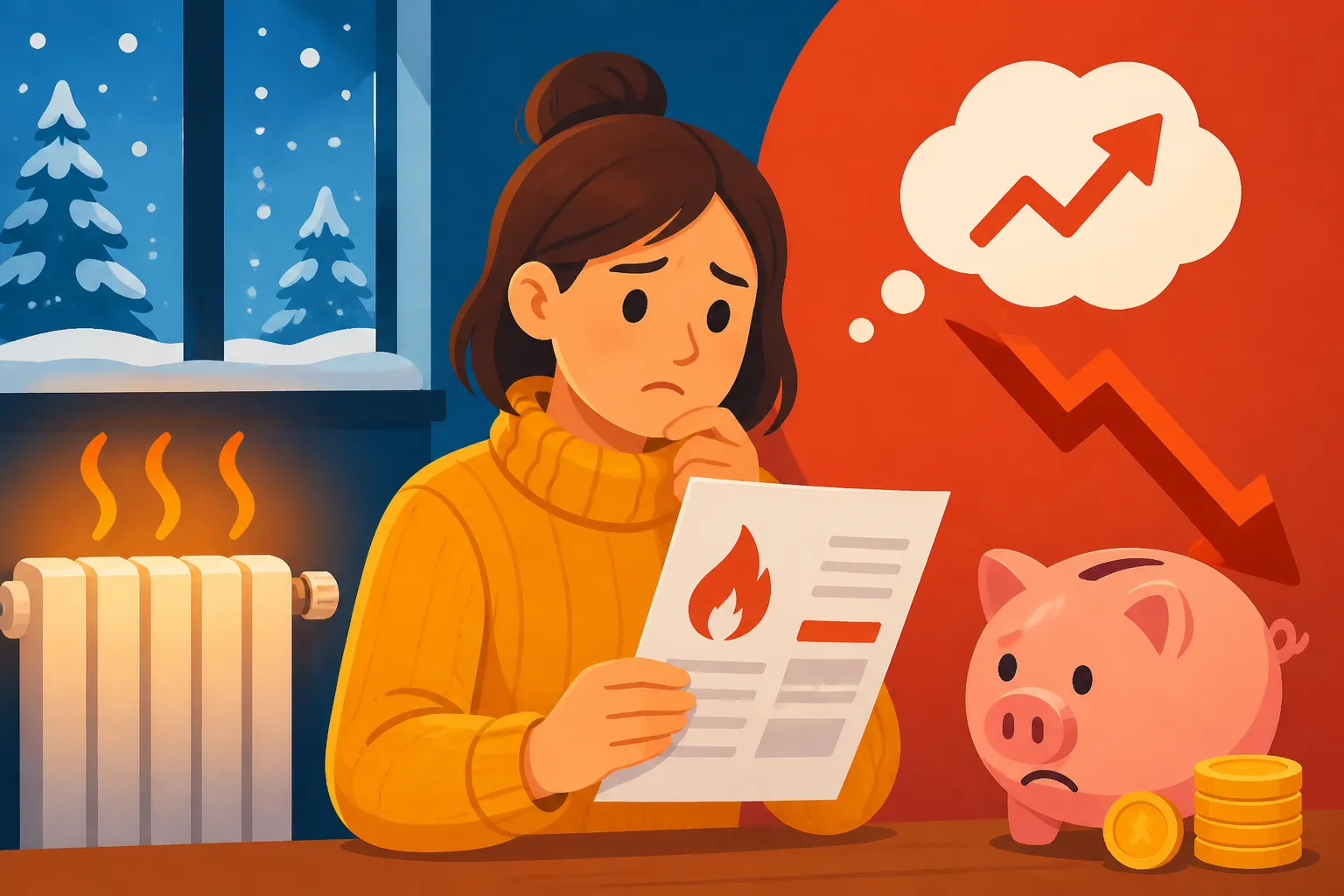
Budgeting for Winter Heating Cost Spikes (Nachzahlung)
You open your mailbox in the middle of a beautiful Austrian spring, only to find a thick, ominous envelope from your energy provider. Inside is the "Nachzahlung"—a back-payment bill for several hundred, or even thousand, euros because your winter heating usage exceeded your monthly estimates. I remember my first winter in a drafty Vienna Altbau where I naively cranked the radiators to maximum, resulting in a €900 shock that nearly wiped out my savings. This guide will teach you exactly how to decode your billing cycle, identify hidden costs, and budget effectively to ensure you never face a financial "cold snap" again.
Understanding the Austrian Energy Billing Cycle
To survive the financial side of an Austrian winter, you first have to understand that you aren't paying for what you use in real-time. The Austrian system is built on a "Teilbetrag" or installment model. When you first move in and complete your Utilities Setup: Electricity, Gas, Water, and Internet, your provider looks at the previous tenant's usage and assigns you a monthly flat rate. This is an estimate, not a reflection of your actual consumption.
The real reckoning happens once a year during the "Jahresabrechnung" (annual statement). A technician might come to read your meter, or you might submit the numbers via an app. If you used more energy than your monthly installments covered, you get hit with a Nachzahlung. If you used less, you get a "Guthaben" (credit). However, the kicker is that if you have a high Nachzahlung, the provider will automatically increase your monthly installments for the following year to "prevent" another spike. This can lead to a double financial hit: paying the debt from last year and paying a much higher monthly bill starting immediately.
The Role of Smart Meters and Estimated Readings
Most of Austria has transitioned to smart meters, which should theoretically make these shocks a thing of the past. However, technical glitches or a lack of communication between the grid operator (like Wiener Netze) and your energy provider can still result in estimated readings. If your bill says "rechnerische Ermittlung," it means they guessed your usage based on an algorithm.
Always check your physical meter against the bill. There are cases where the estimate was significantly higher than the actual meter reading. If this happens, you have the right to demand a correction. Being proactive here is essential for maintaining accurate Cost of Living Benchmarks for Singles, Couples, and Families in your personal budget. Don't assume the machine is always right; the bureaucratic machinery in Austria can be surprisingly prone to manual entry errors.
Teilbeträge and Why They Suddenly Change
Your monthly installment is calculated to spread your total annual cost over ten or twelve payments. If there is a massive price hike in the global energy market, or if your specific contract’s price adjustment clause triggers, your provider might increase your installments mid-year. They are required to notify you, but these letters often look like junk mail.
It is advisable logging into your provider’s portal at least once every three months. Most major providers now allow you to manually adjust your installment. If you know you are a "warmth seeker" and have been running the heat at 23 degrees Celsius all December, go into the portal and increase your monthly payment by €20 or €30 voluntarily. It is much easier to lose the price of a few pizzas a month than to find €500 in May when you’d rather be spending that money on a weekend trip to the Alps.
Factors That Cause Heating Cost Spikes
Not all Austrian apartments are created equal when it comes to thermal efficiency. The architecture of your building is the single biggest predictor of whether you will face a Nachzahlung. If you are still in the process of looking for a home, understanding Altbau vs Neubau: Differences in Rent, Charm, and Heating is vital. A charming 19th-century apartment with high ceilings and original "Kastenfenster" (box windows) is a nightmare to heat compared to a modern "Neubau" with thick insulation and floor heating.
Insulation and the Altbau Struggle
In an Altbau, heat rises and escapes through those beautiful, yet thin, wooden window frames. If you live on the "Erdgeschoss" (ground floor) or the "Dachgeschoss" (attic apartment), your costs will be significantly higher. Ground floor apartments lose heat to the cold cellar below, while top-floor units lose it through the roof.
To mitigate this, you should look into Winterizing Your Austrian Apartment Against Drafts. Simple fixes like heavy curtains, draft stoppers for the bottom of doors (known as "Zugluftstopper"), and ensuring your furniture isn't blocking the radiators can reduce your usage by up to 15%.
Thermenwartung and Boiler Efficiency
If your apartment uses "Etagenheizung" (a gas boiler inside your unit), you are legally responsible for its maintenance. This is called "Thermenwartung." Many expats skip this to save €150 in the short term, but a dirty or poorly calibrated boiler can consume 10-20% more gas to produce the same amount of heat.
Furthermore, if the boiler breaks and you cannot prove it was serviced annually, the landlord can legally pass the entire repair cost—sometimes thousands of euros—to you. Check your rental contract carefully; Gas Boiler Maintenance (Tenant Responsibility) is a standard clause in most Austrian leases. A well-maintained boiler not only keeps your Nachzahlung low but also ensures your safety against carbon monoxide risks.
Budgeting Strategies and Financial Support
Budgeting for energy in Austria requires a "worst-case scenario" mindset. In 2026, while prices have stabilized compared to the volatile years of the early 2020s, the baseline remains higher than a decade ago. You should aim to set aside an "Energy Emergency Fund" that covers at least two months of utility payments.
| Heating Type | Typical Source | Cost Risk Level | Budgeting Tip |
|---|---|---|---|
| Fernwärme | District Heating | Medium | Prices are regulated but can jump annually based on city council decisions. |
| Gas (Etagenheizung) | Natural Gas | High | Very sensitive to global market fluctuations. Requires annual maintenance. |
| Heat Pump | Electricity | Low/Medium | Most efficient, but check if your tariff has high peak-hour rates. |
| Infrared / Electric | Electricity | Very High | Use only as a supplement. Can lead to astronomical bills if used as primary heat. |
Accessing the Heizkostenzuschuss and State Aid
Many residents, including expats on certain residence permits, are unaware that they may be eligible for the "Heizkostenzuschuss" (heating cost subsidy). Each federal state (Bundesland) has its own rules. For example, in Vienna, the "Wiener Energieunterstützung" provides direct grants to households under certain income thresholds.
As part of your Living in Austria 2027: The Expat Starter Guide, you should check the website of your local "Landesregierung" every October. These subsidies are not just for those on social welfare; often, lower-to-middle-income workers and students can claim energy vouchers worth €150 to €400. This is "free" money that the Austrian government sets aside to prevent energy poverty, and there is no stigma in applying for it.
Leveraging the Strompreisbremse and Tariffs
While the government’s Strompreisbremse 2026: How the Electricity Price Brake Works provides a ceiling on electricity costs for a basic consumption level, it does not cover everything. If you have an electric heating system, you will likely exceed the "subsidized" kilowatt-hour limit quickly.
Use comparison tools like Durchblicker or E-Control to ensure you are on the best tariff. Many people stay on the "Standard-Tarif" of the default city provider (like Wien Energie or Salzburg AG) for years out of habit, but switching to a smaller, green energy provider can often save you enough to cover a small Nachzahlung. Just be sure to read the "Kleingedrucktes" (fine print) regarding price guarantees.
Actionable Steps to Reduce the Hit
If you want to avoid a massive bill, you need to change your daily habits. The Austrian culture has a very specific way of dealing with the home environment that actually helps with energy costs. One of the most famous is the concept of "Stoßlüften."
The Art of Stoßlüften vs. Kippen
Leaving a window "auf Kipp" (tilted open) all day is the fastest way to drain your wallet. It cools down the walls of the apartment, meaning your heater has to work double-time to bring the temperature back up. Instead, practice Lüften: The Austrian Art of Ventilating Rooms in Winter. Open all windows wide for five minutes to completely swap the air without losing the heat stored in the walls and furniture.
Also, consider lowering your thermostat by just one degree. According to Austrian energy experts, reducing the room temperature from 22°C to 21°C can save about 6% on heating costs. Invest in a good pair of "Hausschuhe" (slippers) and a thick wool sweater—this is the authentic Austrian way to stay warm without breaking the bank.
What to Do If You Can't Pay the Nachzahlung
If the bill arrives and it is simply too much to pay at once, do not panic and do not ignore it. Austrian energy providers are generally very willing to negotiate "Ratenzahlung" (installment plans). You can usually request to split a large bill over three to six months through their online portal or by calling their customer service line.
If you are facing extreme hardship, you can contact the "Ombudsstelle" of E-Control. They act as a mediator between consumers and energy companies. They can help delay a "Gasabdrehung" (shut-off) and find a sustainable payment path. For more detailed help on managing your local finances, see our guide on Estimating Average Utility Costs (Electricity/Gas) in Winter.
Dealing with Smart Meter Data and Overbilling
Finally, make sure your smart meter is set to "Quarter-Hourly" (Viertelstunden-Auslesung) if you want the most accurate data. This allows you to see exactly when your consumption spikes. Did it spike when you used the old, inefficient space heater in the bathroom? Or perhaps when you ran the washing machine at 60 degrees?
Having this data allows you to adjust your behavior in real-time rather than waiting for a surprise twelve months later. If you find your bill is consistently higher than your peers, it might be worth hiring an energy consultant or asking your landlord to check the building’s central heating "Abgleich" (balancing). Sometimes, the system is simply pushing too much hot water to some units and not enough to others, leading to wasted energy and higher costs for everyone. When you are looking for ways to save, don't forget that certain expenses can be offset, such as How to Deduct Home Office Expenses in 2026 on your annual tax return.
Disclaimer
The information provided in this guide is for educational and informational purposes only. While every effort has been made to ensure the accuracy of the data as of 2026, energy prices, government subsidies, and legal regulations in Austria are subject to frequent changes. Always consult with your energy provider, a qualified tax advisor, or legal counsel regarding your specific situation and contracts. The author and publisher are not responsible for any financial losses or damages resulting from the use of this information.