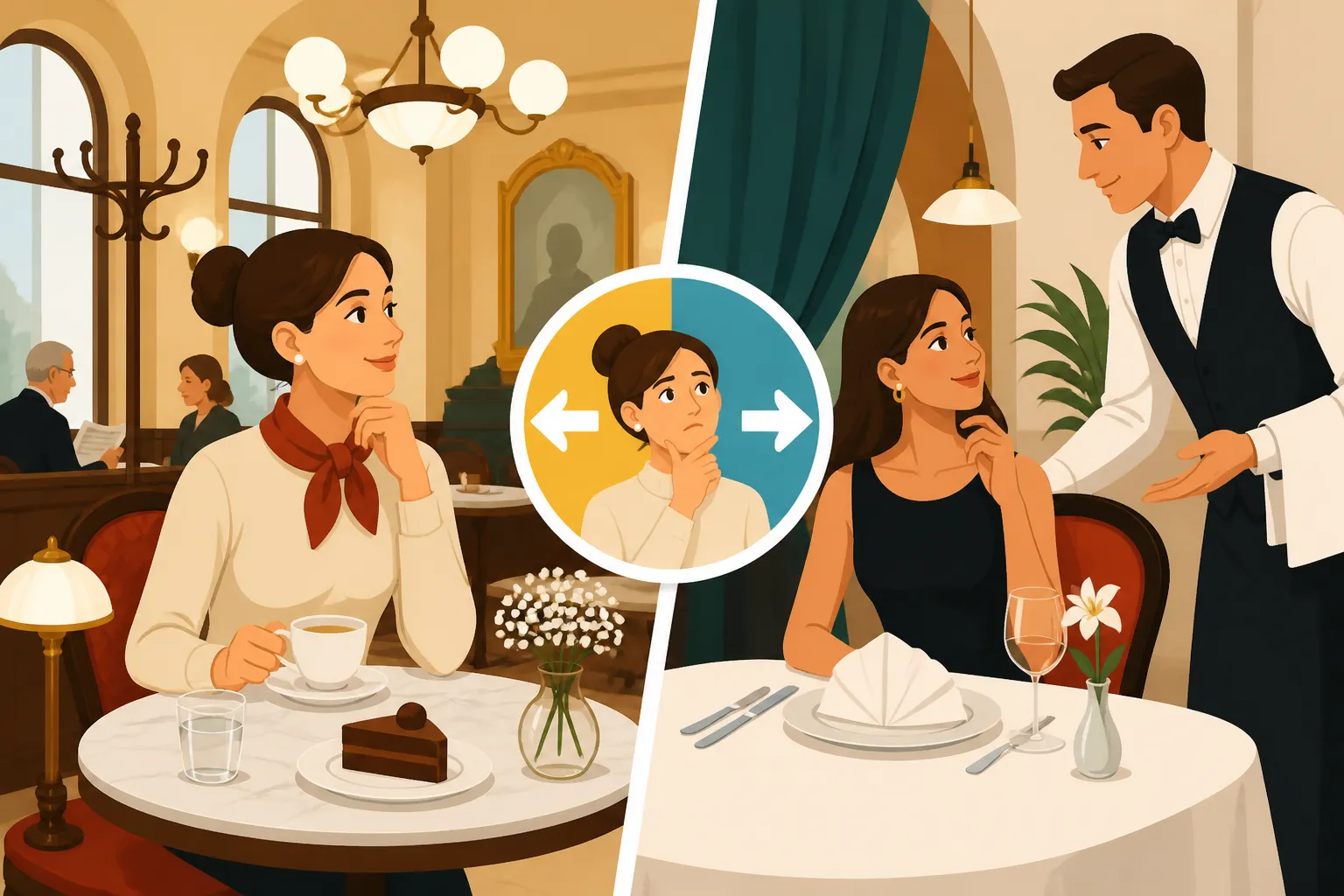
Seating Yourself at an Austrian Kaffeehaus vs Restaurant
Walking into a traditional Viennese cafe and standing awkwardly by the door while waiters zip past you without a glance is a rite of passage for every newcomer. I remember my first month in Vienna, standing paralyzed at the entrance of Cafe Central for fifteen minutes before a grumpy waiter finally barked at me to just sit anywhere. This guide solves the "to wait or not to wait" dilemma, ensuring you navigate Austrian dining like a seasoned local.
The Philosophical Divide Between Coffee and Food
To understand seating in Austria, you have to understand the soul of the establishment you are entering. In many Anglo-Saxon cultures, the "Wait to be Seated" sign is a universal law. In Austria, the rules are dictated by the category of the venue. The traditional Austrian Kaffeehaus is legally and culturally viewed as an "extended living room." This means the space belongs to the public. When you walk into a cafe, the assumption is that you are there to reclaim your piece of that living room.
Conversely, a restaurant (Gasthaus or Beisl) is a place of precision and logistics. Here, the kitchen needs to pace the flow of guests to ensure the Schnitzel arrives crisp and the Tafelspitz is tender. If you snatch a table in a busy restaurant without asking, you aren't just being rude; you are disrupting a carefully calibrated administrative machine. Understanding this distinction is the first step in Living in Austria 2027: The Expat Starter Guide.
Seating Yourself at a Traditional Kaffeehaus
In a classic Kaffeehaus—think places like Cafe Prückel, Cafe Ritter, or Cafe Savoy—the rule is almost always "choose your own adventure." You walk in, scan the room for a vacant table that suits your mood (perhaps one with a good view of the street or a cozy corner near the newspaper rack), and sit down.
There is a specific etiquette to this "self-seating" process. If a table has a small "Reserviert" sign, obviously, you skip it. However, in many old-school cafes, you might see a table that is partially occupied by a single person. In a crowded environment, it is perfectly acceptable to ask, "Darf ich mich dazu setzen?" (May I join you?). This is a common part of the Culture Shock: Adapting to Direct Austrian Communication that many expats find jarring at first. Do not expect conversation; usually, you will both go back to reading your respective newspapers in comfortable silence.
Waiters in these cafes, known as "Herr Ober," may not acknowledge your arrival immediately. Do not take this personally. Their job is not to greet you, but to serve you once you are settled. In 2026, even with the rise of digital ordering in some modern bistros, the traditional Kaffeehaus remains a bastion of the "sit where you want" philosophy. This freedom is one of the greatest perks of the Vienna Neighborhood Guide: Best Districts for Expats because it allows you to truly inhabit the city.
Navigating the Restaurant and Gasthaus Protocol
When you move from the cafe to the restaurant, the rules flip. Whether it is a high-end establishment in the 1st District or a cozy neighborhood Beisl in the 15th, you should generally wait at the entrance. If there is no "Wait to be Seated" sign, look for a staff member, make eye contact, and offer one of the Austrian Greetings: Grüss Gott, Servus, and Handshakes.
The reason for this is practical. Many tables are reserved for later in the evening. In Austria, a "reservation" doesn't just mean the table is held for 15 minutes; it often means that table is blocked for the entire evening. If you sit down at a table that looks empty, you might be occupying a spot promised to a regular who has held that reservation since 1994.
If you are in a more casual Gasthaus during lunch hours, the rules can be slightly more relaxed. If you see no staff at the podium, you can walk toward the counter (Schank) and ask, "Haben Sie einen Platz für zwei?" (Do you have a place for two?). This small act of deference goes a long way in securing better service.
The Sacred Stammtisch Exception
One of the most confusing sights for an expat is a perfectly empty, large, ornate table in the middle of a busy restaurant with a sign that says "Stammtisch." You might be tempted to sit there if the rest of the place is packed. Do not do this.
The Stammtisch is reserved for the "regulars"—the local community members who meet at the same time every week to discuss politics, sports, or the neighborhood gossip. Sitting at a Stammtisch without being part of the group is the ultimate social faux pas. It is a deep-rooted part of the social fabric, and even if no one is sitting there at that exact moment, the table is considered "active." If you are looking for Making Friends in Austria: Expat Groups and Local Clubs, eventually being invited to a Stammtisch is the gold standard of integration.
Comparison of Seating Norms by Establishment Type
| Establishment Type | Seating Rule | Reservation Necessity | Best For |
|---|---|---|---|
| Traditional Kaffeehaus | Self-Seat | Rarely needed | Reading, long stays, coffee |
| Modern Brunch Cafe | Wait to be seated | Highly recommended | Trendy food, social groups |
| Gasthaus / Beisl | Wait to be seated | Recommended for dinner | Traditional Austrian meals |
| Heuriger (Wine Tavern) | Self-Seat (usually) | Recommended for large groups | Wine, cold platters, summer vibes |
| Konditorei (Bakery/Cafe) | Self-Seat | Not usually possible | Quick cake and coffee |
The Schanigarten and Outdoor Seating
During the warmer months, Austria’s streets transform with "Schanigärten"—outdoor seating areas on sidewalks or in squares. The rules for Schanigärten are a hybrid. In a cafe, you generally just pick a chair. In a restaurant, you should still check with the staff.
However, be aware of the "Ruhezeit" or quiet hours. Many outdoor areas have strict permits that require them to close or significantly quiet down by 10:00 PM. If you see a waiter frantically moving people inside at 9:55 PM, it isn't because they want to go home early; it's because the fines for noise violations are steep. This is a key part of Everyday Etiquette: Garbage Sorting, Noise, and Ruhezeit that keeps Austrian cities livable.
Practical Steps for a Stress-Free Arrival
If you feel overwhelmed, follow this simple checklist to ensure you don't offend the local sensibilities:
- Scan for Signs: Look at the tables. If you see "Reserviert" signs on 80% of them, wait for a host.
- Make Eye Contact: Even in a self-seat cafe, a quick nod to a waiter lets them know you've arrived so they can bring a menu eventually.
- Check the "Reserviert" Times: Sometimes a sign will have a time written on it (e.g., "ab 19:00"). If it is currently 2:00 PM, you can sit there, but be prepared to leave before the reserved time.
- Ask Before Joining: If the only spots left are at shared tables, always ask before sitting. It is rare to be told no, but the question is mandatory.
- German is Your Friend: Even if your skills are basic, using the local language for seating requests shows respect. Consider Learning German for Life and Career Success in Austria to make these daily interactions smoother.
Handling the Bill and Tipping
Once you have successfully seated yourself and enjoyed your meal, the final hurdle is the payment. In Austria, the waiter usually brings the bill to the table and calculates the total in front of you. You are expected to state the "round up" amount or the total you wish to pay including the tip.
For example, if the bill is €17.20, you might hand over a €20 note and say "Achtzehn" (eighteen). This indicates you want €2 back and are giving an 80-cent tip. This is quite different from the "leave the change on the table" culture in other countries. For a deep dive into these financial nuances, see our guide on Tipping Etiquette: How Much to Tip in Restaurants.
Dealing with Grumpy Service
It is a common joke that the better the cafe, the grumpier the waiter. In Vienna, this is known as "Wiener Grant." Do not let a short-tempered waiter ruin your experience. Their lack of a bubbly personality isn't a reflection of your behavior; it is part of the traditional theater of the Austrian service industry. They value efficiency and boundaries over friendliness. As long as you follow the seating rules and wait your turn, you are doing fine.
If you ever feel truly unwelcome, remember that the Kaffeehaus culture is protected by UNESCO precisely because it is a place where "time and space are consumed, but only the coffee is found on the bill." You have a right to be there. Once you master the art of the confident entrance and the self-selected seat, you will stop feeling like a tourist and start feeling like a resident.
Disclaimer
The information provided in this guide is based on cultural norms and personal expat experiences in Austria as of 2026. While these rules generally apply across the country, individual establishments may have their own specific policies. Always follow the instructions of local staff and posted signage.