Cost of Living Benchmarks for Singles, Couples, and Families
Staring at a rental listing in Vienna only to realize the "total rent" doesn't actually include heating, electricity, or the fact that there is no kitchen installed is a rite of passage for every expat. I remember my first week in Salzburg, convinced I had a handle on my budget, until a series of "hidden" administrative fees and the reality of Austrian grocery prices hit my bank account. This guide breaks down the real-world cost of living benchmarks for 2026 to ensure you aren't caught off guard.
Housing and Renting: The Foundation of Your Budget
The single largest expense you will face in Austria is your monthly "Miete" (rent). It is also the area where expats most frequently miscalculate because of the distinction between "Kaltmiete" (net rent) and "Warmmiete" (gross rent including some utilities). The market remains competitive, especially in urban hubs like Vienna, Innsbruck, and Salzburg. Understanding the nuances of the local market is the first step to financial stability.
Renting Trends: Altbau vs Neubau
When searching for a home, you will immediately notice the terms "Altbau" and "Neubau." This isn't just about aesthetic preference; it fundamentally changes your legal rights and your monthly outgoings. Altbau refers to buildings constructed before 1945 (specifically before 1953 in some legal contexts). These apartments often feature high ceilings, parquet floors, and double doors. More importantly, they are frequently subject to rent control. If you find a classic apartment in Vienna’s 2nd or 9th district, you might be protected by the Altbau vs Neubau: Differences in Rent, Charm, and Heating guidelines, which limit how much a landlord can legally charge.
Neubau apartments, built after World War II, typically offer better energy efficiency and modern amenities like floor heating and elevators. However, they are not subject to the same strict rent caps, meaning prices are driven by the current market. While the "Kaltmiete" might be higher in a Neubau, your heating costs will likely be significantly lower than in an old, drafty Altbau with 4-meter-high ceilings. I have lived in both, and while the charm of a 19th-century flat is undeniable, the €200 monthly gas bill in winter is a bitter pill to swallow.
Hidden Upfront Costs: Deposit and Agent Fees
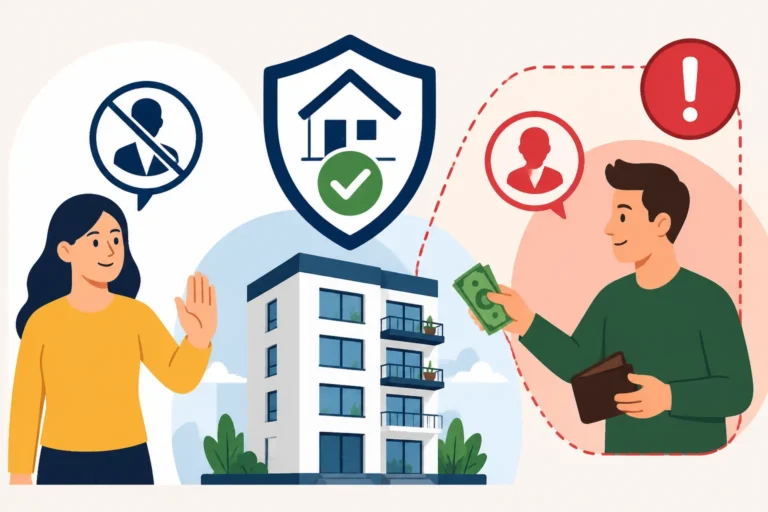
The "entry cost" for an Austrian apartment is notoriously high. Most landlords require a "Kaution" (security deposit) equivalent to three months of gross rent. For a modest €1,200 apartment, you are looking at €3,600 tied up in a bank account from day one. In years past, tenants also had to pay a hefty broker fee, but thanks to legislative shifts, the Bestellerprinzip 2026: Landlords Pay the Agent Fee is now the standard for residential rentals. This means that if the landlord hired the agent, you are no longer responsible for that two-month commission.
However, do not forget the "Ablöse." This is a one-time payment to the previous tenant for furniture or a kitchen they installed. It is very common in Austria for apartments to be rented "nackt" (naked), meaning they lack even a basic kitchen sink or stove. Paying an Ablöse can save you the headache of installing your own kitchen, but you must ensure the price is fair based on the age of the appliances. Always ask for a detailed list of what the Ablöse covers before handing over any cash.
Finding the Right District: Vienna vs Graz vs Linz
Location is the primary driver of price. Vienna remains the most popular choice, but even within the city, prices vary wildly. The 1st District (Innere Stadt) is largely unaffordable for most, while districts like the 7th (Neubau) and 8th (Josefstadt) command high prices due to their trendy status. If you are looking for better value, districts like the 10th (Favoriten) or the 11th (Simmering) offer much lower benchmarks.
Beyond the capital, cities like Graz and Linz provide a high quality of life for a fraction of the cost. Graz, with its large student population, has a vibrant rental market with many "WGs" (shared apartments). Linz, as an industrial and tech hub, offers modern housing that is often 15-20% cheaper than comparable flats in Vienna. When budgeting, consider your proximity to public transport; a cheaper flat in the outskirts might seem like a win until you realize you need a car to get to the supermarket.
Utilities and Digital Living: Keeping the Lights On
Once you have secured your keys, the next hurdle is "Betriebskosten" (operating costs) and utilities. In Austria, these are often handled separately from your rent contract, requiring you to sign individual agreements with energy and internet providers.
Energy Costs and the Fernwärme Mystery
Electricity and gas prices have stabilized since the volatility of the early 2020s, but they remain a significant portion of the monthly budget. Most residents use Electricity Providers in Austria (Wien Energie, Verbund) or regional equivalents like Salzburg AG. You will typically pay a monthly "Teilbetrag" (estimated installment) based on previous usage, with an annual "Jahresabrechnung" (final bill) that either results in a refund or a painful "Nachzahlung" (additional payment).
A unique feature of Austrian cities is "Fernwärme" (district heating). Instead of having a boiler in your apartment, heat is piped in from a central plant. It is generally convenient and requires less maintenance, but you have no choice of provider. If your building is connected to Fernwärme, you are locked into the municipal provider's rates. For a single person in a 50sqm flat, expect to budget roughly €80–€120 per month for combined electricity and heating in 2026.
Mobile and Internet Plans
Austria has some of the most competitive mobile and internet rates in Europe, provided you know where to look. While the big players offer premium packages, discount brands like HoT (Hofer Telekom) or Spusu provide excellent coverage for as little as €10–€15 a month for generous data plans. For home connectivity, you will choose between Home Internet Options: Magenta, A1, and 5G Routers.
Fiber optics are becoming the standard in Neubau areas, but in older districts, many expats opt for 5G boxes. These "Internet Cubes" are popular because they are plug-and-play, avoiding the need for a technician to drill holes in your Altbau walls. A solid 100Mbps home connection will cost you between €30 and €45 per month. Always check if your building has a pre-existing "Kombi-Angebot" which might save you €10 a month by bundling mobile and home internet.
The OBS Household Levy: ORF-Beitrag
A cost that catches many newcomers off guard is the ORF-Beitrag 2026: The New Broadcasting Household Levy Guide. Previously known as GIS, this is a mandatory fee for every household in Austria, regardless of whether you own a television or listen to the radio. It funds the public broadcaster and is legally unavoidable.
As of 2026, the fee is approximately €15 per month, usually billed every two months or annually. You will receive a letter in the mail shortly after registering your address (Meldezettel). Ignoring this letter is not recommended, as the fines for non-payment are steep. It is simply one of those "living in Austria" costs that you have to factor into your monthly subscriptions, much like Netflix or Spotify.
Grocery Shopping and Household Essentials
Eating in Austria can be as expensive or as affordable as you make it. The "quality over quantity" mindset is prevalent here, and you will notice that even discount supermarkets carry high-quality, locally sourced produce.
Supermarket Tiers: Where to Shop
The Austrian grocery landscape is dominated by a few major chains. Understanding their pricing tiers is essential for a balanced budget.
- Hofer and Lidl: These are the primary discounters. Hofer (the Austrian version of Aldi) is a cult favorite even among high-earning locals for its organic "Zurück zum Ursprung" line.
- Billa and Spar: These are the standard supermarkets found on nearly every corner. They offer a massive variety but are generally more expensive.
- Billa Plus and Interspar: These are large hypermarkets. They are great for bulk shopping and have the widest selection of international foods.
For a single person, a monthly grocery budget of €300–€400 is realistic for a mix of high-quality fresh food and pantry staples. Families of four should benchmark at least €800–€1,000, especially if purchasing organic ("Bio") products. Pro tip: look for the "Pickerl" (red stickers) on items nearing their expiry date, which usually offer 25% to 50% off.
Dining Out and Coffee Culture Costs
Austria’s culinary scene is more than just Schnitzel. However, dining out has become notably more expensive in recent years. A standard lunch menu ("Mittagsmenü") in a city center will cost between €12 and €18, usually including a soup and a main course. For a dinner for two with wine at a mid-range "Beisl" (traditional tavern), expect to pay around €60–€80.
Coffee culture is a central pillar of life here. A "Melange" (the Viennese version of a cappuccino) in a traditional coffee house currently sits around €4.50 to €6.00. While it might seem expensive for a cup of coffee, remember that in a traditional Kaffeehaus, you are paying for the right to sit there for three hours with a single newspaper. It’s effectively a rental fee for a very beautiful living room.
Household Goods and Furniture
As mentioned, many Austrian flats come empty. This means your first-year budget needs a significant buffer for furniture. IKEA is the go-to for most expats, with major locations in Vösendorf and Haid. If you are looking for higher-end Austrian brands, XXXLutz and Mömax are ubiquitous.
To save money, I highly recommend becoming an active user of "Willhaben." It is the Austrian equivalent of Craigslist or eBay Kleinanzeigen. You can find everything from designer sofas to kitchen appliances for a fraction of the retail price. Many expats moving away sell their entire household contents on Willhaben, which can be a lifesaver when you are trying to furnish a 3-bedroom apartment on a budget.
Moving Around: Transportation Expenses
One of the greatest joys of living in Austria is the efficiency of the public transport system. In many cities, owning a car is not only unnecessary but actively inconvenient due to limited parking and high fees.
Public Transport: The Power of the Annual Pass
In Vienna, the "Wiener Linien" annual pass is legendary. For €365 a year (exactly €1 per day), you get unlimited access to all subways, trams, and buses within the city limits. This is a benchmark that every single person living in Vienna should utilize. Similar passes exist in Graz and Linz, though they are slightly more expensive.
On a national level, the Is the Klimaticket Worth It? Cost and Benefit Analysis is the ultimate tool for those who travel between cities. For approximately €1,095 per year, you can hop on any train, bus, or tram anywhere in the country. If you find yourself commuting from St. Pölten to Vienna or visiting the mountains every weekend, the Klimaticket pays for itself within months.
Car Ownership: Insurance, Fuel, and the Pickerl
If you do choose to own a car, be prepared for high secondary costs. Fuel prices are generally higher than in North America but comparable to the rest of the EU. The real costs lie in the "NoVA" (a one-time tax on new vehicles) and the annual insurance and road tax, which is calculated based on engine power (kilowatts).
Every year, your car must undergo the "§57a Begutachtung," commonly known as the "Pickerl." This is a mandatory safety and emissions inspection. For older cars, this can be a source of great financial anxiety, as any significant rust or mechanical failure must be repaired before the sticker is granted. Expect to spend at least €150–€200 a month on basic car maintenance and insurance, not including fuel or the cost of the car itself.
Regional Travel and the ÖBB Network
For those without a Klimaticket, the ÖBB (Austrian Federal Railways) offers the "Vorteilscard." For €66 a year, you get 50% off all standard-fare tickets. This is essential for spontaneous weekend trips. A round-trip ticket from Vienna to Salzburg without a discount card can easily top €120, but with a Vorteilscard and a "Sparschiene" (advance booking) ticket, you can find the same trip for €30–€40.
Health, Wellness, and Insurance
Healthcare in Austria is excellent, but it is not "free" in the way many people assume. It is a social insurance system funded by mandatory contributions from your salary.
Social Security and the e-card Fee
If you are employed, your employer automatically deducts social insurance from your gross pay. This covers health, accident, pension, and unemployment insurance. For more details on these deductions, see Public vs Private Health Insurance in Austria Explained. One small but notable cost is the annual e-card service fee, which is around €13.80 in 2026. This is deducted once a year from your January salary.
If you are a freelancer, you will be responsible for your own payments to the SVS. This can be a major shock to the system, as the contributions are roughly 27% of your net income. Always set aside a third of every invoice to cover your social security and income tax obligations at the end of the year.
Private Insurance and Supplemental Care
While the public system is comprehensive, many expats and locals opt for "Zusatzversicherung" (private supplemental insurance). This allows you to stay in private hospital rooms and gives you access to "Wahlarzt" (private doctors) who offer shorter wait times and longer consultations.
Private health insurance premiums for a healthy 30-year-old range from €80 to €150 per month. Additionally, you should factor in the cost of the dentist. The public insurance covers basic fillings and extractions, but professional cleanings (Mundhygiene) and high-quality crowns are out-of-pocket expenses. A professional cleaning usually costs between €100 and €150.
Fitness and Recreation Expenses
Staying active is a way of life in Austria. A standard gym membership in a city will cost between €30 (for budget chains like Fitinn) and €90 (for premium clubs with saunas like Holmes Place). If you prefer the outdoors, factor in the cost of gear. Skiing is the national sport, but a single day pass in a major resort like Ischgl or Arlberg will now set you back €75 or more. Most locals buy seasonal passes or stick to smaller, regional mountains to keep costs manageable.
Family Life and Educational Costs
Moving to Austria with children adds another layer of complexity to your benchmarks. Fortunately, the state provides significant support, but there are still gaps to fill.
Childcare and Kindergarten Fees
In Vienna, public kindergarten is essentially free (you only pay a small fee for meals, around €70–€100 per month). However, getting a spot in a public "Kindergarten" can be a competitive process. Many expats opt for private or bilingual kindergartens, which can cost between €300 and €600 per month.
For younger children (under 3), "Tagesmütter" (childminders) are a common alternative. These costs are often subsidized by the city, but you should still budget for a few hundred euros a month depending on your income level and the hours required.
Schooling: Public vs Private Considerations
The Austrian public school system is very high quality and free. Most children attend their local "Volksschule" and then move on to a "Gymnasium" or "Mittelschule." However, if you want your child to follow an international curriculum (like the IB), you will need to look at Cost Differences: Public vs Private Schools in Austria.
International schools in Vienna, such as the Vienna International School (VIS) or the American International School (AIS), have tuition fees ranging from €20,000 to €30,000 per year. There are "bilingual" public schools that offer a middle ground, but spots are extremely limited and often require a high level of German or English proficiency from the child.
Activities for Kids and Family Weekend Budgets
Extracurricular activities like music lessons at the municipal "Musikschule" or sports clubs ("Vereine") are very affordable, often costing less than €200 per semester. The real cost of family life in Austria is leisure. A family trip to the zoo (Tiergarten Schönbrunn) or a weekend at a "Therme" (thermal spa) can easily cost €150 for a family of four once you include food and travel.
Comparative Cost Benchmarks 2026
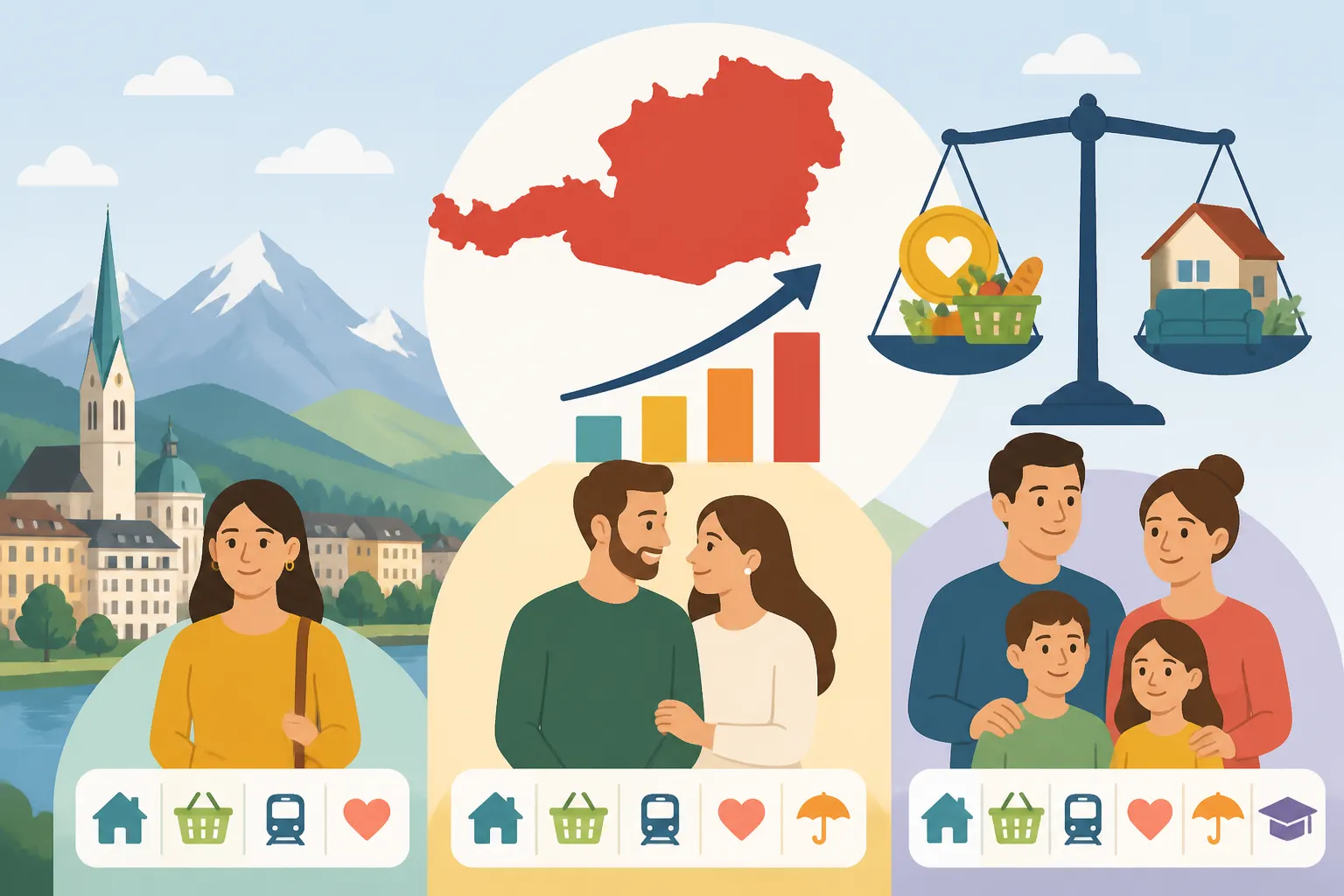
To give you a clearer picture, here is a breakdown of estimated monthly expenses across three household types. These figures assume a "middle-of-the-road" lifestyle—not struggling, but not living in luxury.
| Expense Category | Single (Vienna 50sqm) | Couple (Graz 80sqm) | Family of 4 (Linz 110sqm) |
|---|---|---|---|
| Rent (Warmmiete) | €950 | €1,350 | €1,850 |
| Electricity & Gas | €100 | €150 | €220 |
| Groceries | €350 | €600 | €1,000 |
| Public Transport | €30 | €60 | €120 |
| Internet & Mobile | €50 | €80 | €120 |
| Leisure & Dining | €300 | €500 | €600 |
| Insurance & Misc. | €100 | €150 | €250 |
| Total Estimated | €1,880 | €2,890 | €4,160 |
Note: These are "net" spending figures. To cover these, your gross salary needs to be significantly higher to account for taxes and social security.
Managing Your Net Income: Taxes and Social Insurance
Understanding your "Lohnzettel" (payslip) is the final piece of the financial puzzle. In Austria, the gap between your "Brutto" (gross) and "Netto" (net) salary is quite large, often around 30% to 40%.
Understanding the Lohnzettel
Your payslip will list your gross pay followed by deductions for social insurance (roughly 18% for the employee share) and income tax (Lohnsteuer). Austria uses a progressive tax system. While the first ~€12,000 you earn per year is tax-free, the rates climb quickly to 20%, 30%, and eventually 48% or higher for top earners.
One uniquely Austrian benefit is the 13th and 14th salary. In almost all employment contracts, you are paid 14 times a year: once in June (holiday bonus) and once in November (Christmas bonus). These extra payments are taxed at a much lower rate (usually 6%), which is a massive boost to your annual savings or travel budget.
Church Tax and Other Optional Deductions
If you registered as Catholic or Protestant on your Meldezettel, you will eventually receive a letter from the "Kirchenbeitragsstelle." This is the church tax, which is roughly 1.1% of your taxable income. It is not collected via your payslip but is billed directly to you. If you are not a practicing member, many expats choose to officially "austreten" (leave the church) at the local district office to avoid this fee.
Finally, don't forget the "Haushaltsversicherung" (household insurance). It is almost always required by landlords and covers everything from fire damage to personal liability if you accidentally bike into a pedestrian. It’s a small cost—usually €15 to €25 a month—but it is an essential safety net in the Austrian system.
Disclaimer
The information provided in this guide is for informational purposes only and does not constitute financial, legal, or tax advice. Cost of living benchmarks are estimates based on market trends in 2026 and can vary significantly based on personal lifestyle choices, specific regional price fluctuations, and changes in national legislation. Always verify current prices and legal requirements with official Austrian authorities or certified professionals before making significant financial decisions.