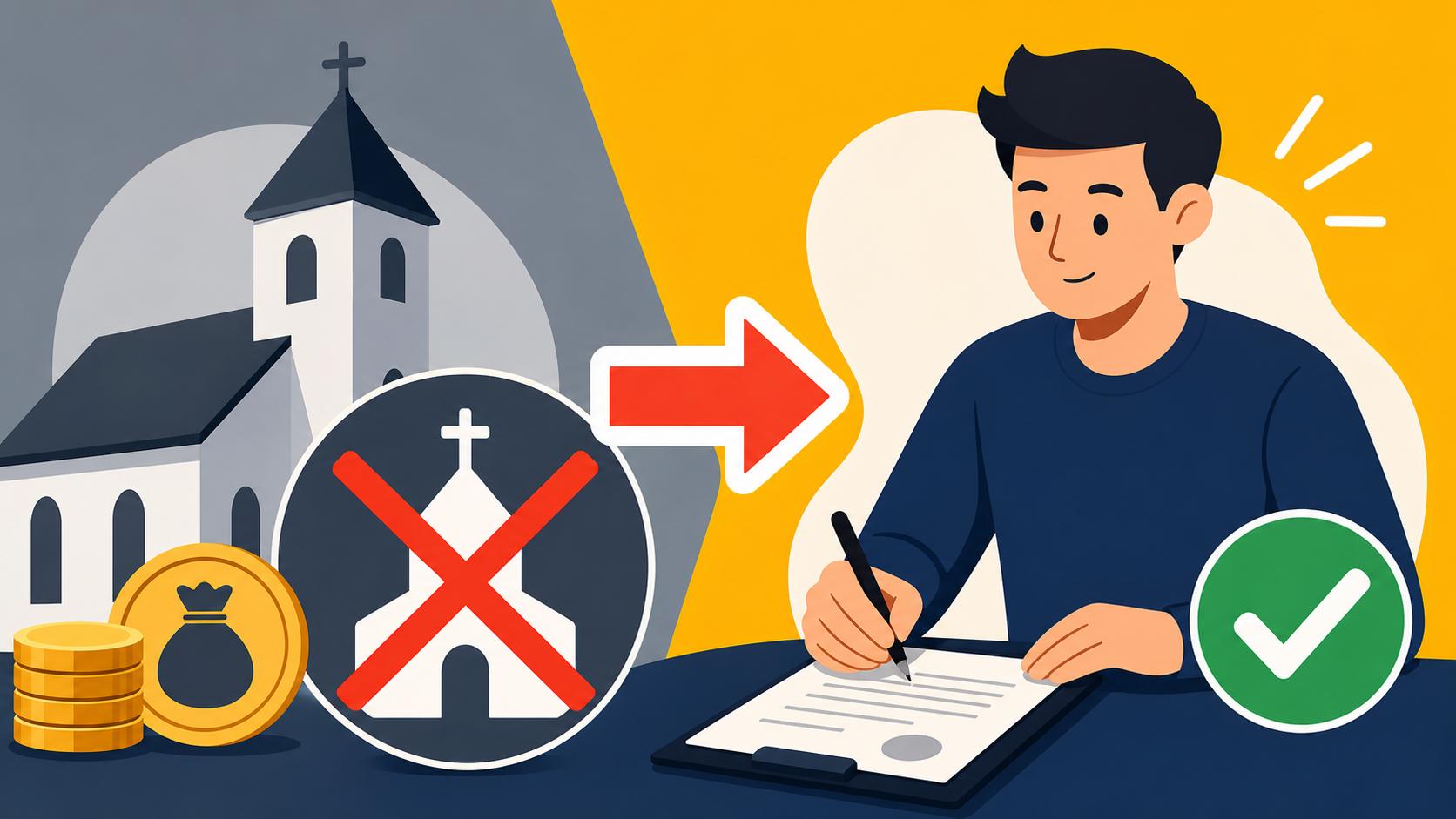
How to Officially Deregister from Church Tax (Kirchenaustritt)
You open your mailbox, expecting a utility bill or perhaps a flyer for the local Billa, and instead, you find a formal letter from an organization you didn’t even know you were "enrolled" in: the Church. I remember the absolute confusion I felt when my first Kirchenbeitrag bill arrived; it felt like a mysterious membership fee for a club I hadn't intentionally joined since moving to Vienna. This guide provides the exact, legally recognized steps to navigate the Kirchenaustritt process so you can stop these mandatory payments once and for all.
Understanding the Austrian Church Tax System
The first thing most expats ask is, "How did they even find me?" In Austria, the relationship between the state and recognized religious communities—most notably the Catholic, Protestant, and Old Catholic churches—is highly integrated. When you completed The Meldezettel Process: Registering Your Address Legally at the Meldeservice office, there was a small box asking for your "Religionsbekenntnis" (religious affiliation). If you wrote down "Catholic" or "Protestant" out of a sense of cultural heritage or habit, that data was automatically shared with the relevant church authorities.
In Austria, the Kirchenbeitrag is not a voluntary donation; it is a legally enforceable contribution. If you are registered as a member, the church has the legal right to request a portion of your income—typically around 1.1% of your taxable income, minus a standard deduction. Because the church doesn't initially know how much you earn, they often send an "estimated" bill that can be shockingly high. This is where the frustration begins for many foreigners who may have been religious in their home country but never had to pay a direct state-sanctioned tax for it.
The church authorities operate their own Kirchenbeitragsstellen (contribution offices) which are separate from the government’s Finanzamt. However, the state grants them the power to sue for unpaid fees. To avoid this, you must formally leave the church through a state-recognized administrative process. Simply stopping the payments or telling the priest you are leaving is not enough. You must perform an official Kirchenaustritt.
Where to File Your Deregistration
One of the most confusing aspects of Austrian bureaucracy is knowing which door to knock on. You do not go to the church to leave the church. Instead, you deal with the civil authorities. The specific office depends entirely on where you live in Austria.
If you live in a major city like Vienna, the process is handled by the Magistrat. Specifically, in Vienna, this is managed by the Magistratisches Bezirksamt for your respective district. If you live in a smaller town or rural area, you will need to contact your local Bezirkshauptmannschaft (BH). These offices are the "administrative heart" of the region, handling everything from passports to trade licenses.
When you go to these offices, you are essentially making a legal declaration of your "Konfessionslosigkeit" (state of being without a confession). The civil authority then notifies the church on your behalf. This is a critical protection for you, as it creates a paper trail that the church cannot ignore. For those looking to avoid future financial surprises, understanding how this fits into your broader residency is key, much like the Healthcare Checklist for Your First 30 Days in Austria ensures you aren't hit with medical debts later on.
The Three Methods of Kirchenaustritt
Depending on your comfort level with the German language and your access to digital tools, there are three main ways to officially deregister.
1. In-Person Appointment
This is the most "old-school" but often the most reassuring method for expats. You simply find your local Bezirksamt or Bezirkshauptmannschaft and show up during their "Parteienverkehr" (public office hours). In Vienna, it is highly recommended to book an appointment online first to avoid waiting for hours. You will need to bring your valid passport and your Meldezettel. The officer will print out a form, you sign it, and you are done. The advantage here is that you can ask for the Austrittsbescheinigung (exit certificate) right then and there.
2. Online via ID Austria
If you have already set up your digital identity, the process is incredibly fast. Logging into FinanzOnline with the ID Austria App is something every expat should master, as it also allows you to handle your church exit digitally through the Mein.gv.at portal or specific municipal websites. In Vienna, the City of Vienna (Stadt Wien) has a dedicated online form where you can upload a scan of your ID and submit the request in minutes. This is by far the most efficient method for those who are busy or live far from their administrative center.
3. Via Post or Email
You can also send a formal letter. This letter must include your full name, date of birth, address, and the specific church you are leaving. Crucially, you should include a copy of your photo ID. If sending by post, it is always wise to send it as a "Einschreiben" (registered mail) so you have proof of delivery. If the church ever claims they didn't receive notice, that yellow receipt from the Post will be your shield.
Required Documentation and Costs
The Austrian system loves stamps and certificates, so being prepared with the right paperwork is essential. Fortunately, for a Kirchenaustritt, the list is relatively short compared to something complex like Red-White-Red Card: Application and Requirements.
| Document | Requirement | Notes |
|---|---|---|
| Valid Photo ID | Mandatory | Passport or Personalausweis (EU) |
| Meldezettel | Highly Recommended | Proves you fall under that office's jurisdiction |
| Baptismal Certificate | Optional | Only needed if there is a dispute about your membership status |
| Admin Fee | Varies | Usually between €0 and €10 depending on the state |
| ID Austria | For Online only | Must be fully activated (formerly Handy-Signatur) |
As of 2026, most provinces have eliminated the "exit fee" to make the process more accessible, but some Bezirkshauptmannschaften may still charge a small administrative fee (usually around €6.50 to €10) for the physical certificate. Always bring a bit of cash or a Bankomatkarte just in case. When you consider the Income Tax Brackets 2026: Navigating the 0% to 55% Rates, saving that 1.1% of your income every month adds up to a significant amount over a few years.
Negotiating Back-Payments and the First Bill
If you have already received a bill for several hundred (or thousand) euros, simply deregistering today will not automatically make that debt disappear. The church will still expect payment for the period from when you registered your address until the date of your formal exit. This is a common trap for foreigners who spend two years in Austria before realizing they are being taxed.
The Kirchenbeitragsstelle is surprisingly open to negotiation, primarily because they would rather get some money than spend years in legal battles with an expat who might move away. If you receive a high bill, do not ignore it. Instead, contact the church office mentioned on the letter. Explain your situation: perhaps you were a student with no income, or you didn't realize you were registered.
You can often negotiate the bill down by providing proof of your actual income, such as a Lohnzettel Breakdown: Gross vs Net Salary Explained. The church usually offers "social discounts" for low earners, students, or families with children. If you can prove your income was below a certain threshold, they may waive a large portion of the back-tax. However, they will only do this if you communicate with them. Ignoring the letters will eventually lead to a "Mahnung" (reminder) and potentially a court order.
Consequences of Leaving the Church
It is important to understand that a Kirchenaustritt is a "civil death" in the eyes of the religious institution. This is a personal decision that carries specific cultural and religious consequences in Austria. Once the state notifies the church that you have left, you will no longer be eligible for certain services.
Firstly, you cannot legally be a godparent (Pate) for a Catholic or Protestant baptism. If a friend asks you to be a godfather or godmother, the church will check the records and see that you have exited, which usually disqualifies you. Secondly, you lose the right to a church wedding. While you can still have a civil ceremony at the Standesamt, the ornate "white wedding" in an Austrian cathedral will be off-limits.
Furthermore, you are technically no longer entitled to a religious funeral service led by a priest. For many expats, these are small prices to pay for financial freedom, but for others, it can be a point of family tension, especially if you have integrated into a local village community where the church is the center of social life. Before you proceed, make sure you are comfortable with these trade-offs, as re-joining the church later often involves a formal interview and a commitment to pay the tax moving forward.
Tax Deductibility of the Church Tax
If you decide to stay in the church, you should at least ensure you are getting the tax benefits associated with it. The Austrian government allows you to deduct up to €400 per year of your Kirchenbeitrag as a "Sonderausgabe" (special expense) on your tax return.
If you are Filing Income Tax (Einkommensteuer) as a Freelancer, this deduction is handled through FinanzOnline. For employees, the church usually reports the amount you paid directly to the tax office, and it is automatically factored into your Arbeitnehmerveranlagung (employee tax assessment). This doesn't make the tax "free," but it does lower your overall tax burden slightly. However, for most people, the €400 deduction doesn't come close to covering the total cost of the tax if you are a high earner.
If you are trying to minimize all unnecessary costs while living here, you might also want to look into ORF-Beitrag 2026: The New Broadcasting Household Levy Guide, as it is another mandatory fee that catches people off guard. Managing these small "leaks" in your budget is part of the "pro" level of expat life in Austria.
Timing and the "Austrittsbescheinigung"
Timing is everything in Austrian administration. The church tax is usually calculated on a monthly basis. If you deregister on the 15th of the month, you are typically liable for that full month. Therefore, it is best to handle your Kirchenaustritt as early as possible once you've made the decision.
After you sign the papers at the Magistrat or submit your online form, you will eventually receive the Austrittsbescheinigung. Do not lose this document. Treat it with the same level of care as your birth certificate or your The Austrian e-card: Registration, Photo Rules, and Usage Guide. This certificate is your only legal proof that you no longer owe the church money. Sometimes, due to administrative lag, the church might send one more bill after you have already left. Having this certificate allows you to send a quick email with a scan of the document to the church office, which will immediately close your case.
If you ever move to a different district or city within Austria, keep a copy of this certificate in your digital files. While the Meldesystem is supposed to track your "Konfessionslos" status, errors can happen during a move. If a new district tries to register you as a member again, you can simply show them your old exit certificate to stop the process before it starts.
Managing the Social Integration Aspect
In bigger cities like Vienna or Graz, leaving the church is very common and carries no social stigma. In fact, more people are leaving every year due to the high cost of living. However, if you live in a small village in Tyrol or Upper Austria, the priest and the church community might notice.
If you want to maintain good relations with your neighbors while still saving money, you might consider Making Local Friends Outside the Austrian Drinking Culture or joining local "Vereine" (clubs) like the fire department or a hiking group. These social connections are often more important for integration than your official religious status. Austrians value honesty, and if a neighbor asks why you left, a simple explanation that you prefer to manage your finances differently is usually respected, even if they don't agree.
The bureaucracy in Austria can feel overwhelming, especially when it reaches into your wallet for religious reasons. But by following the formal Kirchenaustritt process, you are simply exercising your legal right to freedom of (or from) religion as defined by Austrian law. It is one of the many steps in truly mastering the Money in Austria 2027: Banking, Payments, and Financial Setup landscape.
Disclaimer
This guide is for informational purposes only and does not constitute legal or financial advice. Regulations regarding church tax and administrative procedures in Austria can change. Always verify the current requirements with your local Magistrat or Bezirkshauptmannschaft.