Best Places for Physical Currency Exchange in Vienna
Arriving in Vienna and finding yourself without a single Euro in your pocket can feel like hitting a brick wall, especially when you realize that many of the city’s most charming cafes still operate on a cash-only basis. I remember standing in front of a beautiful Melange at a traditional coffee house during my first week here, only to realize I had nothing but a foreign credit card that the waiter politely, but firmly, declined. This guide identifies the absolute best places for physical currency exchange in Vienna so you can avoid the exorbitant fees that target unsuspecting newcomers.
The Reality of Cash Culture in Vienna
If you are coming from a highly digitized society, the first thing you need to understand is that Austria remains deeply tethered to physical currency. While the pandemic accelerated the adoption of contactless payments, the phrase "Nur Barzahlung" (cash only) is still a common sight in small shops, bakeries, and traditional taverns. This is not just a quirk of the older generation; it is a fundamental part of the Cashless Payments vs Cash Culture in Austria Today that expats must navigate daily.
When you land at Vienna International Airport (Schwechat), the temptation to use the first exchange booth you see is overwhelming. However, these booths often offer rates that are significantly lower than the mid-market rate, sometimes costing you 10% to 15% of your total value in hidden spreads. As someone who has lived here through several years of market fluctuations, I can tell you that the airport is the last place you should be swapping your home currency. If you absolutely must have cash for the train or a bus, exchange the bare minimum—no more than 20 or 30 Euros—to get you into the city center where the real deals are found.
The necessity of cash extends beyond just buying a coffee. If you are trying to estimate your monthly outlays, understanding the Cost of Living in Vienna: Singles vs Families will show you that incidental cash expenses can add up quickly. From tipping culture (usually 5-10%) to paying for a locker at a public museum, having physical Euros is non-negotiable.
Top Locations for Physical Currency Exchange in the City Center
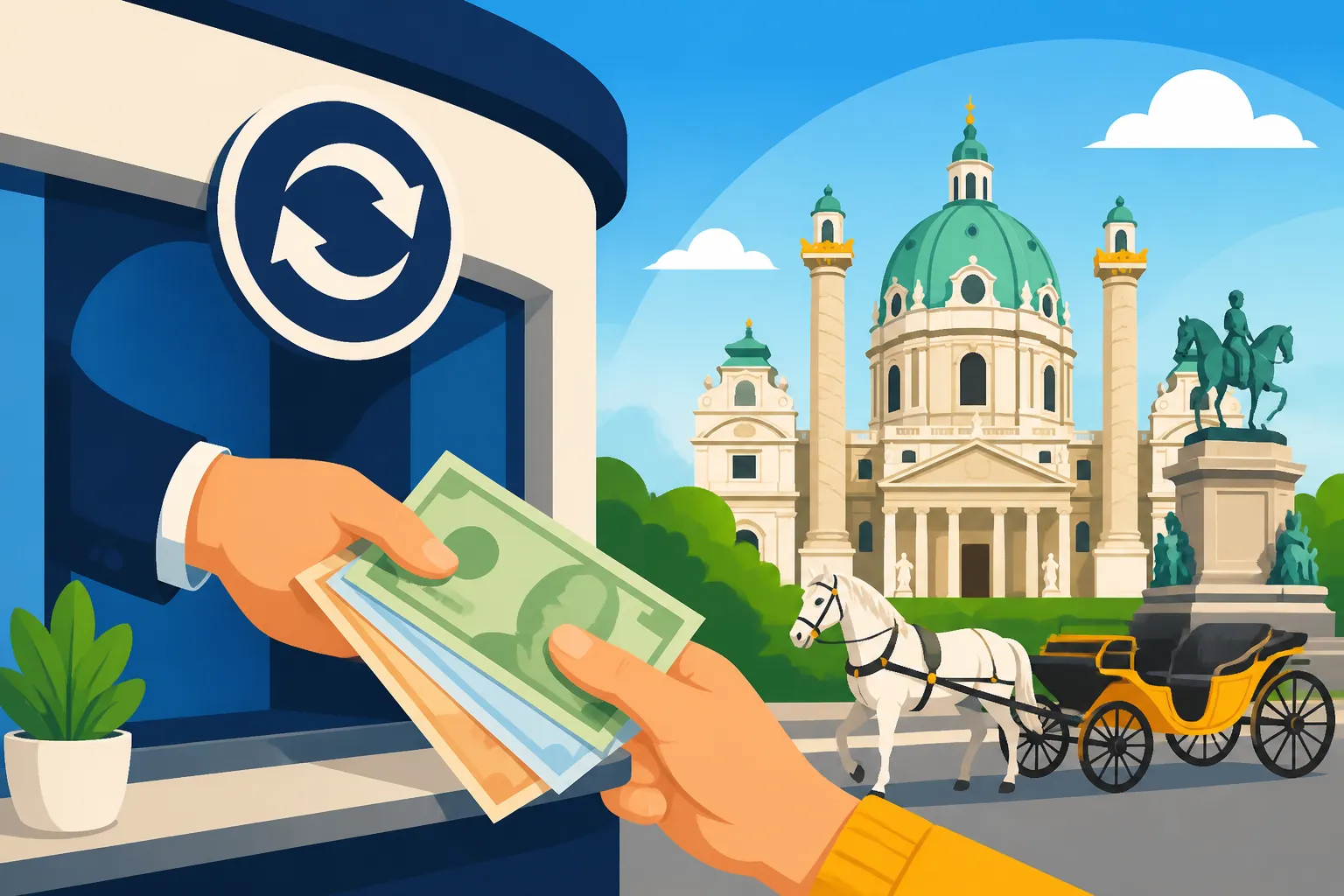
Once you have made it into the city, your options for exchange broaden significantly. The best rates are generally found in the 1st District (Innere Stadt) and along the major shopping arteries like Mariahilfer Straße. However, not all exchange offices are created equal.
The Inner City and Stephansplatz
The area surrounding St. Stephen's Cathedral is packed with currency exchange booths, often referred to as "Wechselstube." While this area is tourist-heavy, the sheer volume of competition keeps the rates somewhat competitive compared to the airport. When walking through the 1st District, look for booths that display both the "Buy" and "Sell" rates clearly. A reputable office will have a narrow spread between these two numbers.
Be wary of signs that shout "No Commission." In the world of Money in Austria 2027: Banking, Payments, and Financial Setup, "no commission" usually means the exchange office has simply folded their fee into a very poor exchange rate. Always ask the teller, "How many Euros will I receive in my hand for X amount of my currency?" before handing over your cash. This prevents any surprises involving administrative fees that might be listed in tiny print at the bottom of a board.
Major Railway Stations: Hauptbahnhof and Westbahnhof
If you arrive in Vienna via train from another European country, you will likely find yourself at either the Wien Hauptbahnhof (Central Station) or Westbahnhof. These stations are essentially mini-malls and contain several exchange options. Generally, the rates here are better than the airport but slightly worse than the specialized kiosks in the city center.
The advantage of using a station-based exchange is the extended opening hours. While most city offices close by 6:00 PM and are completely shut on Sundays, the exchange offices at Hauptbahnhof often remain open later to accommodate travelers. This is particularly useful because of the Sunday Shopping Laws: Why Everything is Closed which can leave you stranded if you aren't prepared with cash on a weekend.
Traditional Austrian Banks
You might think a bank is the safest bet for a fair exchange, and while they are reliable, they are not always the most convenient. Many traditional branches, such as those you will find when Comparing Erste Bank, Raiffeisen, and Bank Austria, have restricted their currency exchange services to their own account holders. If you do find a bank willing to exchange for a non-customer, expect to pay a flat service fee ranging from 5 to 10 Euros on top of the exchange rate spread.
If you are planning a long-term stay, Opening an Austrian Bank Account: Requirements and Top Banks is a much better move. Once you have a local account, you can often order specific foreign currencies or exchange larger amounts of cash with much lower administrative hurdles.
Avoiding Common Currency Exchange Traps
The "trap" in currency exchange isn't always an illegal scam; usually, it is just a very expensive service that people use because they don't know better. One of the most common pitfalls involves Dynamic Currency Conversion (DCC).
The ATM Dynamic Currency Conversion Pitfall
When you use an Austrian ATM (Bankomat) with a foreign card, the machine will often ask if you want to be charged in your "home currency" or in "Euros." It sounds helpful to see the price in your own currency, but this is a massive mistake. If you choose your home currency, the ATM provider sets the exchange rate, and it is almost always terrible. Always choose to be charged in Euros and let your own bank handle the conversion.
Furthermore, some independent ATMs located in high-traffic tourist areas (often brightly colored blue and yellow machines) charge high withdrawal fees. If you can, stick to ATMs located at actual bank branches like Sparkasse or Raiffeisen. You can learn more about How to Avoid ATM Withdrawal Fees with Sparkasse to keep more of your money in your wallet.
Documentation and Legal Requirements
In Austria, as in much of the EU, there are strict anti-money laundering regulations. If you are exchanging a significant amount of physical cash—usually anything over 1,000 Euros—you will be required to provide a valid photo ID, such as a passport. Do not be offended if the teller asks for your local address or proof of where the funds came from. This is standard procedure and part of the broader regulatory environment you will encounter when dealing with Bank Fees: Understanding Account Maintenance and ATM Charges.
Comparison of Physical Exchange Options in Vienna
| Location Type | Best For | Typical Rate Quality | Availability |
|---|---|---|---|
| Airport (Schwechat) | Emergencies only | Poor (High Spread) | 24/7 or late hours |
| City Center Kiosks | Competitive rates | Good (if you shop around) | Business hours only |
| Train Stations | Convenience | Moderate | Extended hours / Weekends |
| Traditional Banks | Security / Large sums | Moderate (plus flat fees) | Limited for non-customers |
| Major ATMs | Speed | Varies (Beware of DCC) | 24/7 |
Modern Alternatives to Physical Exchange
While this guide focuses on physical cash, it would be remiss of a veteran expat not to mention that the world is moving toward digital solutions that often beat physical exchange rates by a wide margin. For those who are moving here for work or study, you will quickly realize that managing Exchange Rate Risks for Expats Paid in Euros is a crucial skill.
Instead of carrying large stacks of physical USD, GBP, or CAD, many savvy residents now use multi-currency accounts to withdraw cash as needed once they arrive. When you are Sending Money Home: Wise vs Standard Bank Transfers, you will notice that the digital middle-market rate is far superior to anything you will get at a physical booth on Mariahilfer Straße.
If you have a foreign card that offers "no foreign transaction fees," you can simply use an Austrian Bankomat to withdraw Euros directly. This often yields the best possible rate because it uses the wholesale interbank rate. Just make sure you understand your home bank's daily withdrawal limits and any fees they might charge for using an international ATM. This strategy, combined with a local Bankomatkarte (Debit) vs Credit Card Usage in Austria, is how most of us veterans handle our finances after the initial "honeymoon phase" of our relocation.
Ultimately, the best place for physical currency exchange in Vienna is a small, specialized kiosk in the 1st or 7th district where the staff is transparent about the fees and the spread. Take your time, compare two or three locations within walking distance of each other, and never feel pressured to sign a receipt until you have seen the final Euro amount. Vienna is a city that rewards those who take a "slow and steady" approach, and your wallet will thank you for the extra ten minutes of effort.
Disclaimer
This guide is for informational purposes only and does not constitute financial, legal, or investment advice. Exchange rates and bank policies in Austria are subject to frequent change. Always verify current rates and fees directly with the service provider before conducting any transactions. The author and publisher are not responsible for any financial losses incurred based on the information provided in this article.