Bankomatkarte (Debit) vs Credit Card Usage in Austria
Standing at a checkout in a Viennese supermarket while a line of impatient locals stares you down because your international credit card was just declined is a rite of passage I survived too many times during my first year here. I remember the sheer embarrassment of having to leave my groceries behind because I didn't realize that "Bankomat" was the only way to pay. This guide solves the confusion between Austrian debit and credit systems so you never face that awkward silence at the register.
The Cultural Divide of Plastic in Austria
To understand how to pay for things in Austria, you first have to understand the local mindset toward money. There is a deep-seated cultural preference for being "schuldenfrei" (debt-free). While the rest of the world embraced high-interest credit cards decades ago, Austrians remained fiercely loyal to their current accounts. Even as we move through 2026, you will find that the way people use plastic here is fundamentally different from the "swipe and worry later" culture found in the US or the UK.
Why Credit Cards Are Often Second Class Citizens
For a long time, many smaller businesses in Austria—think your local bakery, the family-run Gasthaus, or even some pharmacies—simply refused to accept credit cards. The reason was twofold: high merchant fees and a general suspicion of credit. Even today, you might see a sign that says "Bankomatzahlung ab 10 Euro" (Bankomat payment from 10 Euro) or, more frustratingly, "Nur Bankomat" (Only Bankomat). When an Austrian says "Bankomat," they are specifically referring to their debit card, not a credit card.
If you try to pay for a 3-euro Melange at a traditional coffee house with a premium travel credit card, don't be surprised if the waiter shakes his head. Understanding Cashless Payments vs Cash Culture in Austria Today is vital because it explains why "Bankomat" is the king of the street. Even in 2026, carrying a bit of cash is the only way to ensure you can always pay at a rustic mountain hut or a small stall at the Naschmarkt.
The Rise of the Debit Mastercard and Visa Debit
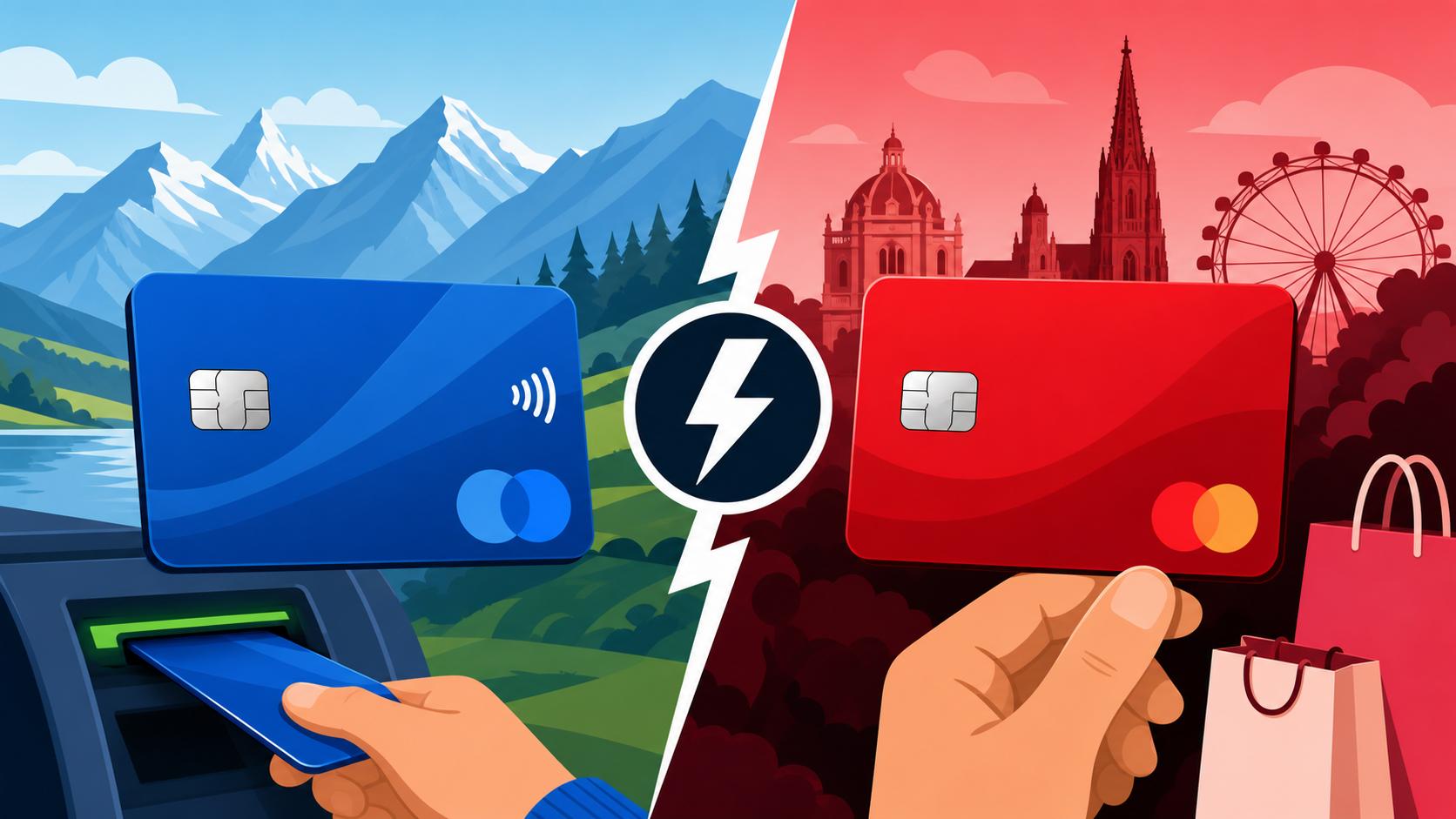
The biggest change in recent years has been the phasing out of the old Maestro system. If you moved here a few years ago, you likely had a card with the blue and red circles. Now, almost every major bank has issued a Debit Mastercard or Visa Debit. This has bridged the gap significantly. These cards look like credit cards because they have a 16-digit number and a CVV code, but they function exactly like a traditional Bankomatkarte, pulling funds immediately from your account.
This shift has made life easier for expats, but the terminology hasn't caught up. People still call these "Bankomatkarten." When setting up your life, Money in Austria 2027: Banking, Payments, and Financial Setup should be your first port of call to understand how these new debit cards integrate with your local IBAN.
Bankomatkarte The Workhorse of the Austrian Economy
The Bankomatkarte is the Swiss Army knife of Austrian finance. It is your key to ATMs, your method for paying at the grocery store, and often your proof of age at cigarette machines (though I don't recommend the habit!). In Austria, your debit card is tied directly to your "Girokonto" (checking account).
Everyday Usage and Acceptance
From Billa and Spar to Hofer and Lidl, the Bankomatkarte is accepted everywhere without question. It is the fastest way through the checkout. Austrians are world-class at packing their bags at lightning speed, and they expect the payment process to be just as efficient. You tap, the machine beeps, and you move.
However, there is a technical nuance you need to be aware of. Some older terminals in very rural areas still run on a system that only recognizes "local" debit cards. If you are using a foreign debit card from a neobank or a bank outside the Eurozone, you might still run into occasional hiccups. This is why many veteran expats recommend Opening an Austrian Bank Account: Requirements and Top Banks as soon as they get their Meldezettel. Having a local card removes that "will it or won't it work" anxiety.
Security and PIN Culture
Austria is very strict about PIN usage. While contactless (NFC) payments are the norm for small amounts, the system will periodically force you to insert your card and enter your PIN for "security reasons." This usually happens after a cumulative spend of 150 euros or after five consecutive contactless transactions.
In Austria, the physical card and the PIN are still the ultimate authority. If you lose your card, the process for freezing it is efficient, but getting a replacement can take up to a week. You can learn more about managing these logistics in our guide on Bank Fees: Understanding Account Maintenance and ATM Charges.
Use at ATMs (Bankomats)
The word "Bankomat" actually refers to the ATM itself. When you use an Austrian Bankomatkarte at an ATM owned by your bank group (e.g., a Sparkasse card at an Erste Bank machine), there is usually no fee. However, be wary of third-party ATMs found in souvenir shops or "Euronet" machines. These often charge exorbitant fees or offer terrible exchange rates if you are using a foreign card.
Credit Cards in Austria A Specialized Tool
If the Bankomatkarte is the workhorse, the credit card is the specialized tool you keep in your "metaphorical" drawer for specific occasions. Most Austrians do not use a credit card for their daily bread and milk. Instead, they use it for travel, online shopping on international sites, and car rentals.
The Challenge of Getting an Austrian Credit Card
As a new arrival, do not expect to be handed a credit card with a 5,000-euro limit on your first day. Austrian banks are notoriously conservative with credit. They will typically want to see three to six months of steady salary deposits before they even consider your application.
Furthermore, your eligibility is heavily tied to your "KSV" score. This is the Austrian version of a credit report. If you have just moved here, you have no history, which the system sometimes interprets as a risk. Understanding how KSV1870 Credit Score: How It Affects Loans and Rentals works is essential, not just for cards but for your future apartment search as well. If you are struggling to get a traditional credit card, you might want to look into Applying for Credit Cards in Austria: Approval Odds to find expat-friendly options.
How Credit Cards Work Differently Here
In many countries, a credit card allows you to carry a balance and pay it off slowly with interest (revolving credit). While this exists in Austria, the "standard" credit card offered by banks like Erste or Raiffeisen is often a "charge card." This means that at the end of the month, the entire balance is automatically deducted from your Girokonto.
This can be a shock if you spend 2,000 euros on a vacation and suddenly see your bank account emptied on the first of the month. Always check the terms of your card to see if you have a "Teilzahlung" (partial payment) option, though be warned that the interest rates are high.
When You Absolutely Need a Credit Card
There are three scenarios where your Bankomatkarte might fail you, and a credit card becomes mandatory:
- Car Rentals: Many agencies at Vienna International Airport or in the city will not accept a debit card for the "Kaution" (security deposit). They want to "block" a certain amount on a real credit card.
- International Hotels: While local pensions are fine with debit, large chains often require a credit card for check-in.
- Online Bookings: Certain airlines and international retailers still struggle with Austrian debit cards, though the new Debit Mastercards have largely fixed this.
| Feature | Bankomatkarte (Debit) | Credit Card |
|---|---|---|
| Direct Link | Tied to your current account | Separate credit line |
| Daily Acceptance | Extremely high (Groceries, cafes) | Moderate (Better in cities) |
| ATM Withdrawals | Usually free at bank machines | High fees and interest |
| Online Shopping | High (using Debit Mastercard/Visa) | Universal |
| Car Rental Deposit | Often rejected | Preferred/Mandatory |
| Monthly Bill | Immediate deduction | Monthly total deduction |
Comparing the Costs and Practical Strategies
Living in Austria requires a hybrid approach. If you rely solely on a foreign credit card, you will lose a fortune in transaction fees and face the constant "Nur Bankomat" rejection. If you rely solely on a local Bankomatkarte, you might find yourself unable to book a car for a weekend trip to the Alps.
Fees to Watch Out For
Austrian banks love their "Kontoführungsgebühren" (account management fees). Unlike some countries where banking is "free," you will likely pay a quarterly fee that covers your account and your Bankomatkarte. A credit card is usually an "add-on" that costs an extra 20 to 60 euros per year.
For the savvy expat, using Neobanks in Austria: Using N26 or Revolut for Salaries can be a way to avoid these fees while still getting a card that works at most terminals. However, keep in mind that for major milestones like a mortgage, having a history with a "traditional" bank like Erste or Raiffeisen is often beneficial. You can compare the big players in our guide Comparing Erste Bank, Raiffeisen, and Bank Austria.
Tipping and Card Payments
One of the most frequent questions I get is: "Can I tip on the card?" In 2026, the answer is mostly yes, but the etiquette is specific. When the waiter brings the mobile card terminal, you don't add the tip on a screen like in North America. Instead, you tell them the "total" amount you want to pay. If the bill is 18.20 euros, you say "Zwanzig" (twenty) while handing over your card. They will type 20.00 into the machine. For a deeper dive into these social graces, check out our guide on Tipping Etiquette: How Much to Tip in Restaurants.
Modern Mobile Payments
Apple Pay and Google Pay have taken Austria by storm. Most Austrian banks now support mobile integration. You can add your Bankomatkarte (if it's a Debit Mastercard/Visa) to your phone and pay almost anywhere that has a contactless symbol. This is incredibly convenient, but again, keep that physical card on you. If a terminal's internet goes down, or if you need to use a machine that requires a physical chip insertion, your phone won't help.
To manage your banking and other state-related financial tasks, it is also highly recommended to set up your digital identity. Using ID Austria for E-Banking and FinanzOnline Access will allow you to sign documents and verify payments with a level of security that the Austrian government requires for modern residents.
Troubleshooting Common Payment Issues
Even with the best preparation, things go wrong. Perhaps you are at a parking garage in Graz and the machine won't take your card, or you're trying to pay your rent and the "Dauerauftrag" (standing order) isn't working.
What to Do When a Card is Declined
If your card is declined, first check your daily limit. Austrian banks often set a "Tageslimit" (daily limit) of 400 euros for ATM withdrawals and 1,000 euros for POS payments. If you are buying a new laptop or a piece of furniture, you might hit this limit without realizing it. You can usually increase this limit instantly via your bank's mobile app.
Secondly, check if "Geo-Control" is active. Some Austrian banks automatically block transactions outside of Europe to prevent fraud. If you are trying to buy something from a US-based website, you might need to "de-block" your card for a 24-hour window in your banking app.
Lost or Stolen Cards
If you lose your card, call the central blocking hotline immediately at 0800 204 8800 (within Austria). This is a unified service for almost all Austrian Bankomatkarten. If it’s a credit card, you’ll need to call the specific provider (CardComplete or AirPlus are common in Austria).
While losing a bank card is a headache, it isn't the only card you need to worry about. For instance, the Lost e-card: Reporting and Replacement Process Explained is a separate but equally important procedure for your health insurance card, which also contains your photo and ID data.
Final Advice for New Arrivals
If I could go back to my first week in Vienna, I would tell myself to stop trying to use my "Gold Travel Card" for everything. It’s a fast track to frustration. Instead, do this:
- Get a local bank account immediately to get a "real" Bankomatkarte.
- Keep a 20-euro note hidden in your phone case for those "Cash Only" emergencies.
- Use your credit card for the big stuff (flights, hotels) but don't expect it to work at the local butcher.
- Learn to say the "total" amount for the tip before the card hits the terminal.
Austria's financial system is incredibly stable and secure, but it is also traditional. Once you stop fighting the "Bankomat" culture and start embracing it, you'll find that paying for things is actually quite seamless. You just have to play by the local rules.
Money and Finance Disclaimer
The information provided in this guide is for informational purposes only and does not constitute professional financial, legal, or investment advice. Banking regulations, fee structures, and card acceptance policies in Austria are subject to change. While we strive to keep this information updated, you should always verify specific terms and conditions with your bank or financial service provider. We are not responsible for any financial losses or inconveniences resulting from the use of this information.