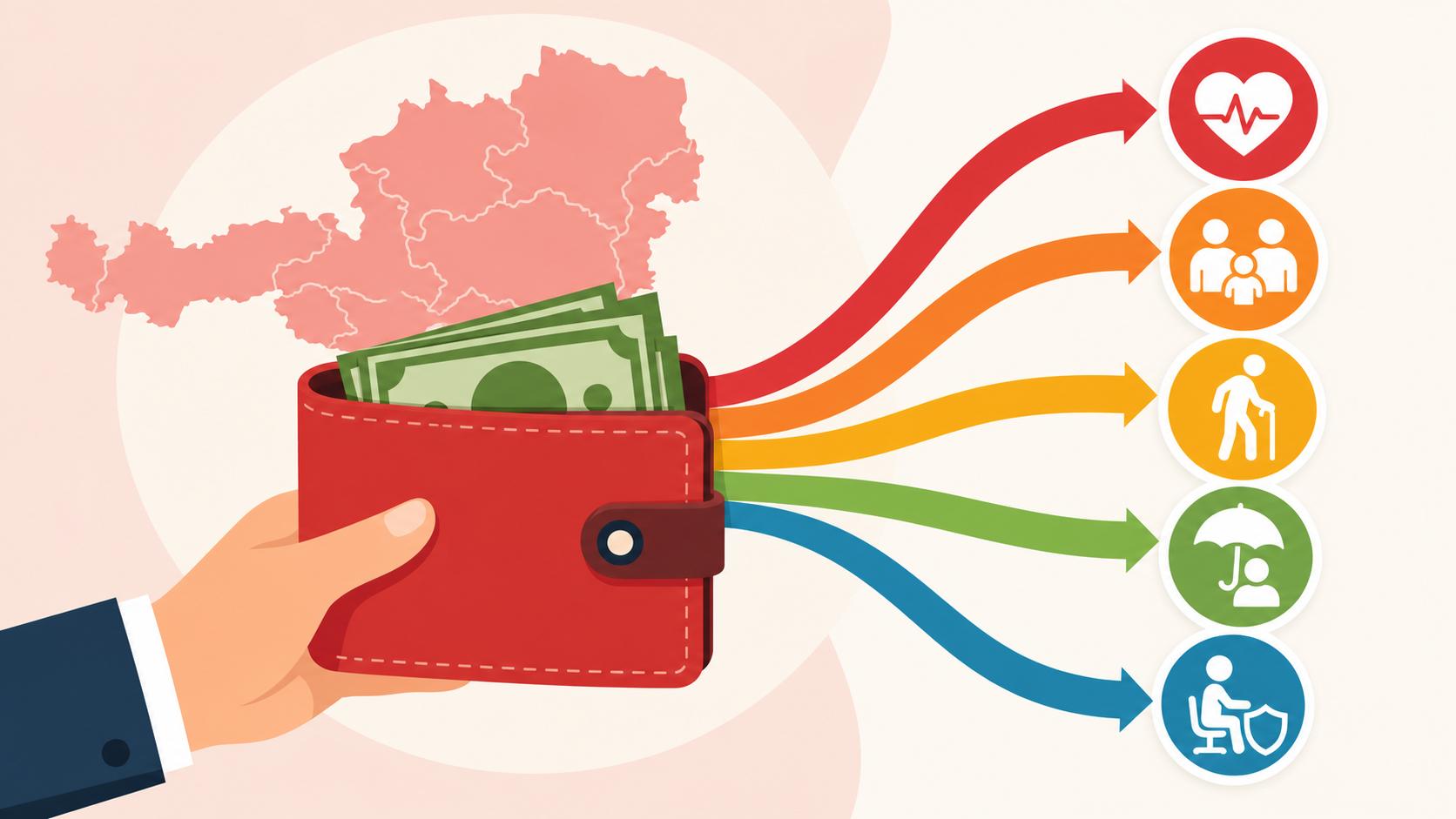
Social Insurance Deductions: Where Does Your Gross Pay Go?
Opening your first bank app notification in Austria can feel like a genuine physical blow to the stomach when you see the gap between your negotiated gross salary and the actual deposit. I remember sitting in my first apartment in the 7th district, staring at my phone and wondering if my HR department had made a clerical error. This guide breaks down exactly where those euros go, why the deductions are so high, and what benefits you are actually buying with that missing money.
The Brutto vs Netto Reality Shock in Austria
For most expats, the journey begins with a job offer that looks fantastic on paper. You see a figure like 4,500 EUR per month and start mentally picking out furniture at XXXLutz. However, the Austrian system operates on a "Brutto" (gross) logic that can be incredibly deceptive to those coming from lower-tax jurisdictions or countries with different social safety nets. Understanding the Lohnzettel Breakdown: Gross vs Net Salary Explained is the first step in surviving the financial transition to life in the Alps. It is not just about tax; it is about a comprehensive social insurance system that covers you from the cradle to the grave.
The frustration often stems from the fact that Austria has one of the highest "tax wedges" in the OECD. This means the difference between what an employer pays to hire you and what you actually take home is substantial. But it is important to remember that this "missing" money isn't just disappearing into a black hole. It funds a world-class public transport system, heavily subsidized childcare, and a healthcare system where you rarely see a bill. While it’s painful to see the deductions, you are essentially pre-paying for a high quality of life that remains stable even if you lose your job or fall ill.
To navigate this, you need to stop thinking about your monthly take-home pay in isolation. In Austria, the concept of 13th and 14th Salary Explained: Holiday and Christmas Pay is vital. You aren't paid 12 times a year; you are paid 14 times. These extra two months of salary are taxed at a significantly lower rate, which often acts as a "forced savings" account for your summer holidays and winter skiing trips. When you average your total annual net income across 12 months, the picture often looks a bit brighter than that first monthly paycheck suggests.
Why the Deductions Seem Higher for Expats
As a newcomer, you might feel like you are being hit harder than your local colleagues. This is usually a misconception, but there are nuances. For instance, if you haven't yet optimized your tax situation by Filing Income Tax (Einkommensteuer) as a Freelancer or as an employee through the annual tax equalization, you might be overpaying in the short term. The system assumes a standard profile, and it is up to you to claim back expenses that are specific to your expat journey, such as relocation costs or dual-household expenses.
Furthermore, the social insurance system is mandatory and immediate. From your very first hour of work, you are covered. Unlike systems where you might choose a private plan with a high deductible to save money, the Austrian Public vs Private Health Insurance in Austria Explained debate is a matter of "both" rather than "either/or" for the public portion. You cannot opt-out of the public system if you are employed, which can be a culture shock for those used to more "flexible" (and often more precarious) insurance markets.
The Impact of the 2026 Tax Reforms
In 2026, we are seeing the continued benefits of the "Kalte Progression" (bracket creep) elimination. Historically, as inflation rose and salaries increased, people were pushed into higher tax brackets even though their purchasing power stayed the same. Now, the government automatically adjusts the Income Tax Brackets 2026: Navigating the 0% to 55% Rates to account for inflation. This means you are likely keeping a slightly higher percentage of your raise than you would have five years ago.
Even with these reforms, the social security contributions remain the largest "chunk" taken before your tax is even calculated. These contributions are split between you and your employer, though as an employee, you only see your portion (roughly 18.12%) deducted from your gross pay. It is a massive collective pot that keeps the country running, and while the "Netto" might look smaller than in London or New York, the hidden costs you don't have to pay in Austria—like 500 EUR a month for health insurance or 2,000 EUR for a decent kindergarten—make the comparison much fairer.
Breaking Down the Social Security Pillars
The biggest deduction on your payslip after income tax is the "Sozialversicherung" (Social Insurance). This isn't just one fee; it is a bundle of four distinct pillars that provide your safety net. Most employees in Austria fall under the Navigating Social Insurance: ÖGK, SVS, and BVAEB Overview umbrella, specifically the ÖGK if you are in the private sector. This deduction is calculated as a percentage of your gross income, up to a certain limit known as the Höchstbeitragsgrundlage.
If you earn above this limit—which in 2026 sits around 6,390 EUR per month—your contributions are capped. This is a small silver lining for high earners, as any Euro earned above that ceiling is only subject to income tax, not further social security deductions. However, for the vast majority of residents, the 18.12% deduction applies to every Euro on the payslip. Let's look at what each pillar actually does for you while you are living here.
Health Insurance (Krankenversicherung)
This is the part of your salary that ensures you never have to worry about the cost of a broken leg or a sudden appendectomy. In Austria, Austria Healthcare System 2027: Complete Guide for Foreign Residents is world-class precisely because everyone contributes. Your deduction covers not just your doctor visits and hospital stays, but also a significant portion of your prescription medication costs and even some dental work.
A common question I get from new arrivals is whether they need to pay more for their family. The beauty of the Austrian system is Co-insuring Family Members (Mitversicherung) on Your Policy. In many cases, your non-working spouse or children are covered under your contribution at no extra cost. This is a massive financial relief for families moving to Austria, as it eliminates the need for separate, expensive private policies for every family member.
Pension Insurance (Pensionsversicherung)
The largest single component of your social insurance deduction goes toward the state pension (PVA). Austria operates on a "pay-as-you-go" system, meaning your current deductions are paying the pensions of today's retirees, and the future workforce will pay yours. For expats, this can feel risky—will I even be here in 30 years? The good news is that if you move within the EU, your contribution periods are usually totaled.
If you are a non-EU citizen and plan to leave after a few years, you might be interested in Claiming a Refund of Pension Contributions After Leaving. There are strict rules around this, and you usually have to wait a few years after moving away, but it is a way to "recover" some of that missing salary if you don't stay long enough to qualify for a monthly pension. For most of us, though, this deduction represents our primary retirement vehicle in a country where private "401k" style plans are less common.
Unemployment Insurance (Arbeitslosenversicherung)
Life happens. Companies downsize, startups fail, and sometimes you just need to leave a toxic environment. Your deductions for unemployment insurance mean that if you find yourself out of work, you are entitled to Unemployment Benefits: Claiming AMS Money as an Expat, provided you have worked the required number of months. Usually, this amounts to about 55% of your previous net income.
This safety net is one of the reasons the Austrian labor market feels less "frantic" than in the US or UK. Knowing that you have several months of financial runway provided by the state allows for a more stable life. When you see that deduction on your Lohnzettel, think of it as an insurance premium for your career. It also gives you access to the AMS (Public Employment Service) Registration and Job Search resources, including potential funding for German language courses or professional retraining.
Accident Insurance (Unfallversicherung)
This is a smaller deduction, but a vital one. It covers you for accidents that happen at the workplace or on your commute. Given how many people in Vienna commute by bike or public transport, this is a very real benefit. It also covers "occupational diseases." If you have a serious accident at work, this insurance pays for your rehabilitation and, in extreme cases, an invalidity pension.
| Contribution Type | Employee Share (Approx. %) | Employer Share (Approx. %) | Total Contribution (%) |
|---|---|---|---|
| Pension (PVA) | 10.25% | 12.55% | 22.80% |
| Health (ÖGK) | 3.87% | 3.78% | 7.65% |
| Unemployment | 3.00% | 3.00% | 6.00% |
| Accident | 0.00% | 1.10% | 1.10% |
| Total Social Security | ~18.12% | ~21.03% | ~39.15% |
Income Tax Brackets and the Progressive Scale
Once social security is deducted, the "taxman" takes his turn. Austria uses a progressive income tax system, meaning the more you earn, the higher the tax rate on your next euro of income. However, it is a common mistake to think that if you move into a 40% bracket, your entire salary is taxed at 40%. Only the portion of your income that falls within that specific bracket is taxed at that rate.
For 2026, the tax-free threshold remains a significant benefit for low earners and students. If you earn below roughly 13,000 EUR per year (after social insurance deductions), you pay zero income tax. This is particularly relevant if you are Working Geringfügig on Top of a Full-Time Job, as it affects how your secondary income is calculated and taxed. As your income climbs, the brackets kick in at 20%, 30%, 40%, 48%, and eventually 50% or 55% for the very highest earners.
The 13th and 14th Salary Tax Advantage
One of the most pleasant surprises for expats is the "Urlaubsgeld" (Vacation Money) in June and "Weihnachtsgeld" (Christmas Money) in November/December. While your standard monthly salary is taxed according to the progressive brackets, these two extra payments are taxed at a much lower, flat rate—usually around 6% after a small tax-free allowance.
This is why your net pay in June and November is significantly higher than in other months. It isn't just a "bonus" from your employer; it is a structurally incentivized payment that the government treats leniently. Understanding this is key to Budgeting in Austria: Accurate Cost of Living Benchmarks. If you only look at your "normal" month, you might feel poorer than you actually are on an annual basis. Most locals use these "extra" months to pay for their annual Klimaticket, Trains, and Wiener Linien passes or their insurance premiums.
Progressive Brackets and "Kalte Progression"
The fight against "Kalte Progression" in 2026 means that the brackets you see on your tax form are more "fair" than in the past. If you receive a 5% inflation-adjustment raise, the tax brackets also shift up by a similar margin, preventing the government from taking a larger slice of your income just because of inflation. This is a huge win for the middle class in Austria.
However, even with these shifts, the 40% and 48% brackets kick in relatively early compared to some other countries. If you are a skilled professional or a manager, you will likely find a large portion of your salary being taxed at these higher rates. This is why it becomes essential to look into Key Tax Deductions: Pendlerpauschale and Familienbonus Plus to lower your taxable base. Every Euro you can legally deduct is a Euro that isn't being taxed at your highest marginal rate.
Church Tax and Voluntary Contributions
There is one "tax" that often catches expats off guard because it isn't always on the payslip, but it is tied to your income. If you registered as Catholic, Lutheran, or another recognized religion on your Meldezettel Process: Registering Your Address Legally, you will eventually receive a letter asking for "Kirchenbeitrag." While technically voluntary in that you can't go to jail for not paying, the church can and will sue to collect if you are a registered member.
Many expats choose to officially "exit" the church to avoid this 1.1% deduction of their taxable income. If you decide to do this, you need to go through the process of How to Officially Deregister from Church Tax (Kirchenaustritt). It is a standard procedure in Austria, but it must be done through the local district authority (Magistrat or Bezirkshauptmannschaft), not just by telling your priest.
The Hidden Deductions on Your Lohnzettel
Beyond the big hitters of Social Security and Income Tax, there are several smaller items on your Lohnzettel that might confuse you. These are often just a few euros each, but they add up and fund specific Austrian institutions. The most common is the Kammerumlage (Chamber of Labor contribution).
The Arbeiterkammer (AK) is a powerful organization that represents the interests of all employees in Austria. Your small monthly contribution (0.5% of gross) gives you access to free legal advice on labor law, help with tax returns, and consumer protection services. Expats are strongly advised to consider using them if you ever have a dispute with your landlord or employer. They are one of the best "hidden" benefits of working in Austria, and your deduction is what keeps them independent and effective.
Wohnbauförderungsbeitrag (Residential Construction Levy)
You might see a line item for "Wohnbauförderung." This is a small deduction (usually 0.5%, split between you and the employer) that goes into a fund to subsidize the construction of affordable housing. This is a big reason why cities like Vienna have such high-quality social housing and relatively stable rents compared to Paris or London. Even if you aren't living in a subsidized flat, your contribution helps keep the overall Renting in Austria: MRG Laws, Leases, and Bestellerprinzip market from spiraling out of control.
It is a classic example of the Austrian "Solidarity" principle. You might not benefit from the fund directly today, but the fact that the fund exists lowers the market pressure on the private rentals you are using. When you see this on your payslip, think of it as a contribution to the social stability of your neighborhood. It is one of the pillars that makes Vienna Neighborhood Guide: Best Districts for Expats so diverse and livable.
The New ORF-Beitrag (Broadcasting Fee)
While not usually a direct deduction from your salary (unless you set up a standing order), the ORF-Beitrag 2026: The New Broadcasting Household Levy Guide is a mandatory financial obligation for almost every household. Since 2024, the old "GIS" system has been replaced by a flat fee per household, regardless of whether you have a TV or radio.
In 2026, you will likely pay this via a separate bank transfer or a "Dauerauftrag." It is roughly 15 EUR per month, depending on which federal province you live in (some provinces add a local surcharge). It is mandatory, and the authorities are very efficient at finding households that haven't registered. If you are struggling with the cost, check if you meet the Exemption Criteria for the ORF-Beitrag Fee, which often applies to students or those on very low incomes.
Union Fees and Voluntary Deductions
If you choose to join a trade union, your membership fees will often be deducted directly from your gross pay. This is beneficial because union fees are tax-deductible, and having them taken out before tax simplifies your year-end paperwork. Unions in Austria are organized by industry—for example, GPA for private-sector employees or VIDA for transport workers.
Joining a union is entirely optional, but it provides an extra layer of protection beyond the Arbeiterkammer. They negotiate the Understanding the Kollektivvertrag (Collective Agreement) that determines your minimum wage and yearly raises. If you see an extra deduction you don't recognize, check if you accidentally signed up for a union or a workplace pension scheme (Betriebliche Vorsorge) during your onboarding.
Understanding Your Lohnzettel: A Practical Walkthrough
Reading an Austrian payslip is like trying to decipher an ancient runic script if you don't know the abbreviations. Most companies use software like BMD or SAP, which produces a standard-looking document with three main sections: your personal data and tax characteristics, the breakdown of gross earnings, and the final calculation of net pay.
The top section is crucial. It lists your "Alleinverdiener" (sole earner) status and the number of children you have. If this is wrong, you will be overtaxed every single month. Make sure your employer has your correct details, especially if you are Co-insuring Family Members (Mitversicherung) on Your Policy or if you are eligible for the Familienbonus Plus per Child. This bonus alone can reduce your tax burden by up to 2,000 EUR per child per year, but it needs to be correctly flagged on your payroll.
Key Abbreviations to Watch For
- SV-Lfd: Your social security contributions for the current month.
- LSt-Lfd: The income tax (Lohnsteuer) deducted this month.
- DB/DZ: Employer-side contributions (you see these, but they aren't taken from your gross).
- BMG: Bemessungsgrundlage—the base amount used to calculate the tax.
- Pendl. P.: Commuter allowance (if you have applied for it).
If you see "Sachbezug," this refers to a "benefit in kind." For example, if your company provides a car or a parking space, the value of that benefit is added to your taxable income. You aren't "paid" that money, but you are taxed on it. This often surprises expats who negotiate a company car without realizing it will actually lower their monthly cash take-home pay due to the extra tax.
How to Verify the Calculations
You don't need to be a math whiz to check your payslip. There are excellent online tools, like the "Brutto-Netto Rechner" provided by the Arbeiterkammer or the Ministry of Finance. It is wise to run your salary through one of these at the start of every year to make sure your Income Tax Brackets 2026: Navigating the 0% to 55% Rates are being applied correctly.
If the numbers don't match, the first stop should be your HR department. In my experience, they are usually very helpful but can occasionally miss a status change, such as you moving further away from work and becoming eligible for the Pendlerpauschale and Familienbonus Plus. Keeping an eye on your Lohnzettel Breakdown: Gross vs Net Salary Explained is simply part of being a responsible adult in the Austrian system.
Digital Access via FinanzOnline
Almost everything is digital. You can log into your FinanzOnline Access Code portal using your ID Austria and E-Government Tools for Foreign Residents. Here, you can see all the data your employer has submitted to the tax office. This is also where you will perform your "Arbeitnehmerveranlagung" (annual tax return).
Even if you aren't required to file a return, doing so voluntarily is almost always worth it for expats. On average, residents get back around 600 EUR per year by claiming back things like Home Office Allowance (Homeoffice-Pauschale) Deductions or professional training costs. Don't leave that money on the table; the system is designed for you to claim what you are owed.
Self-Employed vs Employed Deductions
If you are a freelancer or "Neue Selbständige," the deduction landscape looks very different. You don't have an employer to withhold your taxes and social security, so you are responsible for paying these in quarterly installments to the SVS. This requires a much higher level of financial discipline. Many expats get into trouble in their second or third year when the "catch-up" payments from the SVS kick in.
As a freelancer, you aren't covered by the ÖGK; instead, you fall under the SVS Health Insurance: Rules for Freelancers and Self-Employed. The contribution rates are slightly different, and there is a mandatory "Selbstbehalt" (deductible) for some medical services unless you opt into a preventive health program. Understanding the SVS vs ÖGK: Key Differences for New Freelancers is vital before you decide to go solo.
The SVS "Prepayment" Trap
When you start as a freelancer, the SVS will charge you the minimum contribution. However, once you file your first tax return and they see you earned more than the minimum, they will send you a bill for the difference—retroactively. At the same time, they will increase your future quarterly prepayments. This "double hit" has ruined many a freelancer's bank account.
To avoid this, you should always set aside at least 25-30% of every invoice into a separate Opening an Austrian Bank Account: Requirements and Top Banks sub-account specifically for taxes and SVS. If you earn significantly more than expected, you can voluntarily increase your SVS prepayments to avoid a massive bill later. It's all about staying ahead of the SVS Minimum Monthly Contribution in 2026 updates.
Value Added Tax (Umsatzsteuer)
If your turnover exceeds 35,000 EUR per year, you must also charge and pay VAT (Umsatzsteuer). This isn't a deduction from your pay, but money you collect on behalf of the state. However, many small freelancers fall under the Kleinunternehmerregelung: VAT Exemption for Small Businesses, which simplifies things immensely. If you stay below the threshold, you don't charge VAT, and you don't have to file monthly VAT returns.
This can be a competitive advantage if you work with private clients (who can't claim back VAT), but a disadvantage if you have high business expenses (since you can't claim back the VAT you pay on laptops, rent, etc.). Deciding whether to "opt-in" to VAT even if you are below the threshold is a common crossroad for those Freelancing in Austria: The Neue Selbständige Legal Guide.
Social Security for the "Marginally Employed"
If you are a student or only working a very small job, you might be "Geringfügig" employed. For 2026, the limit is around 530-550 EUR per month. In this case, your employer only pays a small accident insurance contribution, and no pension or health insurance is deducted from your pay. You get the full gross amount as net.
The catch? You aren't automatically health-insured. You must either be co-insured with a partner or parent, or you must pay for Student Self-Insurance Requirements and Monthly Costs 2026 yourself. If you have two "Geringfügig" jobs that combined exceed the monthly limit, you will be hit with a bill for full social insurance contributions at the end of the year. Always track your total earnings if you are juggling multiple small roles.
Strategies for Reducing Your Tax Burden
While the deductions are mandatory, the Austrian tax code offers several "Absetzbeträge" (tax credits) and "Sonderausgaben" (special expenses) that can lower the amount of income tax you pay. The most powerful tool for parents is the Familienbonus Plus. This is a direct reduction of your tax bill, not just a deduction from your taxable income. For 2026, this remains one of the most generous family supports in Europe.
Another common deduction is the "Pendlerpauschale" for those who have a long commute or for whom public transport is "unreasonable." Even if you have a Klimaticket, Trains, and Wiener Linien, you can sometimes claim a portion of this if your commute meets certain distance and time criteria. Use the "Pendlerrechner" on the Ministry of Finance website to see if you qualify.
Deducting Work-Related Expenses
If you work from home, you are entitled to the Home Office Allowance (Homeoffice-Pauschale) Deductions. This covers a flat rate per day (up to a limit) for your electricity, internet, and heating. Additionally, if you had to buy a desk, an ergonomic chair, or a new monitor, you can deduct these as "Werbungskosten" (professional expenses).
The rule of thumb in Austria is that anything you must buy to do your job, which isn't provided by your employer, is potentially deductible. This includes professional literature, specialized clothing, or even Learning German for Life and Career Success in Austria if the course is relevant to your current or future job. Keep every receipt; the Finanzamt can ask for proof up to seven years later.
Voluntary Pension and Insurance Contributions
While the state pension is mandatory, you can also deduct contributions to certain private pension plans or "Prämienbegünstigte Zukunftsvorsorge." However, be careful here; the tax benefits for these have decreased in recent years, and they are often less flexible than simply investing in a World ETF through Flatex or DADAT.
If you have Private Health Insurance: Hospital Class Coverage Upgrades, these premiums are generally not tax-deductible for employees, unlike in some other countries. However, if you have high "extraordinary" medical expenses—like expensive dental work or laser eye surgery—you may be able to deduct these if they exceed a certain percentage of your income (the Selbstbehalt). It is always worth checking How to Submit a Wahlarzt Invoice to ÖGK for Refund first to see what the state will cover.
Relocation and "Double Household" Costs
For the newly arrived expat, this is the most important section. If you moved to Austria for a job, your relocation costs (moving van, flights, etc.) are often tax-deductible as Werbungskosten. Even more significant: if you still maintain a home in your home country because your spouse or children haven't moved yet, you may be able to claim "Doppelte Haushaltsführung" (dual household) expenses.
This allows you to deduct the cost of your Austrian rent and even some travel home for a limited period (usually up to two years). This can result in a tax refund of several thousand euros. Because these cases are complex, I highly recommend hiring a professional; the Average Hourly Rates for a Tax Advisor (Steuerberater) are worth it when the potential refund is this large.
Moving Forward: Life After Deductions
It takes about a year to stop crying when you look at your Lohnzettel. Eventually, the shock fades and you start to appreciate the "all-inclusive" nature of the Austrian state. You realize that while your neighbor in a lower-tax country is stressed about their child's university fund or a surprise medical bill, your deductions have already taken care of those worries.
The key to financial peace in Austria is to build your life around your Netto income, not your Brutto. Once you've optimized your tax return and understood the 14-salary cycle, you'll find that the system is remarkably stable. You are participating in a social contract that prioritizes security and quality of life over raw, untaxed cash flow. It's a trade-off, but for many of us who choose to call Austria home, it's a trade-off that ultimately pays off in peace of mind.
Disclaimer
This guide is for informational purposes only and does not constitute professional tax, legal, or financial advice. Tax laws and social security rates in Austria are subject to frequent change. Always consult with a certified tax advisor (Steuerberater) or the Arbeiterkammer for advice specific to your individual situation. Deductions and eligibility for benefits can vary based on your residency status, contract type, and personal circumstances.