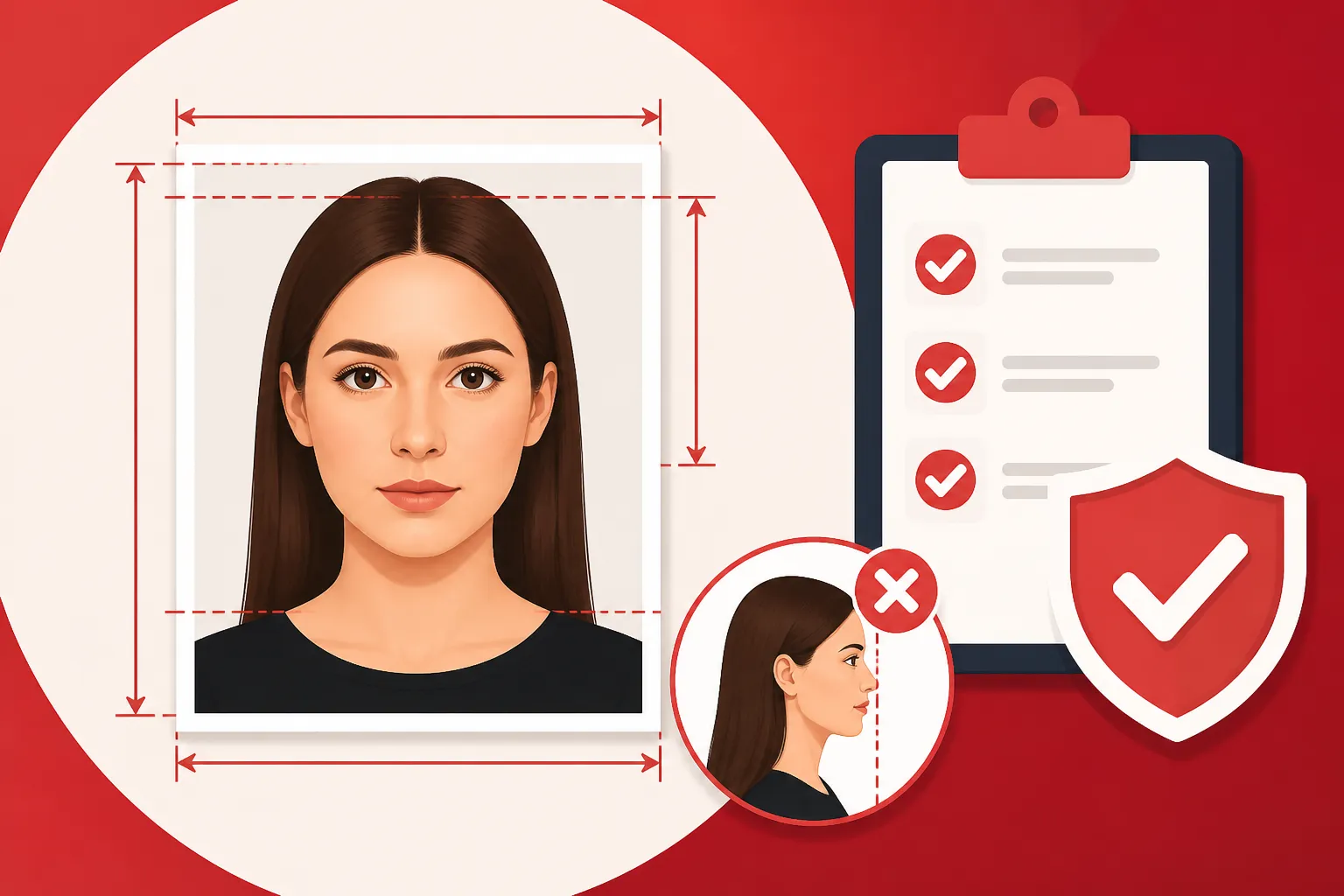
Strict Dimension Requirements for an Austria Visa Photo
Getting your visa application rejected or delayed because your chin is two millimeters too high in a portrait is the ultimate Austrian bureaucratic nightmare. Applicants can wait hours at the MA 35 office in Vienna, only to be told their photo is "unacceptable" because of something as minor as a slight shadow behind one ear. This guide solves the confusion by breaking down the rigid biometric standards you must meet for a successful application.
The Exact Dimensions and Technical Specifications
When the Austrian authorities talk about a "Passfoto," they aren't looking for a nice picture; they are looking for a highly specific biometric data point. The most fundamental requirement is the physical size of the photo itself. In Austria, the standard dimensions are 35mm in width and 45mm in height. While this sounds straightforward, the way your face sits within that small rectangle is where most expats run into trouble.
Width and Height Requirements
The 35x45mm rule is non-negotiable. If you bring a 2×2 inch photo (common in the United States), the official will likely hand it back to you immediately. This size is designed to fit perfectly into the scanning equipment used for the Red-White-Red Card (RWR): Application and Requirements and other residence permits. It is vital to ensure that the photo is cut cleanly with straight edges. Many professional studios in Austria use a special punch-cutter to ensure these dimensions are perfect to the sub-millimeter.
If you are applying from abroad, do not assume your local "passport photo" service knows these European standards. Many newcomers arrive with photos that are just slightly too wide, leading to a frantic search for a photo booth near the embassy. The image must be printed on high-quality, high-resolution photographic paper. Matte or glossy are generally both accepted, but the surface must be smooth and free of any texture or "silk" finishes that interfere with digital scanning.
The 70 to 80 Percent Head Height Rule
The most common reason for rejection isn't the paper size, but the "face height." According to Austrian biometric standards, your face must take up between 70% and 80% of the vertical height of the photo. Specifically, the distance from the top of your head (excluding hair volume) to the bottom of your chin must be between 32mm and 36mm. This is a very tight window.
I remember my first time trying to DIY this—I thought as long as my face was visible, it was fine. Wrong. If your head is too small (e.g., 25mm), the biometric software cannot accurately map your features. If it’s too large, there isn't enough "headroom" above your hair. The top of the head must be visible, and there should be a clear margin of background above the hair. This balance is what makes the Fingerprinting and Biometric Data Collection Process go smoothly once you are in the office.
Resolution and Print Quality
The clarity of the print is more scrutinized than ever. The photo must be in sharp focus, with high contrast and no blurring. This is why photos taken on a smartphone and printed at a home pharmacy kiosk often fail. The resolution should ideally be at least 600 dpi. There should be no "pixels" visible, and the colors must be natural.
Skin tones must be represented accurately without any artificial filters or "beautification" settings. If you’ve edited the photo to remove a blemish or a stray hair, the digital scanners at the MA 35 and Bezirkshauptmannschaft Procedures for Expats offices may detect the manipulation and reject the file. It’s always better to have a raw, high-quality professional print. Ensure the photo has no creases, ink marks, or staple holes in the face area.
Composition and Background Standards
The aesthetic of an Austrian visa photo is often described as "mugshot-chic." It isn't meant to be flattering; it’s meant to be functional. The way you position your body and the lighting in the room are just as important as the dimensions themselves. Any deviation from a "neutral" setup will be viewed as a technical error rather than a stylistic choice.
Background Color and Lighting
The background must be a solid, neutral color—ideally light grey or off-white. Pure white is often accepted, but light grey is preferred because it provides better contrast for the biometric scanners, especially if you have light-colored hair or very fair skin. There must be no patterns, shadows, or objects visible in the background.
Lighting is a frequent "pain point." The light must be even across your entire face. If one side of your face is brighter than the other, or if there is a shadow cast by your nose or ears, the photo will likely be rejected. This is the hardest part to get right if you are taking the photo yourself. Professional studios use "clamshell" lighting setups to ensure there are zero shadows. This level of precision is also required when you are submitting for The e-card Photo Requirement: How and Where to Register later in your residency process.
Neutral Expression and Face Positioning
You must look directly at the camera with a neutral expression. This means no smiling, no frowning, and your mouth must be firmly closed. This is incredibly frustrating for those of us who naturally smile in photos, but even a slight "Mona Lisa" smirk can alter the distance between the corners of your mouth and your eyes, which messes with the biometric mapping.
Your head must be straight—not tilted up, down, or to the side. Both ears should ideally be visible, though this depends on your hairstyle. Your eyes must be open, clear, and looking directly into the lens. Red-eye is an automatic rejection. If you have a fringe (bangs), they must not cover your eyes or the edges of your eyebrows. The authorities need a clear view of your "T-zone" to verify your identity against the digital records stored during the MA 35 Application Timeline: From Submission to Approval.
Hair, Headgear, and Religious Exceptions
Hair can be a tricky subject. While you don't have to tie it back, it must not obscure any part of your face. If you have long hair, ensure it is tucked behind your ears or shoulders so the contours of your face are visible. Headgear is generally not allowed unless it is for religious or medical reasons.
If you wear a head covering for religious purposes (like a hijab), your face must be visible from the bottom of your chin to the top of your forehead. No shadows from the head covering should fall on your face. For medical exceptions, such as a bandage or a head covering due to hair loss from treatment, you will likely need a doctor’s note. This level of detail is consistent whether you are applying for a Student Visa (Aufenthaltsbewilligung Student) Comprehensive Guide or a family reunification permit.
| Requirement | Specification | Common Pitfall |
|---|---|---|
| Photo Width | 35 mm | Using US-standard 2-inch width |
| Photo Height | 45 mm | Using 50 mm height from other EU countries |
| Face Height | 32 – 36 mm | Face appearing too small in the frame |
| Background | Solid Light Grey/White | Shadows behind the ears or shoulders |
| Expression | Neutral / Mouth Closed | Smiling or showing teeth |
| Eye Level | 28 – 35 mm from bottom | Head tilted up or down |
Practical Tips for Taking Your Photo in Austria
Once you are on the ground in Austria, you’ll find that getting the right photo is much easier if you know where to go. While there are DIY options, the "veteran expat" advice is almost always to go to a professional. The few Euros you save at a photobooth aren't worth the weeks of delay if your photo is rejected by a particularly grumpy official.
Using Professional Photo Studios vs. Photobooths
In cities like Vienna, Graz, or Linz, you will see "Prontophot" booths in almost every U-Bahn station. These machines are programmed with a "Passport/Visa" setting that attempts to align your face with the biometric markers on the screen. While they are convenient, they are notorious for poor lighting. I’ve had several friends use these only to have the MA 35 and Bezirkshauptmannschaft Procedures for Expats reject them because of a shadow cast by the booth’s curtain.
The better option is a professional chain like "Hartlauer" or a local "Fotostudio." When you walk in, simply tell them you need "EU-standard biometric photos for a residence permit." They will know the exact 35x45mm dimensions. The benefit here is that they will retake the shot until it’s perfect and often provide a digital copy that meets the requirements for The Austrian e-card: Registration, Photo Rules, and Usage Guide registration. It usually costs between €15 and €25 for a set of four.
Common Pitfalls: Glasses and Shadows
If you wear glasses, the rules have become much stricter. While you are technically allowed to wear them if they are your daily necessity, the lenses must be clear (no tints), and there can be absolutely no reflection or glare on the glass. Furthermore, the frames must not cover any part of your eyes.
In my experience, even the most expensive anti-reflective coating can sometimes catch a stray flash. Most officials will suggest you simply take them off for the photo to avoid any risk of rejection. If you do keep them on, ensure the frames are thin. Thick "hipster" frames that overlap with your eyebrows or eyelids are a common cause for a "redo" request. This is a small detail that can save you a lot of time on your Healthcare Checklist for Your First 30 Days in Austria.
Specific Rules for Children and Infants
Taking a biometric photo of a toddler or a newborn is probably the most stressful part of the moving process. The authorities are slightly more lenient with children under the age of six—for instance, their head doesn't have to be perfectly centered, and the 70-80% rule is more of a guideline. However, the child must still be the only person in the photo. No hands holding the baby can be visible.
For infants, the best trick is to lay them on a light grey sheet on the floor and take the photo from above. This avoids the "slumping" look and keeps the background clean. Even for kids, there should be no pacifiers, toys, or wide headbands in the shot. If you are preparing for Family Health: Eltern-Kind-Pass 2026 and Maternity Care System visits, having these photos ready for their insurance cards early on is a huge help.
Navigating the MA 35 and Embassy Submission
The final hurdle is actually handing over the photo. Whether you are at an Austrian embassy abroad or at a local office like the one on Dresdner Straße in Vienna, the physical condition of the photo matters as much as the image itself.
What Happens if Your Photo is Rejected?
If an official rejects your photo, don't panic, but do expect a delay. Usually, they will give you a small slip of paper explaining why it was rejected (e.g., "Schattenbildung" for shadows or "Format falsch" for wrong size). You will have to go get new photos taken and return to the office. In some lucky cases, if there is a photo shop nearby, they might let you run out and come back the same day without a new appointment, but don't count on it.
A rejection at the embassy stage is more painful because it might mean your entire application packet is put on hold until you can mail in new physical copies. This is why it is wise to carry at least two sets of photos from two different sources (one professional, one booth) just in case one is deemed "too dark" or "too grainy" by a specific clerk. This preparedness is key to managing the MA 35 Application Timeline: From Submission to Approval.
Recent 2026 Updates for Digital Submissions
As Austria pushes toward more e-government solutions through ID Austria and E-Government Tools for Foreign Residents, some applications now allow for digital photo uploads. However, don't think this means you can just upload a selfie. The digital file must still adhere to the 3:4 aspect ratio and the same biometric spacing rules.
If you are using a digital upload for something like an e-card or a permit renewal, the system will often have an "auto-check" feature that will tell you immediately if the face is not centered. Even with digital submissions, the background must remain neutral and the lighting perfect. Many professional studios now offer a service where they email you a "validated" digital file specifically formatted for Austrian government portals, which I highly recommend for anyone using The e-card Photo Requirement: How and Where to Register online portal.
Disclaimer
The information provided in this guide is based on current Austrian biometric standards and expat experiences as of 2026. Immigration rules and photo requirements can change without notice. Always verify the latest specifications with the official Austrian consulate or the Ministry of the Interior (BMI) before your appointment. This guide is for informational purposes only and does not constitute legal advice.