Mandatory Elements on an Austrian Invoice (Rechnung)
Navigating the bureaucratic labyrinth of the Austrian tax system is often the single most stressful part of starting a business or freelancing here. I remember the paralyzing fear I felt when sending my first bill, terrified that a simple formatting error would trigger a Finanzamt audit or prevent my client from paying me. This guide solves that anxiety by breaking down every legal requirement for a compliant Austrian invoice.
Understanding the Legal Framework of the Austrian Rechnung
In Austria, an invoice is not just a request for payment; it is a legal document governed by the Umsatzsteuergesetz (VAT Act). Whether you are a small-scale freelancer or running a growing GmbH, the tax office views your invoices as the primary evidence for your income and, more importantly, for the Value Added Tax (VAT) your clients might be reclaiming. If your invoice is missing even one mandatory element, your client might legally refuse to pay you until it is corrected, as they cannot deduct the VAT (Vorsteuerabzug) without a "proper" document.
The requirements vary slightly depending on the total amount of the invoice and your specific tax status. Most expats starting out will fall under the Freelancing in Austria: The Neue Selbständige Legal Guide category, which often means navigating the fine line between being a small business owner and a full VAT-registered entity. Understanding these distinctions early prevents the nightmare of having to reissue a year’s worth of paperwork during tax season.
The Kleinunternehmerregelung Exception
One of the first things you need to determine is whether you fall under the "Small Business Regulation" (Kleinunternehmerregelung). As of 2026, if your annual turnover remains below the established threshold (recently updated to €55,000 per year), you are generally exempt from charging VAT. This sounds like a relief, and it is, but it comes with a specific invoicing burden. You cannot simply leave the VAT off and say nothing; you are legally required to include a specific note on every single invoice stating why you aren't charging tax.
Commonly, this phrase is "Umsatzsteuerbefreit aufgrund der Kleinunternehmerregelung." Without this sentence, the Finanzamt might assume you simply forgot to charge tax, which can lead to messy "back-tax" calculations later. If you are unsure about your status, it is vital to review the Value Added Tax (Umsatzsteuer) Basics for the Self-Employed to ensure you aren't accidentally crossing the threshold and losing your exemption status without realizing it.
VAT Identification Numbers UID
If you are not a "small business" and you are registered for VAT, you will receive a UID (Umsatzsteuer-Identifikationsnummer) starting with "ATU." This number is your gateway to the European business market. For many foreigners, the process of getting this number involves a bit of a wait after How to Request Your First Tax Number (Steuernummer) from your local tax office. Once you have it, it must be prominently displayed on your invoices.
The UID is not just for your own identification. If you are invoicing another business within the EU, you will often need their UID as well to facilitate "Reverse Charge" transactions. This is where the responsibility for VAT shifts to the recipient. This process requires a very specific set of information on the invoice, which we will detail in the checklist sections below. Failing to verify a client's UID can leave you liable for the tax yourself, so treat these numbers with the utmost respect.
Small-Amount Invoices Kleinbetragsrechnung under 400 Euro
Austria provides a simplified path for smaller transactions. If the total amount of your invoice (including VAT) does not exceed €400, you can issue what is known as a Kleinbetragsrechnung. This is particularly common for retail, hospitality, or small consulting gigs. While it requires fewer details than a standard invoice, you still cannot just scribble a price on a piece of paper and call it a day.
The goal of the simplified invoice is to speed up commerce while still providing the Finanzamt with enough data to track the flow of money. Even at this level, consistency is key. Many expats get into trouble because they used different naming conventions or lacked a clear date of service on their small bills, making it impossible for their bookkeepers to reconcile the accounts later. Using Best Bookkeeping Software for Austrian Small Businesses can help automate this even for the smallest amounts.
Mandatory Elements for Simplified Invoices
For a small-amount invoice to be valid, it must contain five specific pieces of information. First, the full name and address of the service provider (you). Second, the date the invoice was issued (Ausstellungsdatum). Third, a clear description of the goods or services provided, including the quantity. You cannot simply write "Services"; you need to be slightly more descriptive, such as "3 hours of German-English translation."
The fourth and fifth elements are related to the money itself. You must state the gross amount (the total including tax) and the specific VAT rate applied (e.g., 20%, 13%, or 10%). Interestingly, for these small amounts, you do not need to list the recipient’s address or the separate VAT amount in Euros—just the percentage. However, if you are a Kleinunternehmer, you still must include your exemption note instead of a tax rate.
Why Precision Matters Even for Small Sums
You might think that for a €50 bill, the tax office won't care about the details, but that is a dangerous assumption. During a "Betriebsprüfung" (audit), the Finanzamt often looks at these smaller receipts to check for patterns of non-compliance. If they find that your small invoices are consistently missing the date of service or a proper description, they may disqualify those expenses for your clients, which will certainly damage your professional reputation.
Furthermore, if you are the one receiving these invoices, you must ensure they meet these standards if you plan to deduct them as business expenses. Newcomers are advised to check every receipt they get at a restaurant or stationery store. If it doesn't have the VAT rate and the provider's address, it’s just a piece of trash in the eyes of the tax man. Managing your records through Logging into FinanzOnline with the ID Austria App becomes much easier when your raw data is correct from the start.
Standard Invoices over 400 Euro: The Essential Checklist
Once you cross that €400 threshold, the rules become significantly stricter. This is where most errors occur, and where the "veteran" experience really counts. A standard Austrian invoice requires a much higher level of detail to satisfy the Taxes in Austria: Finanzamt, Returns, and Brackets 2026 requirements. If you are billing a corporate client for a monthly retainer or a large project, you must ensure every point on this checklist is present.
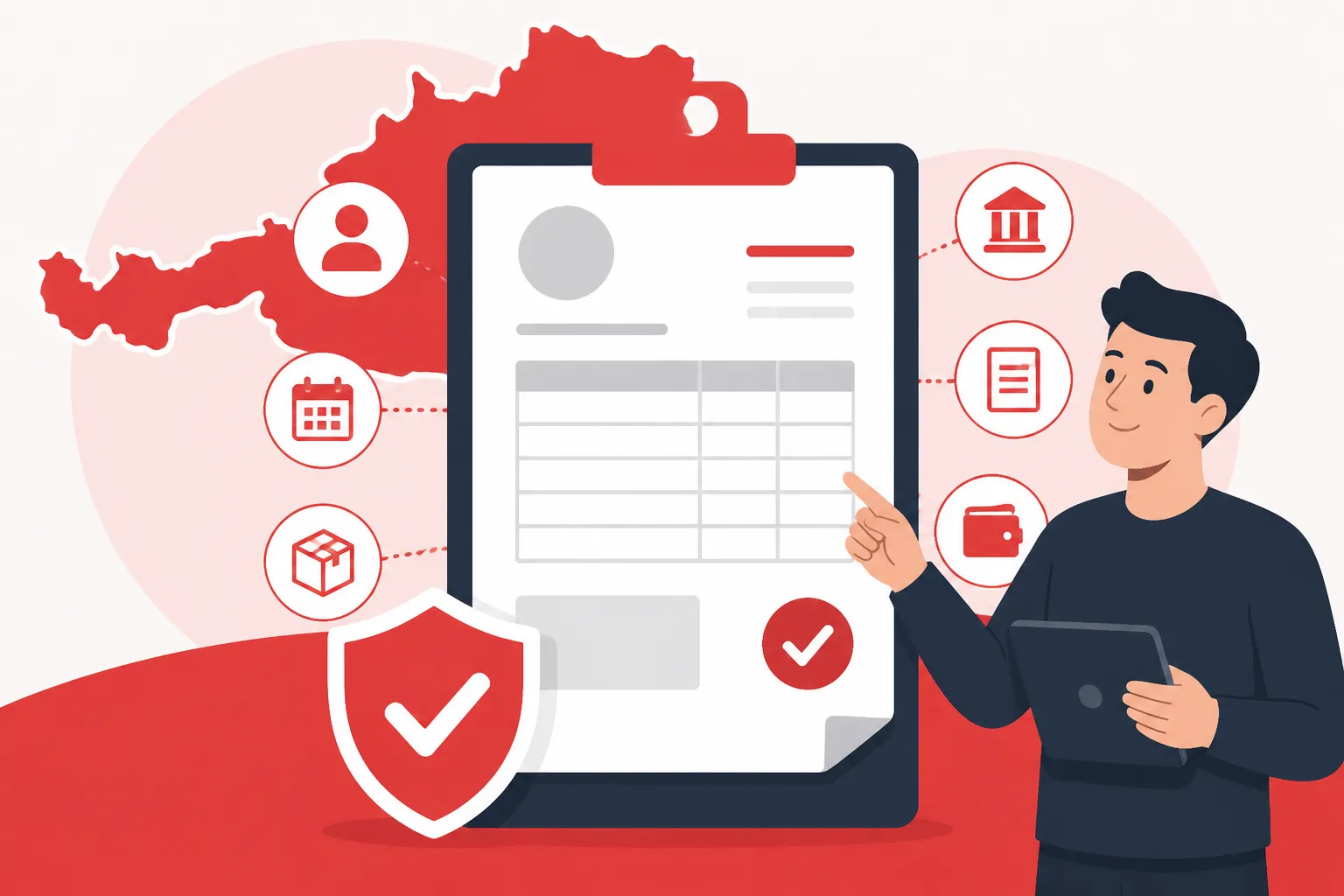
The standard invoice is designed to be a "stand-alone" document. A third party, like a tax auditor who knows nothing about your business, should be able to look at the invoice and understand exactly who did what, for whom, when, and how much tax is owed to the state. This transparency is the bedrock of the Austrian fiscal system.
| Invoice Element | Kleinbetragsrechnung (Under €400) | Standard Rechnung (Over €400) |
|---|---|---|
| Provider Name & Address | Mandatory | Mandatory |
| Recipient Name & Address | Not Mandatory | Mandatory |
| Date of Issue | Mandatory | Mandatory |
| Sequential Invoice Number | Not Mandatory | Mandatory |
| Date of Delivery/Service | Mandatory | Mandatory |
| Description of Goods/Services | Mandatory | Mandatory |
| Net Amount (Excl. VAT) | Not Mandatory | Mandatory |
| VAT Rate (%) | Mandatory | Mandatory |
| VAT Amount in EUR | Not Mandatory | Mandatory |
| Provider UID Number | Not Mandatory | Mandatory |
Header Details and Sequential Numbering
Every standard invoice must have a unique, sequential number (Rechnungsnummer). You cannot just pick random numbers; there must be a logical progression (e.g., 2026-001, 2026-002). This allows the Finanzamt to ensure you haven't "deleted" any invoices to hide income. If you realize you've made a mistake and need to cancel an invoice, you must issue a formal credit note (Gutschrift) rather than just deleting the file.
Your full legal name (as registered with the WKO or tax office) and business address must be clearly visible. Likewise, you must include the full name and address of the recipient. This is a common pitfall: if your client is a company, the invoice must be addressed to the company's legal name, not just your contact person. If the address is wrong, the client won't be able to claim the VAT back, and they will rightfully ask you to redo it.
Detailing the Service and Tax Breakdown
The "Leistungszeitraum" or delivery date is often forgotten but is legally mandatory. This is the date or period when the work was actually performed. It might be different from the date you wrote the invoice. For example, if you did work in January but invoiced in February, the invoice must explicitly state "Performance period: January 2026." This determines which tax period the income belongs to, which is crucial for Filing Income Tax (Einkommensteuer) as a Freelancer.
Unlike the simplified invoice, a standard bill must show the math. You need to list the Net Amount, then the VAT rate (e.g., 20%), then the actual VAT amount in Euros, and finally the Gross Total. If you are providing different services with different tax rates (though rare for most freelancers), you must break these down line by line. If you are exempt from VAT, this is where you reiterate your Kleinunternehmer status to explain the 0% rate.
Special Cases and Digital Compliance
As we move further ahead, the way we handle these documents is shifting. Digital invoicing is no longer just a convenience; for many B2G (Business to Government) transactions in Austria, it is a requirement. Even for B2B, the Finanzamt increasingly prefers machine-readable formats. If you lose track of your filings, you might find yourself Retrieving a Lost FinanzOnline Access Code just to prove your historical compliance.
One complex area for many expats is the "Reverse Charge" system. If you are a freelancer in Vienna providing consulting services to a company in Berlin, you usually do not charge Austrian VAT. Instead, you include the client’s UID and yours, and add the note: "Steuerschuldnerschaft des Leistungsempfängers (Reverse Charge)." This tells the authorities that the German company will handle the VAT on their end. Misidentifying a Reverse Charge situation is one of the quickest ways to get a "please explain" letter from the Finanzamt.
Storage and Archiving Rules
The administrative work doesn't end once the invoice is paid. In Austria, you are legally required to store copies of all issued and received invoices for seven years. This applies to both paper and digital records. If you issue digital invoices, they must be stored in a way that ensures their integrity—meaning they shouldn't be easily editable after the fact. A simple folder of Word documents is technically not enough; PDFs are the bare minimum, but dedicated accounting software is better.
This seven-year rule is strict. If you decide to leave the country, you still need to ensure these records are accessible. Many expats find that Deducting SVS Contributions on Your Tax Return and managing long-term finances requires a digital-first approach to record-keeping to avoid carrying boxes of paper across borders. If you are ever audited, the first thing they will ask for is the "Buchhaltungsunterlagen" (accounting documents) for the last several years.
Final Tips for Professional Invoicing
To make your life easier, it helps to create a robust template that includes your bank details (IBAN and BIC) at the bottom. While bank details aren't technically a "mandatory element" for the tax office, they are certainly mandatory if you actually want to get paid! Including a payment deadline (e.g., "Payable within 14 days") also helps with cash flow management and gives you a legal basis to send reminders if the client is slow.
Always double-check the recipient’s UID via the EU’s VIES website before sending a large cross-border invoice. It takes thirty seconds and can save you thousands in potential tax liabilities. Austria is a country that rewards those who follow the rules to the letter. Once you have your template set up correctly, invoicing becomes a routine five-minute task rather than a source of dread. Keep your records clean, use your Setting up as a Freelancer (Freier Dienstnehmer vs Gewerbe) knowledge to stay compliant, and you'll find the Austrian system is actually quite predictable once you speak its language.
Disclaimer
This guide is provided for informational purposes only and does not constitute legal or professional tax advice. Tax laws and threshold limits in Austria, such as those regarding the Kleinunternehmerregelung or VAT rates, are subject to change. While we strive to keep information current for 2026, you should always consult with a qualified Austrian tax advisor (Steuerberater) or the Wirtschaftskammer Österreich (WKO) to ensure your specific business practices comply with the latest regulations.