Cashless Payments vs Cash Culture in Austria Today
I remember standing at a small bakery in Vienna’s 7th district during my first week in Austria, clutching a single croissant and my high-tech travel credit card. The clerk looked at my card as if I were offering her a piece of Monopoly money, pointed to a faded sign that said "Nur Bares" (Cash Only), and waited. I had to leave the croissant behind and find an ATM, red-faced and frustrated. This guide explains the unique tension between Austria’s deep-rooted cash culture and the modern digital shift, ensuring you never face that awkward checkout moment again.
The Cultural Weight of the Cash is King Mentality
For many expats arriving from the UK, Scandinavia, or North America, the discovery that one of Europe’s wealthiest nations is still obsessed with physical banknotes can be a genuine shock. In Austria, the phrase "Nur Bares ist Wahres" (Only cash is true) is more than a catchy saying; it is a fundamental philosophy regarding privacy, autonomy, and financial control. This isn't just a matter of being "behind the times," as many newcomers mistakenly assume. Instead, it is a conscious choice by a population that values the anonymity that cash provides.
When you live here long enough, you realize that many Austrians view digital payments as a trail that shouldn't necessarily be tracked. There is a deep-seated distrust of large-scale data collection, a sentiment that permeates everything from the way people browse the internet to how they pay for their Melange at a coffee house. This cultural preference means that while the infrastructure for digital payments exists, the social pressure to carry at least €50 in your wallet at all times remains incredibly high.
Privacy and Data Protection Concerns
One of the most significant reasons why cash remains the dominant force in the Austrian economy is the national obsession with "Datenschutz" (Data Protection). In a country that has a complex 20th-century history, the idea of a centralized authority or a private corporation having a record of every single transaction you make—down to the specific brand of milk you buy—feels invasive.
To the average Austrian, using cash is the ultimate way to maintain personal privacy. When you pay with a ten-euro note, the transaction is finished the moment the money changes hands. There are no cookies, no tracking pixels, and no bank algorithms analyzing your spending habits to offer you a loan later. This mindset is reflected in the Money in Austria 2027: Banking, Payments, and Financial Setup guide, which highlights how even digital banking is designed with heavy security and privacy layers in mind.
Debt Aversion and Financial Control
There is also a psychological component to the Austrian cash culture: the fear of overspending. The German word for debt, "Schulden," comes from the same root as the word for guilt, "Schuld." For many locals, physical money provides a tangible sense of what they have left to spend.
You will often see people at supermarkets carefully counting out coins to ensure they stay within a budget. Digital payments, with their frictionless "tap and go" nature, are seen by older generations as a dangerous path toward financial irresponsibility. By carrying cash, residents feel they have a better grip on their daily outgoings, a practice that is often taught to children from a very young age with their first "Taschengeld" (pocket money).
Where You Can (and Cannot) Pay with Card Today
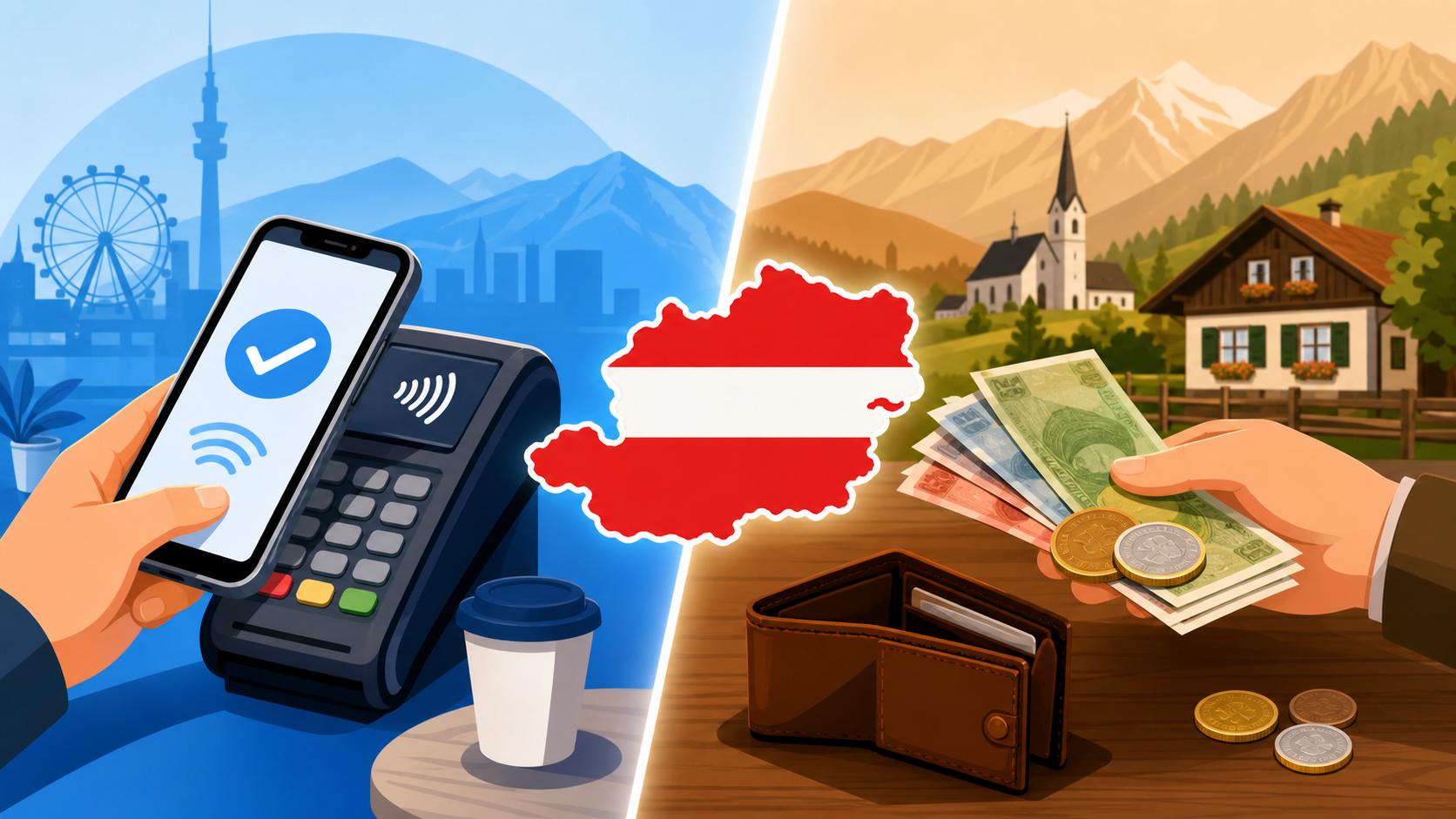
While the traditional mindset is strong, the landscape changed significantly during the early 2020s. Today, you are unlikely to have issues at major retailers, but the further you stray from the high street, the more "Cash Only" signs you will encounter. It is a dual system where the modern and the traditional exist side-by-side, often in the same city block.
If you are moving to a smaller town or a rural area, the reliance on cash is even more pronounced. In these locations, the local "Greißler" (small grocer) or the village pub might not even have a card terminal on the premises. Understanding these boundaries is the first step toward a stress-free financial life in Austria.
Supermarkets and Large Retail Chains
In places like Billa, Spar, Hofer, and Lidl, cashless payments are the standard. In fact, many of these stores have introduced self-checkout kiosks that are card-only to speed up the process. These retailers accept all major debit and credit cards, and most now support Apple Pay and Google Pay.
When Opening an Austrian Bank Account: Requirements and Top Banks, you will receive a debit card that works seamlessly at these locations. However, don't be surprised if the person in front of you still pays for a €150 grocery haul entirely in €10 and €20 bills. It’s simply the way things are done here, and the cashiers are incredibly fast at counting physical currency.
Gastronomy and the Small Business Gap
This is where most expats get caught out. Many traditional Austrian restaurants (Gasthäuser), mountain huts (Hütten), and independent cafes still strictly adhere to a cash-only policy. The reasoning is often related to high transaction fees from card providers and a desire to simplify bookkeeping.
A common middle ground you will see is the sign "Kartenzahlung erst ab 10 Euro" (Card payment only from €10). This can be incredibly frustrating if you just want to buy a single espresso or a bottle of water. Always check the door or the menu for card logos before you sit down. If you don't see them, it is safe to assume they want "Bares." This is particularly important when considering Tipping Etiquette: How Much to Tip in Restaurants, as tips are almost always preferred in cash, even if you manage to pay the main bill by card.
Public Services and Small Vendors
Street markets, like the famous Naschmarkt in Vienna or the farmers' markets in Graz, are predominantly cash-based environments. While some of the more "touristy" stalls have started accepting cards, the local vegetable farmer or the person selling artisan honey usually won't.
Similarly, public transport ticket machines usually accept cards, but if you are buying a ticket directly from a bus driver in a rural area, you will need coins and small bills. Even in 2026, many public toilets in train stations and shopping centers require a 50-cent or 1-euro coin to enter. Forgetting this can lead to a very uncomfortable search for an ATM at the worst possible moment.
Understanding the Austrian Bankomatkarte
If you are going to use a card in Austria, you need to understand that not all plastic is created equal. The most widely accepted form of electronic payment is the "Bankomatkarte." This is a debit card linked directly to your current account, usually carrying the Maestro or V-Pay logo, and more recently, Debit Mastercard or Visa Debit branding.
Many smaller shops that refuse "Credit Cards" (Visa/Mastercard/Amex) will actually accept a Bankomatkarte. This is because the transaction fees for merchants are significantly lower for domestic debit transactions than for international credit networks.
Bankomatkarte (Debit) vs. Credit Card Usage
In the minds of many Austrian shopkeepers, a "Credit Card" is a high-fee luxury item used primarily by tourists. If you try to pay for a €5 item with an American Express, expect a polite but firm "No." However, that same shopkeeper might happily swipe your local Austrian debit card.
When you are Comparing Erste Bank, Raiffeisen, and Bank Austria, you should ask specifically about the limits and acceptance of their debit cards. Having a local card is often the "secret key" to going cashless in places where your foreign travel card might fail. For a deeper dive into this distinction, check out our guide on Bankomatkarte (Debit) vs Credit Card Usage in Austria.
The Rise of Neobanks and Mobile Wallets
Younger Austrians and the expat community have flocked to digital-first solutions. Brands like N26 and Revolut have become common sights. These "neobanks" offer excellent apps and real-time notifications, which appeal to those who want the "control" of cash without the bulk of a physical wallet.
You can read more about how these fit into the local ecosystem in Neobanks in Austria: Using N26 or Revolut for Salaries. While these are great for daily spending, remember that having a "real" Austrian IBAN from a traditional bank is still occasionally necessary for certain long-term contracts or local insurance providers.
| Payment Method | Acceptance Level | Best Used For | Expat Tip |
|---|---|---|---|
| Cash (Euro) | 100% | Everywhere (Bakeries, Tipping, Small Shops) | Keep a €20 bill hidden in your phone case for emergencies. |
| Bankomatkarte | High | Supermarkets, Retailers, Most Restaurants | Often accepted even when "Credit Cards" are not. |
| Credit Cards | Medium | Hotels, High-end Dining, Global Chains | Beware of the "€10 minimum" rule in smaller shops. |
| Apple/Google Pay | Medium-High | Modern Retailers, Vending Machines | Becoming the standard at supermarkets. |
| EPS Online Transfer | High (Online) | Rent, Taxes, Online Shopping | Austria's favorite way to pay for things on the web. |
Practical Tips for Navigating the Cash Gap
Living in Austria requires a bit of "financial gymnastics" that you might not be used to. You can't just leave the house with your phone and expect everything to go smoothly. To live like a local—and avoid the stress of being stuck without a way to pay—you need to develop a few simple habits.
I learned the hard way that "assuming" a place takes card is a recipe for a 20-minute round trip to the nearest Bankomat. Now, I follow a simple set of rules that keep me out of trouble, whether I'm in the heart of Vienna or hiking in the Tyrolean Alps.
Always Carry the "Emergency Fifty"
The golden rule of living in Austria is to always have at least €20 to €50 in cash on your person. This isn't just for buying a Schnitzel; it's for the moments when the card terminal is "broken" (a common excuse in some establishments) or when you find a perfect vintage item at a Flohmarkt (flea market).
Cash is also essential for the "Schanigarten" culture. When you're sitting outside a cafe in the summer, the waiter might not want to bring the portable card machine all the way out to your table for a single soda. Having cash makes the whole process faster and more "Austrian."
Finding and Using ATMs (Bankomats)
Thankfully, ATMs are everywhere in Austria. You can find them inside bank foyers, embedded in the walls of buildings, and even inside some larger supermarkets. Look for the blue and green "Bankomat" sign—a large, illuminated outdoor sign that is easy to spot at night.
Be aware that while most bank-owned ATMs are free to use for local account holders, third-party machines (like Euronet) often charge high convenience fees. To save money, stick to machines operated by major banks. You can find more details on avoiding these costs in Bank Fees: Understanding Account Maintenance and ATM Charges and specifically How to Avoid ATM Withdrawal Fees with Sparkasse.
Tipping and Small Change
In Austria, you don't usually leave the tip on the table. Instead, when the waiter tells you the total (e.g., "That's €18.40"), you tell them the amount you want to pay including the tip (e.g., "Make it €20, please"). If you are paying by card, this can sometimes be tricky depending on the machine's software.
It is always better to pay the bill by card and then hand the waiter a physical €1 or €2 coin as a tip. This ensures the money goes directly to the staff and isn't eaten up by credit card processing fees or employer overhead. Also, start a "coin jar" at home. You will accumulate an incredible amount of 1, 2, and 5-cent coins, which are largely useless but take up a lot of space in your wallet.
The Digital Future: What’s Changing?
Despite the love for paper money, Austria isn't standing still. The government has pushed hard for digitalization through initiatives like "ID Austria," which allows residents to handle many administrative tasks on their smartphones. This digital push is slowly but surely trickling down into the way people handle money.
The arrival of the "Digital Euro" discussions at the EU level and the increasing number of "cashless" kiosks in public spaces suggest that the "Nur Bares" era is entering a new phase. It won't disappear, but it will become one of many options rather than the only option.
ID Austria and Integrated Payments
The "ID Austria" system is now the standard for secure digital identification. While it isn't a payment method itself, it is the gateway to "FinanzOnline" and your bank's most secure features. Most banking apps are fully integrated with ID Austria, making it easier to authorize large transfers or set up new payment services without ever visiting a branch.
The Impact of Tourism and Internationalization
In cities like Salzburg, Hallstatt, and Vienna, the sheer volume of international tourists has forced local businesses to adapt. Even the most traditional souvenir shops now generally accept cards because they know that tourists simply do not carry large amounts of cash. This "tourist-led digitalization" is slowly spreading to the neighborhoods where expats live, making daily life slightly more convenient.
However, don't let this fool you into a false sense of security. The moment you step three streets away from the tourist path, you are back in the land of "Nur Bares." Embrace it as part of the local charm—it's a reminder to slow down, count your change, and enjoy the physical reality of your new home in Austria.
Disclaimer Regarding Financial Advice
The information provided in this article is for informational purposes only and does not constitute financial, legal, or professional advice. While we strive to keep the details accurate and up-to-date for the year 2026, banking regulations, merchant policies, and fee structures in Austria are subject to change without notice. Always consult with your bank or a qualified financial advisor regarding your specific financial situation. No "I've-been-there" anecdote should replace your own due diligence.