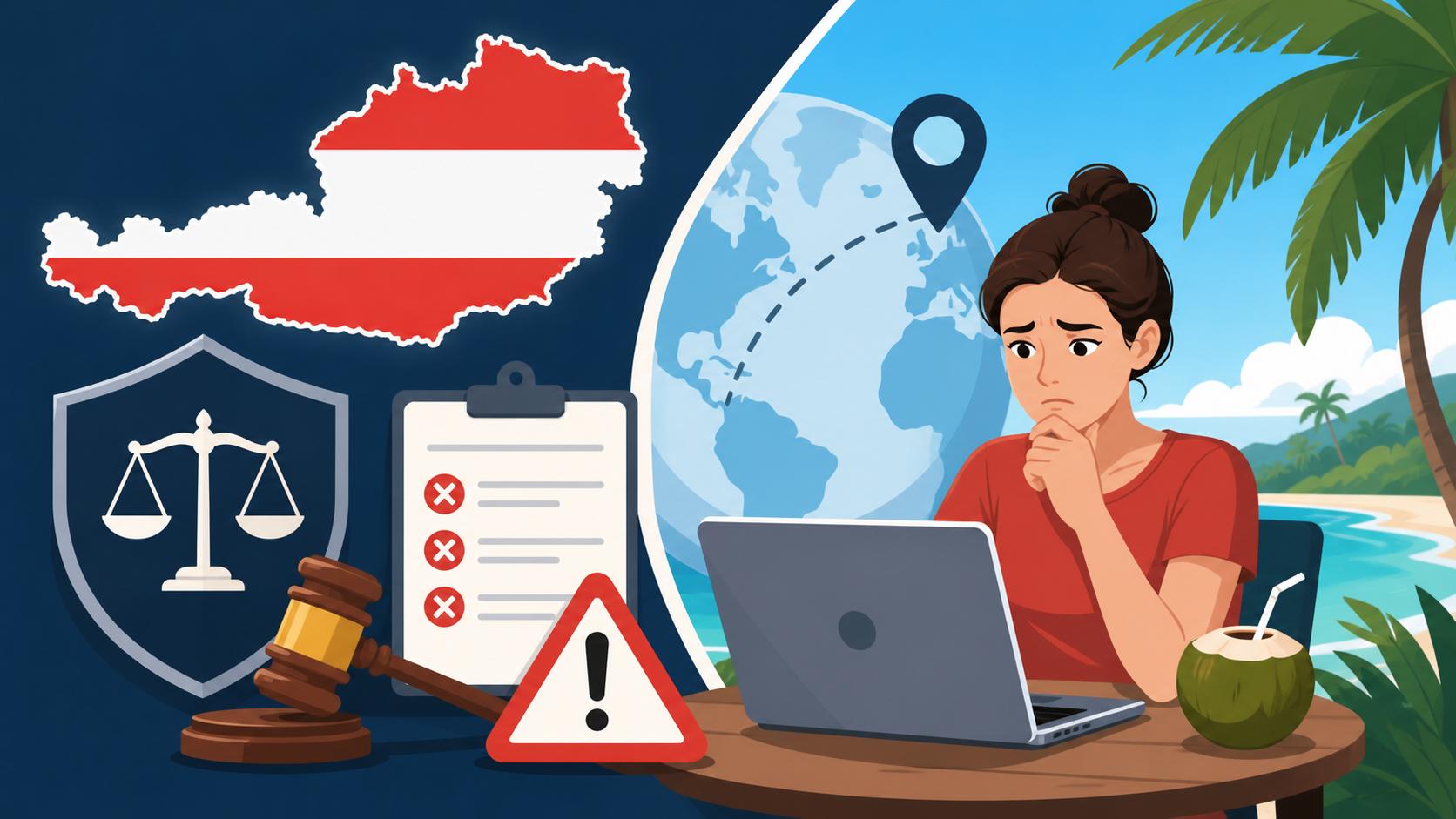
Legal Risks of Remote Work from Outside Austria
You have finally landed that dream job in Vienna or Graz, but the lure of your home country or a sunny beach in Portugal is calling, leading you to wonder if you can just pack your laptop and work "remotely" for a few months. I remember thinking the exact same thing during my second year in Austria, only to realize that the administrative web of tax and social security is far stickier than it appears. This guide solves the mystery of the legal risks of remote work from outside Austria, ensuring you don't accidentally trigger a tax audit or lose your residency.
The Social Security Trap Why You Cannot Just Work Anywhere
The biggest headache you will face when working outside Austria is not actually the tax man, but the social security office. Austria has incredibly strict rules regarding which country’s social insurance system you belong to. If you are employed by an Austrian company, they are paying into the Austrian system on your behalf. The moment you move your physical working location to another country, even for a few weeks, you risk "shifting" your social security center.
For those moving within the European Union, the "25% rule" is the most critical threshold to understand. If you perform 25% or more of your work in your country of residence (if that is not Austria), you are no longer subject to Austrian social security. Instead, you and your employer must pay contributions in your home country. This is an administrative nightmare for Austrian HR departments, as they are likely not set up to pay into the Spanish, French, or Italian social security systems. Understanding the Navigating Social Insurance: ÖGK, SVS, and BVAEB Overview is essential before you even suggest a remote setup to your boss, as it helps you explain why you need to stay under certain limits.
Furthermore, if you are caught working abroad without a so-called A1 certificate, both you and your employer could face heavy fines. The A1 certificate is a document that proves you are still covered by Austrian insurance while working temporarily in another EU country. Without it, a simple workplace accident in a foreign "home office" could result in the insurance company refusing to cover your medical costs. If you are a freelancer, the rules are even more nuanced, and you should look into SVS Health Insurance: Rules for Freelancers and Self-Employed to see how your coverage shifts when crossing borders.
Tax Residency and the Dangerous 183 Day Rule
Most expats have heard of the "183-day rule," but few truly understand how aggressively the Austrian Finanzamt (Tax Office) monitors it. In short, if you spend more than 183 days in a calendar year outside of Austria, you might lose your Austrian tax residency. Conversely, if you spend more than 183 days in another country, that country will likely claim you as a tax resident there. This creates a situation of double taxation risk that can take years to untangle.
The Understanding the 183-Day Tax Residency Rule is the cornerstone of any remote work plan. If you trigger tax residency in a second country, your Austrian employer might be legally required to withhold taxes according to that foreign country's laws. Many expats think they can fly under the radar, but the digital trail left by bank transactions and mobile phone records makes it easier than ever for authorities to spot where you are actually living. If you are maintaining accounts elsewhere, remember the rules regarding Declaring Foreign Bank Accounts to the Austrian Tax Authority to avoid being flagged for potential tax evasion.
There is also a significant "Permanent Establishment" risk for your employer. If you are a high-level manager or have the power to sign contracts while working from your kitchen table in Germany, the German tax authorities could argue that your Austrian company now has a "permanent office" in Germany. This could subject the entire company’s profits to German corporate tax. This is the primary reason most Austrian companies will flatly refuse long-term remote work requests from outside the country; it is simply too much of a legal gamble for their bottom line.
Labor Law Complications and Contractual Risks
Even if you solve the tax and social security puzzles, you still have to contend with the Employment Rights: Arbeiterkammer, Contracts, and Leave that are deeply rooted in Austrian law. Austrian labor law is famously protective, providing for 14 salaries and specific overtime protections. When you work from another country, a "conflict of laws" occurs. Does the Spanish law on the "right to disconnect" apply, or does the Austrian law?
Most international legal frameworks suggest that the laws of the country where the work is habitually performed should take precedence. However, if the laws in your temporary remote location are "more favorable" to the employee, a judge might decide those apply instead. For an employer, this creates massive uncertainty. They might be following the Understanding the Kollektivvertrag (Collective Agreement) to the letter, only to find out they are violating a niche labor regulation in the country where you decided to spend your summer.
Moreover, workplace safety (Arbeitnehmerschutz) is a legal requirement in Austria. Your employer is technically responsible for ensuring your "office" is ergonomically sound and safe. If you are working from a cafe in Bali and develop a repetitive strain injury, the legal liability becomes a murky mess. To protect yourself and your company, any remote work period should be formalized in a written "Home Office Agreement" that specifies the duration, the exact location, and which laws will govern the relationship. If you are looking to supplement your income while abroad, be very careful with Side Hustles: Working Geringfügig on Top of a Full-Time Job as the combined income can push you into new tax brackets in both countries.
Visa and Residency Implications for Non EU Citizens
For third-country nationals living in Austria on a Red-White-Red card or a student visa, working from outside the country is not just a tax issue—it is a residency threat. Your residence permit is generally tied to your physical presence and your employment in Austria. If the immigration authorities (MA 35 in Vienna) discover you have been living abroad while claiming to be an Austrian resident, they can revoke your permit immediately.
A major concern for those aiming for long-term stability is the Maximum Permitted Absences Before Losing Daueraufenthalt Status. Generally, you cannot be absent for more than six months at a time if you want to maintain your progress toward permanent residency or citizenship. If you are currently in the middle of your Red-White-Red Card Employment Journey from Offer to Start, leaving the country for an extended remote work stint could be seen as an abandonment of your "center of vital interests" in Austria.
Immigration officers often check the "Meldezettel" (address registration) and may even conduct random checks to see if you are actually living at your registered address. If you are found to be living elsewhere, you could be hit with a "Vortäuschung von Tatsachen" (misrepresentation of facts), which carries heavy penalties and a potential ban from the Schengen area. Always ensure your remote work plans do not conflict with the requirements of your specific residence title.
Comparison of Remote Work Impacts
The following table highlights the key differences between working 100% in Austria versus attempting a long-term remote stint (more than 183 days or 25% of time) outside the country.
| Feature | Working in Austria | Working Abroad (Long-Term) |
|---|---|---|
| Social Security | Covered by ÖGK/SVS/BVAEB | Likely shifts to the foreign country |
| Income Tax | Paid to Austrian Finanzamt | Potential double taxation/Foreign liability |
| Employer Risk | Standard compliance | High (Permanent Establishment risk) |
| Residency Status | Secure (if conditions met) | High risk of revocation for Non-EU |
| Salary Bonus | Austrian Work Culture: 14 Salaries, Meetings, and Etiquette | May be taxed differently abroad |
| Labor Law | Strict Austrian protections | Murky "more favorable" principle applies |
Practical Steps to Minimize Legal Risk
If you are determined to work from outside Austria, do not do it in secret. The "beg forgiveness rather than ask permission" strategy will backfire spectacularly when the social security data-sharing systems catch up with you. Start by having an honest conversation with your HR department about an A1 certificate for short-term stays. Most companies are comfortable with a few weeks of "workation" within the EU as long as the paperwork is filed correctly.
Check your health insurance coverage specifically for the country you are visiting. Even with an e-card, you may only be covered for emergency treatments, and mountain rescue or private clinic stays can cost thousands. If you find the bureaucracy overwhelming and decide to quit and go full freelance instead, make sure you understand the costs, such as the How to officially deregister from church tax (Kirchenaustritt), which is one of those small financial details many people forget when leaving the Austrian system.
Finally, keep a meticulous log of your days spent in and out of the country. Save your boarding passes and train tickets. If the Finanzamt ever questions your tax residency, having a clear "presence calendar" is your best defense. Remote work is a fantastic perk, but in the land of "Ordnung muss sein," doing it by the book is the only way to ensure your Austrian life remains stress-free.
Disclaimer
The information provided in this article is for general informational purposes only and does not constitute legal, tax, or professional advice. Laws and regulations in Austria are subject to frequent changes, and individual circumstances can significantly affect how these rules apply. Always consult with a qualified legal expert or tax advisor before making decisions regarding remote work or international residency.