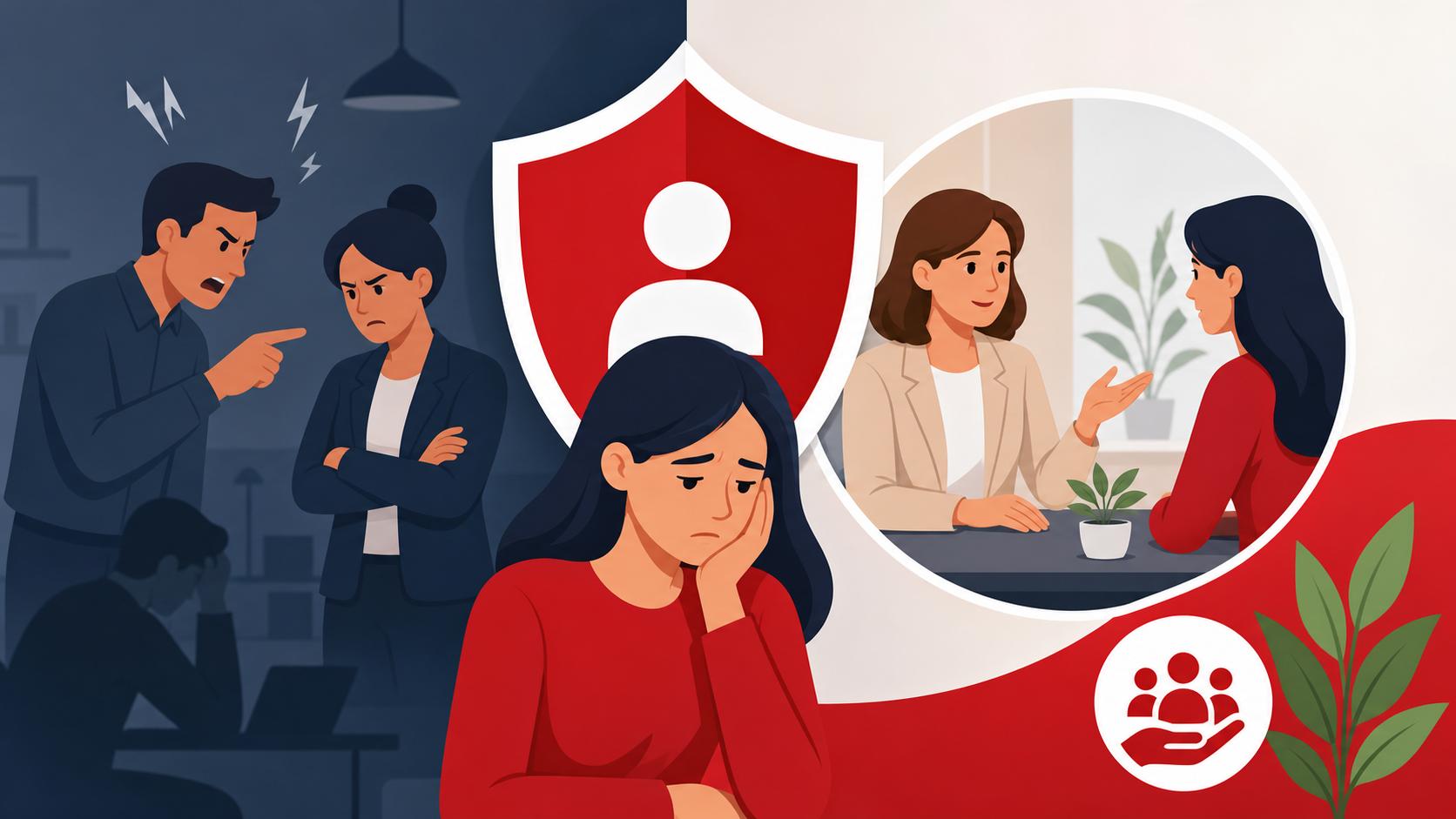
HR Grievance Process: Dealing with Workplace Bullying
Starting a career in a new country is daunting enough without the crushing weight of a colleague systematically undermining your every move. I remember sitting in my Vienna office, feeling my heart race every time a specific manager walked in, wondering if my German just wasn't good enough or if I was being targeted. This guide explains how to navigate the HR grievance process and use Austrian labor laws to protect yourself from workplace bullying.
Understanding Workplace Bullying and Mobbing in Austria
In Austria, the term "Mobbing" is used almost exclusively to describe what many English speakers call workplace bullying. It is not just a personality clash or a one-off argument; it is defined as a systematic, repeated, and long-term hostile behavior directed at a specific employee. To be legally recognized or handled effectively by HR, the behavior usually needs to occur regularly—often cited as at least once a week—over a period of several months.
Expats often struggle to distinguish between the famously direct Austrian Work Culture: 14 Salaries, Meetings, and Etiquette and genuine psychological harassment. While a colleague telling you your report is "completely wrong" might feel like a personal attack, it is often just the local communication style. However, when that same colleague starts "forgetting" to invite you to project meetings, spreading rumors in the breakroom, or giving you tasks that are far below your qualification level to humiliate you, you have entered the realm of Mobbing.
What Qualifies as Mobbing Under Austrian Law
The Austrian legal system views the employment relationship through the lens of a "Duty of Care" (Fürsorgepflicht). This means your employer is legally obligated to protect your physical and mental health while you are at work. Mobbing behaviors that violate this duty include social isolation, such as being ignored by the team or moved to a desk far away from everyone else. It also includes attacks on your professional reputation, where your work is criticized unfairly in front of others, or your private life is mocked.
Another common tactic is "Gaslighting" regarding instructions. You might be given verbal instructions, only to be reprimanded later for following them because the manager claims they said the opposite. Because these actions are often subtle, the law focuses on the cumulative effect rather than a single event. Understanding your Employment Rights: Arbeiterkammer, Contracts, and Leave is the first step in realizing that you do not have to "just deal with it" as part of being a foreigner.
Cultural Nuances and the Expat Experience
As an expat, you are uniquely vulnerable to certain types of bullying. Language is the most common weapon. In some cases, a team deliberately switches from English to a heavy Austrian dialect the moment the expat enters the room, effectively "silencing" them. When the expat complains, the bullies hide behind the excuse of "it is just easier for us to speak German."
There is also the "foreigner's tax" on patience. You might find yourself being given all the administrative "grunt work" that no one else wants to do, under the guise that you are still "learning the system." If you find that your career progression has stalled while your peers move forward, and you are being excluded from social rituals like the Jause (mid-morning snack) or after-work drinks, it is time to take a hard look at whether this is a cultural hurdle or a targeted attempt to push you out.
Initial Steps for Self-Protection and Documentation
If you suspect you are being bullied, your first instinct might be to confront the bully or go straight to HR in a state of emotional distress. Both of these can backfire. In the Austrian corporate world, documentation is king. Without a paper trail, your grievance is merely "your word against theirs," and the system tends to favor the status quo unless proven otherwise.
Before you ever set foot in an HR office, you must begin building your case. This is not just for legal reasons; it is for your own sanity. When you are being gaslit, having a written record of what actually happened helps you stay grounded in reality. It also demonstrates to HR that you are professional, organized, and serious about resolving the issue according to the rules.
Keeping a Mobbing Diary or Gedächtnisprotokoll
In Austria, a "Gedächtnisprotokoll" (memory protocol) is a vital piece of evidence. You should keep a private diary—not on your work computer—where you record every instance of bullying. Each entry must include the date, the time, the location, exactly what was said or done, who else was present (witnesses), and how it made you feel or how it impacted your work.
For example, don't just write "He was mean to me today." Instead, write: "Tuesday, Oct 14th, 10:15 AM in the kitchen. Manager X told me in front of two interns that my German is 'pathetic' and that I should consider a job in cleaning. Witnessed by Sarah B. and Lukas K. Impact: I felt humiliated and was unable to focus on the client presentation for two hours." This level of detail makes it very difficult for HR or the [Arbeiterkammer] to ignore your complaint.
Seeking Support from the Betriebsrat
Many international companies in Austria have a "Betriebsrat" (Works Council). This is an elected body of employees whose job is to represent your interests against the management. They are often your strongest allies in a bullying case because they have special legal protections and cannot be easily fired for raising difficult issues.
Approaching the Betriebsrat is often safer than going to HR initially. The members of the council are your colleagues, and they are bound by confidentiality. They can offer advice on whether what you are experiencing is common in the company and can even accompany you to meetings with HR or your boss. If you are still in your Probation Period: Rights and Termination Risks, be extra careful and consult the Betriebsrat first, as termination during this phase is much easier for the employer.
Navigating the Formal HR Grievance Process
When you finally decide to approach HR, you need to understand their role. While HR is there to support employees, their primary loyalty is to the company’s stability and legal compliance. Your goal is to show them that the bullying is a liability for the company. Bullying leads to high turnover, low productivity, and potential lawsuits—all things HR wants to avoid.
Prepare a formal letter or email requesting a meeting to discuss a "personal grievance" or "workplace climate issues." Avoid using the word "Mobbing" in the subject line of your first email; keep it professional. During the meeting, present your documentation calmly. Focus on the facts and the impact on your work performance.
Formal Internal Complaints and HR Obligations
Once HR is formally notified of a bullying complaint, their "Duty of Care" is triggered. They cannot simply ignore it. Usually, the internal process involves HR interviewing the accused person and any witnesses you named. In a well-run Austrian company, this might lead to a mediation session, a formal warning for the bully, or even a department transfer for one of the parties involved.
However, be prepared for the possibility that HR might try to "smooth things over" without making real changes. This is why having your diary is so important. If HR claims "nothing was found," you can point to specific dates and witnesses that they should have investigated. If the process feels stuck, remind them of their obligation to provide a safe working environment. Sometimes, just knowing that an expat understands their rights under the Austrian Labor Code is enough to make HR take the matter more seriously.
The Role of the Arbeiterkammer
If HR fails to act, or if you feel you are being retaliated against for speaking up, it is time to contact the Arbeiterkammer (AK). Every employee in Austria (except some civil servants) is a member of the AK, and they are the ultimate powerhouse for labor rights. They provide free legal advice and can even represent you in court if necessary.
You can call the AK or book an appointment online to speak with a specialist in labor law. Bring your documentation and any correspondence with HR. The AK can write a formal letter to your employer on your behalf. Often, a letter with the AK letterhead is the only thing that will get a stubborn Austrian management team to move. They know the AK doesn't play games, and they will want to avoid a costly legal battle.
Legal Protections and Professional Safety Nets
Dealing with workplace bullying is exhausting, and it often takes a toll on your health before the administrative process is finished. It is crucial to know how the Austrian social system can support you during this time. You are not expected to just "suffer through" until a legal decision is made. There are systems in place to ensure you don't lose your livelihood while trying to fix a toxic situation.
If the stress becomes unbearable, you may need to step away from the environment entirely. Austria has robust protections for those who are struggling with mental health due to work conditions. Knowing the difference between a standard Sick Leave Rights (Krankenstand): Pay and Protections and a long-term medical leave can be the difference between a total breakdown and a successful career pivot.
Dealing with Workplace Bullying: Legal Recourse and Sick Leave
If you are suffering from anxiety, insomnia, or physical symptoms due to Mobbing, go to your "Hausarzt" (General Practitioner). Be honest about what is happening at work. In Austria, burnout and stress-related illnesses are recognized medical conditions. Your doctor can put you on a "Krankenstand" (sick leave) for several weeks to allow you to recover and plan your next steps.
While on sick leave, you are generally protected from being fired in the short term, though it is not an absolute shield. More importantly, your employer is not allowed to contact you about work matters or pressure you to return early. This "breathing room" is often when expats realize they need to find a new job. You can also seek specialized Mental Health in Austria: Counseling, Therapy, and Expat Support during this time, often partially covered by your public insurance.
Using the Medical System for Long-Term Protection
In severe cases, a doctor might refer you to a psychiatrist or a specialized clinic for Medical Leave for Burnout: How the Austrian System Works. This provides a much deeper layer of protection and professional documentation that the workplace was the cause of your illness. This documentation is incredibly valuable if you later decide to sue for damages or if you need to justify an immediate resignation to the AMS.
If a medical professional confirms that you cannot reasonably be expected to continue working at that specific company for health reasons, you can perform what is called a "Berechtigter Austritt" (justified resignation). This allows you to quit without notice while still retaining your right to immediate Unemployment Benefits: Claiming AMS Money as an Expat, which is normally blocked for four weeks if you quit voluntarily.
Financial and Professional Safety Nets
If you decide that the situation is unsalvageable, you must plan your exit strategically to protect your finances. Austria’s 14-salary system means that your bonuses (holiday and Christmas pay) are pro-rated. If you leave at the wrong time or in the wrong way, you might miss out on thousands of Euros that you are legally owed.
Before you hand in your notice, check your contract for the "Kündigungsfrist" (notice period). For most office jobs, this is one month, but for longer tenures, it can be three months or more. You must follow the Resignation Process: Notice Periods and Handover Rules to the letter to avoid giving the company a reason to withhold your final payments or your "Dienstzeugnis" (work certificate).
Table: Support Entities for Workplace Bullying in Austria
| Entity | Primary Role | When to Contact |
|---|---|---|
| Betriebsrat | Internal Employee Representation | At the first sign of systematic bullying. |
| HR Department | Company Compliance & Mediation | When you have at least 2-4 weeks of documentation. |
| Arbeiterkammer (AK) | External Legal Advice & Advocacy | If HR ignores you or if you fear for your job. |
| Hausarzt (GP) | Medical Certification for Sick Leave | If the bullying is affecting your mental/physical health. |
| Gleichbehandlungsanwaltschaft | Anti-Discrimination Support | If the bullying is based on your nationality, race, or gender. |
The Importance of the Dienstzeugnis
In Austria, every employee has a right to a "Dienstzeugnis" (employment certificate) upon leaving. This is not just a reference; it is a coded document that future employers use to judge your performance. A bully might try to give you a poor certificate as a final parting shot.
If you receive a certificate that seems "off" or uses lukewarm language, take it straight to the AK. There is a legal requirement that a Dienstzeugnis must be "benevolent" (wohlwollend), meaning it shouldn't hinder your future career. The AK can help you force the employer to rewrite it if it doesn't accurately and fairly reflect your work. This is vital because Dealing with Job Hunting Burnout as an Expat is hard enough without a bad reference following you around.
Protecting Your Right to Benefits
If the bullying has made you want to quit immediately, wait. Unless you have a medical certificate or AK advice supporting a "justified resignation," quitting voluntarily usually results in a four-week "Sperrfrist" where you get no money from the AMS. Instead, you might try to negotiate a "Einvernehmliche Auflösung" (mutual termination).
In a mutual termination, you and the employer agree to part ways on a specific date. This usually allows you to receive AMS benefits immediately. If the company knows you have documentation of Mobbing and that the AK is involved, they are often very willing to agree to a mutual termination just to make the problem go away quietly. Always have any such agreement reviewed by a legal professional or Legal Protection Insurance (Rechtsschutzversicherung) Overview before signing.
Disclaimer
This article is for informational purposes only and does not constitute legal or medical advice. Labor laws and social security regulations in Austria are subject to change. Always consult with the Arbeiterkammer, a qualified employment lawyer, or a licensed medical professional regarding your specific situation before taking formal action.