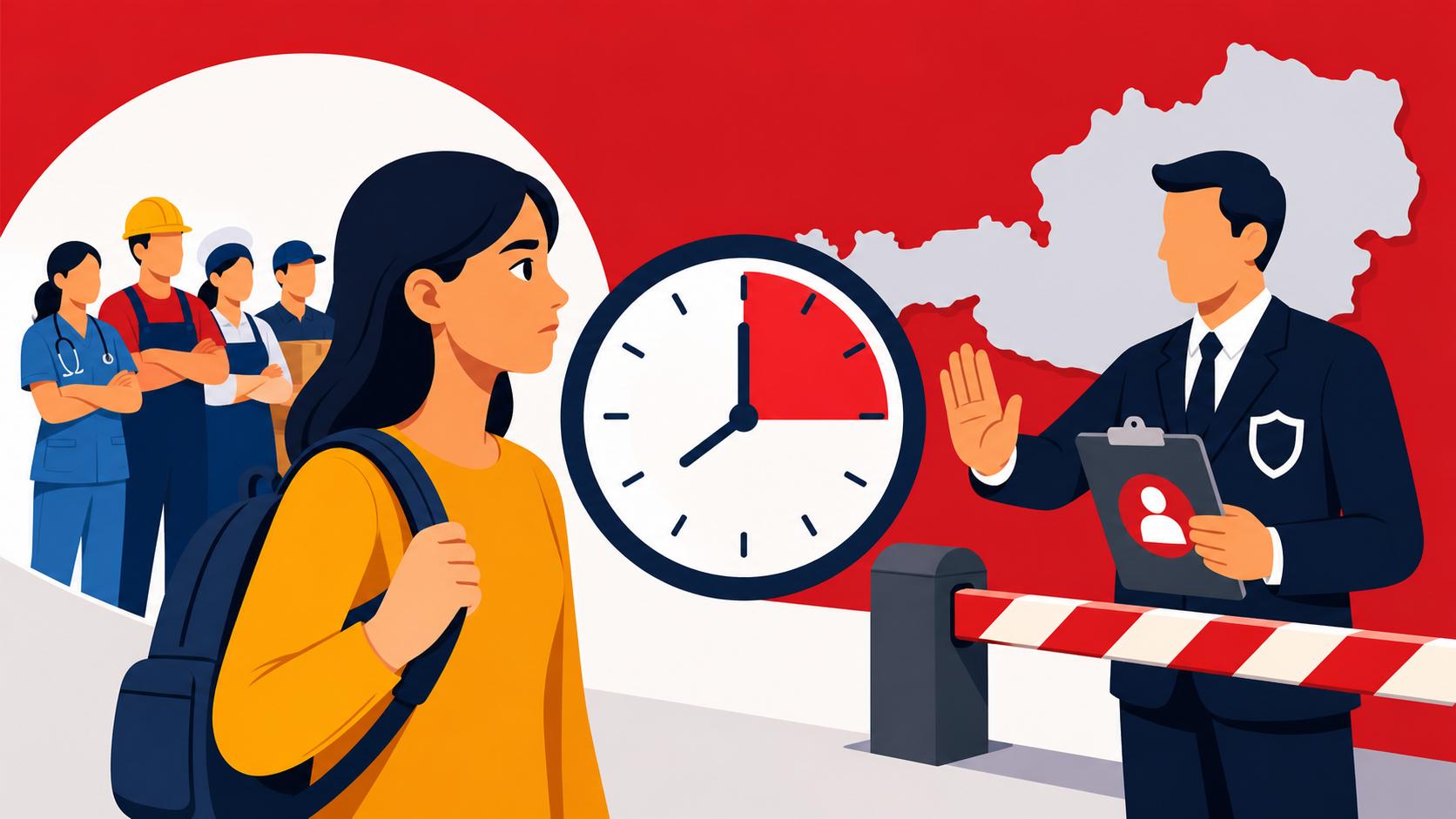
How Immigration Enforces the 20-Hour Work Limit
Navigating the tightrope of the Austrian student visa can feel like a full-time job in itself, especially when you are trying to balance high tuition fees with a strict 20-hour weekly work cap. I remember the constant anxiety of double-checking my timesheets, wondering if a single extra hour would trigger an automatic deportation letter. This guide demystifies exactly how Austrian authorities monitor your hours and what steps you must take to stay safe.
The Digital Web of Social Insurance and Labor Monitoring
Many students mistakenly believe that as long as they don't tell the immigration office (MA 35) about their extra hours, no one will ever find out. In reality, Austria operates a highly integrated digital bureaucracy. The moment you start a job, your employer is legally required to register you with the social insurance provider, usually the ÖGK. This registration is the first link in a chain that leads directly to the labor market authorities.
When you are registered for ÖGK Enrollment Step-by-Step for Employed Residents in Austria, the system records your entry date, your salary, and most importantly, your intended hours. This data isn't just sitting in a silo; it is accessible to the Arbeitsmarktservice (AMS), the agency responsible for issuing your work permit. If your employer reports earnings that are statistically impossible for a 20-hour-a-week position based on the Understanding the Kollektivvertrag (Collective Agreement) for your industry, it raises an immediate red flag.
Furthermore, the "Lohnzettel" (your annual pay slip) is submitted to the tax authorities (Finanzamt). If the math doesn't add up—for example, if your total annual income suggests you worked an average of 30 hours a week—this discrepancy can be flagged during your visa renewal process. The MA 35 does not need to catch you "in the act" at your workplace; they simply look at the digital trail of your social security contributions when you apply to extend your Studying in Austria: Admissions, Visas, and Student Life residency.
The Role of the AMS and the Beschäftigungsbewilligung
For non-EU students, the right to work is not inherent to the visa; it requires a specific document called a Beschäftigungsbewilligung (work permit). This permit is requested by your employer from the AMS. When the AMS receives this request, they check your current The 20-Hour Work Limit for Non-EU Students Explained status to ensure you aren't already holding another permit that, combined with the new one, would exceed the 20-hour threshold.
The AMS acts as the gatekeeper. They do not just issue the permit and forget about it. They maintain a database of every active work permit associated with your name and social security number. If you attempt to hold two "Geringfügig" (marginal) jobs that each claim to be 10 hours, but one employer accidentally records 12, the system notes the overlap.
Consider a scenario where a student works at a cafe and a library. If the cafe manager asks you to stay late during the Vienna Festival weeks, and those hours are logged and paid through the official payroll, the social insurance system records those contributions. When it comes time for your next visa appointment, the MA 35 may request a detailed extract of your insurance record (Versicherungsdatenauszug). This document lists every single day you were insured and under what terms. If they see "Full-time" or "Part-time 30h" listed for even a short period without a specific exception, your residency could be in jeopardy.
Workplace Inspections and the Finanzpolizei
While digital monitoring is the most common method of enforcement, physical inspections do happen, particularly in sectors like gastronomy, construction, and delivery services. The Finanzpolizei (Financial Police) often conduct unannounced raids to check for "Schwarzarbeit" (illegal work) and compliance with labor laws.
If the Finanzpolizei walk into a restaurant and find you behind the bar, the first thing they will ask for is your ID and your work permit status. They check the staff roster against the actual people present. If you are supposed to be off-duty according to the 20-hour schedule you submitted to the AMS, but you are found working, both you and your employer face severe penalties. For the student, this is often classified as a "serious breach of public order," which is grounds for a visa revocation.
These inspections are meticulous. They won't just take your word for it; they will examine the "Dienstplan" (work schedule) and the "Zeitaufzeichnung" (time tracking) logs. If these logs are missing or clearly manipulated—a common tactic where employers only record 20 hours on paper but pay the rest in cash—you are entering a dangerous legal gray area. Even if you aren't caught in a raid, the lack of proper time tracking is an administrative offense that can lead the authorities to dig deeper into your Student Self-Insurance Requirements and Monthly Costs 2026 records.
Consequences for Future Residency and Career Transitions
The danger of exceeding the 20-hour limit isn't just about losing your current student visa; it's about poisoning your future in Austria. Most students eventually want to transition to a Red-White-Red Card Employment Journey from Offer to Start after graduation. This process involves a rigorous check of your history in the country.
If the MA 35 finds that you habitually ignored the work limits during your studies, they can deny your transition to a professional work permit on the grounds of "unreliability." They view the student visa as a permit whose primary purpose is education. Working more than 20 hours is seen as evidence that you are using the student visa as a back-door for labor migration, which the Austrian government is very strict about preventing.
| Employment Type | Monitoring Method | Risk Level for Students |
|---|---|---|
| Standard Part-time (Up to 20h) | Monthly ÖGK reporting & AMS permit | Low (Compliant) |
| Marginal (Geringfügig) | Social insurance registration | Low (Check for overlap) |
| Internship (Pflichtpraktikum) | University confirmation & AMS notification | Medium (Must be course-related) |
| Freelance (Neue Selbständige) | SVS registration & Tax returns | High (Strictly monitored) |
| Unpaid Volunteering | Organisation records | Low (Check visa restrictions) |
Even if you are doing an internship, you must be careful. While some internships are exempt from the 20-hour count if they are a mandatory part of your curriculum, you still need to ensure the paperwork is flawless. Students can lose their status if they take a "voluntary" internship on top of a 20-hour job, not realizing that "voluntary" means it counts toward your work limit. Always check if Are Unpaid Internships Illegal in Austria applies to your specific situation before signing anything.
The Freelance Trap: Self-Employment Risks
One of the most complex areas for international students is the "Neue Selbständige" or freelance status. Some students think that by becoming a freelancer, they can bypass the 20-hour limit because they are "their own boss." This is a significant misconception.
If you are on a student visa, you are still bound by the spirit of the law, which dictates that your studies must be your primary activity. While Self-Employment Restrictions on an Austrian Student Visa allow for some flexibility, your tax returns and your social insurance contributions to the SVS (the insurance for the self-employed) will eventually reveal how much work you are doing. If your income levels suggest a full-time professional output, the MA 35 will demand an explanation.
Authorities look at the "Center of Vital Interests." If your freelance business is making 40,000 Euros a year while you are failing your university exams, the conclusion is obvious to the case officer: you are a worker, not a student. This often results in the non-renewal of the residency permit. When you eventually look into Post-Graduation: Switching from Student to Job Seeker Visa, a clean record is your most valuable asset.
Managing the Transition to Professional Life
The goal for many is Converting a Praktikum into a Full-Time RWR Card after they finish their degree. To reach this milestone, you must maintain a perfect paper trail. This means being the person who insists on proper time tracking, even if your boss is relaxed about it.
If you ever find yourself in a situation where you are forced to work more than 20 hours due to employer pressure, you should contact the Arbeiterkammer (Chamber of Labor). They provide free legal advice to workers in Austria, including foreigners. It is better to report a problem early than to let a pattern of overwork build up on your social security record.
Remember, the system is designed to be self-policing through data integration. The goal of the 20-hour limit is to ensure you actually finish your degree. By staying within the limit, you aren't just following a boring rule; you are protecting your right to live and work in Austria long-term.
Disclaimer on Legal Advice
This article is intended for informational purposes only and does not constitute legal advice. Immigration laws and enforcement practices in Austria are subject to change. Always consult with the official AMS (Arbeitsmarktservice) or a qualified legal professional specializing in Austrian migration law before making decisions regarding your work permit or residency status. Keep in mind that individual cases may vary based on specific district authorities (MA 35 or Bezirkshauptmannschaft).