Coping with Supermarket Checkout Speeds in Austria
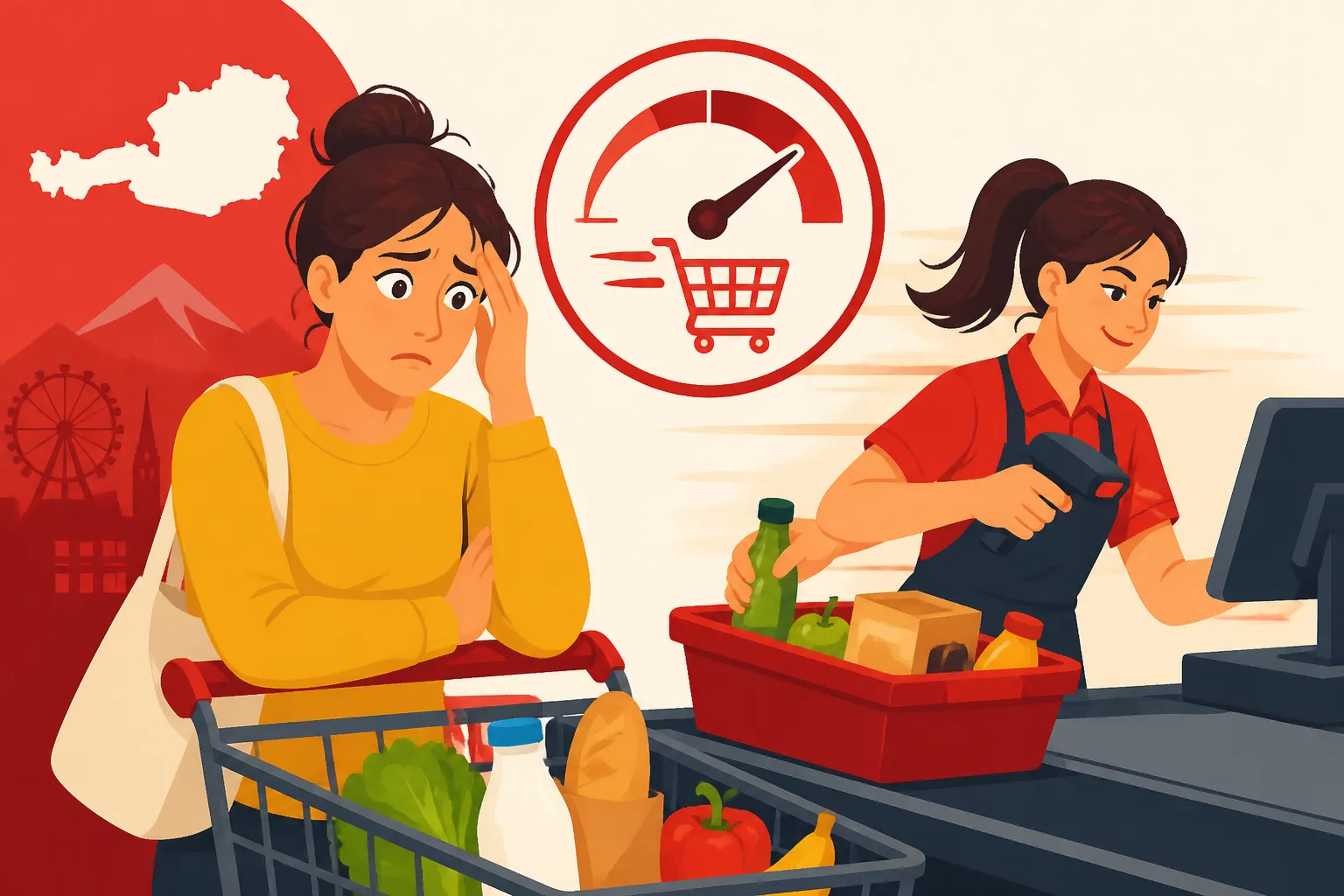
You are standing at the end of a narrow supermarket checkout, a mountain of groceries is hurtling toward you at terminal velocity, and the cashier is already scanning the next customer's milk before you have even found your wallet. I still remember my first week in Vienna, nearly sweating through my coat at a Hofer because I couldn't bag my apples fast enough while three elderly residents watched me with growing impatience. This guide solves the "supermarket olympics" by teaching you the tactical maneuvers, cultural norms, and psychological tricks needed to survive an Austrian grocery run without the stress.
The Cultural Anatomy of the Austrian Checkout Sprint
To understand why Austrian checkouts feel like a competitive sport, one must understand the Austrian value of efficiency. In many countries, the supermarket is a place of social interaction; in Austria, it is a logistical operation. Cashiers are often timed on their scans-per-minute, and the layout of the store is designed to move high volumes of people through a small footprint as quickly as possible. This is particularly true because of the Sunday Shopping Laws: Why Everything is Closed, which means Saturdays and late weekday afternoons are high-pressure environments where every second saved at the till is a victory for the collective.
Unlike in North America or parts of the UK, there are no "baggers" in Austria. You are the loader, the packer, and the payer. The expectation is that you will have cleared your items from the scanning area by the time the total is announced. If you are still fumbling with a plastic bag while the cashier waits for your payment, you are effectively breaking a social contract of speed. This can lead to the infamous "Austrian Glare," a silent but potent form of social correction. However, once you realize this isn't personal—it's just the local way of keeping the gears of society turning—you can start to master the mechanics of the process.
The intensity varies depending on where you shop. If you are Comparing Grocery Prices: Billa vs Spar vs Hofer, you will notice that Hofer (the Austrian branch of Aldi) is the undisputed heavyweight champion of speed. Their scanning beds are famously short, specifically to discourage you from packing at the till. Spar and Billa tend to be slightly more relaxed, but only by a margin of seconds. Understanding this hierarchy helps you choose your "battleground" based on your energy levels for the day.
Practical Strategies for Pre-Checkout Preparation
Survival begins long before the cashier says "Grüss Gott." Your first task is the "Belt Load Strategy." Do not simply dump your items onto the conveyor belt in a random pile. Instead, treat the belt as a staging ground. Group your items by weight and fragility. Heavy, sturdy items like milk cartons, canned goods, and liter bottles of soda should go first. Fragile items like eggs, berries, and soft bread must go last. This ensures that when the items fly at you at the other end, the "foundation" of your bags comes out first, allowing you to pack efficiently without crushing your croissants.
Another vital step is the "Bag Deployment." Never wait until the scanning starts to open your bags. Have your reusable bags open and standing upright in your trolley or on the packing ledge before the first item is scanned. If you are using a trolley, many veteran expats swear by the "Double Bag Open" method, where two large bags are hooked onto the sides of the trolley, creating a gaping maw ready to receive groceries. This is a core part of Supermarket Etiquette: Checkout Speed and Packing Own Bags, as it minimizes the "reach and tuck" time that slows down the line.
Finally, manage your loyalty cards and apps early. Whether you are using the Jö Karte or the Lidl Plus app, have it open on your phone or in your hand as you approach the till. If you are still searching for an app while the cashier is totaling your bill, you are adding unnecessary seconds to the clock. Since you are likely already tracking your Average Monthly Grocery Budget for a Couple in Vienna, having these apps ready also ensures you don't miss out on the "Pickerl" (discount stickers) that are a staple of Austrian frugal living.
Mastering the Mechanics of the Scan and Pack
Once the scanning begins, you enter the "Action Phase." The most important rule in an Austrian supermarket is this: The checkout is not for packing; it is for transferring. Your goal is not to neatly arrange your groceries into bags at the till. Your goal is to move the scanned items back into your trolley as fast as the cashier can scan them. You can worry about the tetris-like organization of your bags at the "Packtisch" (packing table) located behind the checkout area.
If you are not using a trolley and only have a small basket, the pressure is even higher. In this scenario, you must be a "Tactical Packer." Use the heavy items the cashier scans first as a base in your bag, and don't be afraid to use both hands. While it might feel frantic, the key is to maintain a rhythm. If you find yourself falling behind, do not panic. Simply sweep the remaining items back into your basket and move to the packing ledge. This keeps the flow of the line moving and earns you the respect of the people behind you.
Payment is the final hurdle. Austria is transitioning, but there is still a significant Cashless Payments vs Cash Culture in Austria Today that you need to navigate. If you are paying with cash, have your notes ready. If you are using a card, wait for the terminal to prompt you immediately. Do not wait for the cashier to ask. For those using digital wallets, Paying Online with EPS (Electronic Payment Standard) might be common for rent, but at the till, Apple Pay or a standard Bankomatkarte is your fastest friend. The moment the transaction is approved, grab your receipt (Kassabon) and clear the area.
Managing the Post-Scan Recovery and Social Pressure
The final stage of the process happens at the "Packtisch." This is the long counter located past the checkouts, often near the windows. This is your sanctuary. Once you have successfully transferred your mountain of food from the scanning bed to your trolley or basket, wheel it over to this table. Here, you can take your time. You can carefully place the eggs on top, organize your frozen goods into insulated bags, and double-check your receipt for any errors.
Using the packing table is not a sign of defeat; it is the sign of a seasoned resident. It allows you to breathe, reorganize, and leave the store feeling composed rather than frazzled. This is also where you can manage any "Extraordinary Items." For example, if you have been Sourcing Cheap Used Furniture on Willhaben Safely and happened to pick up some bulky cleaning supplies at the store, the packing table gives you the space to secure them before the walk or tram ride home.
If you ever feel the "Stare" from a local while you are struggling at the till, remember that it is rarely personal. The person behind you is likely just anxious to get home and start their weekend. A quick, polite "Entschuldigung" (Excuse me) goes a long way in diffusing tension. Over time, you will find that your speed increases naturally. You’ll start to recognize the "speed demons" among the cashiers and prepare accordingly. Mastering the checkout is one of the final hurdles in feeling like you truly belong in the Cost of Living in Vienna: Singles vs Families landscape.
Supermarket Comparison for Checkout Stress
| Supermarket | Scanning Speed | Stress Level | Best Packing Strategy |
|---|---|---|---|
| Hofer | Extremely Fast | High | Use a trolley; pack everything at the Packtisch. |
| Lidl | Fast | Medium-High | Open bags in the trolley before reaching the cashier. |
| Billa / Billa Plus | Moderate | Medium | Heavy items first; small bags can be packed at the till. |
| Spar / EuroSpar | Moderate | Medium | Use the loyalty app early to avoid delays. |
| MPreis (Tyrol/West) | Relaxed | Low | Generally more space at the end of the belt. |
Mastering the Language of the Till
Communication at the checkout is minimal but specific. You will almost always be asked, "Brauchen Sie den Kassabon?" (Do you need the receipt?). A simple "Ja, bitte" or "Nein, danke" is all that is required. If you are collecting points, they may ask "Haben Sie eine Jö Karte?" Having your response ready prevents the awkward "Wait, what did they say?" moment that often causes a backup.
If you are buying alcohol or energy drinks, be prepared for an age check, though this is less common for those clearly over 25. If you are using a self-checkout—which are becoming more common in urban areas—the pressure is lower, but the machines can be finicky with weight sensors. If you have a large haul, the manned till is actually often faster if you have practiced the strategies mentioned above.
Finally, keep an eye out for the "Zweite Kassa" (Second Register) phenomenon. If a line gets too long, an employee will shout "Zweite Kassa bitte!" and a new register will open. The unspoken rule in Austria is that the person who was next in the original line has the right to move to the new register first, but in reality, it is often a mad dash. Being alert to this can save you ten minutes of waiting, but be prepared for the increased checkout speed that comes with being at the front of a newly opened line.
Conclusion and Final Tips
The Austrian supermarket experience is a reflection of the culture: it is efficient, orderly, and expects a level of personal responsibility. By treating the checkout as a two-stage process—transferring at the till and packing at the table—you remove 90% of the stress. You are no longer "too slow" because you aren't trying to do everything at once.
Remember to breathe. Even the most seasoned expat has days where the bags won't open or the card machine malfunctions. The "Austrian Glare" lasts only a few seconds, but the satisfaction of a perfectly packed trolley and a successful exit is a great feeling. You are now equipped to handle any Hofer cashier or Saturday afternoon rush with the grace of a local.
Disclaimer
The information provided in this guide is based on cultural observations and personal expat experiences in Austria as of 2026. Supermarket policies, scanning technologies, and social norms may vary by region and specific retail chain. This content is for informational purposes only and does not constitute professional advice. For the most current information on payment methods or store policies, please consult the official websites of individual Austrian retailers.